Briefs
There are, in the Taipei Times where I work, sections called “Briefs” on the local and international pages. Consisting of a page-long single column, briefs, usually five to a page, provide little snippets of news — normally no longer than 100 words — from around the world, and the subject is usually something odd or unusual, like “Man loses boa in van,” or “Visitor bites panda at Beijing zoo.” The rest of the page is usually consecrated to more “serious” or newsworthy copy, nowadays nuclear developments in North Korea and Iran, factional violence within the Palestinian Authority, Iraq, Afghanistan, Somalia and Georgia/Russia.
It is indicative of the state of the world when, after reporting on unrest in the Palestinian Territories for weeks, where Hamas and Fatah have engaged in internecine violence, stories on people killed — by the factions or by the Israeli military — were relegated to the “Briefs” section. So routine had the killing of Palestinians become, it seemed, that it was no longer news as such; it was part of the oddities, of the briefs people read in passing, with little emotional attachment.
This only occurred on a few days, when violence elsewhere was such that the deaths of a dozen Palestinians didn’t suffice to break the threshold. Iraq, Afghanistan, N. Korea and Sri Lanka, through violence or the detonation of a nuclear device (this is what it takes now to make it to front page) had pushed it aside. As for Iraq, every new day brings an editorial challenge, not so much in preparing the story as in finding a headline that doesn’t read like the previous five, ten, twenty. "Forty killed in bombing in Baghdad"; "Violence intensifies as Ramadan begins"; "Bloody day in Baghdad as Ramadan comes to an end," etc, etc, etc ad bloody nauseam. There, again, the situation has become so routine that our editor-in-chief made the explicit request that we no longer publish pictures of bombings in Iraq. Every day, as we search the keyword “Iraq” in the Wire Graphics Database, which provides thousands of pictures updated on a daily basis from agencies like EPA, AFP, AP, Reuters and others, most of what we obtain are wrecked vehicles, buildings burning or ruins, in front of which are semi-dazed children or injured passers-by. Being given the order to find “something else” to tell the story is, sadly, very challenging. It’s almost like being asked to find a picture of Hong Kong with a clear sky. So in the past few weeks we provided pictures of Iraqi Muslims gathering in mosques to pray during Ramadan, or vendors making popcorn in preparation for celebrations of the Eid al-Fitr marking the end of Ramadan. But for every such picture there are dozens of carnage and violence. Afghanistan fares no better, and Sri Lanka is headed in that direction as well. Oh, and that is without mentioning the bloody pictures showing the results of war, which are too graphic to be printed in a newspaper.
It is saddening but unfortunately a symptom of the world we live in that people killed with missiles fired from the air, or in car bombings, can turn into an item of such normalcy as to become a mere “brief,” or perhaps worse, that copy editors are asked to search for pictures from the hell holes of our world that are devoid of violence, and have a hard time finding any.
Fortunate are those who can afford to read about these atrocities in the “briefs” section of a newspaper. For Iraqis, Afghans, Palestinians — and I could add many others, sadly — there is nothing non-newsworthy about what’s going on around them, and they don’t get to choose what kind of picture gets taken in their immediate environment either. For them, life is unforgiving, amoral, and unedited. Kids in war zones are growing up with severed bodies around them, the very images that "cannot" be printed, and there is no editor above them telling them to look elsewhere for something brighter, more uplifting. They as they might, news outlets can only come so close to reality.

Friday, October 27, 2006

Sunday, October 22, 2006
A Noisy Wakeup
I don’t know if it is like this throughout the non-English-speaking world, but at least here in Taiwan, there is this assumption that if you’re foreign-looking — and above all, “white” — you must inevitably be English speaking. Never mind that in an international city like Taipei, people from Germany, France, Spain, Russia, Italy, Sweden and other countries come to work; foreigner equals English, and English means American.
Once can hardly blame schoolchildren for holding such conceits, as foreign teachers themselves encourage those perceptions. I was in Taipei 101, on my way to a bookstore that I frequent there, when I ran into two dozen young children accompanied by a blond foreigner in her mid-40s. Immediately upon seeing me, the teacher turned to the children and shouted “Look, an English-speaking person!” whereupon in one ear-shattering and unusually high-pitched chorus the children shouted, in turn, “good morning,” followed by an incomprehensible, nerve-wracking consecution of words. I waived politely as I hurried away to the escalators, but it now transpired that the children, along with the teacher, were in hot pursuit and reached the escalators from the other side before I could escape. Seeing my discomfort, the teacher said, “You can run, but you can’t hide,” which somehow was interpreted by the children as yet another prompt to ransack my ears with the enthusiastic squeals.
Besides the offensiveness of such an unwelcome wakeup and, as I already mentioned, the groundless and quite disrespectful assumption that a foreigner must by default speak English, the incident made me feel like an animal in a zoo, something “other” that inherently warrants special attention. I have lived in Taiwan for nearly a year, integrated its society and am a tax-paying, law-abiding full participant in its fabric. Though my citizenship is Canadian, I am presently a resident of Taiwan, and as such I should be treated — and usually am — like one. Expatriates should therefore never feel compelled to become a spontaneous teacher, or a temporary amusement, on the bus, in shopping malls or on the sidewalk, nor made to feel that by virtue of being foreigner it should be expected of me to teach left and right those who are learning the language.
Did I, when I was in Canada, start shouting “ni hao” to every Chinese-looking person I encountered, expecting to obtain a free five-minute Mandarin lesson? Of course not; that would be rude. Why, then, should it be different in Taiwan, and why would foreign teachers, of all people, impress upon the children the idea that it is ok to approach expatriates in such a manner?
I don’t know if it is like this throughout the non-English-speaking world, but at least here in Taiwan, there is this assumption that if you’re foreign-looking — and above all, “white” — you must inevitably be English speaking. Never mind that in an international city like Taipei, people from Germany, France, Spain, Russia, Italy, Sweden and other countries come to work; foreigner equals English, and English means American.
Once can hardly blame schoolchildren for holding such conceits, as foreign teachers themselves encourage those perceptions. I was in Taipei 101, on my way to a bookstore that I frequent there, when I ran into two dozen young children accompanied by a blond foreigner in her mid-40s. Immediately upon seeing me, the teacher turned to the children and shouted “Look, an English-speaking person!” whereupon in one ear-shattering and unusually high-pitched chorus the children shouted, in turn, “good morning,” followed by an incomprehensible, nerve-wracking consecution of words. I waived politely as I hurried away to the escalators, but it now transpired that the children, along with the teacher, were in hot pursuit and reached the escalators from the other side before I could escape. Seeing my discomfort, the teacher said, “You can run, but you can’t hide,” which somehow was interpreted by the children as yet another prompt to ransack my ears with the enthusiastic squeals.
Besides the offensiveness of such an unwelcome wakeup and, as I already mentioned, the groundless and quite disrespectful assumption that a foreigner must by default speak English, the incident made me feel like an animal in a zoo, something “other” that inherently warrants special attention. I have lived in Taiwan for nearly a year, integrated its society and am a tax-paying, law-abiding full participant in its fabric. Though my citizenship is Canadian, I am presently a resident of Taiwan, and as such I should be treated — and usually am — like one. Expatriates should therefore never feel compelled to become a spontaneous teacher, or a temporary amusement, on the bus, in shopping malls or on the sidewalk, nor made to feel that by virtue of being foreigner it should be expected of me to teach left and right those who are learning the language.
Did I, when I was in Canada, start shouting “ni hao” to every Chinese-looking person I encountered, expecting to obtain a free five-minute Mandarin lesson? Of course not; that would be rude. Why, then, should it be different in Taiwan, and why would foreign teachers, of all people, impress upon the children the idea that it is ok to approach expatriates in such a manner?
Thursday, October 12, 2006
North Korea’s Gift
“It seems impossible to gain any worthwhile insights into the North Korean view of the [Korean] war, as long as Kim Il-sung presides over a society in which the private possession of a bicycle is considered a threat to national security,” wrote historian Max Hastings in his narrative of the Korean War. Substitute Kim Il-sung for Kim Jong-il, and change the date from 1987 — the year Hastings’ history was published — to 2006 and one soon discovers that precious little has changed in the Democratic People’s Republic of Korea (DPRK). Other than the fact that, unless the world community was wrong in its initial seismographic readings following Monday’s underground detonation, it has turned nuclear, that is. Immediately after the test of the device — a 15kt bomb, about the size of the one tested by Pakistan a few years ago, that seems to have fizzled to less than 1kt — condemnation poured from every corner of the planet, including Beijing, Pyongyang’s only diplomatic ally, if we can call it that. Stock markets dropped, and the region’s military — mostly Japan’s and South Korean’s — went on high alert. In addition to demonstrating that a very unstable and delusional regime now seemingly possesses weaponized nuclear technology, the North’s test, however faulty, clearly threatens the very foundations of the Non-Proliferation Treaty (NPT).
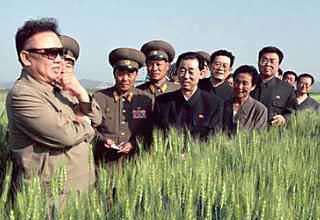 And yet, the greatest threat emerging from the test is not nuclear in nature, however uncomfortable one might be with the idea of a nuclear North Korean. The gravest danger lies in how the international community, and more especially South Korea, Japan and the U.S., reacts in the coming weeks. Already, there have been talks among regional powers, as well as at the UN Security Council, of strengthening the sanction regime against North Korea, short of an embargo.
But it is on the military side, not so much coming in the form of an unlikely military attack against Pyongyang as in the deployment to the immediate region — in the Sea of Japan, in Japan itself and in South Korea — of forces, mostly U.S., which North Korea could construe as indicative of a coming strike, that the true dangers lie. The DMZ which since 1953 has separated the Koreas is the most heavily concentrated conventional military area in the world, with more firepower than obtained in Germany at the height of the Cold War. The North is pointing enough short-range missiles (by some open-source accounts as many as 500 artillery pieces) at Seoul, the South Korean capital, to cause billions of dollars in damage and likely thousands of deaths. Without the necessity of using a nuclear or chemical arsenal — the North has both — Pyongyang has enough deterrent force to make external intervention a la Iraq a very difficult decision to make, and nuclear capabilities notwithstanding, it is difficult to conceive of Washington or Tokyo, let alone Seoul, deciding to endanger the lives of tens of thousands of citizens in the name of the enforcement of the NPT or preemption. Nevertheless, Pyongyang’s threat perception and the paranoid world in which its leader Kim Jong-il lives (he disappeared for weeks before the nuclear test, ostensibly for fear that outside powers might attempt a “decapitation” attack against his regime) contains the risk that it will misinterpret military maneuvers as preparation for a military strike. As is often the case in history, wars are launched not through calculation, but as the result of misperceptions, miscommunication, or downright mistakes.
Finding a solution to the problem that North Korea poses to the region and to the world will not be easy, and the successful resolution of the threat with the avoidance of catastrophic civilian deaths will necessitate a well-calibrated response from the world community. But one thing is certain: had the U.S. and its allies focused on North Korea — which has been a totalitarian, repressive regime since the late 1940s and which possesses proven arsenals of chemical weapons (5,000 metric tons, produced in eight known factories) and which has threatened its neighbors with missile tests and which now can make the claim to being in the nuclear club — rather than Iraq, which admittedly also was repressive but which by many dependable accounts no longer had chemical and biological weapons or a viable nuclear program since at least the mid-1990s and whose conventional military forces had been depleted to such an extent that it no longer posed a threat to the region, maybe the world wouldn’t find itself in the dangerous situation it is in today. It is not a question of historical hindsight; the intelligence on Iraq did prove before the invasion that it no longer had a WMD program, and it was ignored for political reasons. Meanwhile, not only did regional and world powers have intelligence that the DPRK had an ongoing WMD program, but the regime itself claimed that it did.
Politics intervened, and the U.S. went into Iraq. North Korea seized upon that, and now the world is caught wrong-footed, with a U.S. military so overstretched that should it choose to intervene militarily in the Korean peninsula, it would face serious materiel and personnel shortages.
“It seems impossible to gain any worthwhile insights into the North Korean view of the [Korean] war, as long as Kim Il-sung presides over a society in which the private possession of a bicycle is considered a threat to national security,” wrote historian Max Hastings in his narrative of the Korean War. Substitute Kim Il-sung for Kim Jong-il, and change the date from 1987 — the year Hastings’ history was published — to 2006 and one soon discovers that precious little has changed in the Democratic People’s Republic of Korea (DPRK). Other than the fact that, unless the world community was wrong in its initial seismographic readings following Monday’s underground detonation, it has turned nuclear, that is. Immediately after the test of the device — a 15kt bomb, about the size of the one tested by Pakistan a few years ago, that seems to have fizzled to less than 1kt — condemnation poured from every corner of the planet, including Beijing, Pyongyang’s only diplomatic ally, if we can call it that. Stock markets dropped, and the region’s military — mostly Japan’s and South Korean’s — went on high alert. In addition to demonstrating that a very unstable and delusional regime now seemingly possesses weaponized nuclear technology, the North’s test, however faulty, clearly threatens the very foundations of the Non-Proliferation Treaty (NPT).
 And yet, the greatest threat emerging from the test is not nuclear in nature, however uncomfortable one might be with the idea of a nuclear North Korean. The gravest danger lies in how the international community, and more especially South Korea, Japan and the U.S., reacts in the coming weeks. Already, there have been talks among regional powers, as well as at the UN Security Council, of strengthening the sanction regime against North Korea, short of an embargo.
 But it is on the military side, not so much coming in the form of an unlikely military attack against Pyongyang as in the deployment to the immediate region — in the Sea of Japan, in Japan itself and in South Korea — of forces, mostly U.S., which North Korea could construe as indicative of a coming strike, that the true dangers lie. The DMZ which since 1953 has separated the Koreas is the most heavily concentrated conventional military area in the world, with more firepower than obtained in Germany at the height of the Cold War. The North is pointing enough short-range missiles (by some open-source accounts as many as 500 artillery pieces) at Seoul, the South Korean capital, to cause billions of dollars in damage and likely thousands of deaths. Without the necessity of using a nuclear or chemical arsenal — the North has both — Pyongyang has enough deterrent force to make external intervention a la Iraq a very difficult decision to make, and nuclear capabilities notwithstanding, it is difficult to conceive of Washington or Tokyo, let alone Seoul, deciding to endanger the lives of tens of thousands of citizens in the name of the enforcement of the NPT or preemption. Nevertheless, Pyongyang’s threat perception and the paranoid world in which its leader Kim Jong-il lives (he disappeared for weeks before the nuclear test, ostensibly for fear that outside powers might attempt a “decapitation” attack against his regime) contains the risk that it will misinterpret military maneuvers as preparation for a military strike. As is often the case in history, wars are launched not through calculation, but as the result of misperceptions, miscommunication, or downright mistakes.
Finding a solution to the problem that North Korea poses to the region and to the world will not be easy, and the successful resolution of the threat with the avoidance of catastrophic civilian deaths will necessitate a well-calibrated response from the world community. But one thing is certain: had the U.S. and its allies focused on North Korea — which has been a totalitarian, repressive regime since the late 1940s and which possesses proven arsenals of chemical weapons (5,000 metric tons, produced in eight known factories) and which has threatened its neighbors with missile tests and which now can make the claim to being in the nuclear club — rather than Iraq, which admittedly also was repressive but which by many dependable accounts no longer had chemical and biological weapons or a viable nuclear program since at least the mid-1990s and whose conventional military forces had been depleted to such an extent that it no longer posed a threat to the region, maybe the world wouldn’t find itself in the dangerous situation it is in today. It is not a question of historical hindsight; the intelligence on Iraq did prove before the invasion that it no longer had a WMD program, and it was ignored for political reasons. Meanwhile, not only did regional and world powers have intelligence that the DPRK had an ongoing WMD program, but the regime itself claimed that it did.
Politics intervened, and the U.S. went into Iraq. North Korea seized upon that, and now the world is caught wrong-footed, with a U.S. military so overstretched that should it choose to intervene militarily in the Korean peninsula, it would face serious materiel and personnel shortages.
Monday, October 02, 2006
Night Out
Saturday night, after we were done putting together Sunday’s edition of the Times, those of us who were up for it grabbed a cab and headed for a bar. The main reason why we went was to wish good luck to a copy editor who was leaving the Times after two years there so that he could concentrate full-time on learning Mandarin.
After we found a place where we could sit and hear each other talk (the first bar was packed for “South Africa Day,” an occasion that even the South African among us couldn't figure out the reason for), we ordered our drinks and inevitably launched into rather opinionated conversations. Much of the humor touched on two subjects: Taiwanese politics, and the Commonwealth, of which, with a few exceptions, we were all representatives (there were two Australians, one New Zealander, one South African, two Brits, one Canadian, two Americans and a Taiwanese). I soon discovered that in certain ways, New Zealand is to Canada what Australia is to the United States, in that the latter appropriates for itself much of what is, in reality, the smaller state’s. One could say as much about trade, culture, diplomacy, security and everything else.
Ultimately, though, what I retained from the hours we spent chatting was the sense of anger that most of us have towards our home governments. The great majority of us are very much opposed to what is going on back home, mostly in terms of antiterrorism and how that quixotic adventure is defacing the democracies we call home. The greatest anger seemed to be expressed by the Brits and the Americans. The latter, one of whom was in the US military for a while and spent some time in Japan, reserved the most scathing of language for their president and could only shake their heads with dejection at what their country is doing in the name of security (the bill granting the CIA interrogation powers that undermine the Geneva Conventions had just been passed). We all seemed to agree that the NATO mission in Afghanistan was slowly but inexorably turning into a fiasco and that our soldiers who were dying there had not originally signed up for a war against the Taliban — a war that has now spread to the entire country — but rather peace building and reconstruction.
Many learned expatriates I have met in Taiwan share this sense that home, right now, is not the place to be. For many, politics are the principal reason. In a way, this is a forced exile, a need to breathe new, cleaner air. I came out of the bar having realized that one cannot fully understand his country without having stepped outside of it for a while. I had heard that before, and it is true. Never had I spent so much time thinking about what Canada is and what it means to the world than I do now, thousands of kilometers away. Even as I try — one of my main objectives for moving here — to demystify the complex security situation in East Asia, I cannot but also look over my shoulder, across the ocean, and wonder what’s going on back home. Sadly, what I see worries me. And that is something else that I saw in the eyes of most people at table that night: worry.
Saturday night, after we were done putting together Sunday’s edition of the Times, those of us who were up for it grabbed a cab and headed for a bar. The main reason why we went was to wish good luck to a copy editor who was leaving the Times after two years there so that he could concentrate full-time on learning Mandarin.
After we found a place where we could sit and hear each other talk (the first bar was packed for “South Africa Day,” an occasion that even the South African among us couldn't figure out the reason for), we ordered our drinks and inevitably launched into rather opinionated conversations. Much of the humor touched on two subjects: Taiwanese politics, and the Commonwealth, of which, with a few exceptions, we were all representatives (there were two Australians, one New Zealander, one South African, two Brits, one Canadian, two Americans and a Taiwanese). I soon discovered that in certain ways, New Zealand is to Canada what Australia is to the United States, in that the latter appropriates for itself much of what is, in reality, the smaller state’s. One could say as much about trade, culture, diplomacy, security and everything else.
Ultimately, though, what I retained from the hours we spent chatting was the sense of anger that most of us have towards our home governments. The great majority of us are very much opposed to what is going on back home, mostly in terms of antiterrorism and how that quixotic adventure is defacing the democracies we call home. The greatest anger seemed to be expressed by the Brits and the Americans. The latter, one of whom was in the US military for a while and spent some time in Japan, reserved the most scathing of language for their president and could only shake their heads with dejection at what their country is doing in the name of security (the bill granting the CIA interrogation powers that undermine the Geneva Conventions had just been passed). We all seemed to agree that the NATO mission in Afghanistan was slowly but inexorably turning into a fiasco and that our soldiers who were dying there had not originally signed up for a war against the Taliban — a war that has now spread to the entire country — but rather peace building and reconstruction.
Many learned expatriates I have met in Taiwan share this sense that home, right now, is not the place to be. For many, politics are the principal reason. In a way, this is a forced exile, a need to breathe new, cleaner air. I came out of the bar having realized that one cannot fully understand his country without having stepped outside of it for a while. I had heard that before, and it is true. Never had I spent so much time thinking about what Canada is and what it means to the world than I do now, thousands of kilometers away. Even as I try — one of my main objectives for moving here — to demystify the complex security situation in East Asia, I cannot but also look over my shoulder, across the ocean, and wonder what’s going on back home. Sadly, what I see worries me. And that is something else that I saw in the eyes of most people at table that night: worry.
Wednesday, September 27, 2006
Titters in Beijing
It seems that the campaign to oust Taiwanese President Chen Shui-bian (陳水扁) is one of those things that just won’t go away until the deed has become reality. First, an attempt to recall the president failed in June, and for a while it seemed that Chen had weathered the storm. But starting in early September a continuous sit-in and a series of public demonstrations were held in cities throughout Taiwan—events which with but a few unfortunate exceptions were peaceful and orderly. And now it appears that a second recall vote is being considered.
What worries me isn’t the recall process or even the demonstrations, however circus-like they’ve become, what with the concerts held and merchants lining the streets. Though these fall outside the system of law whereby the Taiwanese head of state can be held to account, they are—or should be—intrinsically harmless. What makes me pause as I find myself on Zhong Hua avenue are the swarms of red: T-shirts, baseball caps and flags. Red, as we all know, has long been associated with communism, and the color has long had a special connotation here in Taiwan. It is therefore surprising that the so-called “alliance” against corruption—which in reality is against Chen, for if the people were to turn against corruption per se, most legislators, DPP or KMT, would be jobless as we speak. Whatever they tell the masses, the organizers have made this a crusade against one individual, and that individual is president Chen.
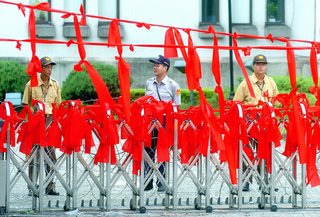 The theory that I am about to propose has already awakened the wrath of the principal organizer of the sit-ins, former DPP Chairman Shih Ming-teh (施明德), who threatened to sue a media outlet that hinted at the possibility that I am about to put on the table. Now, despite the obvious connotation of the color red, I would not establish a theory based on that alone, though I still find it interesting that the organizers of the anti-Chen campaign would choose it to represent their endeavors. They couldn’t use blue, surely, for fear that the whole thing would be perceived to be a pan-blue (that is, KMT-led) effort. Nor could it be green, a color that is associated with Chen’s DPP. But of all the colors remaining in the palette, why did Shih et al have to pick red?
Colors aside, my worries come from the literature on China’s tradition of meddling in Taiwanese affairs. “Taiwanese compatriots are our flesh and blood, we sincerely hope for a peaceful society in Taiwan where the economy develops and people live happily,” said the spokesman of the Taiwan Affairs Office, Li Weiyi (李維一), on Sept. 13. “Our stance and efforts to promote close cross-strait exchanges and all kinds of economic cooperation are unchanged.” At face value, this comment would seem to indicate that Beijing has taken a hands-off approach to recent developments in Taiwan. But then again, who can believe a state that increasingly is regulating the state-controlled media to such an extent as to make the lives of foreign news agencies a newsmaker’s nightmare? I take little comfort in a spokesman of the Taiwan Affairs Office telling us that Beijing wants “a peaceful society,” more so when in the same speech he feels the obligation to mention that China firmly opposes the separatist forces on the island.
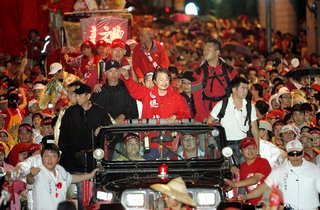 Therein lies the key to my theory: it is true that Beijing wants a Taiwan “where the economy develops and people live happily.” After all, who would want to reunite with a chaotic state with an economy in shambles? Despite the saber rattling, hundreds of short- and mid-range missiles pointing at Taiwan and almost weekly threats of invasion, very few are those within the Chinese Communist Party who honestly seek a military confrontation with Taipei. The reason is simple: whether it could actually win the war or not (which would depend on whether the US is capable of deploying rapidly enough to come to Taiwan’s aid), the economic consequences would be catastrophic for China. The CCP gets its legitimacy through the promise of economic prosperity in China; a war with Taiwan and the assured international embargo and sanctions against Beijing that would ensue—added to the freezing of economic activities between Hong Kong and Taiwan—would undermine that prosperity, the consequences of which could very well include the attempted overthrow of the regime in Beijing. And it is unlikely, too, that despite the sometimes irrational decisions that accompany a strong, emotional sense of nationalism, Beijing would overtly go to war with Taiwan and thereby risk losing the 2008 Olympic Games.
Clearly, China stands to loose too much by engaging in military action against Taiwan. But there is nothing that prevents it from doing things covertly to “firmly oppose” the separatist forces on Taiwan—i.e. Chen. What if, somehow, certain elements in the anti-corruption campaign were being encouraged, if not supported, by Beijing? By this I do not mean that suitcases filled with money have necessarily found their way across the strait, but indirect support based on China’s desire for a Taiwan where the economy develops (remember, the KMT has long accused the DPP of not steering Taiwan’s economy well and has promised that, thanks to its close ties with China, it would do better on that aspect) is not altogether impossible. What if Beijing were underhandedly waging war against Taiwanese separatism by propping up the anti-corruption campaign, using it as a cover to accomplish one thing: the “peaceful” discrediting and eventual overthrow of the person who has made it his goal to rewrite the Taiwanese Constitution, change the county’s international status and obtain (so far unsuccessfully) a seat at the UN Security Council? What if this were yet another rung in Beijing’s attempts to isolate Taiwan diplomatically?
The literature on Beijing demanding that Taiwanese investors in China make a vow to oppose Taiwan independence, or on its buying information from retired Taiwanese military cadres is healthy, as are the CCP’s relations with the KMT, with which it engages in diplomacy and thereby sidelines the official—and elected—government in Taipei. Pro-KMT businesses throughout Taiwan (see “Colors Shown,” Sept. 2) have encouraged their employees to show their support for the anti-Chen campaign by asking for donations and giving leave time in exchange for their participation in the event. I have even heard stories of entire offices asking their employees to wear red at work. That there would be a coincidence of interests between the CCP, the KMT and certain business people here in Taiwan wouldn’t be all that surprising. Add to this a well-planned media campaign and a politically divided island, and the people will follow, wear their red T-shirts and baseball caps and brave the rainy weather to suddenly oppose something that has long existed on the island (and in China) and which certainly isn’t limited to the president (not to mention that the whole thing was sparked as a result of accusations not against Chen himself but rather against his son-in-law).
But behind all this, there might be more than meets the eye. What Taiwanese need to ask themselves is, who stands to gain most from Chen’s ouster? Taiwan, or China. There is much to be commended in people’s effort to combat corruption. But in this case, participants should look beyond the official line to see if there might not be some ulterior motive to the endeavor.
If the anti-Chen campaign comes through, Beijing might just have launched a successful decapitation operation without the use of force.
It seems that the campaign to oust Taiwanese President Chen Shui-bian (陳水扁) is one of those things that just won’t go away until the deed has become reality. First, an attempt to recall the president failed in June, and for a while it seemed that Chen had weathered the storm. But starting in early September a continuous sit-in and a series of public demonstrations were held in cities throughout Taiwan—events which with but a few unfortunate exceptions were peaceful and orderly. And now it appears that a second recall vote is being considered.
What worries me isn’t the recall process or even the demonstrations, however circus-like they’ve become, what with the concerts held and merchants lining the streets. Though these fall outside the system of law whereby the Taiwanese head of state can be held to account, they are—or should be—intrinsically harmless. What makes me pause as I find myself on Zhong Hua avenue are the swarms of red: T-shirts, baseball caps and flags. Red, as we all know, has long been associated with communism, and the color has long had a special connotation here in Taiwan. It is therefore surprising that the so-called “alliance” against corruption—which in reality is against Chen, for if the people were to turn against corruption per se, most legislators, DPP or KMT, would be jobless as we speak. Whatever they tell the masses, the organizers have made this a crusade against one individual, and that individual is president Chen.
 The theory that I am about to propose has already awakened the wrath of the principal organizer of the sit-ins, former DPP Chairman Shih Ming-teh (施明德), who threatened to sue a media outlet that hinted at the possibility that I am about to put on the table. Now, despite the obvious connotation of the color red, I would not establish a theory based on that alone, though I still find it interesting that the organizers of the anti-Chen campaign would choose it to represent their endeavors. They couldn’t use blue, surely, for fear that the whole thing would be perceived to be a pan-blue (that is, KMT-led) effort. Nor could it be green, a color that is associated with Chen’s DPP. But of all the colors remaining in the palette, why did Shih et al have to pick red?
Colors aside, my worries come from the literature on China’s tradition of meddling in Taiwanese affairs. “Taiwanese compatriots are our flesh and blood, we sincerely hope for a peaceful society in Taiwan where the economy develops and people live happily,” said the spokesman of the Taiwan Affairs Office, Li Weiyi (李維一), on Sept. 13. “Our stance and efforts to promote close cross-strait exchanges and all kinds of economic cooperation are unchanged.” At face value, this comment would seem to indicate that Beijing has taken a hands-off approach to recent developments in Taiwan. But then again, who can believe a state that increasingly is regulating the state-controlled media to such an extent as to make the lives of foreign news agencies a newsmaker’s nightmare? I take little comfort in a spokesman of the Taiwan Affairs Office telling us that Beijing wants “a peaceful society,” more so when in the same speech he feels the obligation to mention that China firmly opposes the separatist forces on the island.
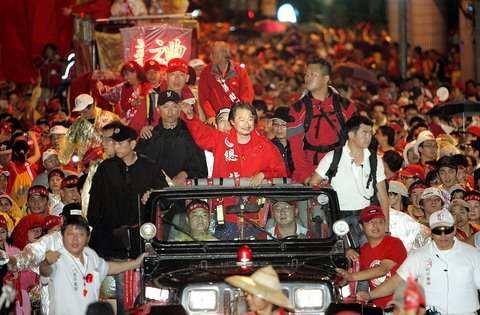 Therein lies the key to my theory: it is true that Beijing wants a Taiwan “where the economy develops and people live happily.” After all, who would want to reunite with a chaotic state with an economy in shambles? Despite the saber rattling, hundreds of short- and mid-range missiles pointing at Taiwan and almost weekly threats of invasion, very few are those within the Chinese Communist Party who honestly seek a military confrontation with Taipei. The reason is simple: whether it could actually win the war or not (which would depend on whether the US is capable of deploying rapidly enough to come to Taiwan’s aid), the economic consequences would be catastrophic for China. The CCP gets its legitimacy through the promise of economic prosperity in China; a war with Taiwan and the assured international embargo and sanctions against Beijing that would ensue—added to the freezing of economic activities between Hong Kong and Taiwan—would undermine that prosperity, the consequences of which could very well include the attempted overthrow of the regime in Beijing. And it is unlikely, too, that despite the sometimes irrational decisions that accompany a strong, emotional sense of nationalism, Beijing would overtly go to war with Taiwan and thereby risk losing the 2008 Olympic Games.
Clearly, China stands to loose too much by engaging in military action against Taiwan. But there is nothing that prevents it from doing things covertly to “firmly oppose” the separatist forces on Taiwan—i.e. Chen. What if, somehow, certain elements in the anti-corruption campaign were being encouraged, if not supported, by Beijing? By this I do not mean that suitcases filled with money have necessarily found their way across the strait, but indirect support based on China’s desire for a Taiwan where the economy develops (remember, the KMT has long accused the DPP of not steering Taiwan’s economy well and has promised that, thanks to its close ties with China, it would do better on that aspect) is not altogether impossible. What if Beijing were underhandedly waging war against Taiwanese separatism by propping up the anti-corruption campaign, using it as a cover to accomplish one thing: the “peaceful” discrediting and eventual overthrow of the person who has made it his goal to rewrite the Taiwanese Constitution, change the county’s international status and obtain (so far unsuccessfully) a seat at the UN Security Council? What if this were yet another rung in Beijing’s attempts to isolate Taiwan diplomatically?
The literature on Beijing demanding that Taiwanese investors in China make a vow to oppose Taiwan independence, or on its buying information from retired Taiwanese military cadres is healthy, as are the CCP’s relations with the KMT, with which it engages in diplomacy and thereby sidelines the official—and elected—government in Taipei. Pro-KMT businesses throughout Taiwan (see “Colors Shown,” Sept. 2) have encouraged their employees to show their support for the anti-Chen campaign by asking for donations and giving leave time in exchange for their participation in the event. I have even heard stories of entire offices asking their employees to wear red at work. That there would be a coincidence of interests between the CCP, the KMT and certain business people here in Taiwan wouldn’t be all that surprising. Add to this a well-planned media campaign and a politically divided island, and the people will follow, wear their red T-shirts and baseball caps and brave the rainy weather to suddenly oppose something that has long existed on the island (and in China) and which certainly isn’t limited to the president (not to mention that the whole thing was sparked as a result of accusations not against Chen himself but rather against his son-in-law).
But behind all this, there might be more than meets the eye. What Taiwanese need to ask themselves is, who stands to gain most from Chen’s ouster? Taiwan, or China. There is much to be commended in people’s effort to combat corruption. But in this case, participants should look beyond the official line to see if there might not be some ulterior motive to the endeavor.
If the anti-Chen campaign comes through, Beijing might just have launched a successful decapitation operation without the use of force.
Wednesday, September 20, 2006
The Arar Commission Sets a Precedent
The release on Monday of Dennis O’Connor’s public report on the events relating to Maher Arar demonstrates that when it takes matters seriously, the government of Canada can accomplish good things—even on matters of terrorism, where it tends to overact, and even when the results make it look bad but are in the interest of the people.
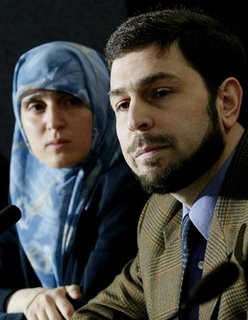 Occurring around the time when US President Bush and the Director of Central Intelligence (DCI) Michael Hayden are pushing for the CIA’s right to continue detaining and using extraordinary interrogation measures against high-value terrorism suspects—using techniques that go against the Geneva Conventions—the release of the Arar report gives us hope that societies have not altogether given up on individual rights when those rights happen to clash with issues of national security. To sum up the Commission’s findings, Mr. Arar has been found not to ever have represented a threat to the security of Canada; the RCMP shared information with US authorities which probably was used by the latter to build a case against him and subsequently deport him to Syria; while in Syria, interrogation techniques utilizing torture methods were likely used against him, leading to confessions that were made under duress; the same information the RCMP shared with the US was deficient but sufficient to damage Mr. Arar’s image; the RCMP and other Canadian governmental agencies were not aware that the information that had been provided to the US would lead to extraordinary rendition resulting in torture; and consular services were provided to Mr. Arar while he was in Syria.
All in all, the RCMP is made to look bad and in fact appears to be the scapegoat. The manner in which Canadian agencies playing the intelligence game distribute and share their intelligence products among themselves and with foreign agencies needs to be looked at. Hearsay, unverifiable or uncorroborated intelligence cannot—should not—be shared willy-nilly with other agencies, especially when it is known that the latter will, in the wake of 9/11, be using it aggressively, as the US so obviously did and still do to this day. It is one thing (already unacceptable) for an investigation to be based on false intelligence occurring here in Canada; it is another for that same information to be shared which will result in an individual’s torture. The quality threshold for intelligence products—raw or finished—that is shared with international allies should be higher. At this writing, it is not, and all kinds of bits of intelligence, from the obviously groundless to the passable, are shared on a daily basis between agencies.
While the Arar Commission sets an encouraging precedent that, one hopes, will force intelligence and law enforcement agencies to clean up their houses, a few question marks remain, and they are troublesome. First, portions of the public report were redacted by the government under the pretext that they contained material whose release could be deleterious to national security. Perhaps this is true, but more likely this continues the long tradition of intelligence agencies hiding blunders behind the wall of secrecy, about which I have written extensively in these pages. And while a full, unexpurgated version has been handed to government, I doubt that even this report is the result of unrestricted access. Here again, walls must have been created to protect high-ranking people at CSIS and the RCMP who have an interest in their activities surrounding the Arar case not being known. I do not intent to imply that there were evil machinations at play in this case, but let’s just say that there is a certain aversion to blunders resulting from incompetence being made public. The old boys’ club likes to keep things the way they are and will do their utmost—use national security confidentiality if need be—to ensure that. Note the sullying campaign, based on groundless accusations, that Canadian agencies launched against Mr. Arar soon after he made his case public.
The clear loser, as I have already stated, in the case is the RCMP. For its part, CSIS seems to have emerged unscathed, and this is not surprising as from the very beginning it has done everything it could to distance itself from the RCMP. But paying close attention to the text raises some questions:
“It is very likely that, in making the decisions to detain and remove Mr. Arar to Syria, the US authorities relied on information about Mr. Arar provided by the RCMP. Although I [O’Connor] cannot be certain without evidence of the American authorities, the evidence strongly supports this conclusion.” The wire service I am relying on to write this entry then paraphrases Mr. O’Connor, adding that CSIS did not share information with the Americans at this time. Those last three words, almost hidden in the text, leave the door open for questions concerning the role of CSIS in all this. What does “at this time” mean? What period does this refer to? While they will likely go unnoticed, those three words seem to imply that CSIS did in fact share information with the US on Arar. If this indeed occurred, was it before, or after the key information that was sent the US way by the RCMP?
The Commission was unquestionably a step in the right direction by the Canadian government. Many future terrorism suspects have Mr. Arar to thank, who unlike most such targets of investigations prefer to suffer in silence. Mr. Arar did not only fight for his own welfare, he fought for what Canada means to our society. He proved, through his courage and not inconsiderable charisma, that in a democracy like ours, individuals can still stand up to entire institutions and come out the winners. If we are lucky, heads will start rolling in Ottawa and the entire process of collection and sharing of intelligence will be scrutinized. The Arar case has demonstrated how far bad intelligence practices can take a targeted individual, and how dire the consequences can be.
If the Commission is simply taken as a list of recommendations, we can assume that nothing of substance will change. For the repercussions of this inquiry to be felt, high-ranking individuals will have to be retired.
The release on Monday of Dennis O’Connor’s public report on the events relating to Maher Arar demonstrates that when it takes matters seriously, the government of Canada can accomplish good things—even on matters of terrorism, where it tends to overact, and even when the results make it look bad but are in the interest of the people.
 Occurring around the time when US President Bush and the Director of Central Intelligence (DCI) Michael Hayden are pushing for the CIA’s right to continue detaining and using extraordinary interrogation measures against high-value terrorism suspects—using techniques that go against the Geneva Conventions—the release of the Arar report gives us hope that societies have not altogether given up on individual rights when those rights happen to clash with issues of national security. To sum up the Commission’s findings, Mr. Arar has been found not to ever have represented a threat to the security of Canada; the RCMP shared information with US authorities which probably was used by the latter to build a case against him and subsequently deport him to Syria; while in Syria, interrogation techniques utilizing torture methods were likely used against him, leading to confessions that were made under duress; the same information the RCMP shared with the US was deficient but sufficient to damage Mr. Arar’s image; the RCMP and other Canadian governmental agencies were not aware that the information that had been provided to the US would lead to extraordinary rendition resulting in torture; and consular services were provided to Mr. Arar while he was in Syria.
All in all, the RCMP is made to look bad and in fact appears to be the scapegoat. The manner in which Canadian agencies playing the intelligence game distribute and share their intelligence products among themselves and with foreign agencies needs to be looked at. Hearsay, unverifiable or uncorroborated intelligence cannot—should not—be shared willy-nilly with other agencies, especially when it is known that the latter will, in the wake of 9/11, be using it aggressively, as the US so obviously did and still do to this day. It is one thing (already unacceptable) for an investigation to be based on false intelligence occurring here in Canada; it is another for that same information to be shared which will result in an individual’s torture. The quality threshold for intelligence products—raw or finished—that is shared with international allies should be higher. At this writing, it is not, and all kinds of bits of intelligence, from the obviously groundless to the passable, are shared on a daily basis between agencies.
While the Arar Commission sets an encouraging precedent that, one hopes, will force intelligence and law enforcement agencies to clean up their houses, a few question marks remain, and they are troublesome. First, portions of the public report were redacted by the government under the pretext that they contained material whose release could be deleterious to national security. Perhaps this is true, but more likely this continues the long tradition of intelligence agencies hiding blunders behind the wall of secrecy, about which I have written extensively in these pages. And while a full, unexpurgated version has been handed to government, I doubt that even this report is the result of unrestricted access. Here again, walls must have been created to protect high-ranking people at CSIS and the RCMP who have an interest in their activities surrounding the Arar case not being known. I do not intent to imply that there were evil machinations at play in this case, but let’s just say that there is a certain aversion to blunders resulting from incompetence being made public. The old boys’ club likes to keep things the way they are and will do their utmost—use national security confidentiality if need be—to ensure that. Note the sullying campaign, based on groundless accusations, that Canadian agencies launched against Mr. Arar soon after he made his case public.
The clear loser, as I have already stated, in the case is the RCMP. For its part, CSIS seems to have emerged unscathed, and this is not surprising as from the very beginning it has done everything it could to distance itself from the RCMP. But paying close attention to the text raises some questions:
“It is very likely that, in making the decisions to detain and remove Mr. Arar to Syria, the US authorities relied on information about Mr. Arar provided by the RCMP. Although I [O’Connor] cannot be certain without evidence of the American authorities, the evidence strongly supports this conclusion.” The wire service I am relying on to write this entry then paraphrases Mr. O’Connor, adding that CSIS did not share information with the Americans at this time. Those last three words, almost hidden in the text, leave the door open for questions concerning the role of CSIS in all this. What does “at this time” mean? What period does this refer to? While they will likely go unnoticed, those three words seem to imply that CSIS did in fact share information with the US on Arar. If this indeed occurred, was it before, or after the key information that was sent the US way by the RCMP?
The Commission was unquestionably a step in the right direction by the Canadian government. Many future terrorism suspects have Mr. Arar to thank, who unlike most such targets of investigations prefer to suffer in silence. Mr. Arar did not only fight for his own welfare, he fought for what Canada means to our society. He proved, through his courage and not inconsiderable charisma, that in a democracy like ours, individuals can still stand up to entire institutions and come out the winners. If we are lucky, heads will start rolling in Ottawa and the entire process of collection and sharing of intelligence will be scrutinized. The Arar case has demonstrated how far bad intelligence practices can take a targeted individual, and how dire the consequences can be.
If the Commission is simply taken as a list of recommendations, we can assume that nothing of substance will change. For the repercussions of this inquiry to be felt, high-ranking individuals will have to be retired.
Tuesday, September 19, 2006
Canada’s Fallen
One of the drawbacks, if you can call it that, of having studied at a military college is that when soldiers are deployed on a combat mission overseas and news start coming back that some of them have fallen, you start to expect that one day you will come upon a name that is familiar. With respect to the situation in Afghanistan—where following yesterday’s suicide bombing 36 Canadian soldiers and one diplomat have been killed—I have not yet, thankfully, had such an encounter (I do personally know, however, a few Americans who were seriously injured in Iraq).
 According to Canada’s Fallen: Understanding Canadian Military Deaths in Afghanistan, a report released yesterday by the Canadian Centre for Policy Alternatives, Canadian soldiers in Afghanistan are three times more likely to be killed than British or other forces deployed there and—get this—six times more likely to be killed than US soldiers in Iraq. Apart from the US, no other country has suffered more military casualties in Afghanistan than Canada. Since February, the report continues, 43 percent (that figure is probably higher now, as the report does not include yesterday’s attack) of non-US casualties in the country were Canadian. Based on these trends, the report concludes with the extrapolation that by the time Canada’s NATO mission in Afghanistan winds down in January 2009, another 108 of its soldiers will have been killed. That number could be higher, or lower, contingent on the vagaries of insurgencies, which by nature are hard to predict and make forecasts on.
The suicide bombing that targeted a Canadian foot patrol in Kandahar Province yesterday killed four Canadian soldiers and injured scores more. What’s even worse is that the bomber, who was riding a bicycle, detonated his bomb while children had gathered around the soldiers, who were handing out (reports conflict) books and pencils or candy. As of yesterday, two dozen children were reported injured.
Tactically, a person choosing certain death to kill a handful of foreign soldiers could make sense—though that person’s commitment to the cause, ratio notwithstanding, may seem alien to us. But for that same person to also target the children of the very country he is ostensibly trying to protect from foreign occupiers points to something else altogether. Combined with the fact that the Afghan insurgency is intensifying, it demonstrates that nearly five years after it was “liberated,” the world is failing Afghanistan, and Canada is part of that failure.
The decision to switch from reconstruction—the original mandate of the Canadian soldiers deployed there—to counterinsurgency has led to Afghanistan resembling more and more like Iraq. Clearly, the “hearts and minds” we had sought to win have slipped through our fingers; how else could we explain the Taliban’s seemingly bottomless pool of militants and the murderous tactics they have adopted to fight NATO? No wonder the British commander of NATO forces in Afghanistan said over the weekend that it would take another three to five years to end the insurgency. This assuredly cannot be seen as good news by those who had swallowed the Afghanistan “success story” line.
The change in Canada’s mandate in Afghanistan was less-than-democratically made when the Liberals were still in power and then expanded upon by the Conservatives. By doing so, Canada has become a participant in a project that without any doubt is not contributing to making Afghanistan—which is scoring record opium production levels—a better place both for its citizens and the rest of the world, which inevitably suffers the consequences of that failed state. Other trends, such as the tripling of the number of attacks against schools this year (172, according to the UN Rapporteur) and the fact that many of the tactics that insurgents have used so effectively in Iraq are increasingly being used in Afghanistan, are worrisome.
Surely, when a man riding a bicycle makes the conscious decision to blow himself up along with children of his own blood, something has been lost, and something terrible has been born to replace it.
Again, as I have done in these pages, I certainly am not arguing for the abandonment of Afghanistan, nor do I mean to imply that we should drop the fight with the Taliban and its allies. However, for the murderous insurgency to pick up steam the way it has in 2006, and for it to take the ugly shape that, as yesterday’s events highlight so bluntly, it has adopted, we clearly have been doing something wrong.
Let us just hope, for the Canadian soldiers and their families’ sake, that the report’s extrapolations were too high.
One of the drawbacks, if you can call it that, of having studied at a military college is that when soldiers are deployed on a combat mission overseas and news start coming back that some of them have fallen, you start to expect that one day you will come upon a name that is familiar. With respect to the situation in Afghanistan—where following yesterday’s suicide bombing 36 Canadian soldiers and one diplomat have been killed—I have not yet, thankfully, had such an encounter (I do personally know, however, a few Americans who were seriously injured in Iraq).
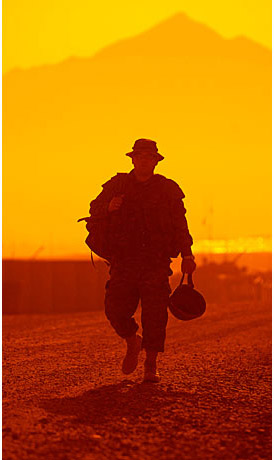 According to Canada’s Fallen: Understanding Canadian Military Deaths in Afghanistan, a report released yesterday by the Canadian Centre for Policy Alternatives, Canadian soldiers in Afghanistan are three times more likely to be killed than British or other forces deployed there and—get this—six times more likely to be killed than US soldiers in Iraq. Apart from the US, no other country has suffered more military casualties in Afghanistan than Canada. Since February, the report continues, 43 percent (that figure is probably higher now, as the report does not include yesterday’s attack) of non-US casualties in the country were Canadian. Based on these trends, the report concludes with the extrapolation that by the time Canada’s NATO mission in Afghanistan winds down in January 2009, another 108 of its soldiers will have been killed. That number could be higher, or lower, contingent on the vagaries of insurgencies, which by nature are hard to predict and make forecasts on.
The suicide bombing that targeted a Canadian foot patrol in Kandahar Province yesterday killed four Canadian soldiers and injured scores more. What’s even worse is that the bomber, who was riding a bicycle, detonated his bomb while children had gathered around the soldiers, who were handing out (reports conflict) books and pencils or candy. As of yesterday, two dozen children were reported injured.
Tactically, a person choosing certain death to kill a handful of foreign soldiers could make sense—though that person’s commitment to the cause, ratio notwithstanding, may seem alien to us. But for that same person to also target the children of the very country he is ostensibly trying to protect from foreign occupiers points to something else altogether. Combined with the fact that the Afghan insurgency is intensifying, it demonstrates that nearly five years after it was “liberated,” the world is failing Afghanistan, and Canada is part of that failure.
The decision to switch from reconstruction—the original mandate of the Canadian soldiers deployed there—to counterinsurgency has led to Afghanistan resembling more and more like Iraq. Clearly, the “hearts and minds” we had sought to win have slipped through our fingers; how else could we explain the Taliban’s seemingly bottomless pool of militants and the murderous tactics they have adopted to fight NATO? No wonder the British commander of NATO forces in Afghanistan said over the weekend that it would take another three to five years to end the insurgency. This assuredly cannot be seen as good news by those who had swallowed the Afghanistan “success story” line.
The change in Canada’s mandate in Afghanistan was less-than-democratically made when the Liberals were still in power and then expanded upon by the Conservatives. By doing so, Canada has become a participant in a project that without any doubt is not contributing to making Afghanistan—which is scoring record opium production levels—a better place both for its citizens and the rest of the world, which inevitably suffers the consequences of that failed state. Other trends, such as the tripling of the number of attacks against schools this year (172, according to the UN Rapporteur) and the fact that many of the tactics that insurgents have used so effectively in Iraq are increasingly being used in Afghanistan, are worrisome.
Surely, when a man riding a bicycle makes the conscious decision to blow himself up along with children of his own blood, something has been lost, and something terrible has been born to replace it.
Again, as I have done in these pages, I certainly am not arguing for the abandonment of Afghanistan, nor do I mean to imply that we should drop the fight with the Taliban and its allies. However, for the murderous insurgency to pick up steam the way it has in 2006, and for it to take the ugly shape that, as yesterday’s events highlight so bluntly, it has adopted, we clearly have been doing something wrong.
Let us just hope, for the Canadian soldiers and their families’ sake, that the report’s extrapolations were too high.
Friday, September 15, 2006
The Moral Slide
We should be alarmed at the state of the world when the “good guys” in the battle that is currently going on inside the US about the treatment of “high value” terrorism suspects argue for corrective measures to the current system that still fall short of the law.
Yesterday, the Senate Armed Services Committee passed a bill that would provide “fair” trials and meet the demands of the US Supreme Court, which has opposed the measures adopted by President Bush. In short, part of Bush’s plan included a narrow definition of the Geneva Convention—the only way, Bush argues (quite erroneously), that the CIA could obtain the valuable information it needs to combat terrorism.
If it were to become practice, the bill would (a) require that defendants have access to the classified “evidence” against them, (b) limit the use of hearsay “evidence,” and (c) restrict the use of “evidence” obtained by coercion.
The two key words in the paragraph above are “limit” and “restrict.” It has long been demonstrated that hearsay is a terrible tool to use in the world of intelligence. Rumors intelligence (RUMINT) will take analysts down multiple paths that had better remain unexplored. Hearsay isn’t based on provable facts; hearsay is innuendo, slander and fabrication. RUMINT collects myths and pieces of information that, when scrutinized, often prove to be motivated by personal hatreds resulting in payback. A source will provide incriminating “evidence” against an individual because of a quarrel—money owned, a fight for leadership within a community, women. By saying that it will “limit” the use of hearsay “evidence,” the bill still leaves the door open to its use, and it will be used whenever the information fits the model that the analysts are seeking.
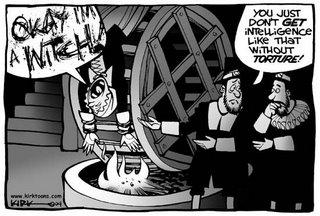 The second and more damaging word, restrict, pertains to the use of “evidence” obtained through coercion or, more precisely, torture. It is here, mostly, that the moral slide that has occurred in the US and other countries is expressed at its fullest, for while the individuals behind the proposed bill seem to have taken the moral high ground, their proposal still leaves room for some use of torture, which goes against not only the Geneva Convention but the US Constitution as well. Whether it occurs while detainees are in US custody or abroad, the Convention Against Torture—to which the US must adhere as it has been signed by and therefore became law in the US (as per federal statute 18 U.S.C. 2340-2340A)—states that “the use of torture and other forms of physical and psychological coercion against any detainee to extract confessions of intelligence related information is a violation of international humanitarian law and is prohibited.” The statute adds that “according to the Third (Art. 17, 87, 99) and the Fourth Geneva Convention (Art. 5, 31, 32), evidence that has been obtained through coercion can never be used…”
This is how the moral slide in the fight against terrorism has occurred. We have reached a point, five years after the incident that sparked the whole thing, where the legal and moral battles are no longer about the law—which doesn’t restrict or limit but bans—but about how often and to what degree we are allowed to break the law. It’s as if we’ve taken two steps back and must now fight with all we have so that we can take but one step forward. As decision-makers in Washington, London and Ottawa argue over these matters, citizens are now subjected to the worst-case scenario (greatly inflated powers of the executive and intelligence agencies) and the not-as-bad scenario (selective use of unlawful methods).
In other words, even those who now take the moral high ground are battling for principles that do not meet the benchmark of legality and morality. Alarming indeed.
We should be alarmed at the state of the world when the “good guys” in the battle that is currently going on inside the US about the treatment of “high value” terrorism suspects argue for corrective measures to the current system that still fall short of the law.
Yesterday, the Senate Armed Services Committee passed a bill that would provide “fair” trials and meet the demands of the US Supreme Court, which has opposed the measures adopted by President Bush. In short, part of Bush’s plan included a narrow definition of the Geneva Convention—the only way, Bush argues (quite erroneously), that the CIA could obtain the valuable information it needs to combat terrorism.
If it were to become practice, the bill would (a) require that defendants have access to the classified “evidence” against them, (b) limit the use of hearsay “evidence,” and (c) restrict the use of “evidence” obtained by coercion.
The two key words in the paragraph above are “limit” and “restrict.” It has long been demonstrated that hearsay is a terrible tool to use in the world of intelligence. Rumors intelligence (RUMINT) will take analysts down multiple paths that had better remain unexplored. Hearsay isn’t based on provable facts; hearsay is innuendo, slander and fabrication. RUMINT collects myths and pieces of information that, when scrutinized, often prove to be motivated by personal hatreds resulting in payback. A source will provide incriminating “evidence” against an individual because of a quarrel—money owned, a fight for leadership within a community, women. By saying that it will “limit” the use of hearsay “evidence,” the bill still leaves the door open to its use, and it will be used whenever the information fits the model that the analysts are seeking.
 The second and more damaging word, restrict, pertains to the use of “evidence” obtained through coercion or, more precisely, torture. It is here, mostly, that the moral slide that has occurred in the US and other countries is expressed at its fullest, for while the individuals behind the proposed bill seem to have taken the moral high ground, their proposal still leaves room for some use of torture, which goes against not only the Geneva Convention but the US Constitution as well. Whether it occurs while detainees are in US custody or abroad, the Convention Against Torture—to which the US must adhere as it has been signed by and therefore became law in the US (as per federal statute 18 U.S.C. 2340-2340A)—states that “the use of torture and other forms of physical and psychological coercion against any detainee to extract confessions of intelligence related information is a violation of international humanitarian law and is prohibited.” The statute adds that “according to the Third (Art. 17, 87, 99) and the Fourth Geneva Convention (Art. 5, 31, 32), evidence that has been obtained through coercion can never be used…”
This is how the moral slide in the fight against terrorism has occurred. We have reached a point, five years after the incident that sparked the whole thing, where the legal and moral battles are no longer about the law—which doesn’t restrict or limit but bans—but about how often and to what degree we are allowed to break the law. It’s as if we’ve taken two steps back and must now fight with all we have so that we can take but one step forward. As decision-makers in Washington, London and Ottawa argue over these matters, citizens are now subjected to the worst-case scenario (greatly inflated powers of the executive and intelligence agencies) and the not-as-bad scenario (selective use of unlawful methods).
In other words, even those who now take the moral high ground are battling for principles that do not meet the benchmark of legality and morality. Alarming indeed.
Thursday, September 14, 2006
A Most Precious Democracy
I am constantly surprised by the position that many Taiwanese people my age and younger have taken on the Taiwan Strait issue. On many occasions when we start talking about whether Taiwan should strive for independence or eventually reintegrate China I am met with the argument that it would be better for the Taiwanese economy if the two Chinas were politically reunited. There is this perception—fed by the media, mostly—that the Taiwanese economy hasn’t been doing well since the Democratic People’s Party (DPP) came to power in 2000.
It’s one thing to think that the economy is ailing, and it is true that during the 1990s Taiwan, one of the small dragons, had fared better. But a close look at the numbers—a GDP growth of 3.8 percent for 2005 (Canada’s is 2.9 percent) and a 4.1 percent unemployment rate (6.8 percent in Canada) and, at about $260 billion, one of the world’s largest foreign exchange reserves—reveals that in spite of the slowdown, Taiwan’s numbers ought to be the envy of many other countries. What compounds the perception of many Taiwanese that unification with China would be a positive development are the stratospheric economic data that are being fed the world by Beijing (unprecedented two-digit growth rates and so on). The problem with those numbers is that they are quite likely exaggerated. Furthermore, China has a very serious distribution problem, which means that the majority of Chinese could hope to benefit from such numbers, even if they were real. Conversely, if China did distribute its wealth in a matter which would permit it to ameliorate its social services, those very same rates would inevitably go down. Failing to invest in its infrastructure (other than building skyscrapers and superhighways that no one uses), the supposed great wealth that is being generated does not result in better living standards for ordinary Chinese. Outside Hong Kong, Shanghai, Beijing and a few other big cities, there lies the “other” China, one where poverty, illiteracy and unemployment are rampant.
But this is just economic matters. More importantly, surely, are the great differences in political freedoms between Taiwan and China. And yet, strangely enough, this is a topic that very rarely is raised by the Taiwanese friends I talk with. I don’t know if that is the result of our reading different publications, but alarmingly most Taiwanese of my generation and those that came after it seem unaware of the pitiful state of affairs in China, where human rights activists are routinely being jailed, reporters and writers forced to revise their comments or also be imprisoned. It is illegal, for example, for sources to leak information on issues of national security—the definition of which is so large and fluid that almost anything, from the outbreak of a disease to how the government deals with a natural catastrophe, can be considered as such and result in prosecution. By the thousands, Chinese are being forced out of their homes so that useless construction projects can continue. Some of those who tried to save their homes have been beaten by police, and news sites reporting on this have been forcefully shut down.
Even more striking is the gradual transformation of Hong Kong, which since its reunification with China—and despite its special status—has also been transformed by the powers that be in Beijing. Surely, if there is something that should serve as a warning to the Taiwanese who are in favor of reunification with China, with HK-like special status or not, the former British territory should be it. Strangely, it doesn’t seem to register. Despite the cries of alarm from various rights groups in Hong Kong, many Taiwanese do not seem to be aware that laws protecting civil liberties are being changed and that the authorities are slowly obtaining powers of intrusiveness that would make anyone in a democracy pause.
Sadly, I do not think young Taiwanese fully understand or appreciate the tremendous value of democracy—a gift that perhaps they take for granted. In their minds, the economy trumps rights and anyway, China is bound to open up and become a better place. Perhaps that is true, but recent signs point in the opposite direction, and this in spite of increased scrutiny as the 2008 Olympic Games in Beijing approach. Diplomats from all over the world are being lied to when Beijing—which is also the pollution capital of the world, by the way—tells them foreign reporters will be given unlimited access throughout the games and subsequently. The state media is becoming more powerful, at the great detriment of any independent outlet, which are now faced with a choice between censorship or closure and jail.
Yesterday, Taiwan’s 14th attempt to gain representation for its 23 million citizens at the United Nations once again met with failure, thanks to opposition from China. Given its economic weight, Beijing is able to co-opt, charm and bully states that otherwise would be in favor of recognizing Taiwan. In the process, China manages to pluck recognition of and political support for the democratic island. A quick look at the ongoing peaceful and orderly sit-in led by former DPP Chairman Shih Ming-teh (施明德) to unseat President Chen Shui-bian (陳水扁) should make the Taiwanese appreciative of their right to do so, to go out on the street and protest. A similar event in China would most assuredly have been met with violence and widespread arrests.
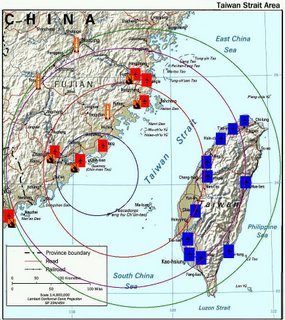 Finally, if all the above isn’t sufficient to convince the Taiwanese that reunification with China for economic benefit isn’t necessarily a good thing, they should consider the odd-800 missiles that Beijing currently has pointing at Taiwan, to which number about 100 new missiles are added every year. Who in his right mind would want to run into the arms of a distant cousin under the threat of physical arm should he fail to do so? Beyond Beijing’s political pressure on potential allies of Taiwan, beyond its meddling in the Taiwanese democratic process, it is the threat of military force, the anti-democratic compelling of a people through the threat of and the planning for use of force (a crime against peace as per Article 6(a) of the United Nations Charter), that should convince every Taiwanese that they stand to lose so much by reuniting with a country that very obviously has no democratic aspirations.
Surely, there must be ways to do business with China without one having to sell his soul in the process.
I am constantly surprised by the position that many Taiwanese people my age and younger have taken on the Taiwan Strait issue. On many occasions when we start talking about whether Taiwan should strive for independence or eventually reintegrate China I am met with the argument that it would be better for the Taiwanese economy if the two Chinas were politically reunited. There is this perception—fed by the media, mostly—that the Taiwanese economy hasn’t been doing well since the Democratic People’s Party (DPP) came to power in 2000.
It’s one thing to think that the economy is ailing, and it is true that during the 1990s Taiwan, one of the small dragons, had fared better. But a close look at the numbers—a GDP growth of 3.8 percent for 2005 (Canada’s is 2.9 percent) and a 4.1 percent unemployment rate (6.8 percent in Canada) and, at about $260 billion, one of the world’s largest foreign exchange reserves—reveals that in spite of the slowdown, Taiwan’s numbers ought to be the envy of many other countries. What compounds the perception of many Taiwanese that unification with China would be a positive development are the stratospheric economic data that are being fed the world by Beijing (unprecedented two-digit growth rates and so on). The problem with those numbers is that they are quite likely exaggerated. Furthermore, China has a very serious distribution problem, which means that the majority of Chinese could hope to benefit from such numbers, even if they were real. Conversely, if China did distribute its wealth in a matter which would permit it to ameliorate its social services, those very same rates would inevitably go down. Failing to invest in its infrastructure (other than building skyscrapers and superhighways that no one uses), the supposed great wealth that is being generated does not result in better living standards for ordinary Chinese. Outside Hong Kong, Shanghai, Beijing and a few other big cities, there lies the “other” China, one where poverty, illiteracy and unemployment are rampant.
But this is just economic matters. More importantly, surely, are the great differences in political freedoms between Taiwan and China. And yet, strangely enough, this is a topic that very rarely is raised by the Taiwanese friends I talk with. I don’t know if that is the result of our reading different publications, but alarmingly most Taiwanese of my generation and those that came after it seem unaware of the pitiful state of affairs in China, where human rights activists are routinely being jailed, reporters and writers forced to revise their comments or also be imprisoned. It is illegal, for example, for sources to leak information on issues of national security—the definition of which is so large and fluid that almost anything, from the outbreak of a disease to how the government deals with a natural catastrophe, can be considered as such and result in prosecution. By the thousands, Chinese are being forced out of their homes so that useless construction projects can continue. Some of those who tried to save their homes have been beaten by police, and news sites reporting on this have been forcefully shut down.
Even more striking is the gradual transformation of Hong Kong, which since its reunification with China—and despite its special status—has also been transformed by the powers that be in Beijing. Surely, if there is something that should serve as a warning to the Taiwanese who are in favor of reunification with China, with HK-like special status or not, the former British territory should be it. Strangely, it doesn’t seem to register. Despite the cries of alarm from various rights groups in Hong Kong, many Taiwanese do not seem to be aware that laws protecting civil liberties are being changed and that the authorities are slowly obtaining powers of intrusiveness that would make anyone in a democracy pause.
Sadly, I do not think young Taiwanese fully understand or appreciate the tremendous value of democracy—a gift that perhaps they take for granted. In their minds, the economy trumps rights and anyway, China is bound to open up and become a better place. Perhaps that is true, but recent signs point in the opposite direction, and this in spite of increased scrutiny as the 2008 Olympic Games in Beijing approach. Diplomats from all over the world are being lied to when Beijing—which is also the pollution capital of the world, by the way—tells them foreign reporters will be given unlimited access throughout the games and subsequently. The state media is becoming more powerful, at the great detriment of any independent outlet, which are now faced with a choice between censorship or closure and jail.
Yesterday, Taiwan’s 14th attempt to gain representation for its 23 million citizens at the United Nations once again met with failure, thanks to opposition from China. Given its economic weight, Beijing is able to co-opt, charm and bully states that otherwise would be in favor of recognizing Taiwan. In the process, China manages to pluck recognition of and political support for the democratic island. A quick look at the ongoing peaceful and orderly sit-in led by former DPP Chairman Shih Ming-teh (施明德) to unseat President Chen Shui-bian (陳水扁) should make the Taiwanese appreciative of their right to do so, to go out on the street and protest. A similar event in China would most assuredly have been met with violence and widespread arrests.
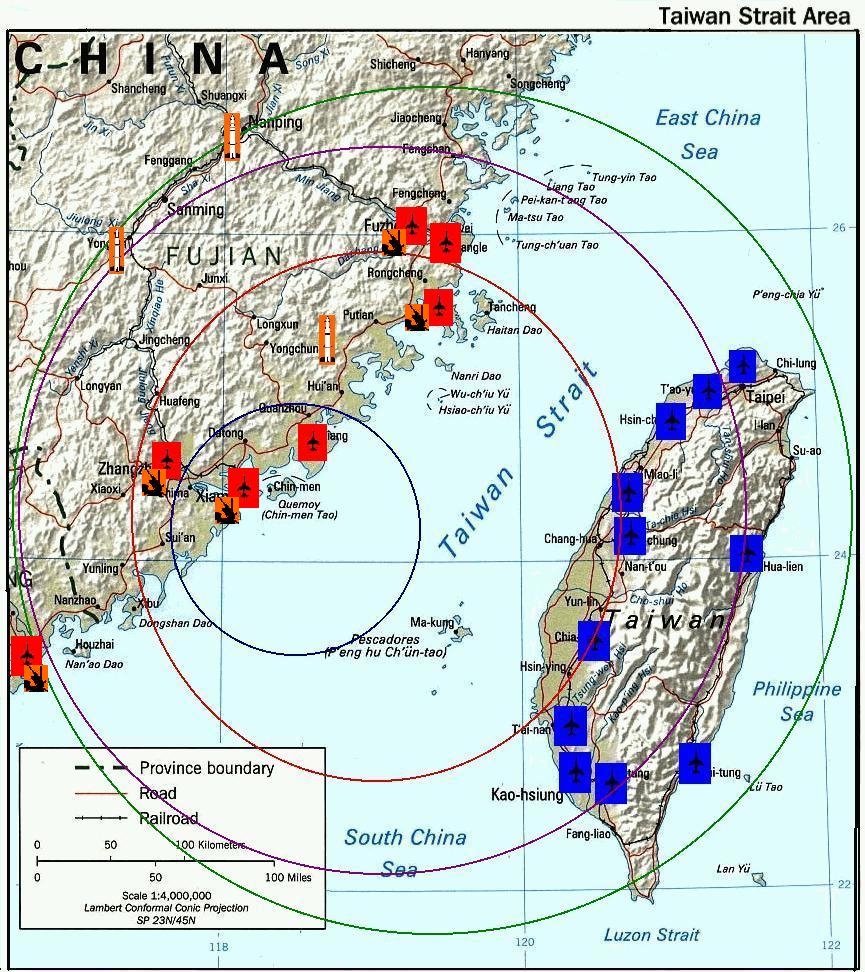 Finally, if all the above isn’t sufficient to convince the Taiwanese that reunification with China for economic benefit isn’t necessarily a good thing, they should consider the odd-800 missiles that Beijing currently has pointing at Taiwan, to which number about 100 new missiles are added every year. Who in his right mind would want to run into the arms of a distant cousin under the threat of physical arm should he fail to do so? Beyond Beijing’s political pressure on potential allies of Taiwan, beyond its meddling in the Taiwanese democratic process, it is the threat of military force, the anti-democratic compelling of a people through the threat of and the planning for use of force (a crime against peace as per Article 6(a) of the United Nations Charter), that should convince every Taiwanese that they stand to lose so much by reuniting with a country that very obviously has no democratic aspirations.
 Surely, there must be ways to do business with China without one having to sell his soul in the process.
Tuesday, September 12, 2006
Five Years (and One Day) Later
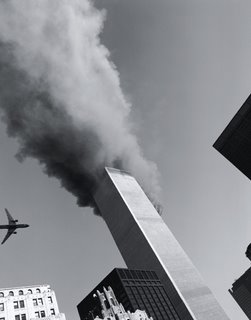 There probably were more articles, opinion pieces and editorials about the Sept. 11 terrorist attacks in New York and Washington over the past week than there were after the strikes five years ago. So much ink has been spilled, pixels been used and airtime taken on that issue that once again it feels like the world has stopped. CNN, the cable news network whose coverage days before the commemoration was nothing if not painfully trite, decided to present the events of 9/11 in real time, five years later, as if every half decade a victim of a car accident had to play the videotape of the event that nearly cost him his life. Experts, not-so-experts, pundits and politicians in office and not—all felt they needed to add their ten cents worth to the chorus. Failing to do so, it seemed, would be an unpardonable sin.
At the Taipei Times where I work, during a time when Taiwanese President Chen Shui-bian (陳水扁) is facing a concerted effort (though hampered by torrential rains) to unseat him, the Opinions pages for the past three days have been about nothing but that, with pieces written by individuals as varied as CNN’s Nic Robertson to the caustic Christopher Hitchens. Being an editor there, I have had the chance (or misfortune, depending on how one sees it) to read, edit and read them all, over and over again.
What emerges is surprisingly—and in a way alarmingly—thin: the chief architects of the attacks, Osama bin Laden and Ayman al-Zawahiri, are still at large and continue to release video tapes threatening more pain on the US and its allies all over the world. This time around, whatever it is that is brewing is—if we are to believe what bin Laden’s right arm says in yesterday’s release—for the Gulf States and Israel. We’ve also learned that the US had the world’s opinion in its favor after 9/11, that most supported retaliation in Afghanistan but that there was unanimous opposition to the 2003 invasion of Iraq, which created many problems but solved precious little. All but the hardcore right-wingers agree in those opinion pieces that Iraq pushed the world back in its campaign against terrorism. Oh—a study now shows that the reduction in air traffic after the 9/11 attacks delayed the spreading of the flu virus, perhaps one of the few positive offshoots of the terrorist attacks.
As the “world” pauses to meditate on the attacks that occurred five years ago, in which nearly 3,000 people lost their lives, I wonder if we should not select a day in the year when we’d all stop and think about the much greater number of civilians who have been killed by the so-called coalition in Afghanistan, Iraq, Palestine and Lebanon, all of whom died from Western bombs launched in the name of a worldwide campaign to protect the vague though from our perspective narrowly-applied concepts of Freedom and Democracy. Should we not, say, make September 12 a remembrance day for all the innocent people who died as a result of the US-led retaliation (and then enlargement) to 9/11? Or are all these people expandable, not as worthy of our time as were the 3,000 or so who perished on that fateful day in September?
Like everybody else, yesterday plunged me back in time momentarily and I, too, relived the day by visualizing myself at 8:00am, 10:00am and so on. I vividly remember waiting at the bus station in Montreal, waiting to take the bus to Ottawa, where I would be taking my very first class in my War Studies graduate program at the Royal Military College of Canada. I still see that old New York-bound black lady as she approaches me and asks if I know the reason why the border with the US has been closed, at which point my cell phone rang and my father apprised me of the news from New York. The eerily-quiet Ottawa (and that says a lot) upon my arrival there is burned in my mind, as is the mood that filled the air in the meeting room at the National Defense building, where we held classes on Tuesdays. As the course that I was taking was, quite appropriately, an introduction to intelligence, I remember my professor—who for very valid reasons showed up a bit late and winded—saying that in light of the day’s events the perspective of the course would have to change a little.
This last aspect has renewed importance five years after the event, for this reorientation of the mind was exactly what I believed—and I still do—needed to be made if we were to avoid other horrors such as 9/11. We needed to alter how we dealt with the Middle East and change the behavior patterns that had given legitimacy to those who perpetrated the attacks.
Unfortunately, despite Donald Rumsfeld’s supposed new, light way of waging war in Afghanistan, or the “shock and awe” high-tech barrage against a country that had no WMD and which (it is now clear) had absolutely no ties to al-Qaeda, the lessons of 9/11 have not been learned. If they had, powerful states like the US and the UK would not have allowed Israel to wage war the way it did in Lebanon in July and August, nor would they have accepted the continued oppression against the Palestinians. Come to think of it, if those lessons had been learned, the US wouldn’t be bogged down in Iraq today after having created the conditions for a bloody civil war that truly risks inflaming an entire region. In fact, it looks as if the decision-makers in Washington made the conscious decision not to learn anything from 9/11 but to nevertheless use the attacks as a pretext to further their agenda for the Middle East, an agenda that as its first stop quite evidently had Baghdad. Many people believe the US invaded Iraq in response to 9/11. That simply isn’t the case. Even back in 2002, as war loomed, intelligence officials and political leaders in Washington knew fully well that Saddam Hussein had nothing to do with 9/11 or its mastermind. They also knew—and had reporting to support it—that Iraq had no existent WMD program to speak of.
All that 9/11 did was to give those people the pretext to go into Iraq, and even then they failed to convince the world of the worthiness of their cause. The UN never gave them the resolution they asked for, and the world over millions of people saw the war for what it was: an illegal war of aggression against a sovereign state.
There is no question that Iraq was a mistake and that the invasion took away precious resources and energy from the task in Afghanistan. As a result, five years after the terrorist attacks the Taliban insurgency is more intense today than it ever has been since the regime was ousted in late 2001, resulting to an insurgency that slowly is starting to take on the airs of Iraq. Canadian and British soldiers are being killed over there, waging a war that shouldn’t be theirs. NATO leaders this weekend called for more troops to be deployed in southern Afghanistan and will try again twice this week to convince members of the alliance to commit more.
Five long years of lessons not learned and savagery that can but further alienate and anger those in whose name (rightly or not) 9/11 was committed, half a decade for the greatest military power in history to fail miserably at apprehending the perpetrators of the attacks and in so doing created thousands of new adherents to a vengeful ideology.
And there you see them, the architects of that fiasco, solemn-looking in New York and behind the Pentagon, who have the gall to say, with a mock conviction that would be too painful to bear were it not so risible, that they will catch bin Laden. Or the “leader” of the so-called free world (though he certainly wasn’t elected by that free world) saying that there are still people out there who wish to do us harm, to attack the things we cherish most, our democracy and freedoms. Five years and those people are still lying—worse than that, five years and they are still allowed to lie through their teeth and look convincing. I wonder if there still are people out there who are truly convinced by those hollow words.
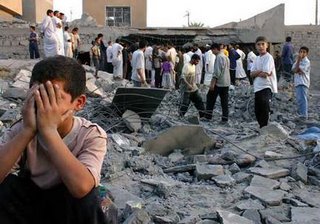 The more I think about it, the more I believe we should have a Sept. 12 day for all the victims of Western aggression against the Middle East. Perhaps then, as we collectively stop and think about the men, women and children whose lives we foreshortened through cruise missiles and cluster bombs, we will be able to come up with the solutions to the problem. September 11, 2001, was horrific—there is no question about that. But we cannot continue to see this event in isolation, as if a wrong had been perpetrated without the inkling of a justification. We cannot stop to meditate, pray or write every September 11 and then continue on with our lives on Sept. 12 without a though for the vengeful plan that began to take shape on that day.
Let us all hope—for our sake and that of the millions who live in the Middle East—that five years from now we will have become a little wiser on this most important issue.
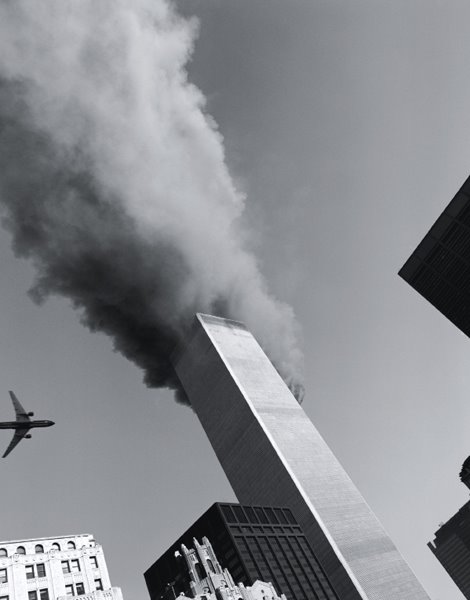 There probably were more articles, opinion pieces and editorials about the Sept. 11 terrorist attacks in New York and Washington over the past week than there were after the strikes five years ago. So much ink has been spilled, pixels been used and airtime taken on that issue that once again it feels like the world has stopped. CNN, the cable news network whose coverage days before the commemoration was nothing if not painfully trite, decided to present the events of 9/11 in real time, five years later, as if every half decade a victim of a car accident had to play the videotape of the event that nearly cost him his life. Experts, not-so-experts, pundits and politicians in office and not—all felt they needed to add their ten cents worth to the chorus. Failing to do so, it seemed, would be an unpardonable sin.
 At the Taipei Times where I work, during a time when Taiwanese President Chen Shui-bian (陳水扁) is facing a concerted effort (though hampered by torrential rains) to unseat him, the Opinions pages for the past three days have been about nothing but that, with pieces written by individuals as varied as CNN’s Nic Robertson to the caustic Christopher Hitchens. Being an editor there, I have had the chance (or misfortune, depending on how one sees it) to read, edit and read them all, over and over again.
What emerges is surprisingly—and in a way alarmingly—thin: the chief architects of the attacks, Osama bin Laden and Ayman al-Zawahiri, are still at large and continue to release video tapes threatening more pain on the US and its allies all over the world. This time around, whatever it is that is brewing is—if we are to believe what bin Laden’s right arm says in yesterday’s release—for the Gulf States and Israel. We’ve also learned that the US had the world’s opinion in its favor after 9/11, that most supported retaliation in Afghanistan but that there was unanimous opposition to the 2003 invasion of Iraq, which created many problems but solved precious little. All but the hardcore right-wingers agree in those opinion pieces that Iraq pushed the world back in its campaign against terrorism. Oh—a study now shows that the reduction in air traffic after the 9/11 attacks delayed the spreading of the flu virus, perhaps one of the few positive offshoots of the terrorist attacks.
As the “world” pauses to meditate on the attacks that occurred five years ago, in which nearly 3,000 people lost their lives, I wonder if we should not select a day in the year when we’d all stop and think about the much greater number of civilians who have been killed by the so-called coalition in Afghanistan, Iraq, Palestine and Lebanon, all of whom died from Western bombs launched in the name of a worldwide campaign to protect the vague though from our perspective narrowly-applied concepts of Freedom and Democracy. Should we not, say, make September 12 a remembrance day for all the innocent people who died as a result of the US-led retaliation (and then enlargement) to 9/11? Or are all these people expandable, not as worthy of our time as were the 3,000 or so who perished on that fateful day in September?
Like everybody else, yesterday plunged me back in time momentarily and I, too, relived the day by visualizing myself at 8:00am, 10:00am and so on. I vividly remember waiting at the bus station in Montreal, waiting to take the bus to Ottawa, where I would be taking my very first class in my War Studies graduate program at the Royal Military College of Canada. I still see that old New York-bound black lady as she approaches me and asks if I know the reason why the border with the US has been closed, at which point my cell phone rang and my father apprised me of the news from New York. The eerily-quiet Ottawa (and that says a lot) upon my arrival there is burned in my mind, as is the mood that filled the air in the meeting room at the National Defense building, where we held classes on Tuesdays. As the course that I was taking was, quite appropriately, an introduction to intelligence, I remember my professor—who for very valid reasons showed up a bit late and winded—saying that in light of the day’s events the perspective of the course would have to change a little.
This last aspect has renewed importance five years after the event, for this reorientation of the mind was exactly what I believed—and I still do—needed to be made if we were to avoid other horrors such as 9/11. We needed to alter how we dealt with the Middle East and change the behavior patterns that had given legitimacy to those who perpetrated the attacks.
Unfortunately, despite Donald Rumsfeld’s supposed new, light way of waging war in Afghanistan, or the “shock and awe” high-tech barrage against a country that had no WMD and which (it is now clear) had absolutely no ties to al-Qaeda, the lessons of 9/11 have not been learned. If they had, powerful states like the US and the UK would not have allowed Israel to wage war the way it did in Lebanon in July and August, nor would they have accepted the continued oppression against the Palestinians. Come to think of it, if those lessons had been learned, the US wouldn’t be bogged down in Iraq today after having created the conditions for a bloody civil war that truly risks inflaming an entire region. In fact, it looks as if the decision-makers in Washington made the conscious decision not to learn anything from 9/11 but to nevertheless use the attacks as a pretext to further their agenda for the Middle East, an agenda that as its first stop quite evidently had Baghdad. Many people believe the US invaded Iraq in response to 9/11. That simply isn’t the case. Even back in 2002, as war loomed, intelligence officials and political leaders in Washington knew fully well that Saddam Hussein had nothing to do with 9/11 or its mastermind. They also knew—and had reporting to support it—that Iraq had no existent WMD program to speak of.
All that 9/11 did was to give those people the pretext to go into Iraq, and even then they failed to convince the world of the worthiness of their cause. The UN never gave them the resolution they asked for, and the world over millions of people saw the war for what it was: an illegal war of aggression against a sovereign state.
There is no question that Iraq was a mistake and that the invasion took away precious resources and energy from the task in Afghanistan. As a result, five years after the terrorist attacks the Taliban insurgency is more intense today than it ever has been since the regime was ousted in late 2001, resulting to an insurgency that slowly is starting to take on the airs of Iraq. Canadian and British soldiers are being killed over there, waging a war that shouldn’t be theirs. NATO leaders this weekend called for more troops to be deployed in southern Afghanistan and will try again twice this week to convince members of the alliance to commit more.
Five long years of lessons not learned and savagery that can but further alienate and anger those in whose name (rightly or not) 9/11 was committed, half a decade for the greatest military power in history to fail miserably at apprehending the perpetrators of the attacks and in so doing created thousands of new adherents to a vengeful ideology.
And there you see them, the architects of that fiasco, solemn-looking in New York and behind the Pentagon, who have the gall to say, with a mock conviction that would be too painful to bear were it not so risible, that they will catch bin Laden. Or the “leader” of the so-called free world (though he certainly wasn’t elected by that free world) saying that there are still people out there who wish to do us harm, to attack the things we cherish most, our democracy and freedoms. Five years and those people are still lying—worse than that, five years and they are still allowed to lie through their teeth and look convincing. I wonder if there still are people out there who are truly convinced by those hollow words.
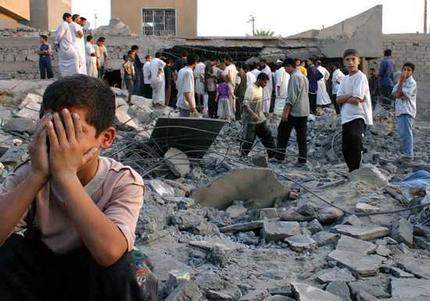 The more I think about it, the more I believe we should have a Sept. 12 day for all the victims of Western aggression against the Middle East. Perhaps then, as we collectively stop and think about the men, women and children whose lives we foreshortened through cruise missiles and cluster bombs, we will be able to come up with the solutions to the problem. September 11, 2001, was horrific—there is no question about that. But we cannot continue to see this event in isolation, as if a wrong had been perpetrated without the inkling of a justification. We cannot stop to meditate, pray or write every September 11 and then continue on with our lives on Sept. 12 without a though for the vengeful plan that began to take shape on that day.
Let us all hope—for our sake and that of the millions who live in the Middle East—that five years from now we will have become a little wiser on this most important issue.
Tuesday, September 05, 2006
Japanese Drums and Day 1 at the Times
My life as editor at a newspaper officially began yesterday at 3pm. Knowing that the job and learning the trade most likely wouldn’t be a walk in the park, I decided to have a very low-key, restful weekend. Most of it, in fact, was spent in coffee shops, reading, or just walking around town.
 But we did do something different Sunday night—and it was extraordinary. We went to Sun Yat-sen Memorial Hall to attend a Japanese drums concert by a troupe called Za Ondekoza (see picture). For a solid two hours we were treated to a meditative and at times hypnotic feat of taiko drumming accompanied by numerous instruments, from the flute to shakuhachi. I had heard taiko drums before, but I certainly didn’t expect a concert to be as much a feat for the eyes as it is for the ears. In fact, the whole affair had a ritualistic feel to it; every hit of the drum is preceded by kata-like posturing, as if every hit were the result of an elaborate strand of meditation on the part of the drummer. What this creates, therefore, is something that resembles a dance; when six drummers do this simultaneously, it creates a whole that cannot leave the onlooker indifferent. The tremendous concentration with which the players do their percussion is nothing less than stunning; how else could a person, standing akimbo in a position that cannot but be uncomfortable, never skip a beat for a song that lasts more than twenty minutes? The drummers are also in exceptional shape and are but muscle. Some of them beat large drums with sword-like sticks while lying on their backs and holding onto the drum with their feet. For every hit, they would do a sit-up. The play of light was also accomplished with perfection, enhancing the mood swings, which went from quiet contemplative to war-like violent.
The following day launched me into the hectic world of the newspaper. Let’s just say that the learning curve isn’t very long. After being asked to read the style guideline (proper to the Times but drawing largely from the Associated Press guide) and shown how to use certain software, I was asked to start editing two stories from international wires. Both, it turns out, were opinion pieces—one on September 11 and the other on the JonBenet media frenzy. Meanwhile, there was mild journalistic excitement surrounding one of the “big” stories of the day, the death of the famous TV “Crocodile Hunter.”
Over the next seven hours, I would ensure that information was correct, check for punctuation, and make appropriate changes to make sure that the texts reflected the style guide (changing yuan to Yuan, or American to US, for example, when referring to the country). There are hundreds of such idiosyncratic style requirements. This also means making sure that dashes and quotation marks are double ones. What surprised me was how liberal we can be in changing certain things, even when the opinion piece is by someone like, say, Joseph Nye of Harvard University. As long as the spirit of the article is maintained, we can change about anything, from headline to subhead to how the text is organized. More so, even, with news items we get off the wires (AP, CP, CNA, Reuters and sundry others). Even when a story reads “CP” and has no “author,” chances are the text will substantially differ from the information that was obtained from the wires. This, therefore, means a lot of cosmetic surgery and rewriting. Then there are the local and regional news, which are written by our own reporters and, if need be, translated from Chinese to English. These are challenging to the editors, as we oftentimes need to understand what the author of the piece meant and retranslate it into proper, publishable English. When a piece is done, it is submitted to the editor-in-chief who goes through the whole thing. After that, it is made into a proper newspaper item; pictures are added and many checks are made to ensure that there are no “bad breaks” and that everything fits the page perfectly (this I will start doing in a few weeks). Everything is checked once more, proofed, and after that the editor-in-chief signs off on that page and it is submitted for print.
Usually, every editor is assigned one or two pages. Yesterday, I had parts of page 8 and most of page 9, which are the letters and opinion sections. After I had gone through a long letter written by a university professor here in Taiwan, the editor-in-chief and I sat together and went through it together. I was surprised by how liberal he was in making changes, which sometimes meant removing whole sentences. As it turns out, even in an opinion piece, if the facts are wrong (say, “Taiwan is in chaos,” which actually was in the piece I worked on), it will be removed.
Overall, day 1 was a very interesting experience. It is hard work—harder than I have worked in a long time—but it is rewarding. Every day, I know that something I worked on, proofread, wrote or rewrote, is in the newspaper and is being read by hundreds of thousands of people. With this, of course, comes a sense of responsibility. Remaining typos will be noticed, and more importantly, factual errors can have repercussions. Never, however, will a piece be treated by one editor alone. Rather, everything comes out of an organism. It may look chaotic while it is in process, but in the end it works out. When 9pm approaches and the deadline needs to be met, things get a little heated and the editor-in-chief may raise his voice to whip his troops.
So there it is, day one at a daily.
My life as editor at a newspaper officially began yesterday at 3pm. Knowing that the job and learning the trade most likely wouldn’t be a walk in the park, I decided to have a very low-key, restful weekend. Most of it, in fact, was spent in coffee shops, reading, or just walking around town.
 But we did do something different Sunday night—and it was extraordinary. We went to Sun Yat-sen Memorial Hall to attend a Japanese drums concert by a troupe called Za Ondekoza (see picture). For a solid two hours we were treated to a meditative and at times hypnotic feat of taiko drumming accompanied by numerous instruments, from the flute to shakuhachi. I had heard taiko drums before, but I certainly didn’t expect a concert to be as much a feat for the eyes as it is for the ears. In fact, the whole affair had a ritualistic feel to it; every hit of the drum is preceded by kata-like posturing, as if every hit were the result of an elaborate strand of meditation on the part of the drummer. What this creates, therefore, is something that resembles a dance; when six drummers do this simultaneously, it creates a whole that cannot leave the onlooker indifferent. The tremendous concentration with which the players do their percussion is nothing less than stunning; how else could a person, standing akimbo in a position that cannot but be uncomfortable, never skip a beat for a song that lasts more than twenty minutes? The drummers are also in exceptional shape and are but muscle. Some of them beat large drums with sword-like sticks while lying on their backs and holding onto the drum with their feet. For every hit, they would do a sit-up. The play of light was also accomplished with perfection, enhancing the mood swings, which went from quiet contemplative to war-like violent.
 The following day launched me into the hectic world of the newspaper. Let’s just say that the learning curve isn’t very long. After being asked to read the style guideline (proper to the Times but drawing largely from the Associated Press guide) and shown how to use certain software, I was asked to start editing two stories from international wires. Both, it turns out, were opinion pieces—one on September 11 and the other on the JonBenet media frenzy. Meanwhile, there was mild journalistic excitement surrounding one of the “big” stories of the day, the death of the famous TV “Crocodile Hunter.”
Over the next seven hours, I would ensure that information was correct, check for punctuation, and make appropriate changes to make sure that the texts reflected the style guide (changing yuan to Yuan, or American to US, for example, when referring to the country). There are hundreds of such idiosyncratic style requirements. This also means making sure that dashes and quotation marks are double ones. What surprised me was how liberal we can be in changing certain things, even when the opinion piece is by someone like, say, Joseph Nye of Harvard University. As long as the spirit of the article is maintained, we can change about anything, from headline to subhead to how the text is organized. More so, even, with news items we get off the wires (AP, CP, CNA, Reuters and sundry others). Even when a story reads “CP” and has no “author,” chances are the text will substantially differ from the information that was obtained from the wires. This, therefore, means a lot of cosmetic surgery and rewriting. Then there are the local and regional news, which are written by our own reporters and, if need be, translated from Chinese to English. These are challenging to the editors, as we oftentimes need to understand what the author of the piece meant and retranslate it into proper, publishable English. When a piece is done, it is submitted to the editor-in-chief who goes through the whole thing. After that, it is made into a proper newspaper item; pictures are added and many checks are made to ensure that there are no “bad breaks” and that everything fits the page perfectly (this I will start doing in a few weeks). Everything is checked once more, proofed, and after that the editor-in-chief signs off on that page and it is submitted for print.
Usually, every editor is assigned one or two pages. Yesterday, I had parts of page 8 and most of page 9, which are the letters and opinion sections. After I had gone through a long letter written by a university professor here in Taiwan, the editor-in-chief and I sat together and went through it together. I was surprised by how liberal he was in making changes, which sometimes meant removing whole sentences. As it turns out, even in an opinion piece, if the facts are wrong (say, “Taiwan is in chaos,” which actually was in the piece I worked on), it will be removed.
Overall, day 1 was a very interesting experience. It is hard work—harder than I have worked in a long time—but it is rewarding. Every day, I know that something I worked on, proofread, wrote or rewrote, is in the newspaper and is being read by hundreds of thousands of people. With this, of course, comes a sense of responsibility. Remaining typos will be noticed, and more importantly, factual errors can have repercussions. Never, however, will a piece be treated by one editor alone. Rather, everything comes out of an organism. It may look chaotic while it is in process, but in the end it works out. When 9pm approaches and the deadline needs to be met, things get a little heated and the editor-in-chief may raise his voice to whip his troops.
So there it is, day one at a daily.
Saturday, September 02, 2006
Colors Shown
The level of personal involvement in politics in Taiwan is unlike anything I had ever experienced before. Not only are the news perpetually reporting on the ongoing plan to oust President Chen Shui-bian (陳水扁) or exposing every allegation of corruption, infidelity or other weaknesses, but politics—the great divide of the Chinese Nationalist Party (KMT) and the Democratic Progressive Party (DPP)—extends, sadly, into the workplace. Whereas in Canada the distance between ordinary citizens and the powers that be in Ottawa appeared to be calculable only in light years, here in Taiwan people make the battle of politics a very personal one indeed. Perhaps this is a consequence of the small size of the country, where distance—physical, political—uses a very different scale from that which is used in immense countries like Canada, Russia, Germany or the United States.
To demonstrate my point. Yesterday, minutes before I was to leave the office for the last time, every Taiwanese employee was had an envelope by their supervisors. Immediately, this made all the employees talk among themselves. I knew, therefore, that something was up, and I started asking around to find out what was going on. As it turns out, the envelopes came from the very top, from the owner of the series of magazines and schools. The object was to strongly encourage every employee to make a NT$100 (approximately $3.10 Canadian) donation to support the fundraising campaign initiated to oust the president. As an incentive, all employees were told that should they make said donation and provide a receipt, they would get an hour off from work in return. Many said, in jest, that they would do it for three hours, but that one hour wasn’t enough. Humor aside, I believe there is great danger in mixing the gift of leave time to employees with politics of the kind that can affect an entire nation. In other words, some people will willingly make their donation not out of political belief, but simply for the fact that they would like to get an hour off. Others, as the invitation came from the top, might feel compelled to make the donation, as doing otherwise will identify them as someone who isn’t of the same political persuasion as that of the employer. In a way, this could be interpreted as a politically-based threat. I don’t know that this would be a widespread occurrence, but I can very well imagine employees of companies with strong political affiliations suffering the professional consequences of failing to donate.
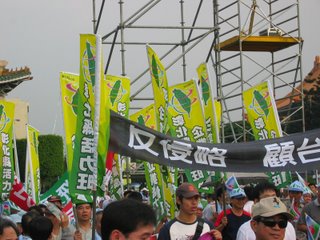 I remember the first time I accompanied my parents as they went voting. What had struck me then was how secretive people generally were about their colors. One couldn’t tell if your neighbor was a Liberal, or a Separatist. Political persuasion was like a religion, something personal that you did not divulge publicly. Discussing politics made people uncomfortable. It was better—safer—therefore, to go into the little secluded room, drop the vote card in the box, and flee the premises. Conversely, here in Taiwan, people are very open about their colors. I know more about an uncle of Stephanie’s pan-blue (KMT) affiliations than about the man himself, and I know more about my father-in-law’s pan-green (DPP) beliefs, and how those have resulted in friction with the abovementioned uncle, than I know about many other aspects of his life. At work, one could easily know who was KMT and who was DPP (the former were in the majority, by the way). There is no doubt that my former employer was pro-KMT.
Whether this is a good thing remains to be proven. In a way, this showcases a deeper, more personal involvement in politics. This probably makes politics and its ramifications more immediate and therefore less distant than politics in Canada, where politics are seen as having very little impact on personal life. After all, Canadians could only argue with some difficulty that the Harper government has fundamentally changed the way they live their lives—as least not in the short term (I would argue, though, that it might in the mid- to long-term). Yes, the country’s foreign policy has changed somewhat, and some laws like same-sex marriage may eventually be reconsidered, but overall life has remained pretty much the same since Martin was ousted.
In Taiwan, however, the nature of a government can have a very serious impact on the future of the country, as the political objectives of the parties looking at each other across the great ideological chasm are very substantial. One pushes for independence, recognition at the United Nations; the other aims for reunification with China. As a result, the outcome of a political ouster, or of a presidential election, will have an immediate impact on the future of the country, in terms of the economy, democracy, security, and many other issues.
No one seeks the protection of the isolated ballot box here. Green, Blue, you show your colors and encourage others—by offering leave time if need be—to rally to the cause. No closet political beliefs indeed.
The level of personal involvement in politics in Taiwan is unlike anything I had ever experienced before. Not only are the news perpetually reporting on the ongoing plan to oust President Chen Shui-bian (陳水扁) or exposing every allegation of corruption, infidelity or other weaknesses, but politics—the great divide of the Chinese Nationalist Party (KMT) and the Democratic Progressive Party (DPP)—extends, sadly, into the workplace. Whereas in Canada the distance between ordinary citizens and the powers that be in Ottawa appeared to be calculable only in light years, here in Taiwan people make the battle of politics a very personal one indeed. Perhaps this is a consequence of the small size of the country, where distance—physical, political—uses a very different scale from that which is used in immense countries like Canada, Russia, Germany or the United States.
To demonstrate my point. Yesterday, minutes before I was to leave the office for the last time, every Taiwanese employee was had an envelope by their supervisors. Immediately, this made all the employees talk among themselves. I knew, therefore, that something was up, and I started asking around to find out what was going on. As it turns out, the envelopes came from the very top, from the owner of the series of magazines and schools. The object was to strongly encourage every employee to make a NT$100 (approximately $3.10 Canadian) donation to support the fundraising campaign initiated to oust the president. As an incentive, all employees were told that should they make said donation and provide a receipt, they would get an hour off from work in return. Many said, in jest, that they would do it for three hours, but that one hour wasn’t enough. Humor aside, I believe there is great danger in mixing the gift of leave time to employees with politics of the kind that can affect an entire nation. In other words, some people will willingly make their donation not out of political belief, but simply for the fact that they would like to get an hour off. Others, as the invitation came from the top, might feel compelled to make the donation, as doing otherwise will identify them as someone who isn’t of the same political persuasion as that of the employer. In a way, this could be interpreted as a politically-based threat. I don’t know that this would be a widespread occurrence, but I can very well imagine employees of companies with strong political affiliations suffering the professional consequences of failing to donate.
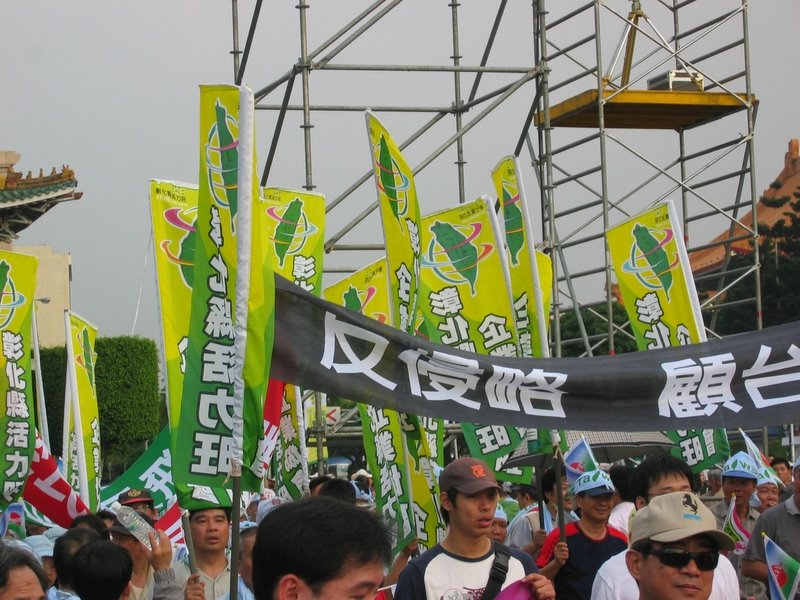 I remember the first time I accompanied my parents as they went voting. What had struck me then was how secretive people generally were about their colors. One couldn’t tell if your neighbor was a Liberal, or a Separatist. Political persuasion was like a religion, something personal that you did not divulge publicly. Discussing politics made people uncomfortable. It was better—safer—therefore, to go into the little secluded room, drop the vote card in the box, and flee the premises. Conversely, here in Taiwan, people are very open about their colors. I know more about an uncle of Stephanie’s pan-blue (KMT) affiliations than about the man himself, and I know more about my father-in-law’s pan-green (DPP) beliefs, and how those have resulted in friction with the abovementioned uncle, than I know about many other aspects of his life. At work, one could easily know who was KMT and who was DPP (the former were in the majority, by the way). There is no doubt that my former employer was pro-KMT.
Whether this is a good thing remains to be proven. In a way, this showcases a deeper, more personal involvement in politics. This probably makes politics and its ramifications more immediate and therefore less distant than politics in Canada, where politics are seen as having very little impact on personal life. After all, Canadians could only argue with some difficulty that the Harper government has fundamentally changed the way they live their lives—as least not in the short term (I would argue, though, that it might in the mid- to long-term). Yes, the country’s foreign policy has changed somewhat, and some laws like same-sex marriage may eventually be reconsidered, but overall life has remained pretty much the same since Martin was ousted.
In Taiwan, however, the nature of a government can have a very serious impact on the future of the country, as the political objectives of the parties looking at each other across the great ideological chasm are very substantial. One pushes for independence, recognition at the United Nations; the other aims for reunification with China. As a result, the outcome of a political ouster, or of a presidential election, will have an immediate impact on the future of the country, in terms of the economy, democracy, security, and many other issues.
No one seeks the protection of the isolated ballot box here. Green, Blue, you show your colors and encourage others—by offering leave time if need be—to rally to the cause. No closet political beliefs indeed.
Friday, September 01, 2006
The Last Day, A Much Lighter Offering
Today represents my last day working as an editor and writer for three English-language magazines in Taiwan. As it wasn't my intention to teach English as a second language (ESL), which is what most foreigners end up doing in Taiwan, this job gave me the opportunity not only to hone my skills as an editor and learn about the magazine trade, but it also provided me with the permits and certificates required to stay legally in the country. But it was evident from the onset that I could only go so far (and long) writing for children and teenagers. In fact, the editor-in-chief who interviewed me back in November last year had been a little apprehensive. "But you have a Master's Degree in [War Studies]" he had said. "Don't you think you will be bored?" he had asked, as it turns out presciently. He was right, of course, but given the choice between teaching rowdy children and working in a magazine, the decision had been an easy one to make.
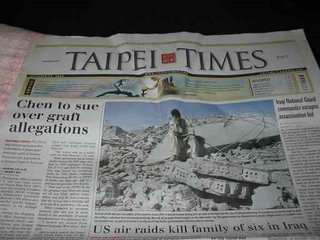 After eight months of doing this, however, the time has come to do something else and to challenge myself—which is exactly what I will get next Monday when I commence work as a copy editor at the Taipei Times, Taiwan's primary English-language newspaper. With a circulation of nearly 300,000 copies daily (and a web edition), I am yet again expanding the amount of people whose heads I will be welcomed into (the magazines I worked for had, I believe, a circulation of about 80,000 copies).
These will be interesting times to be working in a newspaper as well. Given the coming Presidential elections and the various ongoing motions to recall and expel the current DPP president, as well as continued tensions with China, Taiwan's renewed attempt to obtain—this time using its name, Taiwan—representation at the United Nations, arms purchases (66 F-16s from the United States, among other items) and other issues, I will have my fill of local and regional stories, not to mention international coverage, with the Times offers as well. The Times' inclination is pro-separatist (which as my readers will know I fully agree with) and somewhat pro-DPP, though it prides itself in calling everybody, regardless of their political affiliations and standing, to account. Whether they operate at the DPP, the KMT or in Beijing, crooks are crooks are crooks. This notwithstanding, it should be interesting to work in as polarized an environment as Taiwan's political scene. After all, not so long ago Taiwan's media were part of the state apparatus and, much as in China, had little choice but to toe the official line. In many ways, old habits die hard, especially in how one views the world. Today, though, Taiwan's environment is a truly democratic one that starkly contrasts with that which is available across the Strait, where yesterday a journalist was once again condemned, behind closed doors, for allegedly spying on Taiwan's behalf. No country in the world currently has more journalists in detention than does China. As a newspaper editor and sometime writer, I will not, thankfully, be facing such risks in Taiwan.
In the past month and as an earlier posting indicates, I have had my share of problems with the abovementioned editor-in-chief, but that matters little. Professional differences, exacerbated by cultural ones, dissipate with time and really have no weight worthy of mention. What stays, however, are the nice, dedicated people with whom I worked during that period, people who are now showing me that my presence here was indeed appreciated. I will be having dinner and karaoke with many of them this evening, and for those who cannot make it, I have been given well-wishing cards, pictures and so on. If only they, in turn, could be treated a little more fairly by their employer.
Isn't it ironic that the government employer I resigned from almost a year ago to the day entertained such a fear of the one area I am about to enter professionally—that of the news media and a foreign country's to boot!
Today represents my last day working as an editor and writer for three English-language magazines in Taiwan. As it wasn't my intention to teach English as a second language (ESL), which is what most foreigners end up doing in Taiwan, this job gave me the opportunity not only to hone my skills as an editor and learn about the magazine trade, but it also provided me with the permits and certificates required to stay legally in the country. But it was evident from the onset that I could only go so far (and long) writing for children and teenagers. In fact, the editor-in-chief who interviewed me back in November last year had been a little apprehensive. "But you have a Master's Degree in [War Studies]" he had said. "Don't you think you will be bored?" he had asked, as it turns out presciently. He was right, of course, but given the choice between teaching rowdy children and working in a magazine, the decision had been an easy one to make.
 After eight months of doing this, however, the time has come to do something else and to challenge myself—which is exactly what I will get next Monday when I commence work as a copy editor at the Taipei Times, Taiwan's primary English-language newspaper. With a circulation of nearly 300,000 copies daily (and a web edition), I am yet again expanding the amount of people whose heads I will be welcomed into (the magazines I worked for had, I believe, a circulation of about 80,000 copies).
These will be interesting times to be working in a newspaper as well. Given the coming Presidential elections and the various ongoing motions to recall and expel the current DPP president, as well as continued tensions with China, Taiwan's renewed attempt to obtain—this time using its name, Taiwan—representation at the United Nations, arms purchases (66 F-16s from the United States, among other items) and other issues, I will have my fill of local and regional stories, not to mention international coverage, with the Times offers as well. The Times' inclination is pro-separatist (which as my readers will know I fully agree with) and somewhat pro-DPP, though it prides itself in calling everybody, regardless of their political affiliations and standing, to account. Whether they operate at the DPP, the KMT or in Beijing, crooks are crooks are crooks. This notwithstanding, it should be interesting to work in as polarized an environment as Taiwan's political scene. After all, not so long ago Taiwan's media were part of the state apparatus and, much as in China, had little choice but to toe the official line. In many ways, old habits die hard, especially in how one views the world. Today, though, Taiwan's environment is a truly democratic one that starkly contrasts with that which is available across the Strait, where yesterday a journalist was once again condemned, behind closed doors, for allegedly spying on Taiwan's behalf. No country in the world currently has more journalists in detention than does China. As a newspaper editor and sometime writer, I will not, thankfully, be facing such risks in Taiwan.
In the past month and as an earlier posting indicates, I have had my share of problems with the abovementioned editor-in-chief, but that matters little. Professional differences, exacerbated by cultural ones, dissipate with time and really have no weight worthy of mention. What stays, however, are the nice, dedicated people with whom I worked during that period, people who are now showing me that my presence here was indeed appreciated. I will be having dinner and karaoke with many of them this evening, and for those who cannot make it, I have been given well-wishing cards, pictures and so on. If only they, in turn, could be treated a little more fairly by their employer.
Isn't it ironic that the government employer I resigned from almost a year ago to the day entertained such a fear of the one area I am about to enter professionally—that of the news media and a foreign country's to boot!
Thursday, August 31, 2006
"Shocking" and "Immoral"
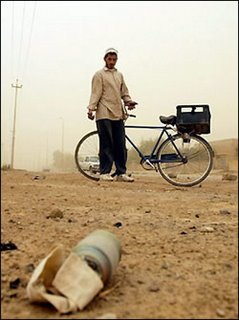 This is how the UN's humanitarian Chief, Jan Egelund, describes Israel's incomprehensible use of cluster bombs during the 72 hours leading up to the August 14 ceasefire in Lebanon. In fact, around 90 percent of the overall number of cluster bombs used by Israel during the 34-day war were dropped during those last three days. So far, the UN has identified 359 separate cluster bomb strikes in Lebanon, with as many as 100,000 unexploded bomblets. As a result, there have been 59 confirmed casualties—including 13 deaths—caused by the explosives since the end of hostilities.
According to international humanitarian law (IHL), cluster bombs—considered illegal by the Ottawa Process to ban land mines and other tied campaigns—should only be used against clearly-defined military targets and certainly not in civilian areas, which is where Israel dropped a great share of them. Cluster bombs belong to a category known as "explosive remnants of war" or "unexploded ordnance (UXO)," and as with land mines, a military that uses them in combat should provide a concise map of the areas where they were used, something Israel hasn't done to date. The problem with cluster bombs lies mostly in the failure rate; in other words, a percentage of the bomblets dropped don't explode on impact. As a result, civilians returning to their homes and children attracted by the objects—not to mention humanitarian workers rebuilding the country—are at great risk (in Afghanistan, UXO were often mistaken for yellow food packages). This is like having 100,000 invisible land mines in and around urban areas. Consequently, the already daunting task of rebuilding Lebanon will now require an element of de-mining as well.
What is difficult to comprehend is the reason why Israel felt the need to use these indiscriminate means against Lebanon—and to intensify their use—when it had already become clear that the hostilities would cease. Other than endanger the lives of civilians and make reconstruction more onerous, there is very little military advantage to having done so. The only explanation, therefore, is that the willful use of an illegal weapon was part of Israel’s plan of collective punishment for Lebanon, something that ties in well with the widespread bombing of civilian infrastructure and the embargo, which, despite please from UN Secretary General Kofi Annan, endures to this day.
The countries that provide Israel with cluster bombs—a list which includes but is not limited to the United States—should pressure Jerusalem to account for its indiscriminate use of these weapons and refrain from selling them to the Jewish state (or any state, for that matter). Hezbollah was often (and justly so) criticized by Israel and the international community for firing rockets indiscriminately into northern Israel. Jerusalem's use of cluster bombs is, haplessly, as indiscriminate, in that the unexploded bomblets linger on and can maim and kill months later without the benefit of targeting.
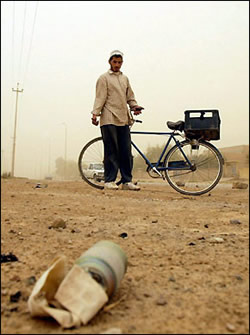 This is how the UN's humanitarian Chief, Jan Egelund, describes Israel's incomprehensible use of cluster bombs during the 72 hours leading up to the August 14 ceasefire in Lebanon. In fact, around 90 percent of the overall number of cluster bombs used by Israel during the 34-day war were dropped during those last three days. So far, the UN has identified 359 separate cluster bomb strikes in Lebanon, with as many as 100,000 unexploded bomblets. As a result, there have been 59 confirmed casualties—including 13 deaths—caused by the explosives since the end of hostilities.
According to international humanitarian law (IHL), cluster bombs—considered illegal by the Ottawa Process to ban land mines and other tied campaigns—should only be used against clearly-defined military targets and certainly not in civilian areas, which is where Israel dropped a great share of them. Cluster bombs belong to a category known as "explosive remnants of war" or "unexploded ordnance (UXO)," and as with land mines, a military that uses them in combat should provide a concise map of the areas where they were used, something Israel hasn't done to date. The problem with cluster bombs lies mostly in the failure rate; in other words, a percentage of the bomblets dropped don't explode on impact. As a result, civilians returning to their homes and children attracted by the objects—not to mention humanitarian workers rebuilding the country—are at great risk (in Afghanistan, UXO were often mistaken for yellow food packages). This is like having 100,000 invisible land mines in and around urban areas. Consequently, the already daunting task of rebuilding Lebanon will now require an element of de-mining as well.
What is difficult to comprehend is the reason why Israel felt the need to use these indiscriminate means against Lebanon—and to intensify their use—when it had already become clear that the hostilities would cease. Other than endanger the lives of civilians and make reconstruction more onerous, there is very little military advantage to having done so. The only explanation, therefore, is that the willful use of an illegal weapon was part of Israel’s plan of collective punishment for Lebanon, something that ties in well with the widespread bombing of civilian infrastructure and the embargo, which, despite please from UN Secretary General Kofi Annan, endures to this day.
The countries that provide Israel with cluster bombs—a list which includes but is not limited to the United States—should pressure Jerusalem to account for its indiscriminate use of these weapons and refrain from selling them to the Jewish state (or any state, for that matter). Hezbollah was often (and justly so) criticized by Israel and the international community for firing rockets indiscriminately into northern Israel. Jerusalem's use of cluster bombs is, haplessly, as indiscriminate, in that the unexploded bomblets linger on and can maim and kill months later without the benefit of targeting.
Monday, August 28, 2006
Beijing's Unsportsmanlike Conduct
Considering that the International Children's Games, which this year were held in Thailand, have as an objective to promote friendship among youth aged 12-15, the Chinese team's behavior vis-à-vis Taiwanese athletes represents a most unfortunate blemish on the event. Chinese sports officials—not children—snatched the Taiwanese flag from the shoulders of two Taiwanese swimming champions as they were walking towards the podium to obtain their gold medals. According to a member of the Beijing delegation, the Taiwanese athletes had left them no choice. Asking if violence was the only way to deal with the issue, a Taiwanese official was reportedly met with a resounding yes from the female members of the Beijing team. Another Taiwanese athlete (seen here), meanwhile, was able to keep her Taiwanese flag as she received her gold medal in Taekwondo. Perhaps the Chinese delegation feared that, given her skills, she would be able to fight back. Doesn't Beijing understand a language other than that of force?
How unfortunate it is that Beijing's aggressive and bellicose stance vis-à-vis Taiwan would seep into games organized to promote harmony among children of different nations. Not only does this provide a bad example to youth, it demonstrates how irresponsible the Beijing cadres can become when it comes to the evidently-emotional issue of Taiwan separatism. There is no place for hatred—even less when it comes to the education of children, upon whom the future of cross-Strait relations will eventually rest. If China, through its state-controlled curriculum and actions in the international arena, continues to inculcate hatred, then the future of the Taiwan-China equation will continue to be a threatening one, with no hope for a peaceful resolution to the conflict.
One of the many reasons why Israel and Palestine have failed to live peacefully side-by-side includes the teaching of hatred in the classroom on both sides. Children who grow up emulating the actions of their teachers, coaches and parents can only but perpetuate the cycle of hatred. Given that the Taiwanese-Chinese issue is far less complex than the Israeli-Palestinian one, such juvenile bullying is definitely not necessary—but it sure is revealing of the manner in which Beijing approaches the question at all levels, from within the halls of the United Nations to the sports arena in Bangkok.
Considering that the International Children's Games, which this year were held in Thailand, have as an objective to promote friendship among youth aged 12-15, the Chinese team's behavior vis-à-vis Taiwanese athletes represents a most unfortunate blemish on the event. Chinese sports officials—not children—snatched the Taiwanese flag from the shoulders of two Taiwanese swimming champions as they were walking towards the podium to obtain their gold medals. According to a member of the Beijing delegation, the Taiwanese athletes had left them no choice. Asking if violence was the only way to deal with the issue, a Taiwanese official was reportedly met with a resounding yes from the female members of the Beijing team.
 Another Taiwanese athlete (seen here), meanwhile, was able to keep her Taiwanese flag as she received her gold medal in Taekwondo. Perhaps the Chinese delegation feared that, given her skills, she would be able to fight back. Doesn't Beijing understand a language other than that of force?
How unfortunate it is that Beijing's aggressive and bellicose stance vis-à-vis Taiwan would seep into games organized to promote harmony among children of different nations. Not only does this provide a bad example to youth, it demonstrates how irresponsible the Beijing cadres can become when it comes to the evidently-emotional issue of Taiwan separatism. There is no place for hatred—even less when it comes to the education of children, upon whom the future of cross-Strait relations will eventually rest. If China, through its state-controlled curriculum and actions in the international arena, continues to inculcate hatred, then the future of the Taiwan-China equation will continue to be a threatening one, with no hope for a peaceful resolution to the conflict.
One of the many reasons why Israel and Palestine have failed to live peacefully side-by-side includes the teaching of hatred in the classroom on both sides. Children who grow up emulating the actions of their teachers, coaches and parents can only but perpetuate the cycle of hatred. Given that the Taiwanese-Chinese issue is far less complex than the Israeli-Palestinian one, such juvenile bullying is definitely not necessary—but it sure is revealing of the manner in which Beijing approaches the question at all levels, from within the halls of the United Nations to the sports arena in Bangkok.
You Won't Get your Answers, Wolf
It was journalism at its poignantly most painful last night on CNN's Late Edition with Wolf Blitzer. Now, despite the fact that the channel is available here in Taiwan, I haven't watched the news network for months. In fact, I prefer al-Jazeera nowadays, whose headquarters in Qatar are rumored to once have been on the list of U.S. targets during the run-up to the 2003 invasion of Iraq. Unable to find sleep last night, and after channel surfing from one old Hong Kong movie to another, I landed on CNN, where the white-bearded anchor, who doesn't appear to have aged one minute in the past fifteen years, was interviewing Iraqi Prime Minister Nouri al-Maliki. I only caught the end of the interview, but to me those last five minutes were extremely revealing.
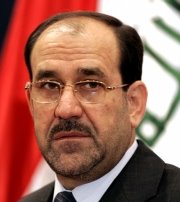 In those five minutes, Blitzer fired three strikingly unpolished questions at al-Maliki that perfectly highlighted how the American government and the fledging one that has emerged in Iraq are so far apart in their views and how, in the end, this outcome may bring great displeasure to the White House and the American public. The first question concerned al-Maliki's alleged support for Hezbollah during the Israeli war against Lebanon in July. On two occasions, Blitzer did his utmost to corner the Prime Minister by asking him if he sided with the militia or Israel, adding that the U.S. government had been fully behind Jerusalem during the 34-day war. Twice, an uncomfortable-looking al-Maliki launched into a painful exercise in oblique statements and references to the people; no binary answer was to be given.
Seeing he was going nowhere, Blitzer switched gears and asked about Iraqi democracy and where al-Maliki saw Iraq five, ten years from now—a democracy (American-style, presumably) or an Islamic state with sharia law (the system of laws inspired by the Koran). In the interviewer's head, it seems that there are only two possible systems in Iraq: democracy, or Islamism. Cornered once more, al-Maliki once again resorted to convolution and all but answered the question. Not only was he being asked to predict the future in a country where, given the state it currently is in, such predictions are more impossible to make than elsewhere, but the two choices were so antipodal as to be irrelevant. Strike two for Blitzer, whose face started showing signs of controlled anger.
The third—and last—question was about the state of Israel. Here, Blitzer went beyond mere support for Hezbollah and asked the Iraqi Prime Minister if he believed the Jewish state had a right to exist. Al-Maliki's first response was a complex set of references to international law and the Security Council and the people. Blitzer, seeking the yes or no answer, rephrased his question, again to no avail. The reply clearly did not match the question. To Blitzer's discontent, al-Maliki added that diplomatic relations between Iraq and Israel were not even on the table. It was also obvious that al-Maliki was ill at ease, which became even more apparent when a relentless Blitzer asked one last time, pointing out that his interviewee hadn't answered his question, if he believed in a two-state solution (i.e. an Israeli state next to a Palestinian one) or a one-state solution (i.e. no Israel and only a Palestinian state). As expected, the third attempt led nowhere, and Blitzer decided, thankfully, that he had run out of time.
Whether the anchor and his staff were aware of this or not, it was clear that binary questions about situations of such complexity as the Middle East cannot be answered on the same term—perhaps even more so when the person being interviewed heads a fractious, multi-denominational state under military occupation and on the brink of civil war. What made the whole exercise almost painful to watch was not only the Iraqi Prime Minister's obvious discomfort but also Blitzer's relentlessness, which left the viewer with the impression that if he asked often enough he might be able to obtain an answer which would satisfy the American people. One could very well imagine poor Blitzer on the edge of a cliff, hanging by a finger, struggling to keep hope alive. In the background, we could almost hear voices shouting "we helped put you there, al-Maliki; we liberated your country. Why can't you give us one answer that our people will like?"
Democracy, however weak and imperfect, has indeed budded in Iraq. It is far from certain that it will spread within the embattled country, let alone in the region. Every day, it is under threat, from within and from without. Its current form isn't even representative of the entire Iraq. But it is a beginning, and al-Maliki is the outcome. The beauty of it is that its voice is already its own and will not yield to the pressures emanating from Washington or some news organization in Atlanta.
Sorry Wolf, but Iraq is not your creation. Ask as often as you want, you might never get the answers you seek.
It was journalism at its poignantly most painful last night on CNN's Late Edition with Wolf Blitzer. Now, despite the fact that the channel is available here in Taiwan, I haven't watched the news network for months. In fact, I prefer al-Jazeera nowadays, whose headquarters in Qatar are rumored to once have been on the list of U.S. targets during the run-up to the 2003 invasion of Iraq. Unable to find sleep last night, and after channel surfing from one old Hong Kong movie to another, I landed on CNN, where the white-bearded anchor, who doesn't appear to have aged one minute in the past fifteen years, was interviewing Iraqi Prime Minister Nouri al-Maliki. I only caught the end of the interview, but to me those last five minutes were extremely revealing.
 In those five minutes, Blitzer fired three strikingly unpolished questions at al-Maliki that perfectly highlighted how the American government and the fledging one that has emerged in Iraq are so far apart in their views and how, in the end, this outcome may bring great displeasure to the White House and the American public. The first question concerned al-Maliki's alleged support for Hezbollah during the Israeli war against Lebanon in July. On two occasions, Blitzer did his utmost to corner the Prime Minister by asking him if he sided with the militia or Israel, adding that the U.S. government had been fully behind Jerusalem during the 34-day war. Twice, an uncomfortable-looking al-Maliki launched into a painful exercise in oblique statements and references to the people; no binary answer was to be given.
 Seeing he was going nowhere, Blitzer switched gears and asked about Iraqi democracy and where al-Maliki saw Iraq five, ten years from now—a democracy (American-style, presumably) or an Islamic state with sharia law (the system of laws inspired by the Koran). In the interviewer's head, it seems that there are only two possible systems in Iraq: democracy, or Islamism. Cornered once more, al-Maliki once again resorted to convolution and all but answered the question. Not only was he being asked to predict the future in a country where, given the state it currently is in, such predictions are more impossible to make than elsewhere, but the two choices were so antipodal as to be irrelevant. Strike two for Blitzer, whose face started showing signs of controlled anger.
The third—and last—question was about the state of Israel. Here, Blitzer went beyond mere support for Hezbollah and asked the Iraqi Prime Minister if he believed the Jewish state had a right to exist. Al-Maliki's first response was a complex set of references to international law and the Security Council and the people. Blitzer, seeking the yes or no answer, rephrased his question, again to no avail. The reply clearly did not match the question. To Blitzer's discontent, al-Maliki added that diplomatic relations between Iraq and Israel were not even on the table. It was also obvious that al-Maliki was ill at ease, which became even more apparent when a relentless Blitzer asked one last time, pointing out that his interviewee hadn't answered his question, if he believed in a two-state solution (i.e. an Israeli state next to a Palestinian one) or a one-state solution (i.e. no Israel and only a Palestinian state). As expected, the third attempt led nowhere, and Blitzer decided, thankfully, that he had run out of time.
Whether the anchor and his staff were aware of this or not, it was clear that binary questions about situations of such complexity as the Middle East cannot be answered on the same term—perhaps even more so when the person being interviewed heads a fractious, multi-denominational state under military occupation and on the brink of civil war. What made the whole exercise almost painful to watch was not only the Iraqi Prime Minister's obvious discomfort but also Blitzer's relentlessness, which left the viewer with the impression that if he asked often enough he might be able to obtain an answer which would satisfy the American people. One could very well imagine poor Blitzer on the edge of a cliff, hanging by a finger, struggling to keep hope alive. In the background, we could almost hear voices shouting "we helped put you there, al-Maliki; we liberated your country. Why can't you give us one answer that our people will like?"
Democracy, however weak and imperfect, has indeed budded in Iraq. It is far from certain that it will spread within the embattled country, let alone in the region. Every day, it is under threat, from within and from without. Its current form isn't even representative of the entire Iraq. But it is a beginning, and al-Maliki is the outcome. The beauty of it is that its voice is already its own and will not yield to the pressures emanating from Washington or some news organization in Atlanta.
Sorry Wolf, but Iraq is not your creation. Ask as often as you want, you might never get the answers you seek.
Wednesday, August 23, 2006
Right Mandate, Albeit One-Sided
The new rules of engagement for UNIFIL troops in Lebanon should assuage the concerns of the potential contributors to the mission, such as France. It is hoped, therefore, that the clearly-defined rules, which include the permission to use deadly force not only in self-defence but also to open up humanitarian corridors, to protect civilians under imminent threat, and defend the Lebanese Army from assault, will lead to the level of contribution which would sustain the projected 15,000 troops by November.
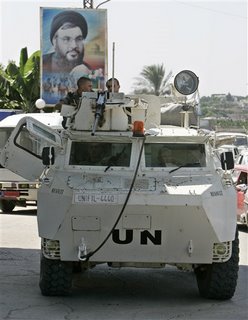 All is well, and there is nothing like a clear mandate granting sufficient powers to accomplish a mission. The problem, however, is that the so-called permission to use deadly force risks being employed only when Hezbollah is seen as a threat. I find it extremely difficult to imagine that UNIFIL members would dare confront Israeli forces in Lebanon. Not only is the IDF orders of magnitude more efficient and better-equipped than the sum of the UNIFIL deployment, but the diplomatic fallout of a military exchange between a UN force and Israel would have overwhelmingly deleterious consequences for the mission, of which the death of UN officials would only be the beginning. Can we really expect, say, Nepalese soldiers attempting to stop an Israeli F-16 from bombing a village in southern Lebanon? As history has shown, the Jewish state has no compunction about targeting civilians or UN soldiers and will do so again if they are seen as preventing it from achieving its objectives. But any military action taken on the part of UNIFIL against Israel will echo back into the halls of UN headquarters in New York, where accusations of anti-Semitism will be directed not only at the country that used force but at the entire UN architecture, against which Israel has already launched many such accusations.
Increasingly, it's starting to look like UNIFIL 2.0 is being constituted not so that it can ensure stability in the region, but to please Israel and, perhaps, do its work on the ground. While the mandate does not currently request the forceful disarmament of Hezbollah, it sure is starting to look like this might be the next step. There is no certainty that a Hezbollah that sees UNIFIL to be but a pawn of Jerusalem (and Washington) will choose to live peacefully with it. Given the disparate nature of its constituents, there is no way UNIFIL could survive a guerrilla war with Hezbollah on Lebanese territory. Israel was unable to do so. Even the United States gets chills at night when it thinks back on what happened to its marines in the 1980s. What seems to have been accomplished is the textbook error, which the international community committed in the very same country in the 1980s, of taking sides. Whether they want to or not, the UN and contributing countries to UNIFIL will be expected to do Israel's bidding. This is a classic mistake, and it very well could be a deadly one.
What all this means for UNIFIL is that before it even has deployed, it already finds itself between a rock a and a hard place: confront Hezbollah in a war it cannot win, or face up to Israel, which it equally cannot afford. We therefore have a UN deployment, however muscular the UN mandate, whose only chance of "success" (however one defines it) is contingent upon the two sides respecting the ceasefire. Things are going to get ugly before they get better, of that this writer is certain.
The new rules of engagement for UNIFIL troops in Lebanon should assuage the concerns of the potential contributors to the mission, such as France. It is hoped, therefore, that the clearly-defined rules, which include the permission to use deadly force not only in self-defence but also to open up humanitarian corridors, to protect civilians under imminent threat, and defend the Lebanese Army from assault, will lead to the level of contribution which would sustain the projected 15,000 troops by November.
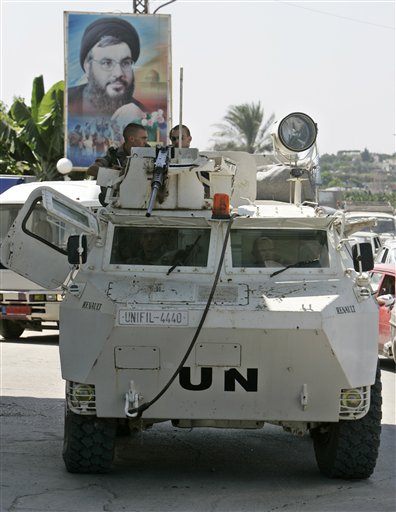 All is well, and there is nothing like a clear mandate granting sufficient powers to accomplish a mission. The problem, however, is that the so-called permission to use deadly force risks being employed only when Hezbollah is seen as a threat. I find it extremely difficult to imagine that UNIFIL members would dare confront Israeli forces in Lebanon. Not only is the IDF orders of magnitude more efficient and better-equipped than the sum of the UNIFIL deployment, but the diplomatic fallout of a military exchange between a UN force and Israel would have overwhelmingly deleterious consequences for the mission, of which the death of UN officials would only be the beginning. Can we really expect, say, Nepalese soldiers attempting to stop an Israeli F-16 from bombing a village in southern Lebanon? As history has shown, the Jewish state has no compunction about targeting civilians or UN soldiers and will do so again if they are seen as preventing it from achieving its objectives. But any military action taken on the part of UNIFIL against Israel will echo back into the halls of UN headquarters in New York, where accusations of anti-Semitism will be directed not only at the country that used force but at the entire UN architecture, against which Israel has already launched many such accusations.
Increasingly, it's starting to look like UNIFIL 2.0 is being constituted not so that it can ensure stability in the region, but to please Israel and, perhaps, do its work on the ground. While the mandate does not currently request the forceful disarmament of Hezbollah, it sure is starting to look like this might be the next step. There is no certainty that a Hezbollah that sees UNIFIL to be but a pawn of Jerusalem (and Washington) will choose to live peacefully with it. Given the disparate nature of its constituents, there is no way UNIFIL could survive a guerrilla war with Hezbollah on Lebanese territory. Israel was unable to do so. Even the United States gets chills at night when it thinks back on what happened to its marines in the 1980s. What seems to have been accomplished is the textbook error, which the international community committed in the very same country in the 1980s, of taking sides. Whether they want to or not, the UN and contributing countries to UNIFIL will be expected to do Israel's bidding. This is a classic mistake, and it very well could be a deadly one.
What all this means for UNIFIL is that before it even has deployed, it already finds itself between a rock a and a hard place: confront Hezbollah in a war it cannot win, or face up to Israel, which it equally cannot afford. We therefore have a UN deployment, however muscular the UN mandate, whose only chance of "success" (however one defines it) is contingent upon the two sides respecting the ceasefire. Things are going to get ugly before they get better, of that this writer is certain.
Tuesday, August 22, 2006
Iran's Stubbornness Passes Through Iraq
Considering the historical belligerence between Iran and the United States, the Islamic Republic was surprisingly helpful in the U.S. invasion of Iraq. With few understandable exceptions, it stayed out of Iraq's internal affairs and refrained from adding—as it could easily have—complexity to an already difficult situation for American soldiers and diplomats in the country. (Though according to recent comments by Major General William B Caldwell and U.S. Ambassador Zalmay Khalilzad, this may be changing. As yet unconfirmed information indicates that Shiite groups may be receiving training in Iran and that the latter may be providing improvised explosive devices to groups in Iraq, all of which is believed by U.S. officials to be in response to Israel's attack upon Lebanon.) For nearly three years since the invasion, Tehran wisely stayed on the sidelines not because it faced the threat of a powerful military occupying its neighbor, but because its interests dovetailed with those of the U.S. A stable, somewhat democratic regime in Iraq was much more palatable to Tehran, mullahs and bellicose presidents alike, than whatever else could have replaced the Saddam Hussein regime.
 But now, with U.S. generals and President Bush beginning to admit that Iraq is going to hell and is teetering on the brink of a multi-faction civil war, Tehran is reconsidering its position. Given its proximity to Iraq, Iran certainly cannot afford to have a failed warring state as a neighbor. Hence, in the past months, its otherwise inexplicable resistance to the world community on the issue of nuclear power and enriched uranium. It is all set to announce, today, that it will not yield to the pressure of the international community to abandon its nuclear ambitions. The fact of the matter is, Tehran sees nuclear power, civilian or otherwise, as an indication of power and status. It needs this, along with a solid conventional military (it conducted short-range missile tests over the weekend) not only to deter the United States by threatening shipping lanes and oil in the region (or to destroy the state of Israel, as some believe it intends to do), but primarily to protect itself from the ramifications of a failed state next door. With hints within the U.S. administration that a substantial force reduction, or even a pull-out in the face of civil war, is not impossible, Tehran can only but accelerate whatever program it has to secure itself.
This isn't as far-fetched or irrational as it seems. Let us imagine for an instant that Canada, or Mexico, is on the brink of civil war. To this we add borders that are far more porous (despite what some Washington officials and media figures claim) than the current existing borders, through which people and weapons can be smuggled. Add also people of similar religious beliefs and put them in an unstable region. What would Washington do—reduce its forces? Of course not. Rather, it would arm itself so as to better protect itself from the unfolding chaos next door.
After the Iran-Iraq War, Iran never really had a chance to refurbish or modernize its U.S.-made military, most of which was purchased when the Shah, an ally of Washington, was in power. Facing sets of sanctions and isolation, Iran turned to former Soviet states to obtain armament, but it didn't have the financial means to completely modernize its army. Facing a crisis next door and unable to consolidate a conventional military force that can meet this challenge with assurance of success, it will turn to the power of nuclear deterrence. Despite its far better understanding of its neighbor than the U.S. (and the rest of the world) will ever be able to attain, even Iran is unable to see far enough into the future to determine what kind of regime would emerge from a civil war in Iraq. Given its long history of persecution (at times real; at times imagined) at the hand of foreigners and the still-fresh wounds of Saddam's invasion in the 1980s, during which course chemical weapons were used liberally, it is no wonder that Tehran would look at the possible futures with a tinge of apprehension. What if whatever leader emerged from an Iraqi civil war were as terrible a tyrant as Saddam? What if he were twice the dictator, inspired by religious zealotry or backed by other Sunni players bent on removing the Shiite "threat" once and for all?
In its refusal to abide by the demands of the international community, Iran may be mostly protecting its interests. Perhaps diplomats ought to start taking Iran's security into consideration. It doesn't exactly live in the most stable neighborhood.
Considering the historical belligerence between Iran and the United States, the Islamic Republic was surprisingly helpful in the U.S. invasion of Iraq. With few understandable exceptions, it stayed out of Iraq's internal affairs and refrained from adding—as it could easily have—complexity to an already difficult situation for American soldiers and diplomats in the country. (Though according to recent comments by Major General William B Caldwell and U.S. Ambassador Zalmay Khalilzad, this may be changing. As yet unconfirmed information indicates that Shiite groups may be receiving training in Iran and that the latter may be providing improvised explosive devices to groups in Iraq, all of which is believed by U.S. officials to be in response to Israel's attack upon Lebanon.) For nearly three years since the invasion, Tehran wisely stayed on the sidelines not because it faced the threat of a powerful military occupying its neighbor, but because its interests dovetailed with those of the U.S. A stable, somewhat democratic regime in Iraq was much more palatable to Tehran, mullahs and bellicose presidents alike, than whatever else could have replaced the Saddam Hussein regime.
 But now, with U.S. generals and President Bush beginning to admit that Iraq is going to hell and is teetering on the brink of a multi-faction civil war, Tehran is reconsidering its position. Given its proximity to Iraq, Iran certainly cannot afford to have a failed warring state as a neighbor. Hence, in the past months, its otherwise inexplicable resistance to the world community on the issue of nuclear power and enriched uranium. It is all set to announce, today, that it will not yield to the pressure of the international community to abandon its nuclear ambitions. The fact of the matter is, Tehran sees nuclear power, civilian or otherwise, as an indication of power and status. It needs this, along with a solid conventional military (it conducted short-range missile tests over the weekend) not only to deter the United States by threatening shipping lanes and oil in the region (or to destroy the state of Israel, as some believe it intends to do), but primarily to protect itself from the ramifications of a failed state next door. With hints within the U.S. administration that a substantial force reduction, or even a pull-out in the face of civil war, is not impossible, Tehran can only but accelerate whatever program it has to secure itself.
 This isn't as far-fetched or irrational as it seems. Let us imagine for an instant that Canada, or Mexico, is on the brink of civil war. To this we add borders that are far more porous (despite what some Washington officials and media figures claim) than the current existing borders, through which people and weapons can be smuggled. Add also people of similar religious beliefs and put them in an unstable region. What would Washington do—reduce its forces? Of course not. Rather, it would arm itself so as to better protect itself from the unfolding chaos next door.
After the Iran-Iraq War, Iran never really had a chance to refurbish or modernize its U.S.-made military, most of which was purchased when the Shah, an ally of Washington, was in power. Facing sets of sanctions and isolation, Iran turned to former Soviet states to obtain armament, but it didn't have the financial means to completely modernize its army. Facing a crisis next door and unable to consolidate a conventional military force that can meet this challenge with assurance of success, it will turn to the power of nuclear deterrence. Despite its far better understanding of its neighbor than the U.S. (and the rest of the world) will ever be able to attain, even Iran is unable to see far enough into the future to determine what kind of regime would emerge from a civil war in Iraq. Given its long history of persecution (at times real; at times imagined) at the hand of foreigners and the still-fresh wounds of Saddam's invasion in the 1980s, during which course chemical weapons were used liberally, it is no wonder that Tehran would look at the possible futures with a tinge of apprehension. What if whatever leader emerged from an Iraqi civil war were as terrible a tyrant as Saddam? What if he were twice the dictator, inspired by religious zealotry or backed by other Sunni players bent on removing the Shiite "threat" once and for all?
In its refusal to abide by the demands of the international community, Iran may be mostly protecting its interests. Perhaps diplomats ought to start taking Iran's security into consideration. It doesn't exactly live in the most stable neighborhood.
Friday, August 18, 2006
Strange War, Strange Peace
The 34-day assault of Israel against Lebanon stuns by the lack of objectives that have been achieved. What ostensibly began as a result of the abduction of two soldiers—though it should be said that unlike what the media claims this was not the cause of the conflict but rather the spark—turned into a month-long aggression of a modern and well-equipped army against mostly undefended civilians. The only real battles occurred towards the end after Israel had deployed troops on the ground, where the soldiers met the fierce resistance of Hezbollah fighters. This was a war in which the military forces of the country being invaded stood by, but some of whose soldiers were nevertheless killed by the invader, while others were held against their will by Israeli forces, in their own country, "for their own safety." This also was a war where all the architecture of international law that exists to prevent savage aggressions against civilians failed the people it was intended to protect. Meanwhile, the world stood by, bickering on words, resolutions and meanings of ceasefires but ultimately did nothing to prevent the carnage. Peace-loving democracies like Canada called the response "a balanced one" and started using dehumanizing language of the sort that characterized the worst genocidal regimes in history. This was a war upon whose so-called conclusion all sides claimed victory: Israel claimed that it had sufficiently weakened Hezbollah by killing 400-500 of its members; Hezbollah, for its part, has but confirmed about 100 of them and has gained a popularity it could not have dreamed of, with its leader Hassan Nasrallah turning into a modern "Che" for the Muslim world. The United States joined in, contending that Hezbollah had clearly been defeated. This was a war whose main objectives were the freeing of the two captured soldiers and the destruction of rockets and launch sites used by Hezbollah to attack northern Israel. The soldiers are still in captivity, and after 34 days of Israeli bombing, Hezbollah was able to fire its most intense volley in a single day. This was a war that allegedly had been launched to assist a fledging democracy in Lebanon but whose outcome has left the democratic elements in such a weakened state as to threaten their very political survival. The war so damaged the infrastructures of state (estimated at 3.6 billion, with 15,000 homes) that groups like Hezbollah, which have a good history of providing social assistance, will carry the brunt of the reconstruction—so much so, in fact, that already the U.S. is trying to speed up the aid process to avoid that becoming a reality. Already, Hezbollah has begun handing out cash to families whose homes were destroyed by Israel. This war ended with a ceasefire in which the side committing aggression reserves the right to use force to prevent the other side from rearming (and did Saturday), as open-ended an interpretation of a ceasefire as has ever been allowed to fly.
 Then, after weeks of trying to come up with a ceasefire document with which all sides could agree, overt hostilities stopped. Israeli gradually pulled out of southern Lebanon, to be replaced by the Lebanese army. A major component of the ceasefire—and the main reason why Israel agreed to it—was the deployment, within fifteen days, of a well-armed multinational force under UN mandate. France, the former colonial power in the region, was expected to be a major contributor and to take the lead.
But now, less than a week after the guns went silent, the first cracks in the multinational deployment are already appearing. Most likely haunted by what happened to outside forces in Lebanon in the 1980s, it now appears that nobody wants to commit troops to go into Lebanon. Given that, should hostilities resume, such forces would not only be caught in the crossfire but would also be subjected to the all-too-possible occasional Israeli accident, this reluctance is quite understandable. So France has balked, saying that it will only add 200 engineers to the 200 UNIFIL soldiers it already has there. It also said that its 1,700 troops offshore would not come under UN command. Germany, another country that could play a major role in the crisis, has only offered border patrols and border agents, along with vessels to interdict arm shipments into Lebanon. Denmark has offered three ships while Bangladesh, Indonesia and Malaysia have each offered a battalion (600-800 troops). Now by no stretch of the imagination is math my forte, but how these contributions add up to 13,000 troops remains a mystery. We are perhaps on the brink of seeing the first invisible muscular peacekeeping deployment in history, a force that will secure a state not by deploying where it has to deploy, but by avoiding doing so. Let's call that virtual peacekeeping.
All along, the war of July 2006 in Lebanon has been a most unusual one. It is now starting to look like the peace will be perpetuating this Kafkaesque use of force.
The 34-day assault of Israel against Lebanon stuns by the lack of objectives that have been achieved. What ostensibly began as a result of the abduction of two soldiers—though it should be said that unlike what the media claims this was not the cause of the conflict but rather the spark—turned into a month-long aggression of a modern and well-equipped army against mostly undefended civilians. The only real battles occurred towards the end after Israel had deployed troops on the ground, where the soldiers met the fierce resistance of Hezbollah fighters. This was a war in which the military forces of the country being invaded stood by, but some of whose soldiers were nevertheless killed by the invader, while others were held against their will by Israeli forces, in their own country, "for their own safety." This also was a war where all the architecture of international law that exists to prevent savage aggressions against civilians failed the people it was intended to protect. Meanwhile, the world stood by, bickering on words, resolutions and meanings of ceasefires but ultimately did nothing to prevent the carnage. Peace-loving democracies like Canada called the response "a balanced one" and started using dehumanizing language of the sort that characterized the worst genocidal regimes in history. This was a war upon whose so-called conclusion all sides claimed victory: Israel claimed that it had sufficiently weakened Hezbollah by killing 400-500 of its members; Hezbollah, for its part, has but confirmed about 100 of them and has gained a popularity it could not have dreamed of, with its leader Hassan Nasrallah turning into a modern "Che" for the Muslim world. The United States joined in, contending that Hezbollah had clearly been defeated. This was a war whose main objectives were the freeing of the two captured soldiers and the destruction of rockets and launch sites used by Hezbollah to attack northern Israel. The soldiers are still in captivity, and after 34 days of Israeli bombing, Hezbollah was able to fire its most intense volley in a single day. This was a war that allegedly had been launched to assist a fledging democracy in Lebanon but whose outcome has left the democratic elements in such a weakened state as to threaten their very political survival. The war so damaged the infrastructures of state (estimated at 3.6 billion, with 15,000 homes) that groups like Hezbollah, which have a good history of providing social assistance, will carry the brunt of the reconstruction—so much so, in fact, that already the U.S. is trying to speed up the aid process to avoid that becoming a reality. Already, Hezbollah has begun handing out cash to families whose homes were destroyed by Israel. This war ended with a ceasefire in which the side committing aggression reserves the right to use force to prevent the other side from rearming (and did Saturday), as open-ended an interpretation of a ceasefire as has ever been allowed to fly.
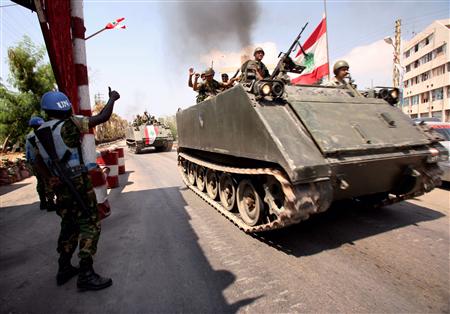 Then, after weeks of trying to come up with a ceasefire document with which all sides could agree, overt hostilities stopped. Israeli gradually pulled out of southern Lebanon, to be replaced by the Lebanese army. A major component of the ceasefire—and the main reason why Israel agreed to it—was the deployment, within fifteen days, of a well-armed multinational force under UN mandate. France, the former colonial power in the region, was expected to be a major contributor and to take the lead.
 But now, less than a week after the guns went silent, the first cracks in the multinational deployment are already appearing. Most likely haunted by what happened to outside forces in Lebanon in the 1980s, it now appears that nobody wants to commit troops to go into Lebanon. Given that, should hostilities resume, such forces would not only be caught in the crossfire but would also be subjected to the all-too-possible occasional Israeli accident, this reluctance is quite understandable. So France has balked, saying that it will only add 200 engineers to the 200 UNIFIL soldiers it already has there. It also said that its 1,700 troops offshore would not come under UN command. Germany, another country that could play a major role in the crisis, has only offered border patrols and border agents, along with vessels to interdict arm shipments into Lebanon. Denmark has offered three ships while Bangladesh, Indonesia and Malaysia have each offered a battalion (600-800 troops). Now by no stretch of the imagination is math my forte, but how these contributions add up to 13,000 troops remains a mystery. We are perhaps on the brink of seeing the first invisible muscular peacekeeping deployment in history, a force that will secure a state not by deploying where it has to deploy, but by avoiding doing so. Let's call that virtual peacekeeping.
All along, the war of July 2006 in Lebanon has been a most unusual one. It is now starting to look like the peace will be perpetuating this Kafkaesque use of force.
Monday, August 14, 2006
Fewer Cartoons, and No Horror
Starting on September 1, foreign cartoons will be banned from prime-time television in China. This is part of President Hu Jintao's campaign to promote "made-in-China" content and limit foreign influence in China. It also, hum, happens to dovetail with the views of the political masters in Beijing. The adventurous Astro and the cynical Simpsons will therefore be edged out by classics like Monkey King and others.
Beyond the cartoons, the state has also ordered local TV station to stop showing horror movies, and news anchors are now required to dress more conservatively. Funding for foreign-owned magazines is on the out, too. Of course, the whole operation has very little to do with protecting the Chinese animation (or news, or magazine) markets from outside influence. Rather, it continues a long, transparent tradition of censoring all types of materials, from literature to martial arts movies, that cast notions like resistance to the authorities and individual freedoms in a favorable light.
Of course, in the modern age electronic content is a very fluid thing which is almost impossible to monitor and control, and as the favorites are forced out of airtime, they will reappear in the numerous back stores and shady alleys that dot the country, or they will simply get downloaded off the web. Based on my own experiences in Kowloon, barring a complete crackdown on the night markets, there is nothing the state can do to prevent the proliferation of pirated foreign content from entering the country. Expect the ratings on Chinese TV to drop, though, as kids will continue to ask for their favorite Japanese cartoons and Hollywood horror flicks.
 Still, if I were Mickey Mouse or Pluto at the Hong Kong Disney, I'd tread carefully—especially now that the authorities have increased powers of intrusion. It'll be a very bad for democracy indeed when the famous mouse is jailed for attempting to overthrow the power in Beijing.
Come to Taiwan, oh Chinese, where the media offer not only a kaleidoscopic serving of all things Japanese, Korean and American, but also the freedom to say—and wear—what you want on TV. It's a no-holes-barred, unforgiving dog-eat-dog media environment, but at least it's a free one. Two cheers for Japanese manga, horror movies, and newscasts in short skirts!
Starting on September 1, foreign cartoons will be banned from prime-time television in China. This is part of President Hu Jintao's campaign to promote "made-in-China" content and limit foreign influence in China. It also, hum, happens to dovetail with the views of the political masters in Beijing. The adventurous Astro and the cynical Simpsons will therefore be edged out by classics like Monkey King and others.
Beyond the cartoons, the state has also ordered local TV station to stop showing horror movies, and news anchors are now required to dress more conservatively. Funding for foreign-owned magazines is on the out, too. Of course, the whole operation has very little to do with protecting the Chinese animation (or news, or magazine) markets from outside influence. Rather, it continues a long, transparent tradition of censoring all types of materials, from literature to martial arts movies, that cast notions like resistance to the authorities and individual freedoms in a favorable light.
Of course, in the modern age electronic content is a very fluid thing which is almost impossible to monitor and control, and as the favorites are forced out of airtime, they will reappear in the numerous back stores and shady alleys that dot the country, or they will simply get downloaded off the web. Based on my own experiences in Kowloon, barring a complete crackdown on the night markets, there is nothing the state can do to prevent the proliferation of pirated foreign content from entering the country. Expect the ratings on Chinese TV to drop, though, as kids will continue to ask for their favorite Japanese cartoons and Hollywood horror flicks.
 Still, if I were Mickey Mouse or Pluto at the Hong Kong Disney, I'd tread carefully—especially now that the authorities have increased powers of intrusion. It'll be a very bad for democracy indeed when the famous mouse is jailed for attempting to overthrow the power in Beijing.
Come to Taiwan, oh Chinese, where the media offer not only a kaleidoscopic serving of all things Japanese, Korean and American, but also the freedom to say—and wear—what you want on TV. It's a no-holes-barred, unforgiving dog-eat-dog media environment, but at least it's a free one. Two cheers for Japanese manga, horror movies, and newscasts in short skirts!
Subscribe to:
Posts (Atom)