Monday, August 23, 2010

Analysis: Taiwan’s debate on submarine expansion resurfaces

Amid mounting apprehensions surrounding the emergence of China as a major military power, defense experts continue to focus their attention on Washington’s reluctance to sell Taipei advanced combat aircraft. A small group of military specialists, however, argues that another long-neglected system could prove a superior deterrent to Chinese aggression: submarines.
For almost a decade, the issue of submarines has been subject to the political vagaries of the triangular relationship between Taipei, Washington and Beijing, as well as disagreement over their utility and high cost.

Mark Stokes, executive director at the Project 2049 Institute, is a strong proponent of submarines for Taiwan.

“The key thing about submarines is their inherent stealth and potential lethality,” he told the Taipei Times. “They represent one of the few capabilities that would be difficult to take out in a first, disarming first strike, especially if on patrol.”

According to most scenarios, a Chinese attack on Taiwan would open with missile salvos against Taiwan’s military targets, including airfields and command-and-control centers.

This analysis, published today in the Taipei Times, continues here.

Sunday, August 22, 2010

Book Review: China’s journalists find chinks in the state’s armor

Watchdog journalism has flourished in China over the past decade as reporters and editors risk their careers and sometimes their lives to expose official corruption and government malfeasance

Despite strong control of information by the state, the characterization of Chinese journalism as invariably propagandistic and uncritical of the authorities is an unfair one. For a minority of reporters, watchdog journalism is their raison d’etre, a calling that forces them to play a constantly shifting game of cat-and-mouse with the state apparatus and corrupt local politicians who, more often than not, are the object of their reportage.

This noble tradition finds its roots in baogao wenxue (報告文學), or reportage literature, which artfully blends fact and fiction to expose actual events. One of the pioneers of the genre was the China Youth Daily’s Liu Binyan (劉賓雁), whose stories exposing injustice in the 1950s earned him the designation of “rightist” and landed him in a re-education camp until the late 1970s. Only during the period of soft liberalization in the 1980s, however, did investigative journalism in a form recognizable to Western news consumers emerge in China, especially after then-premier Zhao Ziyang (趙紫陽) in 1987 incorporated the term yulun jiandu (輿論監督), which literally means “supervision by public opinion,” into his annual report to party leaders.

This form of journalism is the subject of Investigative Journalism in China, which explores eight cases of watchdog journalism as told from the perspective of the prominent reporters themselves, who were invited to the Journalism and Media Studies Center at the University of Hong Kong to share their experiences.

This book review, published today in the Taipei Times, continues here (html) and here (pdf).

Thursday, August 19, 2010

Taiwan caught in the middle as US, Japan to hold exercise near Diaoyutais

The Yomiuri Shimbun today reported that Japan and the US were planning to hold joint naval exercise near the disputed Diaoyutai (釣魚台, Senkaku in Japanese) Islands later this year. Citing unnamed sources, the paper said the US Seventh Fleet would participate in a scenario involving Japan recapturing an unnamed remote southwestern island from an enemy.

Japanese fighter and patrol aircraft, as well as 250 paratroopers from cargo planes guarded by F-15 fighters, will also be involved in the drill in Oita Prefecture, near Okinawa.

This announcement, though the Japanese defense ministry has yet to confirm it, points to a shift in US posture in the Asia Pacific. Not only does it come on the heels of a US Department of Defense report on the Chinese military threat, but the exercise will be held in an area close to a chain of islands contested by Japan, China and Taiwan, and away from the traditional exercises to Japan’s east, in the Pacific Ocean.

This is a shift inasmuch as it reinvigorates the US-Japanese security alliance after nearly a decade of neglect. The timing of the announcement, soon after a series of exercises with the South Korean navy in the Sea of Japan, points to US re-engagement with its traditional allies in the region. It also clearly places China, whose naval ambitions appear to be expanding, as the main enemy, and will most assuredly exacerbate fears in Beijing that it is being “boxed in.”

Where things become less clear-cut, however, is Taiwan’s position in the equation. There is no doubt that the US’ reaffirming who it would side with during conflict over the Diaoyutais is based on hard political calculations and that Taiwan, which has a claim of its own over the islands, is an afterthought in Washington. We can expect that the Ma Ying-jeou (馬英九) administration, along with the lunatic, China-funded Chinese Diaoyutai Defense Association, will go through the motions and express nationalist anger at this latest development, but at the end of the day, the US has little time for them: The principals are Japan and China.

In a way, this could be construed as a sign that Washington has abandoned Taiwan to the Chinese camp — something that would not have happened under the Chen Shui-bian (陳水扁) or Lee Teng-hui (李登輝) administrations, which could even have sought (albeit with little chance of success) to participate in the exercise. There is a very real risk, depending on how Taipei responds to the situation, that the exercise will push Taipei further into Beijing’s sphere of influence. Whereas the line used to be drawn in Taiwan, we may be experiencing the consolidation of a fallback that is now clearly defined in the area near the Diaoyutais and Okinawa. This could be a way for Japan and the US of ceding territory to strengthen their rear, part of a strategic readjustment that began with Japan’s redrawing in June of its Air Defense Identification Zone (ADIZ) from Yonaguni Island westwards, about 500km out at sea from Okinawa and 110km from Taiwan.

At this writing, Taipei had yet to respond to the announcement.

Cambodia nixes Taiwan trade office over ‘one China’

President Ma Ying-jeou’s (馬英九) promise that China would be more amenable to Taiwan inking free-trade deals or integrating with other regional economies after signing the Economic Cooperation Framework Agreement (ECFA) was put into question after reports revealed that Cambodia turned down a request by Taipei to open a representative office because of Phnom Penh’s “one China” policy.

The Phnom Penh Post last week quoted Cambodian Prime Minister Hun Sen (seen above, left, with Chinese President Hu Jintao) as saying that Taiwan could not establish a trade office in Cambodia because the country abides by the “one China” principle, prompting the Ministry of Foreign Affairs (MOFA) on Aug. 11 to issue a statement emphasizing the Republic of China’s status as a sovereign and independent country.

Any Cambodian official departing from the “one China” policy and seeking to allow Taiwan to open a representative office would be dismissed, the Post said.

As Taiwan seeks to sign trade agreements with regional economies — especially ASEAN members — opening trade offices constitutes a crucial step toward achieving this goal.

This article, published today in the Taipei Times, continues here.

Monday, August 16, 2010

Enough with words, a call to action

The pages of this newspaper [the Taipei Times] and other liberal publications are filled with beautiful slogans about the need to “protect” Taiwan based on lofty principles such as democracy, justice and human rights. Commendable as these prescriptions may be, in and of themselves they are impotent in the face of the present challenges confronting this nation.

Although the intentions of the opinion writers who propose such measures are undoubtedly honorable, their prose often lacks the rigorous intellectual inquisitiveness that would give them true meaning, leaving us with little more than a constellation of presumptuous abstracts. In fact, more often than not, the ideals they espouse are at best a means to contrast what the authors are trying to protect with the entity that poses the most formidable threat to it — China.

However, using words to describe what China is not is hardly the kind of call to action that will ward off the threat to Taiwan’s continued existence.

An understanding of the opponent makes this abundantly clear. Sloganeering doesn’t gain traction with the Chinese Communist Party and the politicians and business leaders in Taipei who seem inclined to be co-opted by the Chinese. It doesn’t move, sway or frighten them.

This op-ed, published today in the Taipei Times, continues here.

Tuesday, August 10, 2010

We are doomed

Car-free initiatives have become trendy in cities worldwide trying to sensitize the population to the environmental damage caused by motorized vehicles. Taipei, like many other major cities, participated in that initiative, doing so for the first time in 2008.

This year’s month-long series of activities will begin on Monday, with a festival and various promotions encouraging use of public transportation touted by the city government. However, in announcing the activities today, the authorities said that to avoid inconveniencing the public during the car-free day on Monday, the department of transportation would … not close roads to traffic, meaning that car-free day will be anything but car free.

Undeniably, car-free days in busy metropolises is always inconvenient, but isn’t that the whole point? Without hassle, without inconvenience, we simply go on with our highly polluting and highly destructive lives, unaware that this very insouciance is taking our fragile habitat closer to extinction, one particle per million of carbon dioxide at a time.

Short-lived inconvenience now, if it serves to educate us about the impact of our rapacious behavior, is far more desirable than the (likely permanent) inconvenience that awaits us years hence when we’ve passed the tipping point.

Monday, August 09, 2010

Media wars

Officials at the US-based Freedom House on Monday [early May] denied the watchdog was angry at the Liberty Times over its coverage of a draft report on press freedom in Taiwan released last week.

Want Want China Times Group’s CtiTV on Saturday accused the Liberty Times of “politicizing” the report in a front page article on Friday, in which it provided excerpts both in the original English version and a Chinese translation. The Chinese-language Apple Daily also ran a story on the report, as did the Taipei Times and Agence France-Presse.

Singling out the Liberty Times, CtiTV’s Washington correspondent Zang Guohua (臧國華) alleged that the Freedom House was “not happy with the paper after it used the report as a tool for political battle” and implied that the Liberty Times had overemphasized concerns raised by Freedom House over possible changes in the editorial line at the China Times following the takeover by Want Want Group in November 2008.

Zang’s report included excerpts of an interview with Karin Karlekar, managing editor of the “Freedom of the Press Survey” at Freedom House, in which she said of the Liberty Times article: “It is very troubling. We’re trying to describe a situation as best we can and raise issues of concern, but it is annoying to be used like this as part of a bigger political battle.”

In a telephone interview with Sarah Cook, the researcher who wrote the section of the report on Taiwan, Zang asked her if she had spoken with Want Want chairman Tsai Eng-meng (蔡衍明).

"No,” Cook said.

Pressed as to whether she had spoken with anyone else at the China Times, she said she preferred not to go into details of the sources used to write the report.

Asked about the CtiTV report on Monday, Freedom House officials said they were quoted out of context.

Moreover, while they denied having any major problems with the coverage given to the report by the Taipei Times or the Liberty Times, they repeated general editorial “concerns” about the China Times.

In separate telephone interviews from their New York offices, however, Karlekar and Cook both stressed there had been no major decline in press freedom in Taiwan.

Cook sent copies of her draft report on Taiwan to some newspapers last month, but the final report is not expected until next month.

“We have released draft reports for years. In past years, as happened this year, the media has wanted to pick up quotes from the draft report and we don’t have a problem with that," Karlekar said.

“The date of publication by the Liberty Times and the Taipei Times was not an issue at all. They published after the embargo, there was no problem," she added.

“The only trouble I had with the Liberty Times was that it wasn’t mentioned this was a draft report. And it seems that the bits concerning the China Times were the main bits that were quoted. I would be troubled if they were trying to imply the China Times was the reason for a big decline in press freedom,” she said.

I tried to make it clear there had not been a big decline in press freedom in Taiwan. The score remained almost the same as last year. The reason for any deterioration was not particularly the China Times. It was a pretty big report and the China Times was only one part of the report,” she said.

Moving on to the CTiTV program in which she was interviewed on camera, Karlekar said: “I have just looked at the CTiTV report and the bits that are in English are pretty selective. They must have had me on camera for about 45 minutes and so it was pretty easy for them to pull out the few bits that they felt would help them, that would help their story the most.”

“What I was trying to say, what I did say during the interview, was that I was not the person writing the report, that I was not sure what evidence they had, or did not have, of a change in editorial policy at the China Times. But we had contact with a number of sources and some of them had raised this as an issue,” she said. “That is why it was in the report as being a continuing issue of concern — that is, a potential change in editorial policy at the China Times. It’s not that we had hard evidence of it or that we had done content analysis, but some of our sources had raised this as an issue. And statements made by the head of the China Times group also raised concern and had become an issue.”

Karlekar said that while no major changes were expected in the final report on Taiwan, comments and criticism of the draft report would be taken into consideration.

Cook, who has visited Taiwan on a number of recent occasions, said that the China Times did not receive a copy of her draft report because “I had a contact at the China Times, but for some reason whenever I followed up with that person to send them drafts or information, I never received a response.”

"In the end I sent the draft to the Taipei Times and to a range of people that I know are interested in these issues. I feel badly that it seems there was some kind of discriminatory act here, but it was very much unintentional,” she said.

On the CTiTV interview, Cook said: “We do feel that there was some misleading, misquoting, out-of-context use of what we had said in the TV interview.”

“When I sent the draft to the Liberty Times and the Taipei Times, I had every intention that they would be able to quote it as it is and other than the fact that it could have been emphasized a little bit more that this was a draft report I don’t think we have serious concerns about the way it was covered,” she said.

“It was a fairly fair portrayal of the content of the report,” she said.

She said that Freedom House hoped that news stories about the draft report on Taiwan would emphasize the reasons for the small decline in press freedom over the last year.

“The reasons for the decline were circumstances other than the specific example of the China Times. And from that perspective the Taipei Times article was more even handed and reflective of what we would have liked to have gone out than the Liberty Times. They emphasized more of the China Times angle and that — in terms of the numerical scores and stuff like that — wasn’t something that contributed to the decline,” she said.

"Before the final report comes out, there will be more fact checking, she said, but “our intention is to put out in the public domain what we see as being an accurate reflection of the analysis we have done and not to change it one way or the other because it may upset particular individuals or entities,” she said.

We talked to a range of different people and looked at a range of different sources of information, including the comments that the owner of the China Times made himself to the media. Comments like that, coming from the owner of a media outlet, raise eyebrows,” Cook said.

“That was part of it, but there were other issues relating to the actual content of the newspaper and concerns that people were raising. Part of it was that concerns were being raised and we don’t have the resources at the moment to do a thorough content analysis," she said. “But we do feel it is important. We did not go in looking to raise concerns about the China Times. But when there are comments like that, and you have some of the other concerns expressed, and some of the other incidents that occurred during the year, we felt it was very important to reflect that. Again, it was concerns and not necessarily conclusive,” Cook said.

This article, scheduled for publication sometime in May, was eventually cancelled.

Sunday, August 08, 2010

In one fell swoop, Ma dispenses with the PRC

Based on recent comments by President Ma Ying-jeou (馬英九), it would seem that the cross-strait “diplomatic truce” he initiated soon after coming to office either enfeebles the mind, or cannot be explained by anything other than contradictions.

During a roundtable on Monday, Ma was all wisdom when, channeling ancient Chinese philosopher Mencius (孟子), he said the best means by which two countries can get along was for the smaller country to be smart and flexible in dealing with the bigger one.

By smart, we can conclude that Ma meant keeping a low profile, being conciliatory and willing to compromise and not rattling the diplomatic cage — all things that his administration has managed with considerable success.

Just as the churning waters in the Taiwan Strait looked like they might be pacified by Ma the wise, however, the president on Wednesday told visiting Japanese academics that the Economic Cooperation Framework Agreement (ECFA) signed in late June was not a treaty signed between two states. The reason?

“We do not recognize China as a state, so our relationship with each other is not one of country-to-country,” Ma said.

So in Ma’s alternate universe, former presidents Lee Teng-hui (李登輝) and Chen Shui-bian (陳水扁) — who both recognized the existence of the People’s Republic of China (PRC) as a sovereign state — were “troublemakers,” and yet the man who would deny Beijing’s legitimacy, and the government of its 1.3 billion people, is somehow a “peacemaker.”

Only in the hallucinatory world of Ma’s cross-strait politics could insulting the larger neighbor by denying its existence be equated with wisdom and peacemaking.

This op-ed, published today in the Taipei Times, continues here.

Friday, August 06, 2010

Preserving the ROC Air Force’s rich history

As my latest article in the Taipei Times indicates, we have good reason to worry about the ability of Taiwan’s military to ward off an invasion by the People’s Liberation Army (PLA), which, according to the findings of the Ministry of National Defense’s latest computer simulation, would only require three days to occupy Taipei, command-and-control centers and the Presidential Office.

This development stems from three principal reasons: the PLA’s rapid modernization in the past decade; the long delays (caused by a KMT-controlled legislature) in arms acquisition by Taipei during the Chen Shui-bian (陳水扁) administration; and Washington’s unwillingness, under both George W. Bush and Barack Obama, to provide Taiwan with the advanced weapons systems it needs to maintain the balance of power in the Taiwan Strait. A fourth, albeit more recent, development is the lack of military preparedness under the Ma Ying-jeou (馬英九) administration, which, as I point out in my article, has cut military budgets by as much as US$1.2 billion in the past two years, toned down live exercises, and made nature, rather than China, the military’s principal opponent.

Dispiriting as the situation may be, Taiwan’s military wasn’t always in such a pitiful state and has a fascinating history that spans attempts, under Chiang Kai-shek (蔣介石), of retaking the “mainland,” to ensuring superiority in the Taiwan Strait. The modernization of Taiwan’s military, which for decades kept Taiwan safe, would not have been possible without US assistance and the role played by individuals such as the legendary Claire Chennault (seen right).

This rich history is well captured at the Republic of China (ROC) Air Force museum that is being built in Kaohsiung under the supervision of Major General Mike Tien (田在勱). I had the good fortune of visiting the partially open museum last week, at the invitation of the ROC Air Force, which flew about three dozens journalists in a Hercules C-130 (lots of leg room, though very noisy) from Songshan Air Force Base to Kaohsiung  last Friday.

While the museum, whose main building is under development, will not be open for another two years, it already has, for public scrutiny, a cornucopia of Air Force memorabilia, from historical pictures, badges, documents, statues and many other items, many of which were donated to the museum by Maj. General Tien. While this alone makes this well worth visiting, the open-sky museum, a tour of which Mr. Tien and other Air Force officers were kind enough, in the crushing heat, to give me and Defense News’ Wendell Minnick, makes a visit even more worthwhile. Aside from retired ROC aircraft, which include F-104 Starfighters and a variety of spy and transport airplanes, the museum also has the actual MiG aircraft that were flown by defecting PLA Air Force pilots across the Taiwan Strait, as well as North Korean MiG that was seized years ago, in pieces, on board a cargo ship and pieced back together  for the museum.

Interestingly, the museum is open the Chinese tourists, though, as one officer told us, there is no knowing what Chinese think when they see their MiGs, 八一 emblem with the Red Star (8-1 stands for Aug. 1, 1927, the year the PLA was created following the Nanchang uprising) and all. Chances are they’ve never heard of such a thing as a PLA defector.

The well-respected Maj. Gen. Tien, who as I was leaving could not help but give me wise advice (“remember, always write good things about the Air Force”), is hard at work trying to obtain a variety of retired aircraft from the US Air Force, including a U-2 spy plane. Should he succeed, the fully completed museum should be a must see when it officially opens two years hence.

Sadly for us, the clouds were too low for the scheduled AT-3 trainer aircraft show, which, though it would have been the highlight of the visit down south, had to be canceled for safety reasons.

Now the question is, amid signs that the Taiwanese military is losing steam and becoming increasingly irrelevant in the face of a growing threat across the strait, can Ma (and the US) ensure that the long, rich tradition highlighted in the museum is maintained, and that the sacrifices made by the dedicated men and women who people its history were not made in vain?

Thursday, August 05, 2010

Three days is all it would take the PLA

The latest computerized scenario carried out by the military showed that in a war with China, Taipei would be occupied by enemy forces in just three days, a magazine report said yesterday.

Last month’s simulation, attended by President Ma Ying-jeou (馬英九), came amid warnings that China was expected to increase the number of its missiles aimed at Taiwan by several hundred to more than 1,900 by the end of this year. These include ballistic missiles, cruise missiles and other weaponry deployed throughout China.

Under the scenario, which assumed war at next year’s force levels, the People’s Liberation Army (PLA) launched intensive air raids on Taiwan before sending in ground troops from the sea and air, the Chinese-language Next Magazine reported.

The drill found that Chinese troops could march into Taipei on the third day of hostilities, seizing control of top military command facilities and the Presidential Office, Next said, quoting unnamed sources.

The results were a severe blow to Ma’s goal of building “solid defense and efficient deterrence” with a small but elite army, the magazine said.

During his presidential campaign, Ma vowed to build a stronger military as a deterrent against aggression by Beijing. Under Ma’s plan, Taipei has worked to achieve an all-volunteer force, but this will come at great cost to the defense budget, which is set at US$9.3 billion this year, a 6.9 percent drop from last year’s US$9.6 billion and US$10.5 billion in 2008.

The military must also cope with a number of aging defense systems that are due for refurbishing or replacement, including its F-16A/B fighter aircraft.

The Ministry of National Defense dismissed Next’s report.

This article, published today in the Taipei Times, continues here.

Tuesday, August 03, 2010

KMT makes a mockery of free media

The Chinese Nationalist Party (KMT) confirmed on June 23 that Broadcasting Corporation of China (BCC) chairman Jaw Shaw-kong (趙少康) — founder of the pro-China New Party — was joining its team of campaign advisers and image experts ahead of the crucial November municipal elections.

Jaw, we have learned, was invited by KMT Secretary-General King Pu-tsung (金溥聰), a spin doctor who serves as the clearest evidence that, despite claims to the contrary, the KMT continues to extend tentacles in the media — both to grab its profitable assets and to control information.

A bit of history is in order to demonstrate how incestuous the relationship between the KMT and the media remains, even after years of alleged divestment.

Amid a program under the Democratic Progressive Party (DPP) administration to end influence by political parties and the military in the media, in 2005 BCC (formerly a KMT-owned radio station) was privatized and sold to Jungli Investment Co, a subsidiary of the China Times Group, a media conglomerate that, since it was acquired in November 2008 by Want Want Group chairman Tsai Eng-meng (蔡衍明), has adopted an unequivocally pro-China editorial line. In December 2006, the China Times Group sold BCC to UFO Radio, which is controlled by Jaw. (Unsurprisingly, both BCC and UFO Radio were strong supporters of Ma Ying-jeou (馬英九) during the presidential election, while far less wealthy stations tended to back the DPP.)

A mere three months after Tsai was acquiring the China Times Group, King was becoming chief executive officer of Next Media’s planned 24-hour news TV station, claiming that despite his close relationship with Ma — both as a campaign aide and former deputy Taipei mayor, among others — the TV station would provide “balanced” reporting on the Ma administration. Back then, King also vowed not to take a formal post with the Ma administration.

The decision to hire King as CEO was Next Media founder Jimmy Lai’s (黎智英), whose group lost the bid to acquire the China Times Group to Tsai’s Want Want. (Rumor has it that it was Lai who also arranged for King to get a six-month visiting professorship at Hong Kong University in the summer of 2008, which served as cover for King to do “underground” political work for Ma.)

Ten months later, in December last year, the National Communications Commission was rejecting Lai’s bid for a news channel in Taiwan. Within the same 24-hour period, the KMT was confirming that King was taking over as party secretary-general.

Since the KMT came back into power in 2008, it has faced numerous accusations of interference in the media, from personnel changes at Radio Taiwan International to the appointment of Joe Hung, a fellow at the National Policy Foundation — the KMT’s think tank — as chairman of Central News Agency. Half of Public Television Service’s (PTS) US$38 million budget was frozen by the KMT-controlled legislature in 2008, just as the party was considering increasing government influence over its programming.

The problems PTS has run into present a particularly worrying case and actually began two years prior to the KMT’s return to power, when the station became part of the Taiwan Broadcasting System (TBS), which also included the recently privatized Chinese Television System (CTS), formerly a KMT-owned media outlet. Around that time, a famous KMT legislator (who shall remain unnamed) was unashamedly telling a senior official at PTS that the KMT was just bidding its time and expected to regain control, if indirectly, of CTS and its prized assets (including valuable land), once the KMT came back into office.

On Jan. 1 the following year, Hakka Television, Taiwan Indigenous Television and Taiwan Macroview Television merged to form TBS. Under KMT pressure since 2008, not only did PTS see its government funds frozen by the legislature, but it also had to divided its now very limited resources to also ensure the operations of the other entities that now formed TBS.

In the past year or so, the PTS board has been attacked and intimidated by the KMT, often with the help of the Government Information Office (GIO). This includes verbally assaulting PTS officials in the legislature after some of them made critical comments about the Ma administration at a media conference in France, suing seven PTS board members, and breaking the law by approving eight KMT/GIO-selected board members in a legislature that (a) was in recess, and (b) whose composition of judges no longer reflected the balance of power in the legislature after the KMT lost a series of seats to the DPP. Rather than select a new panel of judges, as required by law, the legislature claimed it could use the one from the previous legislative session. And it got away with it.

The legislature passed an amendment to the Public Television Act (公共電視法) in June increasing the number of PTS board members, a move that was largely seen as an attempt by the government to increase its influence on PTS. Only an injunction by acting chairman Cheng Tung-liao (鄭同僚) halted the appointment of the eight board members and that of his likely replacement, the KMT’s hand-picked Chen Shih-min (陳世敏), a former colleague of King at National Chengchi University. So problematic was the whole process that the Control Yuan censured the GIO for what it said were problematic procedures involving the appointment of the eight members. Still, this didn’t prevent “acting chairman” Chen Sheng-fu (陳勝福) — head of the Ming Hwa Yuan Taiwanese Opera troupe and a strong supporter of the KMT, whose wife, opera diva Sun Tsui-feng (孫翠鳳), was tapped by the KMT as a potential spin-spokesperson for the Economic Cooperation Framework Agreement (ECFA) — from showing up in court with a mere “note of acknowledgment” (hardly a legal document) from the GIO to have the injunction against the eight (including himself) lifted. The executive letter was stamped, but PTS allegedly never saw it (as a “goodwill” gesture, the GIO injunction against the six original board members was also lifted so that the internecine-stricken board could resume its work).

Not only does this point to the judiciary doing the KMT’s bidding in facilitating the party’s assault of free media, but the Control Yuan didn’t even lift a finger to stop the process.

A senior official at PTS who is very close to all this told me on condition of anonymity that the man behind all this is no other than King, whose cronies are either seeking to get PTS “on message” or to regain control of CTS assets. The official also said that under the DPP, PTS was very much left alone and allowed to operate as an independent broadcaster, as it should.

There is very little independent media left in Taiwan, and the little that remains is, like PTS, under assault. Equally worrying is the fact that the non-independent majority is developing increasingly close relations with government, with officials — like King and Jaw — effortlessly crossing from one side to the other and ensuring the interests of both in the process.

Late last month, reports emerged that an amendment that would scarp a seven-year ban on investments by political parties, government agencies and the military were making their way through the Executive Yuan. Early copies of the revision state that, if passed, the three groups could be allowed to indirectly own as much as a 10 stake in satellite TV broadcasters.

A clause, meanwhile, would prohibit public officials from holding management posts in the industry.

The amendment is believed to have passed a preliminary review by the Executive Yuan and would also need to be approved by the (KMT-dominated) legislature before coming into force.

KMT spokesman Su Jun-pin (蘇俊賓) said that as political parties, government and the military are different in nature, they should not be lumped together pertaining to their investment and management of media outlets.

KMT Legislator Justin Chou (周守訓) said he supported relaxing the regulations.

Note: For reasons that I will not discuss here, I have been unable to publish this op-ed in the Taipei Times.

Monday, August 02, 2010

Interview: Actor-producer brings Taiwan’s history to the big screen

Taiwanese-American Will Tiao, producer and actor in the political thriller ‘Formosa Betrayed,’ sat down with ‘Taipei Times’ staff reporter J. Michael Cole last week to talk about the political and philosophical underpinnings of the film and the threat from China.

Taipei Times: Given your parents’ experience of being blacklisted by the Chinese Nationalist Party (KMT) during the White Terror era, did they ever worry about your safety after you embarked on this project?

Will Tiao (刁毓能): Ever since I left Washington, my career in politics, to pursue a career in Hollywood, I told them I wanted to do something about this issue, with regards to this idea of there being a series of murders of Taiwanese intellectuals, some of them in the US … that there were student spies on almost every campus. I had always wanted to tell the story for an American audience. I knew it was part of my parents’ story. I made it clear from day one that this was something I wanted to do. My father especially said that if you’re going to do something for Taiwan, then I’ll support you.

Of course we knew that doing this movie was something that would be provoking and controversial. But we were always careful about not pointing fingers. Other than Chiang Kai-shek (蔣介石), no other historical figure is mentioned. Never in the film did we use the terms Kuomintang or waishengren (外省人); we don’t call out any specific person … Of course we were aware that this could cause — and obviously caused — a lot of consternation among certain people, but we were always careful not to keep this in the typical blue-green divide that deals with Taiwan.

My interview with Mr. Tiao continues here.

Interestingly, the interviewee also had a few things to say about our encounter last week:

The final interview of the day is with J. Michael Cole of the Taipei Times. I'm pleasantly surprised to find out that he is French Canadian, and we joke around for a bit in French much to the chagrin of the Chinese/Taiwanese speakers in the room who have no idea what we're saying! It turns out Mr. Cole has a very interesting history. He used to work for the Canadian version of the FBI — but was frustrated by the policies of his government. He met and fell in love with a Taiwanese woman, and they moved to Taiwan. Now, he is the Deputy News Editor for the Taipei Times, which is Taiwan's leading English language daily newspaper.

The Taipei Times has already done some interviews with me about Formosa Betrayed and done some news coverage about the film's release in North America. So Mr. Cole decides he wants to get into some of the more weighty political and philosophical issues that we tackle in the film. It's a fun and wide-ranging interview, different than most of the typical questions I get. We also give him some information that hasn't been made public up to now — about why we decided to film Formosa Betrayed in Thailand instead of Taiwan. You're going to have to read his story to find out why...

Sunday, August 01, 2010

Book Review: The great divide: Can Asia and the US work together?

The global economic crisis, added to missteps by the administration of former president George W. Bush, widened the space between the US and Asia in a process that could have far reaching implications economically and politically, Simon Tay argues in a timely new book.

My review of Asia Alone, The dangerous post-crisis divide from America, continues here (pdf) and here (html).

Saturday, July 31, 2010

Why 'Formosa Betrayed' wasn't filmed in Taiwan

Those who have already seen the movie Formosa Betrayed, which is scheduled for release in Taiwan on Friday, may have noticed that the actors’ accents, the locales and many of the characters didn’t look or sound “authentic.” The reason for this is very simple: The Taiwan scenes weren’t filmed here, but in Thailand.

However, the decision to shoot there, rather than where the political thriller is set, wasn’t entirely in the hands of the producers. In an interview with the Taipei Times in Taipei on Thursday, Will Tiao (刁毓能), one of the main actors and the producer of the film, suggested politics played a big part.

“What most people don’t know is that we came to Taiwan, we had casting sessions here and we wanted Taiwanese actors,” said Tiao, a Taiwanese-American.

However, the shadow of the giant market next door weighed heavily.

“A number of performers didn’t want to do this because they were afraid of what this would do to their careers in China,” he said. “We interviewed a number of actors and later would hear through their agent: ‘We read the script and we decided no, we’re not doing it.’”

Another issue with the Taiwanese performers who auditioned was that as the movie is primarily in English. Many of the actors weren’t fluent enough.

Those, however, were not the main reasons why the film wasn’t shot here.

The movie studio had turned to the National Development Fund (NDF), a Cabinet agency, for funding, a process that started in 2007, one year before shooting began and when Chen Shui-bian (陳水扁) of the Democratic Progressive Party was still in power.

This article, published today in the Taipei Times, continues here. The rest of my interview with Will Tiao will be published on Monday.

Friday, July 30, 2010

Fugitive dissident not done trying to re-enter China

One of China’s most wanted fugitives says he hasn’t given up trying to return to China and won’t relent in his efforts to pressure Beijing to democratize.

Wuer Kaixi, a prominent student leader during the 1989 Tian anmen Square protests, told the Taiwan Foreign Correspondents Club yesterday that despite two failed attempts, he would continue to try to re-enter China to visit his parents in Urumqi, Xinjiang, whom he hasn’t seen for 21 years.

Since Wuer Kaixi became a wanted “criminal” after the Tiananmen crackdown, his parents have been barred from leaving the country.

The dissident, who lives in exile in Taiwan, was turned back after attempting to enter Macau last year and was barred from boarding a flight from Tokyo to Beijing last month.

He was arrested by Japanese police and detained for two days after attempting to jump over a security gate to get into the Chinese embassy in Tokyo.

“I am now able to say I am a political dissident with jail experience — two days,” the 42-year-old said.

This article, published today in the Taipei Times, continues here.

Friday, July 23, 2010

PRC’s new rules could limit Chinese reports on Taiwan

New regulations by China’s Propaganda Department on provincial and metropolitan news media could have serious implications for investigative reporting and press freedom in the country, Reporters Without Borders (RSF) said on Wednesday — and could undermine the ability of Chinese media to obtain information about Taiwan.

The latest restrictions reportedly include a ban on exchanges of newspaper articles with media in other provinces, and a prohibition on media in metropolitan areas carrying their own reporting on national or international stories, or modifying the coverage of stories on such topics provided by state-owned media.

It remains to be seen if the regulations would apply to Chinese media operating in Taiwan.

At present, five regional Chinese media outlets operate in Taiwan. Reporters from Fujian SETV, the Fujian Daily, Xiamen TV, Hunan Television, the Shenzhen Special Zone Daily and the Shenzhen Economic Daily are posted here.

Five state-owned outlets — Xinhua news agency, the People’s Daily, China Network Television, China National Radio and China News Service — also have reporters filing from Taiwan.

If the regulations are applied to Chinese media operating in Taiwan, the regional media outlets based here could be barred from providing their reporting to media in Chinese provinces, or media in metropolitan areas could be prohibited from using reporting about Taiwan from sources other than state-owned media, such as Xinhua.

The new regulations also include a call to cease all negative reporting about the police and judicial authorities.

Hong Kong’s Ming Pao newspaper said the new regulations were implemented on July 1.

This story, published today in the Taipei Times, continues here.

Wednesday, July 21, 2010

Speakers nix PRC cyber warfare talk under pressure

Experts at a private Taiwanese security company decided to pull out of a security conference in Las Vegas after coming under what was described as pressure from Chinese and Taiwanese agencies.

Wayne Huang, chief technology officer and founder of Taiwanese security vendor Armorize Technologies, and Jack Yu, a researcher at the company, were scheduled to give a talk on Chinese cyber warfare capabilities at the Black Hat USA 2010 security conference, which will be held in Las Vegas on Wednesday and Thursday next week.

They said they decided to pull out last week after coming under pressure from several Chinese and Taiwanese agencies.

“The Chinese Cyber Army: An Archaeological Study from 2001 to 2010,” derived from information gathered from intelligence groups across Asia, had been advertised as an in-depth analysis of government-backed Chinese cyber espionage.

“Using facts, we will reconstruct the face of the Cyber Army, including who they are, where they are, who they target, what they want, what they do, their funding, objectives, organization, processes, active hours, tools and techniques,” the Black Hat Web site quoted the presenters as saying.

On Wednesday last week, Armorize chief executive officer Caleb Sima wrote on Twitter that the talk had been pulled because the “Taiwanese [government] is prohibiting it due to sensitive materials.”

Black Hat conference organizers yesterday confirmed to the Taipei Times that the talk had been cancelled, but refused to discuss the reasons why. 

This article, published today in the Taipei Times, continues here.

Sunday, July 18, 2010

'Tourist' may have been guided by PRC intel

Information has come to light that could indicate that a Chinese tourist who was caught in May last year taking photos in a restricted area of an army recruitment center in downtown Taipei may have been directed by Chinese intelligence.

On May 25 last year, Ma Zhongfei (馬中飛), a Chinese tourist who reportedly was chairman of a high-tech company, left his tour group at Taipei 101 and ended up at an Armed Forces recruitment center on Keelung Road, about 2km away from the landmark. After entering a computer warfare command area through a back door, Ma was caught by security taking photos in the computer warfare command area.

While the recruitment center is open to the general public, the computer warfare command area is a restricted facility.

After being apprehended by military police, Ma was handed over to the Taiwan High Prosecutors’ Office for investigation on suspicion of illegally intruding into a military area.

The following day, a prosecutor ordered Ma’s release and did not bar him from leaving Taiwan. The Ministry of Justice said it didn’t have sufficient evidence to indict him.

A former government official who handled intelligence matters under the former Democratic Progressive Party administration told the Taipei Times last week that the Ma case was far more alarming than it first appeared and hinted that political intervention may have played a role in the decision not to charge him.

This article, published today in the Taipei Times, continues here.

Monday, July 12, 2010

China corrupts, wherever it goes

As Chinese President Hu Jintao (胡錦濤) passed through the Canadian capital late last month ahead of the G20 meeting, there was yet another example of the nefarious influence the Chinese government is having on freedom of expression worldwide. Given Taiwan’s proximity to — and increasingly close ties with — the Asian giant, this latest development should serve as a warning.

While the great majority of state visits with world leaders in Ottawa conclude with a press conference, Hu’s didn’t. In fact, it has since been revealed that the office of Canadian Prime Minister Stephen Harper agreed to cancel the joint press conference to prevent critical Chinese journalists from participating. The Chinese embassy in Ottawa was reportedly concerned that the press conference would include reporters from two media organizations reviled by Beijing — the Epoch Times and New Tang Dynasty TV.

A few weeks prior to Hu’s visit, the Chinese embassy had reporters from those two organizations barred from attending the press conference. The request was first turned down by the parliamentary press gallery, on the grounds that the media organizations were full members of the gallery.

Not to be dissuaded, the embassy then went straight to the prime minister’s office. Initially, as the Globe and Mail reported, Harper’s office attempted to strike a compromise with the gallery. Facing principled opposition, Harper’s office decided to cancel the press conference altogether, sparking accusations from Helene Buzzetti, president of the parliamentary press gallery in Ottawa, that Harper had agreed to Chinese censorship.

This op-ed, published today in the Taipei Times, continues here.

Sunday, July 11, 2010

Telling the story

Years in the making and produced on a shoestring budget, Formosa Betrayed has already played in select theaters in the US and Canada. Starting on August 6, it will finally be playing in the country whose story it strives to bring to a wider audience — that of Taiwan.

This author had a chance to see the much talked-about movie on Friday at a pre-screening in Ximending. Some Taiwanese Americans had already told me that, ostensibly for budgetary reasons (the movie cost US$7 million, pocket change by contemporary Hollywood standards), the Taiwan scenes were actually filmed in Thailand. As a result, Taiwanese — along with expatriates who have lived in Taiwan long enough — can immediately tell that most actors and extras are Thai rather than Taiwanese, which is also reflected in how they speak. The same applies to the location, which anyone familiar with Taipei would tell you isn’t an accurate representation.

In the end, however, this doesn’t really matter. After all, big-budget movies have also, albeit for different reasons, used people from another ethnic group, and different locales, to tell “historical” stories. Chinese actress Zhang Ziyi playing a Japanese geisha on a set in California is a perfect example of this.

What makes Formosa Betrayed work as a movie is that it is actually quite entertaining, has very few longueurs and flows well. It makes good use of non-linear storytelling and foreshadowing. Furthermore, the main actors do a convincing job and have some pretty intense scenes. Beyond the pure entertainment value, which should attract people who otherwise would not be interested in a political movie about little-known, distant Taiwan, is the fact that it tells an important story, one that is inspired by actual events.

It is important to emphasize that the movie is not a documentary, nor does it pretend to portray the era with airtight accuracy. In fact, for the Taiwanese who lived during that dark period in Taiwan’s history, or who, like this author, have made Taiwan their specialization, certain anachronisms will catch the eye, such as large poster, with dictator Chiang Kai-shek’s figure and text calling on Taiwan to “retake” the mainland, or the presence of military and police on almost every street corner. While these scenes would have been realistic for a movie taking place in the 1960s or 1970s, they are slightly inaccurate in a 1980s setting, when (a now-dead) Chiang’s dream of retaking the mainland had long been seen as pure folly, and where police brutality, though still existent, was no longer as overt as it is portrayed in the movie.

That said, by mixing fiction with historical fact, Formosa Betrayed manages to make the White Terror era and the 228 Massacre of 1947 not only alive again, but also interesting. That part of Taiwan’s history, successfully effaced by the regime responsible for the atrocities through propaganda, education, and a system of fear that lingered on well after Martial Law was lifted in 1987, is little known by those who either did not live through it or who are not from Taiwan. And yet, it was formative to the nation’s psyche and helps explain the political rift that still exists on the island. It also makes it easier to understand why many Taiwanese who lived during that dark period, are apprehensive at President Ma Ying-jeou’s courting of authoritarian China. Theirs isn’t irrational fear, as many media would portray it, but one that is founded on first-hand experience of relatives being arrested, taken away, locked away for years, tortured and, in many instances, killed by the authorities.

This regime of fear, whose deadly hand extended to the US in the form of murder of dissidents (often with the help of triad organizations) — and is the core of the movie — has conveniently been forgotten by many who now hope for rapprochement between Taipei and Beijing. Younger generations of Taiwanese, those born in the 1990s, know very little about the other Taiwan, the one that a mere 30 years ago was more akin to China than the vibrant, free, safe and wealthy democracy that it is today. People didn’t talk about such things as 228 back then, lest they be taken away by the authorities. Many today still cannot talk about it, conditioned as they were to avoid discussing such dangerous topics.

As a result, generations of Taiwanese suffer from amnesia, and as long as the story isn’t told, the catharsis that is required for healing as a nation will not occur. While older generations of Taiwanese have, in some cases, sought to tell tomorrow’s leaders about what it was like to live under the White Terror, Taiwanese youth today does not make for a receptive audience. In many cases, this is ancient history for them, and they would rather focus on getting a good education and a good job (and play video games, chat with friends and read Japanese manga). Documentaries, history books and academic articles — the domain in which 228 and the White Terror have been explored — simply has no appeal to young people.

That is why a movie like Formosa Betrayed is so important — and timely. The format is far likelier to appeal to young people than jargon-filled academic discussions or late-night political talk shows. It is also far likelier to interest non-Taiwanese and awaken enough curiosity in some, who will then turn to the history books or pay more attention to what is currently happening in the Taiwan Strait.

In many ways, art is a far more powerful educator than even the best speech or academic work, and has the capacity to engender emotional reactions that simply cannot be aroused by, say, works of non-fiction or documentaries. It is that emotional connection that turns forgotten causes into objects of mobilization. Taiwan has long been an orphan, easy to ignore or subsume into China, because its people (out of fear, perhaps) haven’t told their story to the world in a way that appeals to people’s imagination. Formosa Betrayed does that, just as Steven Spielberg’s Schindler’s List did in its treatment of the Holocaust, which eventually created a new wave of public interest (even among non-Jews) in the question.

It is also aptly titled, as it gradually dawns on the audience that the betrayal is not so much by the authoritarian regime in Taiwan, but rather by the US, which conveniently looked the other way when their man in Taipei, be it Chiang or his son, Chiang Ching-kuo, served their purposes in the Cold War, even if this implied ruling Taiwanese with an iron fist. There was nothing free about “free China,” yet this is what government officials in Washington called it. Independence and democracy movements were nuisances and terribly inconvenient to a government that was fighting its ideological (and sometimes hot) war against communism.
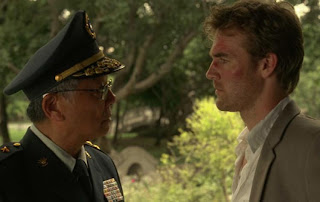
Fast-forward to today, and the war of ideologies has been replaced by regional integration, free trade and stock markets. China, the old enemy, is no longer regarded in that light, while Taiwan is an active democracy. And yet, the same old aspirations for freedom and right to choose one’s future continue to be regarded as nuisances and “trouble-making.” In many ways, the conflict between ideals and geopolitical imperatives, remains as true today as it was during the period covered in the movie. In one of the most powerful scenes in the movie, a young, idealistic FBI agent, skillfully played by James Van Der Beek, has a shouting match with his boss back in Washington after returning from Taipei. Political forces want him to ignore human rights violations in Taiwan; his sense of justice, however, tells him this is what really matters. The conflict isn’t fiction: It was alive then, and it is alive today, despite the different times.

By fictionalizing a story about a different time, Formosa Betrayed makes its important message timeless, which is what art is all about. Taiwan’s story is a fascinating one, one that the world ignores at its own loss. Perhaps this movie will get the ball rolling, and who knows, maybe director Ang Lee — a product of this land — will make his own big-budget Taiwanese version of Schindler’s List one day.

The DVD of Formosa Betrayed will be released in the US on July 13.