Thursday, September 14, 2006

A Most Precious Democracy

I am constantly surprised by the position that many Taiwanese people my age and younger have taken on the Taiwan Strait issue. On many occasions when we start talking about whether Taiwan should strive for independence or eventually reintegrate China I am met with the argument that it would be better for the Taiwanese economy if the two Chinas were politically reunited. There is this perception—fed by the media, mostly—that the Taiwanese economy hasn’t been doing well since the Democratic People’s Party (DPP) came to power in 2000.

It’s one thing to think that the economy is ailing, and it is true that during the 1990s Taiwan, one of the small dragons, had fared better. But a close look at the numbers—a GDP growth of 3.8 percent for 2005 (Canada’s is 2.9 percent) and a 4.1 percent unemployment rate (6.8 percent in Canada) and, at about $260 billion, one of the world’s largest foreign exchange reserves—reveals that in spite of the slowdown, Taiwan’s numbers ought to be the envy of many other countries. What compounds the perception of many Taiwanese that unification with China would be a positive development are the stratospheric economic data that are being fed the world by Beijing (unprecedented two-digit growth rates and so on). The problem with those numbers is that they are quite likely exaggerated. Furthermore, China has a very serious distribution problem, which means that the majority of Chinese could hope to benefit from such numbers, even if they were real. Conversely, if China did distribute its wealth in a matter which would permit it to ameliorate its social services, those very same rates would inevitably go down. Failing to invest in its infrastructure (other than building skyscrapers and superhighways that no one uses), the supposed great wealth that is being generated does not result in better living standards for ordinary Chinese. Outside Hong Kong, Shanghai, Beijing and a few other big cities, there lies the “other” China, one where poverty, illiteracy and unemployment are rampant.

But this is just economic matters. More importantly, surely, are the great differences in political freedoms between Taiwan and China. And yet, strangely enough, this is a topic that very rarely is raised by the Taiwanese friends I talk with. I don’t know if that is the result of our reading different publications, but alarmingly most Taiwanese of my generation and those that came after it seem unaware of the pitiful state of affairs in China, where human rights activists are routinely being jailed, reporters and writers forced to revise their comments or also be imprisoned. It is illegal, for example, for sources to leak information on issues of national security—the definition of which is so large and fluid that almost anything, from the outbreak of a disease to how the government deals with a natural catastrophe, can be considered as such and result in prosecution. By the thousands, Chinese are being forced out of their homes so that useless construction projects can continue. Some of those who tried to save their homes have been beaten by police, and news sites reporting on this have been forcefully shut down.

Even more striking is the gradual transformation of Hong Kong, which since its reunification with China—and despite its special status—has also been transformed by the powers that be in Beijing. Surely, if there is something that should serve as a warning to the Taiwanese who are in favor of reunification with China, with HK-like special status or not, the former British territory should be it. Strangely, it doesn’t seem to register. Despite the cries of alarm from various rights groups in Hong Kong, many Taiwanese do not seem to be aware that laws protecting civil liberties are being changed and that the authorities are slowly obtaining powers of intrusiveness that would make anyone in a democracy pause.

Sadly, I do not think young Taiwanese fully understand or appreciate the tremendous value of democracy—a gift that perhaps they take for granted. In their minds, the economy trumps rights and anyway, China is bound to open up and become a better place. Perhaps that is true, but recent signs point in the opposite direction, and this in spite of increased scrutiny as the 2008 Olympic Games in Beijing approach. Diplomats from all over the world are being lied to when Beijing—which is also the pollution capital of the world, by the way—tells them foreign reporters will be given unlimited access throughout the games and subsequently. The state media is becoming more powerful, at the great detriment of any independent outlet, which are now faced with a choice between censorship or closure and jail.

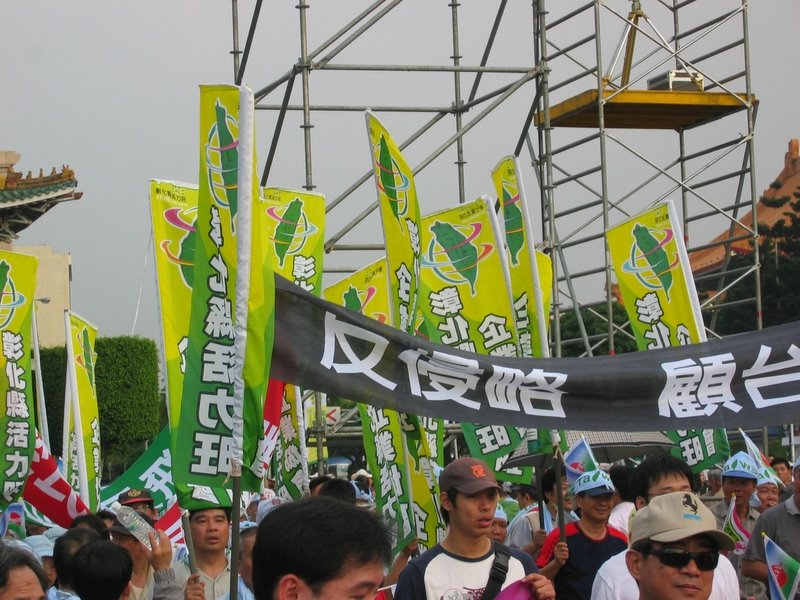
Yesterday, Taiwan’s 14th attempt to gain representation for its 23 million citizens at the United Nations once again met with failure, thanks to opposition from China. Given its economic weight, Beijing is able to co-opt, charm and bully states that otherwise would be in favor of recognizing Taiwan. In the process, China manages to pluck recognition of and political support for the democratic island. A quick look at the ongoing peaceful and orderly sit-in led by former DPP Chairman Shih Ming-teh (施明德) to unseat President Chen Shui-bian (陳水扁) should make the Taiwanese appreciative of their right to do so, to go out on the street and protest. A similar event in China would most assuredly have been met with violence and widespread arrests.
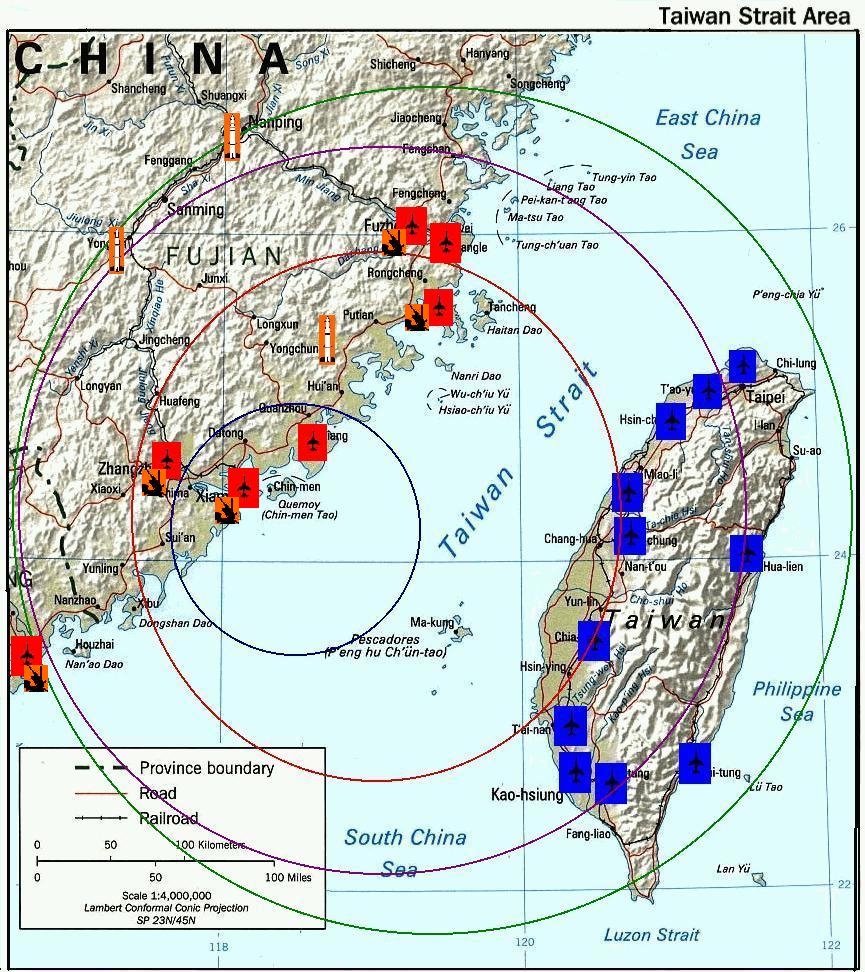
Finally, if all the above isn’t sufficient to convince the Taiwanese that reunification with China for economic benefit isn’t necessarily a good thing, they should consider the odd-800 missiles that Beijing currently has pointing at Taiwan, to which number about 100 new missiles are added every year. Who in his right mind would want to run into the arms of a distant cousin under the threat of physical arm should he fail to do so? Beyond Beijing’s political pressure on potential allies of Taiwan, beyond its meddling in the Taiwanese democratic process, it is the threat of military force, the anti-democratic compelling of a people through the threat of and the planning for use of force (a crime against peace as per Article 6(a) of the United Nations Charter), that should convince every Taiwanese that they stand to lose so much by reuniting with a country that very obviously has no democratic aspirations.

Surely, there must be ways to do business with China without one having to sell his soul in the process.

Tuesday, September 12, 2006

Five Years (and One Day) Later

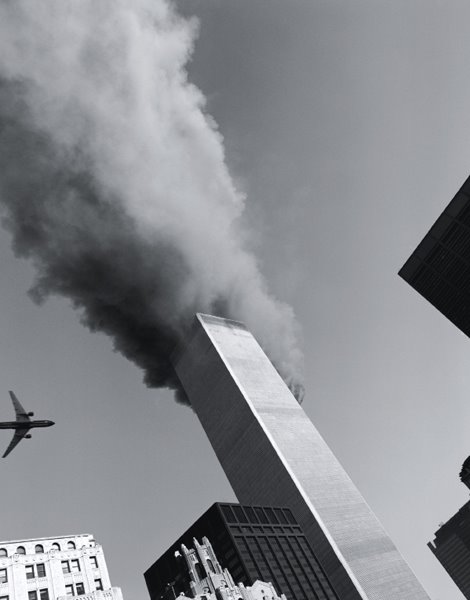
There probably were more articles, opinion pieces and editorials about the Sept. 11 terrorist attacks in New York and Washington over the past week than there were after the strikes five years ago. So much ink has been spilled, pixels been used and airtime taken on that issue that once again it feels like the world has stopped. CNN, the cable news network whose coverage days before the commemoration was nothing if not painfully trite, decided to present the events of 9/11 in real time, five years later, as if every half decade a victim of a car accident had to play the videotape of the event that nearly cost him his life. Experts, not-so-experts, pundits and politicians in office and not—all felt they needed to add their ten cents worth to the chorus. Failing to do so, it seemed, would be an unpardonable sin.

At the Taipei Times where I work, during a time when Taiwanese President Chen Shui-bian (陳水扁) is facing a concerted effort (though hampered by torrential rains) to unseat him, the Opinions pages for the past three days have been about nothing but that, with pieces written by individuals as varied as CNN’s Nic Robertson to the caustic Christopher Hitchens. Being an editor there, I have had the chance (or misfortune, depending on how one sees it) to read, edit and read them all, over and over again.

What emerges is surprisingly—and in a way alarmingly—thin: the chief architects of the attacks, Osama bin Laden and Ayman al-Zawahiri, are still at large and continue to release video tapes threatening more pain on the US and its allies all over the world. This time around, whatever it is that is brewing is—if we are to believe what bin Laden’s right arm says in yesterday’s release—for the Gulf States and Israel. We’ve also learned that the US had the world’s opinion in its favor after 9/11, that most supported retaliation in Afghanistan but that there was unanimous opposition to the 2003 invasion of Iraq, which created many problems but solved precious little. All but the hardcore right-wingers agree in those opinion pieces that Iraq pushed the world back in its campaign against terrorism. Oh—a study now shows that the reduction in air traffic after the 9/11 attacks delayed the spreading of the flu virus, perhaps one of the few positive offshoots of the terrorist attacks.

As the “world” pauses to meditate on the attacks that occurred five years ago, in which nearly 3,000 people lost their lives, I wonder if we should not select a day in the year when we’d all stop and think about the much greater number of civilians who have been killed by the so-called coalition in Afghanistan, Iraq, Palestine and Lebanon, all of whom died from Western bombs launched in the name of a worldwide campaign to protect the vague though from our perspective narrowly-applied concepts of Freedom and Democracy. Should we not, say, make September 12 a remembrance day for all the innocent people who died as a result of the US-led retaliation (and then enlargement) to 9/11? Or are all these people expandable, not as worthy of our time as were the 3,000 or so who perished on that fateful day in September?

Like everybody else, yesterday plunged me back in time momentarily and I, too, relived the day by visualizing myself at 8:00am, 10:00am and so on. I vividly remember waiting at the bus station in Montreal, waiting to take the bus to Ottawa, where I would be taking my very first class in my War Studies graduate program at the Royal Military College of Canada. I still see that old New York-bound black lady as she approaches me and asks if I know the reason why the border with the US has been closed, at which point my cell phone rang and my father apprised me of the news from New York. The eerily-quiet Ottawa (and that says a lot) upon my arrival there is burned in my mind, as is the mood that filled the air in the meeting room at the National Defense building, where we held classes on Tuesdays. As the course that I was taking was, quite appropriately, an introduction to intelligence, I remember my professor—who for very valid reasons showed up a bit late and winded—saying that in light of the day’s events the perspective of the course would have to change a little.

This last aspect has renewed importance five years after the event, for this reorientation of the mind was exactly what I believed—and I still do—needed to be made if we were to avoid other horrors such as 9/11. We needed to alter how we dealt with the Middle East and change the behavior patterns that had given legitimacy to those who perpetrated the attacks.

Unfortunately, despite Donald Rumsfeld’s supposed new, light way of waging war in Afghanistan, or the “shock and awe” high-tech barrage against a country that had no WMD and which (it is now clear) had absolutely no ties to al-Qaeda, the lessons of 9/11 have not been learned. If they had, powerful states like the US and the UK would not have allowed Israel to wage war the way it did in Lebanon in July and August, nor would they have accepted the continued oppression against the Palestinians. Come to think of it, if those lessons had been learned, the US wouldn’t be bogged down in Iraq today after having created the conditions for a bloody civil war that truly risks inflaming an entire region. In fact, it looks as if the decision-makers in Washington made the conscious decision not to learn anything from 9/11 but to nevertheless use the attacks as a pretext to further their agenda for the Middle East, an agenda that as its first stop quite evidently had Baghdad. Many people believe the US invaded Iraq in response to 9/11. That simply isn’t the case. Even back in 2002, as war loomed, intelligence officials and political leaders in Washington knew fully well that Saddam Hussein had nothing to do with 9/11 or its mastermind. They also knew—and had reporting to support it—that Iraq had no existent WMD program to speak of.

All that 9/11 did was to give those people the pretext to go into Iraq, and even then they failed to convince the world of the worthiness of their cause. The UN never gave them the resolution they asked for, and the world over millions of people saw the war for what it was: an illegal war of aggression against a sovereign state.

There is no question that Iraq was a mistake and that the invasion took away precious resources and energy from the task in Afghanistan. As a result, five years after the terrorist attacks the Taliban insurgency is more intense today than it ever has been since the regime was ousted in late 2001, resulting to an insurgency that slowly is starting to take on the airs of Iraq. Canadian and British soldiers are being killed over there, waging a war that shouldn’t be theirs. NATO leaders this weekend called for more troops to be deployed in southern Afghanistan and will try again twice this week to convince members of the alliance to commit more.

Five long years of lessons not learned and savagery that can but further alienate and anger those in whose name (rightly or not) 9/11 was committed, half a decade for the greatest military power in history to fail miserably at apprehending the perpetrators of the attacks and in so doing created thousands of new adherents to a vengeful ideology.

And there you see them, the architects of that fiasco, solemn-looking in New York and behind the Pentagon, who have the gall to say, with a mock conviction that would be too painful to bear were it not so risible, that they will catch bin Laden. Or the “leader” of the so-called free world (though he certainly wasn’t elected by that free world) saying that there are still people out there who wish to do us harm, to attack the things we cherish most, our democracy and freedoms. Five years and those people are still lying—worse than that, five years and they are still allowed to lie through their teeth and look convincing. I wonder if there still are people out there who are truly convinced by those hollow words.

The more I think about it, the more I believe we should have a Sept. 12 day for all the victims of Western aggression against the Middle East. Perhaps then, as we collectively stop and think about the men, women and children whose lives we foreshortened through cruise missiles and cluster bombs, we will be able to come up with the solutions to the problem. September 11, 2001, was horrific—there is no question about that. But we cannot continue to see this event in isolation, as if a wrong had been perpetrated without the inkling of a justification. We cannot stop to meditate, pray or write every September 11 and then continue on with our lives on Sept. 12 without a though for the vengeful plan that began to take shape on that day.

Let us all hope—for our sake and that of the millions who live in the Middle East—that five years from now we will have become a little wiser on this most important issue.

Tuesday, September 05, 2006

Japanese Drums and Day 1 at the Times

My life as editor at a newspaper officially began yesterday at 3pm. Knowing that the job and learning the trade most likely wouldn’t be a walk in the park, I decided to have a very low-key, restful weekend. Most of it, in fact, was spent in coffee shops, reading, or just walking around town.

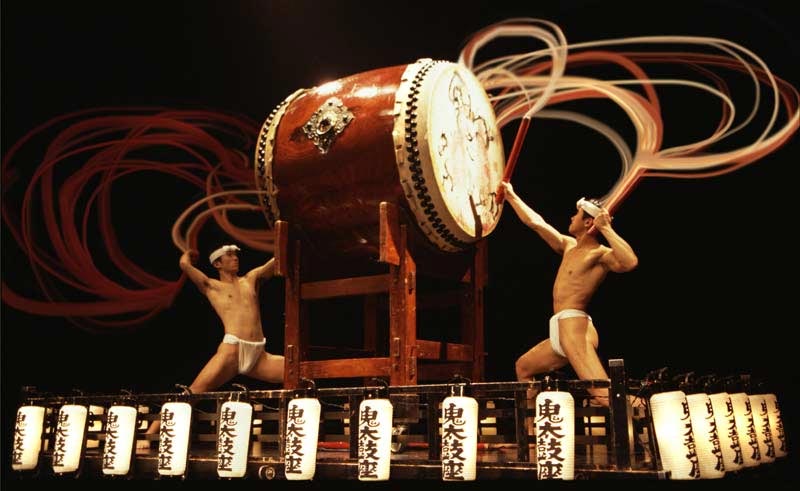
But we did do something different Sunday night—and it was extraordinary. We went to Sun Yat-sen Memorial Hall to attend a Japanese drums concert by a troupe called Za Ondekoza (see picture). For a solid two hours we were treated to a meditative and at times hypnotic feat of taiko drumming accompanied by numerous instruments, from the flute to shakuhachi. I had heard taiko drums before, but I certainly didn’t expect a concert to be as much a feat for the eyes as it is for the ears. In fact, the whole affair had a ritualistic feel to it; every hit of the drum is preceded by kata-like posturing, as if every hit were the result of an elaborate strand of meditation on the part of the drummer. What this creates, therefore, is something that resembles a dance; when six drummers do this simultaneously, it creates a whole that cannot leave the onlooker indifferent. The tremendous concentration with which the players do their percussion is nothing less than stunning; how else could a person, standing akimbo in a position that cannot but be uncomfortable, never skip a beat for a song that lasts more than twenty minutes? The drummers are also in exceptional shape and are but muscle. Some of them beat large drums with sword-like sticks while lying on their backs and holding onto the drum with their feet. For every hit, they would do a sit-up. The play of light was also accomplished with perfection, enhancing the mood swings, which went from quiet contemplative to war-like violent.

The following day launched me into the hectic world of the newspaper. Let’s just say that the learning curve isn’t very long. After being asked to read the style guideline (proper to the Times but drawing largely from the Associated Press guide) and shown how to use certain software, I was asked to start editing two stories from international wires. Both, it turns out, were opinion pieces—one on September 11 and the other on the JonBenet media frenzy. Meanwhile, there was mild journalistic excitement surrounding one of the “big” stories of the day, the death of the famous TV “Crocodile Hunter.”

Over the next seven hours, I would ensure that information was correct, check for punctuation, and make appropriate changes to make sure that the texts reflected the style guide (changing yuan to Yuan, or American to US, for example, when referring to the country). There are hundreds of such idiosyncratic style requirements. This also means making sure that dashes and quotation marks are double ones. What surprised me was how liberal we can be in changing certain things, even when the opinion piece is by someone like, say, Joseph Nye of Harvard University. As long as the spirit of the article is maintained, we can change about anything, from headline to subhead to how the text is organized. More so, even, with news items we get off the wires (AP, CP, CNA, Reuters and sundry others). Even when a story reads “CP” and has no “author,” chances are the text will substantially differ from the information that was obtained from the wires. This, therefore, means a lot of cosmetic surgery and rewriting. Then there are the local and regional news, which are written by our own reporters and, if need be, translated from Chinese to English. These are challenging to the editors, as we oftentimes need to understand what the author of the piece meant and retranslate it into proper, publishable English. When a piece is done, it is submitted to the editor-in-chief who goes through the whole thing. After that, it is made into a proper newspaper item; pictures are added and many checks are made to ensure that there are no “bad breaks” and that everything fits the page perfectly (this I will start doing in a few weeks). Everything is checked once more, proofed, and after that the editor-in-chief signs off on that page and it is submitted for print.

Usually, every editor is assigned one or two pages. Yesterday, I had parts of page 8 and most of page 9, which are the letters and opinion sections. After I had gone through a long letter written by a university professor here in Taiwan, the editor-in-chief and I sat together and went through it together. I was surprised by how liberal he was in making changes, which sometimes meant removing whole sentences. As it turns out, even in an opinion piece, if the facts are wrong (say, “Taiwan is in chaos,” which actually was in the piece I worked on), it will be removed.

Overall, day 1 was a very interesting experience. It is hard work—harder than I have worked in a long time—but it is rewarding. Every day, I know that something I worked on, proofread, wrote or rewrote, is in the newspaper and is being read by hundreds of thousands of people. With this, of course, comes a sense of responsibility. Remaining typos will be noticed, and more importantly, factual errors can have repercussions. Never, however, will a piece be treated by one editor alone. Rather, everything comes out of an organism. It may look chaotic while it is in process, but in the end it works out. When 9pm approaches and the deadline needs to be met, things get a little heated and the editor-in-chief may raise his voice to whip his troops.

So there it is, day one at a daily.

Saturday, September 02, 2006

Colors Shown

The level of personal involvement in politics in Taiwan is unlike anything I had ever experienced before. Not only are the news perpetually reporting on the ongoing plan to oust President Chen Shui-bian (陳水扁) or exposing every allegation of corruption, infidelity or other weaknesses, but politics—the great divide of the Chinese Nationalist Party (KMT) and the Democratic Progressive Party (DPP)—extends, sadly, into the workplace. Whereas in Canada the distance between ordinary citizens and the powers that be in Ottawa appeared to be calculable only in light years, here in Taiwan people make the battle of politics a very personal one indeed. Perhaps this is a consequence of the small size of the country, where distance—physical, political—uses a very different scale from that which is used in immense countries like Canada, Russia, Germany or the United States.

To demonstrate my point. Yesterday, minutes before I was to leave the office for the last time, every Taiwanese employee was had an envelope by their supervisors. Immediately, this made all the employees talk among themselves. I knew, therefore, that something was up, and I started asking around to find out what was going on. As it turns out, the envelopes came from the very top, from the owner of the series of magazines and schools. The object was to strongly encourage every employee to make a NT$100 (approximately $3.10 Canadian) donation to support the fundraising campaign initiated to oust the president. As an incentive, all employees were told that should they make said donation and provide a receipt, they would get an hour off from work in return. Many said, in jest, that they would do it for three hours, but that one hour wasn’t enough. Humor aside, I believe there is great danger in mixing the gift of leave time to employees with politics of the kind that can affect an entire nation. In other words, some people will willingly make their donation not out of political belief, but simply for the fact that they would like to get an hour off. Others, as the invitation came from the top, might feel compelled to make the donation, as doing otherwise will identify them as someone who isn’t of the same political persuasion as that of the employer. In a way, this could be interpreted as a politically-based threat. I don’t know that this would be a widespread occurrence, but I can very well imagine employees of companies with strong political affiliations suffering the professional consequences of failing to donate.

I remember the first time I accompanied my parents as they went voting. What had struck me then was how secretive people generally were about their colors. One couldn’t tell if your neighbor was a Liberal, or a Separatist. Political persuasion was like a religion, something personal that you did not divulge publicly. Discussing politics made people uncomfortable. It was better—safer—therefore, to go into the little secluded room, drop the vote card in the box, and flee the premises. Conversely, here in Taiwan, people are very open about their colors. I know more about an uncle of Stephanie’s pan-blue (KMT) affiliations than about the man himself, and I know more about my father-in-law’s pan-green (DPP) beliefs, and how those have resulted in friction with the abovementioned uncle, than I know about many other aspects of his life. At work, one could easily know who was KMT and who was DPP (the former were in the majority, by the way). There is no doubt that my former employer was pro-KMT.

Whether this is a good thing remains to be proven. In a way, this showcases a deeper, more personal involvement in politics. This probably makes politics and its ramifications more immediate and therefore less distant than politics in Canada, where politics are seen as having very little impact on personal life. After all, Canadians could only argue with some difficulty that the Harper government has fundamentally changed the way they live their lives—as least not in the short term (I would argue, though, that it might in the mid- to long-term). Yes, the country’s foreign policy has changed somewhat, and some laws like same-sex marriage may eventually be reconsidered, but overall life has remained pretty much the same since Martin was ousted.

In Taiwan, however, the nature of a government can have a very serious impact on the future of the country, as the political objectives of the parties looking at each other across the great ideological chasm are very substantial. One pushes for independence, recognition at the United Nations; the other aims for reunification with China. As a result, the outcome of a political ouster, or of a presidential election, will have an immediate impact on the future of the country, in terms of the economy, democracy, security, and many other issues.

No one seeks the protection of the isolated ballot box here. Green, Blue, you show your colors and encourage others—by offering leave time if need be—to rally to the cause. No closet political beliefs indeed.

Friday, September 01, 2006

The Last Day, A Much Lighter Offering

Today represents my last day working as an editor and writer for three English-language magazines in Taiwan. As it wasn't my intention to teach English as a second language (ESL), which is what most foreigners end up doing in Taiwan, this job gave me the opportunity not only to hone my skills as an editor and learn about the magazine trade, but it also provided me with the permits and certificates required to stay legally in the country. But it was evident from the onset that I could only go so far (and long) writing for children and teenagers. In fact, the editor-in-chief who interviewed me back in November last year had been a little apprehensive. "But you have a Master's Degree in [War Studies]" he had said. "Don't you think you will be bored?" he had asked, as it turns out presciently. He was right, of course, but given the choice between teaching rowdy children and working in a magazine, the decision had been an easy one to make.

After eight months of doing this, however, the time has come to do something else and to challenge myself—which is exactly what I will get next Monday when I commence work as a copy editor at the Taipei Times, Taiwan's primary English-language newspaper. With a circulation of nearly 300,000 copies daily (and a web edition), I am yet again expanding the amount of people whose heads I will be welcomed into (the magazines I worked for had, I believe, a circulation of about 80,000 copies).

These will be interesting times to be working in a newspaper as well. Given the coming Presidential elections and the various ongoing motions to recall and expel the current DPP president, as well as continued tensions with China, Taiwan's renewed attempt to obtain—this time using its name, Taiwan—representation at the United Nations, arms purchases (66 F-16s from the United States, among other items) and other issues, I will have my fill of local and regional stories, not to mention international coverage, with the Times offers as well. The Times' inclination is pro-separatist (which as my readers will know I fully agree with) and somewhat pro-DPP, though it prides itself in calling everybody, regardless of their political affiliations and standing, to account. Whether they operate at the DPP, the KMT or in Beijing, crooks are crooks are crooks. This notwithstanding, it should be interesting to work in as polarized an environment as Taiwan's political scene. After all, not so long ago Taiwan's media were part of the state apparatus and, much as in China, had little choice but to toe the official line. In many ways, old habits die hard, especially in how one views the world. Today, though, Taiwan's environment is a truly democratic one that starkly contrasts with that which is available across the Strait, where yesterday a journalist was once again condemned, behind closed doors, for allegedly spying on Taiwan's behalf. No country in the world currently has more journalists in detention than does China. As a newspaper editor and sometime writer, I will not, thankfully, be facing such risks in Taiwan.

In the past month and as an earlier posting indicates, I have had my share of problems with the abovementioned editor-in-chief, but that matters little. Professional differences, exacerbated by cultural ones, dissipate with time and really have no weight worthy of mention. What stays, however, are the nice, dedicated people with whom I worked during that period, people who are now showing me that my presence here was indeed appreciated. I will be having dinner and karaoke with many of them this evening, and for those who cannot make it, I have been given well-wishing cards, pictures and so on. If only they, in turn, could be treated a little more fairly by their employer.

Isn't it ironic that the government employer I resigned from almost a year ago to the day entertained such a fear of the one area I am about to enter professionally—that of the news media and a foreign country's to boot!

Thursday, August 31, 2006

"Shocking" and "Immoral"

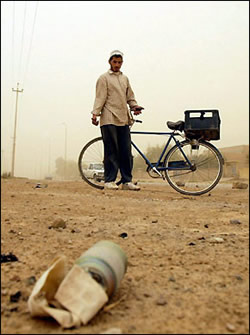
This is how the UN's humanitarian Chief, Jan Egelund, describes Israel's incomprehensible use of cluster bombs during the 72 hours leading up to the August 14 ceasefire in Lebanon. In fact, around 90 percent of the overall number of cluster bombs used by Israel during the 34-day war were dropped during those last three days. So far, the UN has identified 359 separate cluster bomb strikes in Lebanon, with as many as 100,000 unexploded bomblets. As a result, there have been 59 confirmed casualties—including 13 deaths—caused by the explosives since the end of hostilities.

According to international humanitarian law (IHL), cluster bombs—considered illegal by the Ottawa Process to ban land mines and other tied campaigns—should only be used against clearly-defined military targets and certainly not in civilian areas, which is where Israel dropped a great share of them. Cluster bombs belong to a category known as "explosive remnants of war" or "unexploded ordnance (UXO)," and as with land mines, a military that uses them in combat should provide a concise map of the areas where they were used, something Israel hasn't done to date. The problem with cluster bombs lies mostly in the failure rate; in other words, a percentage of the bomblets dropped don't explode on impact. As a result, civilians returning to their homes and children attracted by the objects—not to mention humanitarian workers rebuilding the country—are at great risk (in Afghanistan, UXO were often mistaken for yellow food packages). This is like having 100,000 invisible land mines in and around urban areas. Consequently, the already daunting task of rebuilding Lebanon will now require an element of de-mining as well.

What is difficult to comprehend is the reason why Israel felt the need to use these indiscriminate means against Lebanon—and to intensify their use—when it had already become clear that the hostilities would cease. Other than endanger the lives of civilians and make reconstruction more onerous, there is very little military advantage to having done so. The only explanation, therefore, is that the willful use of an illegal weapon was part of Israel’s plan of collective punishment for Lebanon, something that ties in well with the widespread bombing of civilian infrastructure and the embargo, which, despite please from UN Secretary General Kofi Annan, endures to this day.

The countries that provide Israel with cluster bombs—a list which includes but is not limited to the United States—should pressure Jerusalem to account for its indiscriminate use of these weapons and refrain from selling them to the Jewish state (or any state, for that matter). Hezbollah was often (and justly so) criticized by Israel and the international community for firing rockets indiscriminately into northern Israel. Jerusalem's use of cluster bombs is, haplessly, as indiscriminate, in that the unexploded bomblets linger on and can maim and kill months later without the benefit of targeting.

Monday, August 28, 2006

Beijing's Unsportsmanlike Conduct

Considering that the International Children's Games, which this year were held in Thailand, have as an objective to promote friendship among youth aged 12-15, the Chinese team's behavior vis-à-vis Taiwanese athletes represents a most unfortunate blemish on the event. Chinese sports officials—not children—snatched the Taiwanese flag from the shoulders of two Taiwanese swimming champions as they were walking towards the podium to obtain their gold medals. According to a member of the Beijing delegation, the Taiwanese athletes had left them no choice. Asking if violence was the only way to deal with the issue, a Taiwanese official was reportedly met with a resounding yes from the female members of the Beijing team. Another Taiwanese athlete (seen here), meanwhile, was able to keep her Taiwanese flag as she received her gold medal in Taekwondo. Perhaps the Chinese delegation feared that, given her skills, she would be able to fight back. Doesn't Beijing understand a language other than that of force?

How unfortunate it is that Beijing's aggressive and bellicose stance vis-à-vis Taiwan would seep into games organized to promote harmony among children of different nations. Not only does this provide a bad example to youth, it demonstrates how irresponsible the Beijing cadres can become when it comes to the evidently-emotional issue of Taiwan separatism. There is no place for hatred—even less when it comes to the education of children, upon whom the future of cross-Strait relations will eventually rest. If China, through its state-controlled curriculum and actions in the international arena, continues to inculcate hatred, then the future of the Taiwan-China equation will continue to be a threatening one, with no hope for a peaceful resolution to the conflict.

One of the many reasons why Israel and Palestine have failed to live peacefully side-by-side includes the teaching of hatred in the classroom on both sides. Children who grow up emulating the actions of their teachers, coaches and parents can only but perpetuate the cycle of hatred. Given that the Taiwanese-Chinese issue is far less complex than the Israeli-Palestinian one, such juvenile bullying is definitely not necessary—but it sure is revealing of the manner in which Beijing approaches the question at all levels, from within the halls of the United Nations to the sports arena in Bangkok.
You Won't Get your Answers, Wolf

It was journalism at its poignantly most painful last night on CNN's Late Edition with Wolf Blitzer. Now, despite the fact that the channel is available here in Taiwan, I haven't watched the news network for months. In fact, I prefer al-Jazeera nowadays, whose headquarters in Qatar are rumored to once have been on the list of U.S. targets during the run-up to the 2003 invasion of Iraq. Unable to find sleep last night, and after channel surfing from one old Hong Kong movie to another, I landed on CNN, where the white-bearded anchor, who doesn't appear to have aged one minute in the past fifteen years, was interviewing Iraqi Prime Minister Nouri al-Maliki. I only caught the end of the interview, but to me those last five minutes were extremely revealing.

In those five minutes, Blitzer fired three strikingly unpolished questions at al-Maliki that perfectly highlighted how the American government and the fledging one that has emerged in Iraq are so far apart in their views and how, in the end, this outcome may bring great displeasure to the White House and the American public. The first question concerned al-Maliki's alleged support for Hezbollah during the Israeli war against Lebanon in July. On two occasions, Blitzer did his utmost to corner the Prime Minister by asking him if he sided with the militia or Israel, adding that the U.S. government had been fully behind Jerusalem during the 34-day war. Twice, an uncomfortable-looking al-Maliki launched into a painful exercise in oblique statements and references to the people; no binary answer was to be given.

Seeing he was going nowhere, Blitzer switched gears and asked about Iraqi democracy and where al-Maliki saw Iraq five, ten years from now—a democracy (American-style, presumably) or an Islamic state with sharia law (the system of laws inspired by the Koran). In the interviewer's head, it seems that there are only two possible systems in Iraq: democracy, or Islamism. Cornered once more, al-Maliki once again resorted to convolution and all but answered the question. Not only was he being asked to predict the future in a country where, given the state it currently is in, such predictions are more impossible to make than elsewhere, but the two choices were so antipodal as to be irrelevant. Strike two for Blitzer, whose face started showing signs of controlled anger.

The third—and last—question was about the state of Israel. Here, Blitzer went beyond mere support for Hezbollah and asked the Iraqi Prime Minister if he believed the Jewish state had a right to exist. Al-Maliki's first response was a complex set of references to international law and the Security Council and the people. Blitzer, seeking the yes or no answer, rephrased his question, again to no avail. The reply clearly did not match the question. To Blitzer's discontent, al-Maliki added that diplomatic relations between Iraq and Israel were not even on the table. It was also obvious that al-Maliki was ill at ease, which became even more apparent when a relentless Blitzer asked one last time, pointing out that his interviewee hadn't answered his question, if he believed in a two-state solution (i.e. an Israeli state next to a Palestinian one) or a one-state solution (i.e. no Israel and only a Palestinian state). As expected, the third attempt led nowhere, and Blitzer decided, thankfully, that he had run out of time.

Whether the anchor and his staff were aware of this or not, it was clear that binary questions about situations of such complexity as the Middle East cannot be answered on the same term—perhaps even more so when the person being interviewed heads a fractious, multi-denominational state under military occupation and on the brink of civil war. What made the whole exercise almost painful to watch was not only the Iraqi Prime Minister's obvious discomfort but also Blitzer's relentlessness, which left the viewer with the impression that if he asked often enough he might be able to obtain an answer which would satisfy the American people. One could very well imagine poor Blitzer on the edge of a cliff, hanging by a finger, struggling to keep hope alive. In the background, we could almost hear voices shouting "we helped put you there, al-Maliki; we liberated your country. Why can't you give us one answer that our people will like?"

Democracy, however weak and imperfect, has indeed budded in Iraq. It is far from certain that it will spread within the embattled country, let alone in the region. Every day, it is under threat, from within and from without. Its current form isn't even representative of the entire Iraq. But it is a beginning, and al-Maliki is the outcome. The beauty of it is that its voice is already its own and will not yield to the pressures emanating from Washington or some news organization in Atlanta.

Sorry Wolf, but Iraq is not your creation. Ask as often as you want, you might never get the answers you seek.

Wednesday, August 23, 2006

Right Mandate, Albeit One-Sided

The new rules of engagement for UNIFIL troops in Lebanon should assuage the concerns of the potential contributors to the mission, such as France. It is hoped, therefore, that the clearly-defined rules, which include the permission to use deadly force not only in self-defence but also to open up humanitarian corridors, to protect civilians under imminent threat, and defend the Lebanese Army from assault, will lead to the level of contribution which would sustain the projected 15,000 troops by November.

All is well, and there is nothing like a clear mandate granting sufficient powers to accomplish a mission. The problem, however, is that the so-called permission to use deadly force risks being employed only when Hezbollah is seen as a threat. I find it extremely difficult to imagine that UNIFIL members would dare confront Israeli forces in Lebanon. Not only is the IDF orders of magnitude more efficient and better-equipped than the sum of the UNIFIL deployment, but the diplomatic fallout of a military exchange between a UN force and Israel would have overwhelmingly deleterious consequences for the mission, of which the death of UN officials would only be the beginning. Can we really expect, say, Nepalese soldiers attempting to stop an Israeli F-16 from bombing a village in southern Lebanon? As history has shown, the Jewish state has no compunction about targeting civilians or UN soldiers and will do so again if they are seen as preventing it from achieving its objectives. But any military action taken on the part of UNIFIL against Israel will echo back into the halls of UN headquarters in New York, where accusations of anti-Semitism will be directed not only at the country that used force but at the entire UN architecture, against which Israel has already launched many such accusations.

Increasingly, it's starting to look like UNIFIL 2.0 is being constituted not so that it can ensure stability in the region, but to please Israel and, perhaps, do its work on the ground. While the mandate does not currently request the forceful disarmament of Hezbollah, it sure is starting to look like this might be the next step. There is no certainty that a Hezbollah that sees UNIFIL to be but a pawn of Jerusalem (and Washington) will choose to live peacefully with it. Given the disparate nature of its constituents, there is no way UNIFIL could survive a guerrilla war with Hezbollah on Lebanese territory. Israel was unable to do so. Even the United States gets chills at night when it thinks back on what happened to its marines in the 1980s. What seems to have been accomplished is the textbook error, which the international community committed in the very same country in the 1980s, of taking sides. Whether they want to or not, the UN and contributing countries to UNIFIL will be expected to do Israel's bidding. This is a classic mistake, and it very well could be a deadly one.

What all this means for UNIFIL is that before it even has deployed, it already finds itself between a rock a and a hard place: confront Hezbollah in a war it cannot win, or face up to Israel, which it equally cannot afford. We therefore have a UN deployment, however muscular the UN mandate, whose only chance of "success" (however one defines it) is contingent upon the two sides respecting the ceasefire. Things are going to get ugly before they get better, of that this writer is certain.

Tuesday, August 22, 2006

Iran's Stubbornness Passes Through Iraq

Considering the historical belligerence between Iran and the United States, the Islamic Republic was surprisingly helpful in the U.S. invasion of Iraq. With few understandable exceptions, it stayed out of Iraq's internal affairs and refrained from adding—as it could easily have—complexity to an already difficult situation for American soldiers and diplomats in the country. (Though according to recent comments by Major General William B Caldwell and U.S. Ambassador Zalmay Khalilzad, this may be changing. As yet unconfirmed information indicates that Shiite groups may be receiving training in Iran and that the latter may be providing improvised explosive devices to groups in Iraq, all of which is believed by U.S. officials to be in response to Israel's attack upon Lebanon.) For nearly three years since the invasion, Tehran wisely stayed on the sidelines not because it faced the threat of a powerful military occupying its neighbor, but because its interests dovetailed with those of the U.S. A stable, somewhat democratic regime in Iraq was much more palatable to Tehran, mullahs and bellicose presidents alike, than whatever else could have replaced the Saddam Hussein regime.

But now, with U.S. generals and President Bush beginning to admit that Iraq is going to hell and is teetering on the brink of a multi-faction civil war, Tehran is reconsidering its position. Given its proximity to Iraq, Iran certainly cannot afford to have a failed warring state as a neighbor. Hence, in the past months, its otherwise inexplicable resistance to the world community on the issue of nuclear power and enriched uranium. It is all set to announce, today, that it will not yield to the pressure of the international community to abandon its nuclear ambitions. The fact of the matter is, Tehran sees nuclear power, civilian or otherwise, as an indication of power and status. It needs this, along with a solid conventional military (it conducted short-range missile tests over the weekend) not only to deter the United States by threatening shipping lanes and oil in the region (or to destroy the state of Israel, as some believe it intends to do), but primarily to protect itself from the ramifications of a failed state next door. With hints within the U.S. administration that a substantial force reduction, or even a pull-out in the face of civil war, is not impossible, Tehran can only but accelerate whatever program it has to secure itself.

This isn't as far-fetched or irrational as it seems. Let us imagine for an instant that Canada, or Mexico, is on the brink of civil war. To this we add borders that are far more porous (despite what some Washington officials and media figures claim) than the current existing borders, through which people and weapons can be smuggled. Add also people of similar religious beliefs and put them in an unstable region. What would Washington do—reduce its forces? Of course not. Rather, it would arm itself so as to better protect itself from the unfolding chaos next door.

After the Iran-Iraq War, Iran never really had a chance to refurbish or modernize its U.S.-made military, most of which was purchased when the Shah, an ally of Washington, was in power. Facing sets of sanctions and isolation, Iran turned to former Soviet states to obtain armament, but it didn't have the financial means to completely modernize its army. Facing a crisis next door and unable to consolidate a conventional military force that can meet this challenge with assurance of success, it will turn to the power of nuclear deterrence. Despite its far better understanding of its neighbor than the U.S. (and the rest of the world) will ever be able to attain, even Iran is unable to see far enough into the future to determine what kind of regime would emerge from a civil war in Iraq. Given its long history of persecution (at times real; at times imagined) at the hand of foreigners and the still-fresh wounds of Saddam's invasion in the 1980s, during which course chemical weapons were used liberally, it is no wonder that Tehran would look at the possible futures with a tinge of apprehension. What if whatever leader emerged from an Iraqi civil war were as terrible a tyrant as Saddam? What if he were twice the dictator, inspired by religious zealotry or backed by other Sunni players bent on removing the Shiite "threat" once and for all?

In its refusal to abide by the demands of the international community, Iran may be mostly protecting its interests. Perhaps diplomats ought to start taking Iran's security into consideration. It doesn't exactly live in the most stable neighborhood.

Friday, August 18, 2006

Strange War, Strange Peace

The 34-day assault of Israel against Lebanon stuns by the lack of objectives that have been achieved. What ostensibly began as a result of the abduction of two soldiers—though it should be said that unlike what the media claims this was not the cause of the conflict but rather the spark—turned into a month-long aggression of a modern and well-equipped army against mostly undefended civilians. The only real battles occurred towards the end after Israel had deployed troops on the ground, where the soldiers met the fierce resistance of Hezbollah fighters. This was a war in which the military forces of the country being invaded stood by, but some of whose soldiers were nevertheless killed by the invader, while others were held against their will by Israeli forces, in their own country, "for their own safety." This also was a war where all the architecture of international law that exists to prevent savage aggressions against civilians failed the people it was intended to protect. Meanwhile, the world stood by, bickering on words, resolutions and meanings of ceasefires but ultimately did nothing to prevent the carnage. Peace-loving democracies like Canada called the response "a balanced one" and started using dehumanizing language of the sort that characterized the worst genocidal regimes in history. This was a war upon whose so-called conclusion all sides claimed victory: Israel claimed that it had sufficiently weakened Hezbollah by killing 400-500 of its members; Hezbollah, for its part, has but confirmed about 100 of them and has gained a popularity it could not have dreamed of, with its leader Hassan Nasrallah turning into a modern "Che" for the Muslim world. The United States joined in, contending that Hezbollah had clearly been defeated. This was a war whose main objectives were the freeing of the two captured soldiers and the destruction of rockets and launch sites used by Hezbollah to attack northern Israel. The soldiers are still in captivity, and after 34 days of Israeli bombing, Hezbollah was able to fire its most intense volley in a single day. This was a war that allegedly had been launched to assist a fledging democracy in Lebanon but whose outcome has left the democratic elements in such a weakened state as to threaten their very political survival. The war so damaged the infrastructures of state (estimated at 3.6 billion, with 15,000 homes) that groups like Hezbollah, which have a good history of providing social assistance, will carry the brunt of the reconstruction—so much so, in fact, that already the U.S. is trying to speed up the aid process to avoid that becoming a reality. Already, Hezbollah has begun handing out cash to families whose homes were destroyed by Israel. This war ended with a ceasefire in which the side committing aggression reserves the right to use force to prevent the other side from rearming (and did Saturday), as open-ended an interpretation of a ceasefire as has ever been allowed to fly.

Then, after weeks of trying to come up with a ceasefire document with which all sides could agree, overt hostilities stopped. Israeli gradually pulled out of southern Lebanon, to be replaced by the Lebanese army. A major component of the ceasefire—and the main reason why Israel agreed to it—was the deployment, within fifteen days, of a well-armed multinational force under UN mandate. France, the former colonial power in the region, was expected to be a major contributor and to take the lead.

But now, less than a week after the guns went silent, the first cracks in the multinational deployment are already appearing. Most likely haunted by what happened to outside forces in Lebanon in the 1980s, it now appears that nobody wants to commit troops to go into Lebanon. Given that, should hostilities resume, such forces would not only be caught in the crossfire but would also be subjected to the all-too-possible occasional Israeli accident, this reluctance is quite understandable. So France has balked, saying that it will only add 200 engineers to the 200 UNIFIL soldiers it already has there. It also said that its 1,700 troops offshore would not come under UN command. Germany, another country that could play a major role in the crisis, has only offered border patrols and border agents, along with vessels to interdict arm shipments into Lebanon. Denmark has offered three ships while Bangladesh, Indonesia and Malaysia have each offered a battalion (600-800 troops). Now by no stretch of the imagination is math my forte, but how these contributions add up to 13,000 troops remains a mystery. We are perhaps on the brink of seeing the first invisible muscular peacekeeping deployment in history, a force that will secure a state not by deploying where it has to deploy, but by avoiding doing so. Let's call that virtual peacekeeping.

All along, the war of July 2006 in Lebanon has been a most unusual one. It is now starting to look like the peace will be perpetuating this Kafkaesque use of force.

Monday, August 14, 2006

Fewer Cartoons, and No Horror

Starting on September 1, foreign cartoons will be banned from prime-time television in China. This is part of President Hu Jintao's campaign to promote "made-in-China" content and limit foreign influence in China. It also, hum, happens to dovetail with the views of the political masters in Beijing. The adventurous Astro and the cynical Simpsons will therefore be edged out by classics like Monkey King and others.

Beyond the cartoons, the state has also ordered local TV station to stop showing horror movies, and news anchors are now required to dress more conservatively. Funding for foreign-owned magazines is on the out, too. Of course, the whole operation has very little to do with protecting the Chinese animation (or news, or magazine) markets from outside influence. Rather, it continues a long, transparent tradition of censoring all types of materials, from literature to martial arts movies, that cast notions like resistance to the authorities and individual freedoms in a favorable light.

Of course, in the modern age electronic content is a very fluid thing which is almost impossible to monitor and control, and as the favorites are forced out of airtime, they will reappear in the numerous back stores and shady alleys that dot the country, or they will simply get downloaded off the web. Based on my own experiences in Kowloon, barring a complete crackdown on the night markets, there is nothing the state can do to prevent the proliferation of pirated foreign content from entering the country. Expect the ratings on Chinese TV to drop, though, as kids will continue to ask for their favorite Japanese cartoons and Hollywood horror flicks.

Still, if I were Mickey Mouse or Pluto at the Hong Kong Disney, I'd tread carefully—especially now that the authorities have increased powers of intrusion. It'll be a very bad for democracy indeed when the famous mouse is jailed for attempting to overthrow the power in Beijing.

Come to Taiwan, oh Chinese, where the media offer not only a kaleidoscopic serving of all things Japanese, Korean and American, but also the freedom to say—and wear—what you want on TV. It's a no-holes-barred, unforgiving dog-eat-dog media environment, but at least it's a free one. Two cheers for Japanese manga, horror movies, and newscasts in short skirts!
A Truce with a Huge Hole in It

The UN-sponsored truce between Israel and Hezbollah must be one of the oddest truces in the history of warfare. Not only is Israel's military intensifying its bombing of Beirut and dropping threatening leaflets forty-five minutes before the truce is to come into effect, but it also claims that it is still entitled to use force "to prevent Hezbollah from rearming"—even after the truce comes into effect. This liberty of action is so open-ended as to be insulting to the international community. Already, some Western diplomats have expressed concern at Israel's broad definition and fear that clashes could reignite a full-scale war. And it just might.

Judging from the dreadful efficacy of Israel's targeting system, which has resulted in the targeting of civilian convoys and dozens upon dozens of other nonmilitary items, what this truce that isn't means is that Israel will continue to bomb pretty much everything in Lebanon. So ineffective and unproductive, indeed, has Israel's targeting been that after one month of war and 30,000 Israeli troops on the ground in Lebanon, yesterday Hezbollah was able to fire 250 rockets into northern Israel, the highest quantity in a single day since the commencement of hostilities. This is hardly a Hezbollah ending up with "its tail between its legs," as a clearly myopic Israeli deputy Prime Minister Shimon Peres said yesterday.

Once the truce comes into effect, the only difference will be that approximately 15,000 Lebanese soldiers, along with an eventual multinational deployment, will be standing between Israel and its targets. Judging from history, however, this shouldn't stop the Jewish state from using military force, with terrible consequences for whomever happens to be in the way—UN peacekeepers, Red Cross workers, Canadians, etc.

And consider the words of the Israeli Trade Minister, whose language belies an individual who is better equipped to trade blows than goods: "If a single stone is thrown at Israel from whatever village that happens [sic], it should be turned into a pile of stones." Peace be unto you too, Mr. Minister. A truce in good faith? Hardly so. Just like everything else since the beginning of the war, Israel expects that it can do what it wants while Hezbollah, Syria, Iran, Lebanon and the Palestinians should give and give and give. Hezbollah is expected to stop all military activity while Israel is to pull out gradually. Both sides have already said that they will respond to any violation with force. Every incident, every suspicion, will be seen as justification by Jerusalem to use force. Hezbollah will be blamed, accused of terrorism (by attacking a foreign military occupying its territory, of all things), and Israel will lash out.

The sad script is already written, and the world knows it. Lebanon is still alone. Sadly for it, the euphemism for continued aggression that is this truce means that more lives will be foreshortened, and more pain will be visited on the lot. All for a senseless war that has not led to the destruction of Hezbollah nor resulted in increased security for Israel or the release of its soldiers taken prisoner. Two things have been accomplished that easily could have been avoided, though: more than 1,000 civilians have been killed, and Hezbollah leader Hassan Nasrallah has become a regional hero. Meanwhile, Olmert is facing a long fight for political survival. And Hezbollah has demonstrated that it can stand up to one of the world's mightiest militaries and survive the onslaught.

From day one it was evident that a military solution did not exist. Israel jumped into the mire, and truces and resolutions notwithstanding, it still shows that it is willing to go deeper.

Thursday, August 10, 2006

Small Dictators

In the grand scheme of things, the object of today's entry shouldn't even register as a speck of dust. I look at the news, and what I come upon cannot but make one pause and wonder at the state of our world. It's not necessarily getting worse, but it certainly isn't getting better either. Humanity (or lack thereof) goes in cycles, and currently we find ourselves at one unpleasant extreme. As I have argued in the past, the only difference is that we increasingly have the means to make one of those swings our very last one.

But I digress, and I did net set out today to write about the ills of this world. In a way, this should provide the reader the occasion to take a deep breath and to stop thinking about Afghanistan and Lebanon and North Korea, to name a few, for a moment.

Having kept the reader in suspense for much too long already, my topic today is small dictators in the workplace. Many of us (and unfortunately perhaps all of us) have, at one point or another, had to deal with a supervisor who for some reason felt that his subordinates owed him abject respect. Last year around this time, I resigned from a position at government after having suffered under such a person for fourteen long months. Coming, I think, from a great sense of insecurity—as the people she supervised were for the most part much more competent and educated than she—she would bark at any attempt, however honorable, to question the manner in which we were doing certain things. In her defense, she happened to be part of a paramilitary-like system in which authority is never defied, and with hindsight I now understand that the entire organization could not survive if that system were to change. Having had enough of this (coupled with very serious moral issues), I resigned, thinking that I would never have to deal with such people again. The private sector, I kept saying, has the solution. Since the idea is to maximize profits, good innovative ideas would be welcome—at least listened to.

So sometime in November, my girlfriend and I moved to Asia and relocated to a country that for the past fifteen years has been among the so-called Asian tigers, what with their very successful economies. Surely, I thought, if there's a place where creative ideas will be welcomed, that country would be it.

A few weeks later, I was hired by a publishing company as an English copywriter and editor. Equipped with a Master's Degree and a number of years of experience writing and translating for the media (and for a year writing threat assessments for the government of Canada), I was coming to the job with the full confidence that my educated perspectives would be tapped into and used to their fullest. After all, part of our job as editors was to bring the English world to the local students and to help them deal with the complexities of the language.

Little did I know, however, that Confucianism still rules that society, which means that age, as opposed to skills and qualifications, often determine who's who in the hierarchy. Now that I think of it, what years of service is to government, age is to a Confucian-based society. As time passed, I came realize that my editor-in-chief, a man whom I nicknamed Cao Cao, after a most villainous character in Romance of the Three Kingdoms, expected nothing but unquestioning respect of his dictates. (How fitting, come to think of it, that his initials are also C.K.S.) He was boss, and the mere suggestion that we might want to do something differently was met with anger, invidious accusations and slander via email and "official" letters. I faced his wrath yesterday, which resulted in no less than two emails, along with a printed version dropped on my desk this morning. "I am the boss," the letter informs me, "and I am always right. You never question me and should always do as I say." It went on and on and, as it certainly didn't make for good reading, I shall spare my esteemed readers. Needless to say, I did not even dignify his accusations with a response, knowing fully well that doing so would only add fuel to the fire.

Now, had this situation only occurred with me, I might eventually have been led to believe that I was the problem. But as editor after editor ran into similar hot water and received the same idiotic letters, I realized that the issue was once again insecurity, along with a great fear of the different views westerners bring to their job, in that it is right to question things and to debate—as long as what results at the end is a better product, idea, or whatever. But out here, that's not the case. It's about face and respect for older people. Questions are insults, even worse if there happens to be other people around when the question is raised. In the end, whether the product suffers for it is beside the point.

Anyway, I rant. It just seems that wherever one goes, he is bound to encounter small dictators. Travelers beware, therefore, for some parts of Asia are no different. This being said, if everything goes according to plan I will be starting a new job as copyeditor at the Taipei Times sometime in early September. Ah oh—the editor in chief there is from Australia.

Tuesday, August 08, 2006

A Morally-Corrupt Enterprise

With hindsight, I cannot believe that during the 29 months that I worked for the Canadian government on matters of national security I was a participant (an unwilling one, at best) in Israel's racist treatment of Arabs in the Middle East. If I were still with that organization today, I would most assuredly have resigned in protest. On intelligence issues (and now even more so on the diplomatic side), Canada is inarguably an ally of Israel, and whenever one questions the morality of siding with them he is shot down and told that "he doesn't get it." On more than one occasion I protested being a participant in that wrongful enterprise, and that invariably created problems for me.

And the situation has only become unacceptable. Israel, not content with creating a humanitarian crisis in the Occupied Territories, is creating another one in Lebanon. According to the International Committee of the Red Cross (ICRC) and Medecins Sans Frontieres (MSF), Israel has made it next to impossible to reach Lebanese refugees in urgent need of assistance. Bridges have been bombed, in one case forcing MSF workers to deliver aid by crossing a river on foot. Israeli warplanes have also dropped missiles 40 meters in front of a UN convoy, killing two civilians. Israel had not given security or safe passage guarantees to aid workers, making their job all the more dangerous. And now a 10:00PM curfew in southern Lebanon has been imposed by Israel, which warns that any vehicle seen running after that time will be fair game. Compounding these problems is the naval embargo that Israel has struck against the country.

Close to 1 million Lebanese civilians have been forced to leave their homes, and when they return, many of them will find that they no longer have a home. About a thousand have been killed. Every day, we learn on the news of mostly Israeli soldiers being killed, against mostly Lebanese civilians, at a rate of 10 to 1. This, alone, is criminal. That Israel would then consciously assail aid workers and destroy the means by which their aid can be delivered during a humanitarian crisis is unconscionable. Despite its objections, Israel is now at war against the Lebanese people.

Whoever supports Israel—in Jerusalem or anywhere else in the world—is now complicit in a tremendous crime against humanity. This certainly does not mean that we should support Hezbollah's firing missiles into Israel, especially when we know that such missiles cannot be aimed properly, which makes that indiscriminate bombing, an illegal act of war. It all goes back to what I have been writing since the commencement of hostilities, that responses should be proportionate.

The Jewish state has been committing the same atrocities to the Palestinians for many years, but it took Lebanon to make the rest of the world aware of the nefarious regime of fear that has been crushing the region for so long.

I regret ever having had anything to do, however indirectly and against my will, with Israel's repressive and murderous regime. Nothing Hezbollah does warrants Israel's indiscriminate attack against an entire people.

Monday, August 07, 2006

Smoke as News

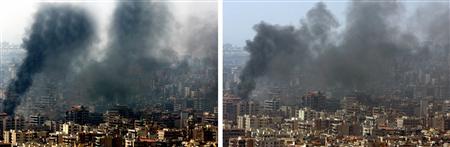
Ok, maybe photographer Adnan Hajj manipulated his picture on Photoshop and added a little thick black smoke in the skies of a bombed Beirut. Or maybe, as he claims, it was unintentional, the result of poor lighting and the unfortunate consequence of an attempt to remove dust marks. The reader can judge for himself (the picture on the left is the adulterated one, while the one on the right has not been manipulated). But whatever it was, it certainly isn't newsworthy, and either way, that's a lot of smoke. Reuters, which released the picture, is, we are told, very strict about its selection of photographs, and as a result of the above mishap it will no longer be accepting photographs by Mr. Hajj.

The news agency is well within its right to choose whose images it takes and whose it rejects. But for the story to be construed as news while almost a thousand Lebanese civilians are killed, nearly a million people are displaced, and an economy is crippled is unbelievingly disrespectful of the nightmare the Lebanese have been plunged into. Israeli Prime Minister Olmert can inflate the threat, or totally misrepresent the number of civilians killed by the NATO bombing in Kosovo (see below), and no one raises an eyebrow. But to add some smoke over Beirut, what a crime!
Hong Kong's New Surveillance Bill

The entire pro-democracy opposition walked out, leaving the rest of the 60-member Hong Kong legislature to vote 32-0 in favor of the new surveillance bill. This new bill gives authorities increased powers of intrusion, such as tapping phone lines, intercepts of mail and email, undercover infiltration, and other types of physical surveillance.

In and of itself, increased surveillance powers should not necessarily be cause for alarm. The heart of the matter—and what legislators and human rights activists need to resist—is the fact that the two bodies charged with authorizing surveillance and intercepts, a panel of judges and an independent judge, will be appointed by the city's chief executive, Donald Tsang (曾蔭權). Given the latter's pro-Beijing position, what the new bill means is that it will be easier to spy on political opponents, as well as on conversations between sources and reporters (as during the case of the 2003 SARS outbreak, for example), or lawyers and clients than ever before—or at least to give the impression that it is being done legally.

Despite Hong Kong Secretary for Security Ambrose Lee's (李少光) assurances that there is "a good balance between effective law enforcement on the one hand and the protection of privacy on the other," the new bill doesn't bode well for Beijing's opponents. How much fate can Hong Kong residents have in the supposed just power-granting bodies when, a year ago, Tsang issued an executive order allowing law enforcement agencies to eavesdrop electronically on suspects after courts had repeatedly thrown out the case on the basis that it violated the suspects' civil rights? What this bill does, among other things, is provide cover, through the illusion of independent judges, for the same type of disregard for civil liberties. Put differently, it closes the gap between the chief executive and the exercise of intrusive powers.

The adoption of the new bill is worrying, not so much for the added powers that it grants as for its mockery of truly just warranted powers. Although Lee claims that the new law is "crucial for the territory's public safety," (in other words, servitude to or not too great a distance from Beijing), what it will likely ensure is that opposition to the ever-encroaching central authority, along with support for such worthy causes as democracy, political transparency and even Taiwanese independence, will be more easily monitored and stifled.
Time for China to Step Up to the Plate

The past four bloody weeks in the Middle East make it clear that the one superpower system we have known since the end of the cold war has failed, both morally and in terms of international stability. For dangerously far too long, the United States ands its allies in the Middle East (namely Israel, Egypt, and Saudi Arabia) have been able to repress, bomb, invade, imprison and dishonestly negotiate with the weakened population in the area. More than ever, as the Palestinian Authority continues to be boxed in, bombed and prevented from functioning, it is becoming evident that the Palestinian question will never be resolved under the U.S.-Israel Peace Process, which offers nothing but crumbs to the Palestinians and is in effect an indirect way to make a repressed population agree to occupation and abandon their rights as a people. All of which serves as fuel for those, like al-Qaeda, who despise the U.S.

The situation in Lebanon is no better, and the reason why the entire region is currently in such a mess is because Israel, backed and armed by the U.S., knows it can unleash its forces without facing the consequences of its actions. In other words, Washington's green light on the invasion of Lebanon means that Israel can do what it wants with near impunity (other than the 90-odd killed, more than half of them soldiers, by Hezbollah). The U.S. system of direct invasion (Iraq) or of reliance on regional spearheads like Israel has amply demonstrated its moral and in fact strategic corruption, and can only take us where we don't want to go.

What is needed, therefore, is another superpower, one that can not only tell Israel to stop, but that can make Washington pause, too. There simply cannot not be a price to pay for what the neo-colonial powers are doing in the Middle East. It is therefore time for China to step to the plate and claim its rightful place in the world of diplomacy. Only it, through its economic clout, can hurt Israel to such an extent that the latter will think twice before continuing its destruction of Lebanon, or push onwards into Syria. As The Asia Times has noted, "Israel's military industry is dependent on exports for its survival. And arms sales to China are among its most lucrative businesses." If ever there was a lever, this is one that Beijing could consider.

Only China can make Washington realize that there will be a cost to propping up a rogue state in the region, one that destabilizes it to such an extent that it endangers world security and access to the oil that the country of 1.3 billion so desperately needs.

Arab states have failed as a community of nations and are too divided to consolidate into a common front to confront the formidable might of a combined Israel and U.S. military. Other powers like Britain, France, Germany, India and Japan are unable to sway the superpower and, when they are not rallying behind it, are treated as little more than mere annoyances. Note that all of them have long been plugged into the system of economic subservience devised by Washington.

Sadly, it now seems that the world urgently needs the entry onto the scene of a state that, it must be said, is far from diplomatic or respectful of the human rights of its citizens. This notwithstanding, China's population, added to its economic and, increasingly, military weight, is required as a counterbalance to the lopsided, primus inter pares system that currently exists. This, dear readers, is the lesser of two evils. The human rights abuses committed by Israel, with support from the U.S., far outweight whatever ills currently haunt the Chinese system. And don't get me wrong; as my previous writings make it crystal-clear, I am no fan of Beijing's policies. Still, only China can afford to go against the U.S., and China is the only country that the U.S. cannot afford to lose, both as a trading partner and a promoter of security and prosperity in an all-too-important region of the world. Only it has a voice that the rest of the world might consider listening to.

It's grand time for a new voice. The murderous monologue has gone on for far too long.
Olmert's Hallucinations

Interviewed by the German newspaper Welt am Sonntag, Israeli prime minister Ehud Olmert said that European leaders concerned with Israel's slaughter of civilians in Lebanon have no right to preach the Jewish state. The article came soon after UN aid workers in Lebanon pointed out that Israeli bombing had all but made it impossible to deliver emergency aid to the more than 800,000 Lebanese displaced by Israel's attack against their country.

To support his argument, Olmert claimed that Europe's military had killed 10,000 civilians during the 1999 military intervention in Kosovo. Yet again, the Israeli leadership is demonstrating that it lives on a different planet from the rest of us, for the civilian casualties resulting from the NATO bombing were no more than 500 (see Human Rights Watch February 2000 report), and were overwhelmingly the result of U.S. bombing. Kenneth Roth, the executive director of HRW, rightly pointed out that "all too often, NATO targeting subjected the civilian population to unacceptable risks." And those 500 were killed over a 79-day period.

There is no question that the NATO bombing in Kosovo caused unacceptable damage in civilian lives and infrastructure, or that illegal weapons, such as cluster bombs (which Israel is also using in Lebanon), were utilized. But for the leader of a supposedly just, innocent and democratic state to use a precedent of atrocity—and to self-servingly inflate the real figure by twenty—belies a lack of moral foundation. We cannot use past war crimes to justify current and future ones, just as Israel should never be allowed to exploit the Holocaust only to create an Apartheid-like military occupation of 3 million Palestinians and the repeated aggression of a neighboring country. Otherwise the entire system of laws crumbles, and mass murders, ethnic cleansing and genocide will keep going until there isn't a single one of us left to lie to.

Better get your facts straight, Ehud.

Friday, August 04, 2006

Adding to the War Crimes

Day 24 of the Israeli aggression against Lebanon. Twenty-seven farmers, including Syrians and Kurds, were killed when the trucks they were loading fruit in, on a farm, were bombed by Israeli aircraft. Surely, Hezbollah was to blame, another whitewash of in Israeli inquiry would reveal. Perhaps the fruit were Hezbollah, too. Bridges, buildings, highways, hospitals, airports, factories, communication towers, TV stations, vans, bicycles, children, women and men are not enough anymore. Food is targeted as well.

Speaking of which—Israel’s overnight bombing of four highway bridges in northern Lebanon has all but made it impossible for humanitarian convoys transporting food, shelter and other forms of aid to the hardest-hit areas of Beirut to reach the needy, or about 900,000 displaced civilians. As a result, both UNHCR and the WFP had to postpone trips to various cities. Meanwhile, Lebanese Prime Minister Fouad Siniora has stated that because of the embargo against his country, Lebanon will be running out of oil within a week or so. I wonder how Larry Hollingworth, the Deputy Humanitarian Coordinator for Beirut for UN OCHA and a former instructor of mine at the diploma in humanitarian assistance that I took in New York City in 2001, is dealing with the situation. I am sure he must be tapping into all the calm, resourcefulness and sense of humor I remember him for—but it can’t be easy.

The deliberate interruption of emergency aid—or even one that, if we stretch the imagination, is resulting collateral from the destruction of legitimate military targets (which is doubtful at this point)—for almost a million people should be seen as a war crime. It is, without any doubt, collective punishment, on the scale of the destruction of a country’s civilian infrastructure.

I don’t know which is worse: that Israel continues to pile up the war crimes, or that the international community would allow for such acts of savagery to continue. Despite the rhetoric of the Israeli government and its supporters world-wide, despite all the unconvincing claims that Hezbollah started the whole thing and that all Israel is doing is nothing but self-defense, we are well beyond that now. In fact, Israel’s bizarrely disproportional reaction to the July 12 kidnapping is starting to look like a premeditated attempt, concocted by Israel and its criminal backers in Washington, to weaken Lebanon and perhaps to provoke Iran. Or perhaps it is just blind stupidity, or hubris, or a miscalculation of gargantuan proportion. No matter what the reason is, it is a messy escalation from which it will take a long time to extricate ourselves.
A Region Angered

The pounding of Lebanon and the un-evenhanded response of world powers to the crisis is awakening a dangerous giant in southern and central Iraq, where firebrand leader and no friend of the United States Muqtada al-Sadr has called for a "million-man march in support of Lebanon and Hezbollah." The demonstration will be held after Friday prayers in Sadr City, a Shiite suburb. Thousands of people, some of them reportedly wearing the white shrouds symbolizing their willingness to martyr themselves, are heading for the area. This doesn't bode well for the U.S. troops in the country, or for the Iraqi government they back. Already, U.S. forces have tightened the noose around Sadr City, expecting trouble. Yesterday, Shiites in Saudi Arabia, where public demonstrations are banned, were nevertheless held, and the authorities did not crack down.

Through miscalculation and perhaps a blind faith in the umbrella of U.S. protection, Israel has engendered a mobilization of Shiites on a scale perhaps never seen before. Thanks to its refusal, along with that of the U.S. and Great Britain, to see how aggravating the invasion of Lebanon and how incendiary the slaughter of almost a thousand civilians have been, the Jewish state has possibly made itself more exposed and vulnerable than it ever has been since it was created in 1948.
Harper and Others Ought to Listen to Chavez

Whether you like him or not, Venezuelan president Hugo Chavez does, on occasion, put his flamboyant rhetoric to good use. After expressing his indignation at Israel's violent occupation of Lebanon and the world's inability to stop the "horror," Chavez made an interesting and refreshingly balanced point. "The Israeli elite repeatedly criticize Hitler's actions against the Jews, and indeed Hitler's actions must be criticized, not just against the Jews but against the world. It's also fascism what Israel is doing to the Palestinian people ... terrorism and fascism." Once you look past his hyperbolic reference to Israel committing genocide in Lebanon (which it is not, in spite of all the pain inflicted), it is nice to see a world leader put his mouth where his heart is, and to see him act on his beliefs. Since then, Venezuela has recalled its ambassador to Israel.

A massive recall of ambassadors, combined with the expulsion of Israeli ambassadors to various countries, would make Jerusalem pause. In a world where a rogue state, with the backing of the only superpower, can fire at will and displace one quarter of a country's population with impunity, it may seem like one cannot do much. Isolating Israel diplomatically and economically could nevertheless generate some of the pressure that is so urgently needed.

Thursday, August 03, 2006

Debunking the Myth

Ever since the war in Lebanon began three weeks ago, Israel and its supporters worldwide have claimed that the killing of Lebanese civilians with Israeli bombs and missiles is Hezbollah's responsibility, not only because Hezbollah supposedly started the whole thing in the first place, but even more so because the group uses children, women and the elderly as "human shields." The problem, until very recently, was that it was extremely to prove or disprove that contention. Entire Lebanese families were wiped out (a mother, father and five children in Al Jamaliyeh again yesterday), Israel is always "deeply sorry," but in the same sentence it informs us that the household had been used by Hezbollah, either to store weapons or to fire rockets. In the past few days, following unpardonable remarks made by a Vancouver rabbi and the Canadian minister of foreign affairs, pundits all over the country have repeated, with no critical assessment whatsoever, the "human shield" theory. Hezbollah, they claim, wants Lebanese people to be killed. Case in point, the so-called Israeli military inquiry into the Qana bombing of a "suspicious structure," in which 56 civilians—more than half of them children—were killed, has found Hezbollah responsible. Israel says so, so it must be true.

But this is all based on faith, in a belief (and people want to believe) that whatever Israel tells us is true. Never mind its track record of the past 39 years of killing civilians en masse. Were all those Palestinians hiding weapons in their houses? Are minivans filled with Lebanese civilians fleeing a scene of destruction, or people on bicycles, some new versions of vehicle-borne improvised explosive devices that somehow will take flight and destroy Israeli F-16s in mid-flight?

As I have mentioned countless times in these pages, Israel's intelligence apparatus, whether we look at its civilian or military component, is very often off the mark, the unfortunate result of sheer paranoia and the attendant casting of far-too-wide a net. Racism and the dehumanization of the enemy, along with the deresponsibilization of being part of a system of orders from above, nevertheless makes it easy to fire, destroy, and kill without compunction.

According to Human Rights Watch, which has researchers on the ground in Lebanon, Israel has yet to provide a single proof of a civilian building that was used by Hezbollah either as storage or as a site from which to fire missiles at Israel. Hundreds of buildings were destroyed, hundreds of civilians killed, but in not a single instance was there a Hezbollah presence warranting an attack, let alone making the collateral militarily acceptable. No rockets or Hezbollah equipment were found at the obliterated sites. (I am sure there must be exceptions to this, and in some instances the Lebanese being interviewed may have hidden the fact that Hezbollah was there; but hundreds of times, not only in Lebanon but also in Palestinian territories? No.) In a report released today, HRW notes that "the pattern of attacks in more than 20 cases investigated by Human Rights Watch researchers in Lebanon indicates that [Israel's] failures cannot be dismissed as mere accidents and cannot be blamed on wrongful Hezbollah practices." (Readers can access the full report at www.hrw.org.) Based on this, most such bombings were therefore crimes of war, for which the Israeli leadership should be held accountable.

Ironically, if Israel were so good, as it claims, at determining where Hezbollah is hiding its arsenal—so proficient, in fact, that it even knows what's concealed inside civilian homes—then how do we explain the fact that yesterday the group was able to fire a record number of missiles into Israel (more than 230)?

This is what Israel has, its order of battle, if you will. A powerful modern military backed and supplied by the most formidable military force in history; terrible (in effectiveness and morality) intelligence apparatuses; and a well-oiled propaganda machine that makes it all possible.

Wednesday, August 02, 2006

Rabbi McKay

Sadly, the Canadian prime minister standing by mutely while a Vancouver rabbi spewed words of hatred wasn't enough for the Conservative government. Peter McKay, Canada's ignorant minister of Foreign Affairs, a man who obviously knows nothing about the complexities of the Levant, adopted the rabbi's dehumanizing language and repeated the unforgivable reference to Hezbollah as "a cancer," this time a cancer that's eating away at Lebanon. Furthermore, by arguing that the group of "cold-blooded killers" is a threat to Lebanon's democracy, he fails to take into consideration the fact that Hezbollah members were elected, by the Lebanese people, into government last year.

Unlike some critics of the Harper administration, I do not think that Canada should necessarily always do its utmost to maintain a neutral stance in the world. Even though I believe (as does the majority of Canadians, especially in the Province of Quebec) that the Conservatives are gravely mistaken in their staunch support for Israel, they have a right to propose and sustain a policy. But for the government to adopt the language of hatred—and thereby make it its official position—is unconscionable and reveals a lack of imagination. Does Mr. McKay's cancer eating away at Lebanon include whoever opposes Israel's murderous onslaught, or supports, in one way or another, Hezbollah's resistance to the invasion of their country? Where do we draw the line? Hezbollah is not this entity you can clearly point at; it is a symbol of resistance and the only successful representative of a much weakened and impoverished part of the Lebanese population, the Shiites.

If Mr. McKay knew his stuff, if he could be bothered, as I have, to read the documentation on which the listing of Hezbollah as a terrorist entity is founded, he would see two things. First, he would realize that the affidavit fails to distinguish between, on the one hand, the governmental and social aspects of the organization, and on the other hand the branch that engages in resistance to Israel (the part of Hezbollah's activities that is referred to as "terrorism"). According to the documentation (and to CSIS), everything Hezbollah is "terrorism." Even attacks against Israel's military within Lebanon are catalogued as terrorism—a total lie and a sheer disfigurement of the laws of war. Secondly, if Mr. McKay were to compare the supposed ills of Hezbollah with what Israel has done to the region in the past thirty-nine years, he would see that the latter has all the attributes of a terrorist organization, with support from a state (the United States, and now Canada). It has broken all the nonproliferation treaties in developing an illegal nuclear weapons program (even Iran has yet to achieve that); it has indiscriminately killed thousands of civilians; used illegal weapons (and still does in Lebanon, what with cluster bombs and perhaps phosphorus); disappeared people without due process; committed torture; broken dozens of UN resolutions; invaded neighboring countries; struck alliances with death squads (think Sabra and Shatila); terrorized whole populations; conducted mass punishment, and the list goes on. McKay, if he had any understanding of the realities in the region, would soon realize that Israel represents the greatest current threat to regional—and perhaps world—security.

Harper and McKay have proven themselves to be ignoramuses and sell-outs, but we elected them. If I were in the opposition, or in the Senate, though, I would be screaming for justice standing on my desk. Where are the Romeo Dallaires? Why is our Canada turning into a blown-up version of Israel, where the enemy is dehumanized and dissent disregarded? A relative of the Montreal Lebanese family that was exterminated by Israel last month tried to share his views at the House of Commons today. Despite his being uninvited, the least that the government could have done was to listen to what he had to say. Instead, he was escorted outside. Thanks to their ignorance and racism, Harper and McKay, along with everybody who backs them, are destroying the very fabric of Canada and its image abroad.

This is the language of Hitler's propagandists, of Pol Pot, of Slobodan Milosevic. This is the language of hatred, of nihilism, of the failure of humanity. No one, and even less a Canadian minister, should ever be allowed to say such things. I know Mr. Ignatieff wouldn't.

How long are we, as a people, going to tolerate a government that clearly doesn't represent, and in fact shows total disregard for, what we believe in? Let us hope that the 40,000-strong chorus of booing that greeted the representative of the Conservative government at the Outgames in Montreal over the weekend will echo across the country.

Tuesday, August 01, 2006

Al-Qaeda but a Pimple, Hezbollah a Cancer, Says
Vancouver Rabbi

How the Canadian prime minister can attend a pro-Israel rally in Vancouver, during which event a rabbi not only claims, nonsensically, that Hezbollah is “about death” (what does that mean anyway?) but also that what Israel is doing in Lebanon “is a form of chemotherapy [which] you cannot stop until the cancer is eliminated” defies the imagination (how that statement is any less “about death” eludes me). Are the 37 children who were murdered by Israel over the weekend, the nearly 700 Lebanese citizens killed, thousands injured, and 750,000 displaced part of that cancer, too? Or will the Lebanese who refuse to stand by idly while Israel destroys their country or kills the people they love, be subjected to the same unconscionable characterization? This, sadly, isn’t the first time that dehumanizing language has been used by Israel and its representatives to describe Palestinians in particular, and Arabs in general. Almost every Israeli leader, from 1948 on, has used it in one form or another.

That a Canadian leader would stand by while such a statement of hatred is made on Canadian soil, however, and do nothing to correct such blatant malice or even paint a more balanced picture is sickening and makes me ashamed as a Canadian to have him as our elected leader.

Rabbi Philip Bregman not only managed to display his racist view of Arabs by comparing them to a cancer that needs to be eliminated, but also showcased his total ignorance by adding that in comparison to Hezbollah, al-Qaeda is “but a pimple.” The only reason why he felt he could make such a declaration is because Hezbollah presents a more proximate and immediate challenge to Israel than does al-Qaeda. But to claim that Hezbollah, a group whose stated objective is the defense of a territory—Lebanon—represents a threat to international security is pure hallucination. Perhaps the rabbi should drop his religious texts and read up a little on history and political science.

Can anyone imagine what would happen in Canada if a Sheikh or an Imam were to state, in public, that Jews are a cancer that needs to be eliminated? Not only would he be (rightly) accused of anti-Semitism, but he would also be attacked in the media, by the Israeli lobby, the Canadian government, and immediately targeted by CSIS and the RCMP. The rabbi, who most assuredly will not come under the scrutiny of the subservient Canadian security intelligence apparatus, fails to recognize that the hatred in his language speaks volumes about his quality as a religious authority.

To add insult to injury, Bregman also had the gall to compare Canada’s and Israel’s great democratic and liberal systems and applauded their shared respect for human rights and equality. This would be risibly absurd if it didn’t mask decades of human rights violations against an entire people and the illegal Apartheid-like military occupation of more than 3 million Palestinians, with its attendant disappearances, assassinations, rape of state institutions, repression, mass humiliation and punishment, and so on. There is nothing in these actions that can even remotely be equated with democracy and equality. Moreover, within the Israeli state itself, democracy is for Jews alone; Arabs are treated as second-rate citizens. Hardly the signs of a liberal democracy on the scale of and as refined as that of Canada.

There is a thing in Canada called freedom of expression. When it doesn’t fall into incitation to hatred, it is perfectly acceptable. Moreover, rabbi Bregman, even if his comments reveal him to be a second-rate mind with a third-rate heart, has a right to his own political opinions, however delusional and distanced from reality they are. But when a respected member of the community spreads hatred for a group and fails even to mention the terrible injustice that has been visited upon the Lebanese, and furthermore uses language to represent the other that is as evil as that used by the Nazis to justify exterminating the Jews during World War II, the Canadian government has a moral responsibility and an imperative to censure him. By failing to do so, Harper, who doesn’t even seem to have it in him to share in the suffering of the Montreal family that was murdered by Israel, condoned and underwrote the rabbi’s language of hate and betrayed what the country he supposedly leads stands for.

This is shameful, unpardonable, and a very sad period for Canada.
Why Palestinians and Hezbollah Seek a Prisoner Exchange

Fifty-three-year-old Ghazi Falah, an Arab with dual Israeli and Canadian citizenship and former professor at the University of Toronto (he lived in Toronto from 1992 to 2001), spent 22 days in an Israeli jail under suspicion that he was spying for organizations that were opposed to Israel—read Iran and Hezbollah. During his ordeal, Mr. Falah was often tied to a chair by his interrogators, and one session reportedly lasted as many as 60 hours.

Falah's mistake, if there was one, was to take pictures along the border between Israel and Lebanon, including one of an Israeli military antenna. Of course, the Israeli authorities who detained and kept him incommunicado, without access to a lawyer, couldn't care less about the fact that Mr. Falah is an expert on border dispute issues, or that his activities were purely academic in nature (which appears to be the conclusion the Israelis reached after detaining and interrogating Mr. Falah for 22 days).

Despite the treatment and the injustice of the detention, this story ended well, and Mr. Falah was released on July 30. Sadly, there are hundreds—thousands—of similar stories that have not seen such resolution. For years Israel has been arresting and detaining young Palestinian and Lebanese men on suspicion that they were supporting one of the many organizations that Israel believes are bent on its destruction. With no legal recourse or due process, and without assistance from state authorities (what authorities in the Palestinians' case) that can request their release, these individuals have absolutely no way to defend themselves against charges that quite frequently are either uncorroborated or altogether false. Israel's legendary intelligence services are indeed aggressive, but there is nothing reasonable or discriminate about their targeting of groups and individuals. From my own experience, their intelligence is often little better than a sieve, cases with so many holes in them that they are practically useless. But that doesn't matter within Israel, in the Occupied Territories and in and around Lebanon; Israel arrests and detains and uses illegal interrogation practices (a polite euphemism if ever there was one) with impunity. This should not come as a surprise, given Israel's overly paranoid view of the other. What it does with bombs it also does very well with detentions and disappearances.

Mr. Falah's dual citizenship probably saved his life. Absent this, he probably would have disappeared into Israel's vast prison underworld. But there are many, many more people who have been done a similar injustice.

Individuals whose intention truly was to commit terrorism (in the true sense of the word, as opposed to how Israel defines it) do belong in jail. These individuals made a choice, and that choice led them down the path of violence. But even then they should be granted due process, which they certainly are not. The problem is the hundreds, possibly thousands, who were disappeared and are still being detained on erroneous charges. Their disappearance, without any means to clear their names, is unacceptable.