Monday, November 19, 2012

A Bump in the Road for Taiwan and Japan, but Little More

Taiwanese fishing vessels head for the Diaoyutais
Historical ties with Japan and disinterest among Taiwanese in the Diaoyutai issue will make it difficult for Ma to take action that can truly harm the relationship 

Although its voice is often ignored in the escalating spat over the disputed Diaoyu/Senkaku islands in the East China Sea, Taiwan reacted with uncharacteristic bombast to the Japanese government’s purchase of three islets in the disputed island chain in September. The response reached unprecedented levels with a high-profile “sea protest” involving dozens of Taiwanese fishing vessels, accompanied by several Coast Guard Administration ships, during which CGA officers engaged in a water cannon battle with their Japanese counterparts. The sequence of events, combined with the hardened rhetoric in Taipei, has raised fears of souring relations between Taiwan and Japan, and attracted speculation about possible co-operation between Taipei and Beijing in “defending” territory they both claim as their own. 

A closer look at Taiwan’s idiosyncratic role in the triumvirate, however, shows that, rather than clearly taking sides, Taipei is playing a difficult, and perhaps perilous, balancing act. 

My article, published in the current issue of the Jamestown Foundation’s China Brief, continues here. The full issue can be accessed here.

Court cuts fine in follow-up to Lafayette frigate scandal

A Lafayette- (or Kang Ding) class frigate, hull 1202
An agreement stipulated that Taiwan would receive a 15 percent discount if French agents were caught paying commissions to middlemen

Less than two years after winning a landmark 630 million euro (US$875 million) lawsuit against a French defense contractor over the scandal-plagued sale of Lafayette-class frigates to Taiwan in the 1990s, an arbitration court last week shot down Taipei’s hopes for a second win in a related case, citing a lack of evidence. 

In its follow-up claim, Taipei had filed claims of 45.5 million euros, including interests and prosecution fees, against DCNS, the maker of the frigates, over a 1996 spares supply contract for the six multi-role stealth frigates. 

My article, published today in the Taipei Times, continues here.

Wednesday, November 14, 2012

DPP makes wise choice in Joseph Wu, Washington office

The well-spoken Joseph Wu has a heavy task ahead of him
The challenges will be formidable, but it’s hard to imagine a man better placed to meet them 

The announcement on Monday that the Democratic Progressive Party (DPP) had tapped former representative to the US Joseph Wu (吳釗燮) to reopen and head the party’s office in Washington is an important development for the future of Taiwan’s relations with its principal ally.

Although, as some critics have already pointed out, it is unusual for the opposition party of a democratic ally to have an office in the US capital, Taiwan’s idiosyncratic — and at times precarious — position makes this essential. The disparity in power and resources between the DPP and the Chinese Nationalist Party (KMT) alone is such that any counterweight to the Taipei Economic and Cultural Representative Office (TECRO) must be physically present in Washington to be heard. 

Since the DPP closed its Washington office in 2000 when it entered the Presidential Office, the party has relied on a one-man liaison office to negotiate the vagaries of the always complex relationship between Taiwan, the US and China. That man, Mike Fonte, has done a wonderful job and earned the respect of many officials, but the immensity of the task, along with Taiwan’s uncertain future as President Ma Ying-jeou (馬英九) accelerates the pace of cross-strait exchanges, requires more resources. 

My unsigned editorial, published today in the Taipei Times, continues here.

Tuesday, November 13, 2012

US-Japan to revise defense guidelines

US Secretary of Defense Leon Panetta addresses soldiers
The planned revisions to longstanding defense guidelines leave no doubt as to the identity of the principal antagonist 

Much has been said in recent months about the so-called U.S. “pivot” to Asia, a rebalancing that, though often discussed, remains surprisingly hard to define. However, one key component of Washington’s strategy seems to be taking shape and could gain sharper focus in coming weeks: a new, expanded and more flexible role for Japan’s military. 

With U.S. and Japanese armed forces currently conducting a major joint exercise across Japan and in the Pacific, the two governments announced this weekend that they had agreed to consider revisions to the defense cooperation guidelines that, since 1978, have served as a basis for how the two countries address defense matters of common interest. 

Since the guidelines were adopted, Japan’s security situation — in fact the entire region — has undergone a dramatic transformation. 

My article, published today in The Diplomat, continues here.

Taiwan test-fires variant of HF-3 ‘carrier killer’ missile

CSIST's HF-3 on display at a military parade
Reports claim the variant of the Hsiung Feng III has a range of 400km and can reach a maximum speed of Mach 3.0 

Taiwan’s top military research institute last month test-fired a powerful new anti-ship missile that could send a strong signal to China as it launches its first aircraft carrier, a reports said yesterday.

According to the Chinese-language United Daily News, the Chung Shan Institute of Science and Technology completed a series of tests of the missile, which has been referred to as a variant of the Hsiung Feng III (HF-3) anti-ship missile. 

My article, published today in the Taipei Times, continues here.

Taiwan confident US military ties are strong

Deputy Minister of National Defense Andrew Yang
Taiwan’s deputy minister of national defense sees no reason to fear US abandonment of Taiwan and points to sustained cooperation 

Taiwan is very much on the US’ radar and remains an important component of Washington’s strategy in the West Pacific, a top defense official said in an interview published yesterday. 

Deputy Minister of National Defense Andrew Yang (楊念祖), who recently returned from one of his frequent visits to the US, told Defense News in an interview conducted late last month that while Taiwan does not figure prominently in the US rebalance — commonly referred to as the “pivot” — to Asia, Taipei and Washington have “widely” cooperated over the past two years or so. 

My writeup of Defense News’ interview with Andrew Yang, published today in the Taipei Times, continues here.

Monday, November 12, 2012

Japan, US launch ‘Keen Sword’ exercises amid regional tensions

US and Japanese vessels take part in Keen Sword
China said it was paying close attention to the exercises and said it ‘sternly opposes’ moves by Japan to bring outsiders to the region

Approximately 47,000 Japanese Self-Defense Forces (JSDF) and US Forces on 5 November launched joint-bilateral exercises in a time of heightened tensions due to an ongoing territorial dispute between Japan and China in the East China Sea.

Keen Sword 2013, which runs through 16 November, is part of a series of regular field training exercises meant to enable US and JSDF armed forces to hone co-ordination procedures and improve operational interoperability to ensure that Japan can meet various security contingencies in the Asia-Pacific region.

My article, published today in Jane’s International Defence Review, continues here (subscription required).

Thursday, November 08, 2012

Not a good year for Taiwan’s economy

Taipei 101 as seen from near Taipei International Airport
Prospects for Taiwan’s economy in 2013 have been the object of concern among investors and financial watchers 

As economists predicted late last year, 2012 has been a tough year for Asian exporters, and Taiwan, its economy increasingly dependent on the Chinese engine, has been no exception to the downturn.

From forecasts in mid-2011 of 4.51 percent GDP growth for 2012, government indicators in August predicted annual growth would settle at just 1.66 percent (the Taiwan Institute of Economic Research has since cut its forecast to a mere 1.16 percent). It was the lowest in a long series of downward revisions through the year — primarily the result of a slowing Chinese economy and the struggles of Eurozone economies. Taiwan’s economy shrank 0.18 percent year-on-year in the three months to June, the first quarterly contraction since the third quarter of 2009 — mostly the result of poor exports performance.

Despite the difficulties, the Ma administration’s plan to revive the economy does not seem to imagine anything beyond further expansion of economic ties with China.

My article, published in the October/November 2012 issue of Asia Today International, can be accessed here (subscription required).

Wednesday, November 07, 2012

Blue and green skies above Taiwan

A statue on the site of the Jingmei detention center
The DPP must apply the lessons learned from an unrivaled master of Taiwanese politics, former president Lee Teng-hui 

Former Democratic Progressive Party (DPP) chairperson Tsai Ing-wen (蔡英文) came in for some heavy criticism during her trip to the US over remarks she made that Taiwanese should give more “space” to the idea that the Republic of China (ROC) is Taiwan, and Taiwan the ROC. However, if the past is any indication, she might be onto something. 

For good reasons, the initial reaction among many Taiwanese and human rights defenders to equating their homeland with the ROC — a regime that was forced upon them after the conclusion of World War II — will be to bristle. Such reactions might even be more pronounced when a Taiwanese, who once headed the DPP and ran for high office, utters such words. Indeed Tsai became the object of rather scathing personal attacks, with some accusing her of giving up on Taiwanese independence and siding with President Ma Ying-jeou (馬英九) of the Chinese Nationalist Party (KMT). 

However, anyone who knows Tsai will agree that selling out is the last thing on her mind. Rather, her comments, which it must be said she has made before, reflect an understanding of the parameters within which the DPP must operate if it is ever to have any hope of returning to power. 

My unsigned editorial, published today in the Taipei Times, continues here.

Tuesday, November 06, 2012

Clarifications on Taiwan’s early-warning radar: Will Taiwan share with the US?

Major-General Liu Shi-lay
One cannot accuse Taiwan’s military of leaking like a sieve and complain that it isn’t being completely transparent when describing sensitive programs in unclassified settings

Critics of the Ma Ying-jeou (馬英九) administration may have believed they had found new ammunition when on Monday Lieutenant-General Liu Shi-lay (劉溪烈) told the legislature that the Ministry of National Defense would not “offer” to the US data collected by the early-warning system that is being built on Leshan (樂山), Hsinchu County, after it comes online later this year. In their view, this could be final proof that the administration has decided to abandon Taiwan’s longstanding defense relationship with the US and to side with Beijing instead.

However, appearances notwithstanding, the situation might not be as troubling as it would seem — in fact, there’s probably very little to worry about, at least when it comes to the US$1 billion-plus EWR being built by US-based Raytheon Corp. The reason is simple: US-Taiwan defense ties have long been characterized by ambiguity. In other words, the scope of cooperation between the two armed forces is a secret matter, with Taipei and Washington often publicly downplaying the extent of the relationship. This is done for both political reasons, as Beijing tends to be sensitive to any sign of defense cooperation between the two countries, and to ensure that some secrets remain, well, secret. Viewed from this perspective, it makes perfect sense for a Taiwanese military officer not to confirm whether Taipei will share signals collected by the EWR with the US, and if so, under what circumstances, and to what extent. The US itself may not want Taiwan to provide such confirmation.

One should nevertheless add that not even the closest allies share everything with one another — in fact, even agencies within the same government often keep secrets from one another, as I discovered during my time as an intelligence officer.

One thing is pretty clear: The US would not have agreed to install what has been described as the world’s most powerful EWR on the face of the planet without the expectation of something in return. Furthermore, military-to-military ties between Taiwan and the US remain healthy, with training and exchange programs occurring on a continual basis. As such, even if political signaling from the Presidential Office or in the Legislative Yuan gives impressions to the contrary, military cooperation between the two countries’ armed forces goes on.

Another reason why Liu said what he did has to do with the need to protect sensitive collection sources. After all, the LY session was not classified, so there was every expectation that whatever was said during the meeting would be made public. And it was. This is normal practice, especially when it comes to electronic means of intelligence collection. Back when I served as an IO, I often had to prepare classified briefings for other government agencies, both domestic and foreign, as well as federal courts for the renewal of affidavits and warrants. Practitioners of intelligence will agree that what, above all, needs to be protected are sources, including means of collection. When writing documents for judges who had a security clearance and had been “indoctrinated,” or other agencies, the names of sources were never disclosed, and the same applied to electronic devices (e.g., wiretaps) and allied agencies. The same holds for military and exchanges of information, especially when that information includes every air-breathing target down to the size of a golf ball operating 3,000km inside China. One cannot accuse Taiwan’s military of leaking like a sieve and simultaneously complain that it isn’t being completely transparent when describing sensitive programs in a public session at the LY.

Lastly, while the US military would undoubtedly benefit from whatever data came out of the EWR, the Taiwanese military does not need that information to be passed on to US networks for it to be useful. The EWR is part of Taiwan’s Surveillance Radar Program architecture, which provides Taiwan’s air defense systems with tracking and cueing information on incoming objects, from ballistic and cruise missiles to aircraft. Simply out, there is no need for radar data to be shared with the US for Taiwan’s PAC-3s and Tien Kung IIs to do what they’re supposed to do. And under circumstances such as a Chinese attack, there’s no way the Taiwanese military would not share its intelligence with the US, including that collected by the EWR at Leshan. (A slightly different version of this op-ed was published in the Taipei Times on Nov. 10.)

Monday, November 05, 2012

Japan developing ballistic missile-tracking drone

Visitors at a rocket launch site in North Korea
Targeting ballistic missiles during the boost phase has several advantages, and unmanned aerial vehicles could be well-suited to accomplish that task 

When back in April North Korea launched what the international community claimed was a ballistic missile, the country that had the most to fear from the launch — Japan — failed to track it, raising anxiety in Tokyo that its defenses against a missile attack by Pyongyang were insufficient

Ironically, the reason why Japan’s ground radars and Aegis destroyers, backed by U.S. early-warning surveillance satellites, were unable to track the launch is because the launch was a failure: the object, which Pyongyang all along maintained was an orbiter, never reached high enough an altitude to allow for its detection.

What came as an embarrassing failure for the North Korean regime served as a reminder to Tokyo that more was needed to ensure it had the ability to detect low-altitude objects as well as missile launches in their early phase. To address this shortcoming, the Japanese Defense Ministry has reportedly embarked on a multibillion-Yen program to develop unmanned aerial vehicles equipped with ultrasensitive infrared sensors to track ballistic (and possibly cruise) missiles as well as other low-altitude objects. 

My article, published today in The Diplomat, continues here.

Thursday, November 01, 2012

PLA reshuffle signals factional balancing, continuity

With an average age of above 60 and all with about 40 years’ experience in the PLA, the new appointments reflect a desire for continuity 

The Chinese Ministry of Defense’s announcement last week of a series of top personnel reshuffles left out some of the more extreme elements within the armed forces, showed interest in continuity, and reflected a delicate balancing act between the Chinese Communist Party’s (CPC) two main factions.

My article, published today in Jane’s Defence Weekly, continues here (subscription required).

Wednesday, October 31, 2012

China’s J-31 Stealth Aircraft Takes Flight

The J-31, right, on its maiden flight, with J-11B escort
The aircraft performed a high-speed taxi run before flying for about 10 minutes 

Well, the Chinese aviation industry sure isn’t wasting any time: From the first glimpse of the tarp-covered fuselage being hauled in the first official pictures released by Shenyang Aircraft Corp (SAC) in September, China’s second fifth-generation stealth aircraft, the J-31, has now taken its maiden flight. 

While defense analysts have been busy fretting over Chengdu Aircraft Industry Corp’s (CAC) J-20, first unveiled in January 2011, it looks like SAC was not dwindling its thumbs but instead was hard at work developing a second low-signature aircraft. Since the unveiling in September, defense watchers had been holding their breath in anticipation of what would come next. 

SAC didn’t make them wait for long, with in-flight images of the J-31, which previously had been designated J-21, popping up on defense Internet sites on October 31. Bearing the tail designation “31001,” the aircraft, accompanied by two Shenyang J-11Bs, reportedly conducted a high-speed taxi run, followed by a 10-minute flight with its landing gear in the lowered position. 

My article, published today in The Diplomat, continues here.

Promoting gay rights helps Taiwan

Participants at the LGBT parade on Saturday
There are no better placed people to combat discrimination than those who have been the victims of discrimination for decades 

On Saturday afternoon, a multicolored assemblage of about 50,000 people from 20 countries gathered in front of the Presidential Office in Taipei to support calls for the government to recognize — and just as importantly, legalize — same-sex unions. 

For a relatively conservative Asian society, the turnout for the LGBT (lesbian, gay, bisexual and transgender) Pride parade, which was celebrating its first decade, was more than respectable. The fact that the parade took part in an open-minded, orderly and welcoming atmosphere was just as important. There were none of the hateful protesters and religious zealots who all too often turn up at similar parades in the US, or in Russia, where non-heterosexuals are often physically assaulted by extremists.

Well-known artists also turned up
Passers-by looked on with curiosity, ice cream vendors had a field day, petitions were signed and participants, from the scantily clad to the gaudily plumed, had a blast having their pictures taken while supporting an important social cause.

That such progressiveness could take root within a traditional society is testament to the social progress that has occurred in Taiwan. This is an example to other societies, including that across the Taiwan Strait, where difference is treated as a malady rather than something to celebrate. 

That is not to say that discrimination does not occur in Taiwan. Despite the openness that characterized Saturday’s event, homosexuals continue to live under the shadow of intolerance, both in society at large and, even more devastatingly, within their own families. This often forces them to live a lie or to clip their wings, as it were. 

My unsigned editorial, published today in the Taipei Times, continues here.

Tuesday, October 30, 2012

Planned bonus cut angers military officers, threatens morale

Taiwanese soldiers stand at attention
‘Our family’s rightfully deserved pension bonuses have been confiscated by the government ... her father can no longer afford to hand out red envelopes or buy them new clothes on Lunar New Year’ 

Plans announced last week by the Executive Yuan to slash the year-end bonuses for retired civil servants have caused consternation among both serving and retired military personnel, hurting morale and potentially undermining plans to create an all-volunteer force by 2015.

Following an expedited review of the annual year-end bonus for retired civil servants, military personnel and public school teachers, Premier Sean Chen announced a provisional plan to cut the budget for the bonus from NT$19.2 billion (US$656 million) under the current regime to about NT$1 billion. 

Under the new regime, which could come into force starting in February next year, retired public servants in only two categories — those receiving a monthly pension of less than NT$20,000 and the families of military personnel who died or were injured in the line of duty — would be entitled to the bonus, or about 42,000 people, from 432,000 at present. 

Although most people agree that the current system is unsustainable given the treasury’s financial difficulties, divisions remain on the breadth and scope of the proposed cuts. 

My analysis, published today in the Taipei Times, continues here.

Monday, October 29, 2012

Taiwan’s China Spy Problem: The Chang Chih-hsin Case

Retired navy commander Chang Chih-hsin
Even with warming relations across the Taiwan Strait, Chinese intelligence collection against the island it regards as its own remains as aggressive as ever 

As relations between Taipei and Beijing continue to improve following the re-election of Taiwan’s President, Ma Ying-jeou, to a second term in January, China’s intelligence collection against the island it claims as its own remains as aggressive as ever, with major spy cases grabbing the headlines about once every six months.

It’s been less than two years since Taiwan was hit by the worst spying case in half a century, in which Army general Lo Hsien-che was arrested for passing classified military information to Chinese intelligence officers since 2004, in return for payment. In July of the same year, Lo was sentenced to life in prison, but it was hard to contain the damage, especially as doubts remained over how much access he had to the nation’s Command, Control, Communications, Computers, Intelligence, Surveillance and Reconnaissance (C4ISR) systems, which Taiwan has been modernizing with U.S. assistance for well over a decade [...]

Now Taiwan’s military is once again on damage control mode, with reports emerging on October 29 that commander Chang Chih-hsin, a retired naval officer, had been arrested on suspicion that he had collected classified information on behalf of China.

My article, published today in The Diplomat, continues here.

Taiwanese pilots, crew to begin training on AH-64 'Echo' Apache in November

An AH-64E Apache helicopter in flight
The Apache 'Delta' Block III had enough significant upgrades to warrant a new designation. Taiwan received its first one of 30 in May 

The Taiwanese army earlier this year took delivery of the first of 30 Apache combat helicopters from the US and next month pilots and crew will begin training on the platform, which recently received a new designation from the US Army. 

As a result of the significant upgrades made to the AH-64D Block III Apache during its development, the US Army recently decided to re-designate it the E model. To date, 25 AH-64Es have been delivered to the US Army and Taiwan received its first delivery during a low-key handover ceremony at Boeing Co’s Mesa facilities in Arizona in May. 

According to Aviation Week, training for Taiwanese pilots and crews is expected to begin next month.

My article, published today in the Taipei Times, continues here.

Friday, October 26, 2012

Taiwanese jailed in US for illegal exports to Iran

Susan Yeh, aka Susan Yip
Among the items she and two others procured or tried to procure for Iran were underwater locator beacons and military-grade crystal oscillators 

A US federal court on Wednesday sentenced a 35-year-old Taiwanese woman to two years in a federal prison for helping procure sensitive technology for Iran in defiance of a trade embargo against the country. 

On July 20, Susan Yeh pleaded guilty to one count of conspiracy to violate the Iranian Transaction Regulations (ITR) by using her companies in Taiwan and Hong Kong to illegally broker the export of thousands of electronic parts to Iran, the target of US sanctions over its sponsorship of terrorism and a suspected nuclear weapons program. 

Yeh, who also goes by the name Susan Yip, has been in custody in the US since May after she entered the country on a US visa. 

A seven-count indictment unveiled in a federal court in San Antonio, Texas, on Wednesday said that between Oct. 9, 2007, and June 15 last year, Yeh, working with Mehrdad “Frank” Foomanie of Iran and Merdad Ansari of the United Arab Emirates, obtained or attempted to obtain more than 105,000 parts valued at more than US$2.6 million from companies worldwide, involving more than 1,250 transactions. Of those, 599 were transactions with 63 US companies, from which the trio obtained or attempted to obtain parts without notifying them that the end user was Iran, the US Attorney’s Office for the Western District of Texas said in a press release. 

My article, published today in the Taipei Times, continues here.

Wednesday, October 24, 2012

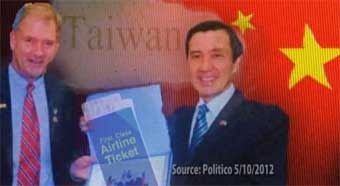
US political ad uses wrong ‘Taiwan’ flag

A still from Doheny's TV ad
Congressional candidate Matt Doheny’s new ad snipes at Congressman Bill Owens over a visit to Taiwan last year, but used the Chinese flag as a backdrop 

Taiwan has become the object of a US congressional battle, with a Republican candidate accusing his Democrat opponent in a new TV ad of violating house rules by having lobbyists pay for a US$22,000 trip to Taiwan last year — except there’s a problem: the ad shows the Chinese flag as a backdrop. 

The ad, paid for by Republican congressional candidate Matt Doheny, has led to some head scratching in the US and accusations that the “inflammatory” error could mislead the US public. At one point, the ad shows a composite image of New York Congressman Bill Owens on the left-hand side of the screen, holding a blown-up picture of a first-class airline ticket. President Ma Ying-jeou (馬英九) stands in mid-screen, also holding the airline ticket. In the background is a supine white island in the shape of Taiwan, with the word “Taiwan” inscribed on it in black, while the right-hand side of the screen displays two yellow stars on a red background, in what is clearly the flag of the People’s Republic of China (PRC). 

My article, published today in the Taipei Times, continues here.

A chance to learn from others

John Baird, PM Harper and Premier Wen Jiabao
An Canada-China investment agreement that is close to being implemented could provide important lessons to Taiwan, provided Taipei is willing to listen 

The deal, signed on Sept. 9 and quietly tabled late last month, is to be ratified, behind closed doors, within just 21 sitting days and without any public hearings. Legislators on the trade committee were briefed for just one hour by government officials last week, with no independent witnesses present. To any Taiwanese who has tracked the style of negotiations between President Ma Ying-jeou’s (馬英九) administration and China in the past four years, the situation described above will sound eerily familiar. 

However, the deal in question is not the Economic Cooperation Framework Agreement (ECFA) signed in 2010 after six months of negotiations, or the investment protection agreement inked on Aug. 9. It is the Foreign Investment and Protection Agreement (FIPA) between China and Canada, which critics say requires public scrutiny and risks putting Canada at a disadvantage. 

The Conservative government of Canadian Prime Minister Stephen Harper, however, refuses to hold public hearings and seems intent on forging ahead with an agreement that even its supporters admit contains flaws. 

My unsigned editorial, published today in the Taipei Times, continues here.

Tuesday, October 23, 2012

A portrait of the artist as a victim of the Ayatollahs: A review of Salman Rushdie’ Joseph Anton

Author Salman Rushdie
Rushdie’s all-too-timely memoirs of the fatwa years are a reminder that things have grown progressively worse 

In a world where the black birds of hatred have felled colossal towers, threatened cartoonists with murder and attacked embassies over a film preview, Salman Rushdie’s years under the fatwa, a death warrant ordered by the Ayatollah Khomeini on Feb. 14, 1989, may not seem extraordinary. The fact that living under the shadow of terror in the name of religion, of cross-border assaults on freedom of expression, is now regarded as close to normal speaks worrying volumes about the world we now inhabit. 

It wasn’t always so, and a brilliant new book by Rushdie takes us down into the heart of darkness, a portrait of the artist as a victim of state-sponsored terror as mullahs and religious zealots called for murder over his novel, The Satanic Verses, which in their interpretation of it had blasphemed against the Prophet Mohammed and insulted Islam. Joseph Anton — the pseudonym Rushdie would use during his years in hiding under police protection — is a story of intolerance, anger, fear and betrayal, but also courage, resilience, love and friendship, in a decade-long battle between the forces of repression and freedom.

The book, US edition
The contours of the story are pretty well known: In 1988, Rushdie, the Indian-born author of the Booker Prize-winning Midnight’s Children and one of the greatest storytellers of our time, published his fourth novel, The Satanic Verses, a book partly inspired by the life of the Prophet Mohammed and a deranged man’s musings on the early days of Islam. No stranger to controversy, Rushdie had already succeeded in angering Indian Prime Minister Indira Gandhi and General Mohammad Zia ul-Haq of Pakistan in Midnight’s Children and Shame respectively. The Satanic Verses was no exception. The Indian government banned it before its release, and soon afterwards, a large protest was organized outside the American Cultural Center in Islamabad, during which six people were killed. Muslim communities in the UK also felt the book was an assault on the Koran, and soon enough, in scenes that were more at home in Nazi Germany than late twentieth-century Britain, the book was burned, as was an effigy of the author himself. 

My book review, published today in the Taipei Times, continues here.

Monday, October 22, 2012

Russia Flexes its Atomic Muscles

A submarine-launched missile heads for its target
Angered by US plans to deploy missile defenses, Moscow puts on display its fearsome nuclear arsenal 

With the U.S. and Russia deadlocked over a plan by NATO to deploy a European missile defense system, Moscow showed the world what it meant by “technical response” last week by holding what has been described as the most comprehensive test of its strategic nuclear arsenal since the collapse of the Soviet Union in 1991.

According to Russian media, President Vladimir Putin, whom critics have accused of overplaying the nuclear threat from the West to boost his political fortunes domestically, oversaw the entire series of tests, which were conducted mostly on Oct. 19. All three components of Moscow’s nuclear “triad” — strategic bombers, land and sea-launched long-range nuclear missiles — as well as communications and command-and-control systems featuring “new algorithms,” were tested.

My article, published today in The Diplomat, continues here.

Saturday, October 20, 2012

Taiwan’s great cognitive divide

Taiwanese cross a street in Taipei
Two contesting extremes in Taiwan politics are making it impossible for a universal view to emerge, and Taiwan suffers as a result 

The elderly man approached the podium immediately after I finished delivering my talk. “Not bad, but you’re not one of us, so you can’t truly understand our problem, or how evil the Chinese Nationalist Party [KMT] really is,” he said. 

For the previous half hour, I had been addressing a crowd of 200 Taiwanese-Americans in Dallas, Texas, encouraging them to seek out allies in the pan-blue camp rather than regard it as an unchangeable, monolithic and invariably inimical entity. Well, so much for that. 

I’d been warned, before delivering my talk, to expect this from some people, and frankly, I didn’t need the reminder, as this has happened on a number of occasions since I began writing about Taiwanese politics six years ago. Somehow, for reasons that are presumably cultural or genetic, Westerners are unable, we are told, to understand not only the “Asian mind,” but Asian history as well. No matter how deeply one plunges into Asia’s past, culture, language or contemporary events, and no matter how long one has lived there, it is impossible to get to the core; as if only Asiatic minds are capable of deciphering the mysteries of their race. How very, pardon the term, Chinese. 

Not to be bested, there are some expatriates in Taiwan, or people based elsewhere who follow Taiwanese political developments, who also engage in similar bigotry. 

My op-ed, published today in the Taipei Times, continues here.

Wednesday, October 17, 2012

The contrast across the Taiwan Strait

People watch a water show outside Longshan Temple
How Taiwanese and Chinese behave in the face of political crises is yet another sign of the huge identity gap that exists in the Taiwan Strait 

Four Japanese and a Chinese co-worker were enjoying a quiet dinner on Thursday when, out of nowhere, a group of people approached them and roughed them up, the kicks and punches accompanied by queries — some warped idea of due process, perhaps — as to whether they were indeed Japanese. 

This “welcome” to China dispatched the Japanese and their Chinese friend, whose hand was apparently slashed by an assailant’s knife, to hospital. According to a Japanese consulate official, the attack may have been linked to the escalating tensions between China and Japan over the Diaoyutais (釣魚台). Given a series of similar attacks on all things Japanese across China in recent weeks, the official’s assessment was probably not too far off the mark. 

What is worrying about this latest incident is that it didn’t occur in some backwater, where lack of exposure to foreigners would perhaps explain the ignorance and xenophobia that led to the attack. No, it was perpetrated at the heart of China’s commercial hub, in “modern,” glitzy Shanghai. 

My unsigned editorial, published today in the Taipei Times, continues here .

Monday, October 15, 2012

Coming To a Warzone Near You: Kamikaze Drones

South Korea's Devil Killer UAV
Look out! Defense firms are now designing killer drones that are meant to launch suicide attacks on their targets 

Just a few weeks ago The Diplomat reported that the U.S. military was developing unmanned aerial vehicles that are capable of making life-and-death “decisions” on their own, without the need for human input. This scenario, which immediately drew comparisons to at least one famous apocalyptic science-fiction movie, is worrying enough, raising fears of hordes of “sentient” drones turning on their former masters. Now there’s something else out there to worry about, and this one is much closer to seeing action in war zones — the “kamikaze” drone.

About a year ago, reports emerged that the U.S. Army had placed its first order for “Switchblade” drones, small explosive-laden unmanned aerial devices that are launched from a tube and capable of loitering over an area until the order is given to dive at a target and detonate its charge. About the size of a backpack, the “Switchblade,” acquired as part of the Army’s Close Combat Weapons Systems project, acts as what is known as a standoff agile munition, with the soldier using video feed or GPS to identify targets and call in a “suicide” attack. The 2.5 kg Switchblade has an operational radius of 10 km, with an endurance of 10 minutes and an operational altitude below 500 feet (though it can reach 15,000 feet) [...]

According to more recent reports, the U.S. is not alone in developing that type of technology. The South Korean military is developing its own “kamikaze drone” — known as the “Devil Killer” — which can crash into targets in North Korea at speeds reaching 250 mph.

My article, published today in The Diplomat, continues here.

Friday, October 12, 2012

Opening Pandora’s Box: If Israel Strikes Iran, What About Hezbollah?

Militants carry Iranian and Hezbollah flags
Hezbollah, through direct strikes on Israel or terrorist attacks, could complicate Israel's decision to attack Iran and spark an even greater regional crisis 

As the day approaches when Israel may decide to launch a preemptive strike against Iran in order to cripple its nuclear infrastructure, Israeli policymakers and their allies abroad would carefully assess how the Lebanese-based group Hezbollah would react. 

Although Israel is unlikely to launch an attack on Iran prior to the U.S. Presidential election in November, the government of Prime Minister Benjamin Netanyahu is said to be running out of patience and is becoming more vocal in warning that Iran’s nuclear program could cross Israel’s so-called “red line” by next spring or summer at the latest. Other factors, including the outcome of the U.S. elections, the outcome of the P5+1- Iran talks that are expected to follow the U.S. Presidential Election, growing instability in neighboring Syria, and the outcome of the early elections that Netanyahu has just called, will all factor into Israel’s decision on whether to use force against Tehran, and if so, when. 

But perhaps no single factor, besides Iran’s nuclear program itself, will be as important in influencing Israel’s strategic assessment as the realization that attacking Iran risks sparking a war on several fronts; that is, one that not only invites retaliation from Iran, but very likely from its regional ally and sometimes proxy, Hezbollah. 

My feature, published today in The Diplomat, continues here.

Wednesday, October 10, 2012

Reflections on National Day

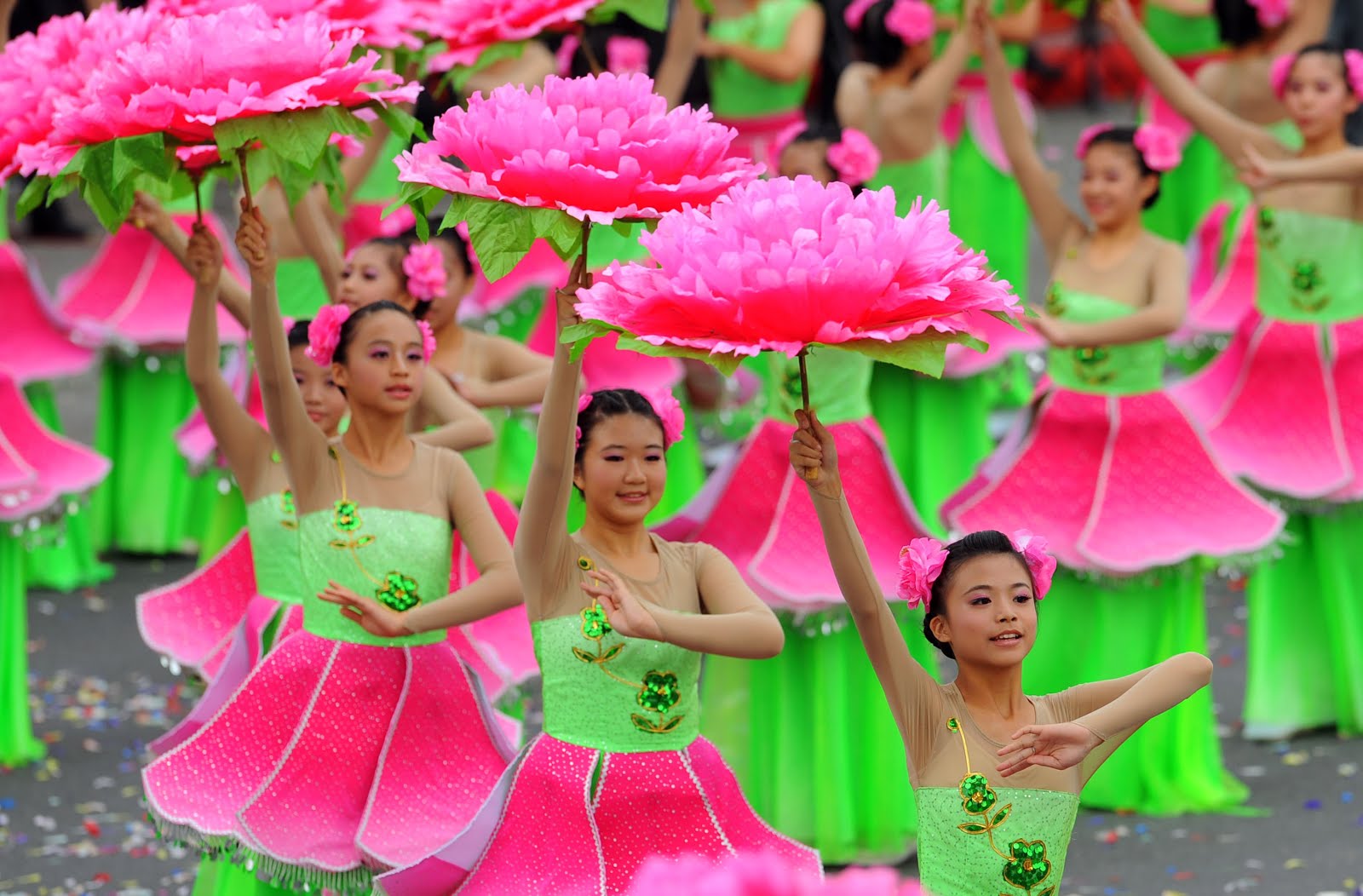
Dancers perform on National Day in Taipei
Much as the Nationalist flag has gained new meaning, so does the day on which people celebrate the idea of nation 

Oct. 10 is always a problematic issue among Taiwanese and their supporters, many of whom will argue that the date, which coincides with the birth of the Republic of China in 1911, does not, cannot, stand for Taiwan’s national day. Some have in fact proposed other dates — March 23 (1996), for Taiwan’s first free presidential election, or July 15 (1987), when Martial Law was lifted — to mark Taiwan’s birthday.

The confusion, and perhaps even the resentment, is perfectly understandable. After all, the Republic of China, in its original and repressive iteration, was imposed on Taiwan after World War II and even more so following the Nationalists’ defeat to the communists in 1949. However, over the years, from the authoritarian era to the lifting of martial law, the ROC and the Chinese Nationalist Party (KMT) indigenized, liberalized and democratized, while the old guard, politicians and soldiers who aimed one day to “retake the Mainland,” either passed away or became inactive as the result of old age. With the passage of time, furthermore, a larger percentage of the people alive in Taiwan today were born on the island, and with that, any attachment to “the Mainland” become more distant, a mere abstract that perhaps applied to one’s parents or grandparents, but had little meaning for contemporary people here.

Consequently, rather than colonize Taiwan, it could be argued that Taiwan colonized the ROC and the KMT by forcing both to become localized, and the need to win democratic elections only served to accentuate that transformation. As such, when Taiwanese come out and celebrate National Day, even if they’re wielding the Nationalist flag, in their heart what they’re celebrating is not some tenuous attachment to “the Mainland,” but Taiwan as an independent nation in its own right, built on the sediments of both its history as a colonial subject and as a people that reached out to the outside world to carve its distinct identity.

Taiwan is not unique in that respect. A fact little known to most, my home country, Canada, also celebrates its national day, on July 1, upon colonial foundations: On that day in 1867, the British North American Act, which united three colonies into the British Empire, was enacted. It then became Dominion Day (Jour de la Confédération in French), and only came to be known as Canada Day in 1982 (I was already seven at the time) following passage of the Canada Act. One would be challenged to find a single person among the hundreds of thousands of Canadians who celebrate every July 1 who, in his heart of hearts, does so out of lingering attachment to the old days of British rule. Times changed, identities changed; only the date remained. There’s no reason why it should be any different in Taiwan.

Happy National Day!

The case against pet strollers

A Japanese dog stroller
The practice is not only ridiculous, it’s bad for the animal 

By some account, the following scene has to constitute animal cruelty — first comes the stroller, catching the attention of passers-by seeking to catch a glimpse of little toes, or a toddler’s innocent smile. However, instead of a baby, they see a furry, yapping little thing, and if that were not disconcerting enough, the dog is incongruously wearing four tiny red shoes.

No country has more house pets per capita that are not walking on all fours — as they were meant to be — than Taiwan. The phenomenon deserves attention, as the preternatural pampering masks a darker side of society. 

My (much lighter) unsigned editorial, published today in the Taipei Times, continues here.

Monday, October 08, 2012

New Missile Rules in Asia?

Mock missiles on display at a museum in S Korea
Seoul recently announced an agreement with the US that allows it to extend the range of its ballistic missiles. Could Taiwan be next?

South Korea announced on Sunday it had reached a new agreement with the U.S. that allows it to substantially extend the range of its ballistic missiles to 800 km and to greatly increase the payload of shorter-range missiles. The move, which has been described as a means to increase South Korea’s deterrence capability vis-à-vis North Korea, could make other countries within the region, particularly Taiwan, seek a similar lifting of restrictions.

A 2001 accord signed between Seoul and Washington prevented the South Korean military from developing ballistic missiles with ranges of more than 300km and payloads exceeding 500kg (prior to that agreement, the maximum range was 180km, but North Korea’s test-firing of a Taepodong-1 missile over Japan in 1998 encouraged the change). The 2001 arrangement, which reflected the guidelines stipulated in the Missile Technology Control Regime (MTCR), a voluntary mechanism principally meant to curb nuclear proliferation and the means to deliver nuclear warheads, held for years as Washington feared lifting it would spark an arms race in Asia.

Pyongyang’s continued efforts to develop long-range missiles and nuclear technology, however, appear to have convinced the U.S. of the virtues of having its local ally bolster its own deterrence capabilities.

My article, published today in The Diplomat, continues here.

UPDATE: Reacting to the announcement, North Korea on Tuesday said the new agreement showed that Seoul and the US were plotting to invade the North as part of a conspiracy to ignite a war. The National Defense Commission said it would consequently bolster its military preparedness, while reminding Washington that it had missiles capable of reaching the US mainland.

The ‘status quo’ and the stultification of the mind

The Presidential Office in Taipei
Decades of relative stability and lack of drama in the Taiwan Strait have made it possible for ‘experts’ to get away with laziness 

Recent events have convinced me, more than ever, that the “status quo” that has prevailed in the Taiwan Strait for more than two decades has stultified otherwise sharp minds, making it less likely that the solutions necessary to address the complex problem of Taiwan’s future will emerge.

Taiwan’s situation — only 23 smallish official diplomatic allies, an awkward existence as officially unofficial with others, claimed by China as a province — is as complex as it is fascinating. But its struggle has gone of for so long without resolution or even high drama that its people’s future is easily ignored by a large segment of humanity. As a result, only a small group of individuals, including lobbyists, officials, academics, journalists, bloggers, can be said to be keeping the flame alive on the international scene. 

Unfortunately, many of those individuals, noble intentions notwithstanding, have also fallen victim to the calcifying effects of the so-called “status quo.” Lack of interest abroad in the problem, added to the absence of dramatic developments, have transformed the narrative into one of facile “us versus them” generalizations, pitting the pro-independence green camp against the “alien” and “pro-China” blue camp within Taiwan. That narrative finds sustenance in history, with the blue Chinese Nationalist Party (KMT) acting as a colonial power invading Taiwan and repressing the native Taiwanese. Rarely, however, does the storyline change. As a result, the perception of today’s KMT remains in essence one of an alien and nefarious party, while the green camp’s existential battle continues to be regarded from the perspective of the victim, forever crushed under the heel of much more powerful and invariably satanic forces. 

Given the general lack of interest among the media and within government agencies worldwide, the so-called “experts” and lobbyists who perpetuate such interpretations of the situation usually get away with it. This lack of curiosity, plus the absence of drama in the Taiwan Strait, has made it possible for some advocates to become lazy. They won’t get caught if they are dead wrong, or fail to do their homework, or claim to “know” Taiwan, without having lived here for years or visited frequently enough and for extended periods of time to be intimately aware of what’s truly going on here. 

Taiwan may be alone in the small group of conflicts that have gone unresolved for several years in that there hasn’t been high drama to shock people from the deep slumber they’ve fallen into, nothing like the sporadic explosions of violence between Israelis and Palestinians, or the occasional clashes between North Korea and South Korea, the self-immolations by Tibetans opposing Chinese rule, the small wars between Indians and Pakistanis over Kashmir, Russia’s scorched-earth policy in Chechnya, genocidal acts by Sudanese in Darfur, sectarian violence in Iraq, guerrilla war in Afghanistan, and so on. Wars, violence and revolutions are ugly, but in them one nevertheless finds rejuvenation, and through that the need to revisit one’s assumptions and to learn the facts, old and new. 

Without this, and through twenty, or even thirty years of relative inactivity of the headline-grabbing sort, the question of Taiwan hasn’t compelled those who care about it to keep pace with events. One, therefore, can sit comfortably thousands of kilometers away from the reality of life in Taiwan, and still be called an expert on the subject, unaware, meanwhile, that silently, behind the clamor of the world’s headlines, things are indeed changing. Have been changing. 

Sadly, revisiting one’s ossified assumptions requires far less effort than learning things anew, and therefore such “experts” (by no means all; there are good ones out there) will often refuse to acknowledge different views held by those who, by virtue of being here in Taiwan, or of having come relatively late upon it, will perhaps have a slightly fresher, if not more realistic, take on the situation. Rather than accept the notion that rejuvenation is necessary, those experts (there are exceptions, to be fair) will systematically reject any contradictory information and attack individuals rather than their ideas, and will turn to exclusion rather than inclusion so as to protect the comfortable environment with which they have become accustomed over the years, and on whose stepping stones they have built their reputations. 

This, I fear, bodes ill for Taiwan’s future.

Thursday, October 04, 2012

Taiwanese pilot dies in Mirage 2000 crash in France

Two Mirage 2000 take off at an airbase in Taiwan
A Taiwanese pilot died yesterday morning after his Mirage 2000-5F crashed in France 

The pilot, identified as Wang Tung-yi (王同義) was on a training exchange program at the BA 116 airforce base in Luxeuil-les-Bains, Haute-Saone, and his aircraft crashed north of Luxeuil, near the Froideconche community soon after takeoff at 10:05am, French military officials told media. 

Froideconche Mayor Henri Passard said the aircraft crashed in a wooded area about 500m from a housing community and dozens of kilometers from the air base. “For the time being, nobody has been able to approach the site of the crash, for security reasons,” he said. “We must first determine what type of weapons were on board the aircraft.” 

French newspaper Le Figaro reported that witnesses had seen a “ball of fire” prior to the crash. Passard said that based on information he had received, the pilot did everything in his power to avoid crashing into houses.

My article, published today in the Taipei Times, continues here.

US carrier battle groups active in West Pacific

The USS George Washington sails near Guam
The presence and exercises are mostly routine, but the US Navy is definitely showing the flag in the region 

Two of the US Navy’s global force aircraft carrier strike groups are currently patrolling the Western Pacific within distance of the South and East China Seas, providing “a combat-ready force that protects and defends the collective maritime interest of the United States and its allies and partners,” the US Seventh Fleet has said. 

US Navy officials said the USS George Washington carrier strike group had begun operating near the East China Sea — recently the scene of escalating tensions between Japan, China and Taiwan over the Diaoyutai Islands (釣魚台) — while the John C. Stennis Strike Group (JCSSG), led by the USS John C. Stennis carrier, is now operating near the South China Sea, also the scene of sovereignty disputes involving China, Taiwan, Vietnam and the Philippines. 

US Pacific Command (PACOM) said the JCSSG paid a scheduled port visit at Kota Kinabalu in Sabah, Malaysia, on Sunday. This was the first visit by a US carrier in Sabah, which adjoins the South China Sea. The JCSSG is currently with the Seventh Fleet area of operations for training and will eventually rejoin the Fifth Fleet in the Middle East. 

Meanwhile, the USS Bonhomme Richard forward-deployed amphibious assault ship, with about 2,000 marines on board, along with two escort vessels, is said to be operating in the Philippine Sea. 

All three carrier battle groups took part in joint live-fire exercises with the Japanese Self-Defense Forces near Guam last month, drills that also included beach landings. A spokesman for PACOM said the exercises and carrier deployments were not necessarily related to the Diaoyutai dispute.

My article, published today in the Taipei Times, continues here.

Wednesday, October 03, 2012

Nothing to gain (and lots to lose) by lying to the US

Taiwanese fishing boats mix with Japan coast guard vessels
Ironically, some Taiwan advocates seem to believe CCP propaganda more than they do senior Taiwanese officials 

For once, Taiwan has behaved like an independent country in its response to the Diaoyutai Islands (釣魚台) dispute, and yet critics argue that by doing so the administration of President Ma Ying-jeou (馬英九) is actually doing Beijing’s work. 

The irony is hard to miss, but this is exactly what some supporters of Taiwanese independence have been saying. Even though Taipei’s recent actions over the islets may have gone against the wishes of its benefactor in Washington, one cannot advocate for Taiwanese independence only to attack the government when it acts to protect its perceived interests, even if one disagrees with the policy.

Unfortunately, the groups in question suffer from a bad case of “groupthink” and remain fixated on an idea — the Chinese Nationalist Party (KMT) as irremediably bad — while conveniently discarding whatever information does not fit their preconceptions. 

My unsigned editorial, published today in the Taipei Times, continues here.

Lockheed awarded US$1.85bn F-16 contract

Two ROCAF F-16s sit on the tarmac
The ball is now rolling for the upgrade program, which will greatly enhance the capabilities of Taiwan’s existing F-16s 

US-based Lockheed Martin Corp announced on Monday it has been awarded a US$1.85 billion contract by the US government to initiate the upgrade of Taiwan’s 145 Block 20 F-16A/B aircraft. 

The multi-year retrofit is part of a US$5.2 billion package notified to US Congress in September last year and will include Active Electronically Scanned Array (AESA) radar, embedded global positioning and upgrades to the electronic warfare systems and avionics. 

The defense firm, which will also be the prime integrator for the upgrade of 300 US Air Force (USAF) F-16s, said both programs would be based on the F-16V, for “Viper,” configuration. The new version, the result of input from the USAF and foreign clients, was unveiled at the Singapore Air Show. 

My article, published today in the Taipei Times, continues here.

Monday, October 01, 2012

The age of the sentient killer drones

A 'dumb' US Predator drone takes off in Kandahar
Military technicians are working on developing drones that do not need human supervision. Some could even have license to kill 

It’s almost impossible nowadays to attend a law-enforcement or defense show that does not feature unmanned vehicles, from aerial surveillance drones to bomb disposal robots, as the main attraction. This is part of a trend that has developed over the years where tasks that were traditionally handled in situ are now operated remotely, thus minimizing the risks of casualties while extending the length of operations.

While military forces, police/intelligence agencies and interior ministries have set their sights on drones for missions spanning the full spectrum from terrain mapping to targeted killings, today’s unmanned vehicles remain reliant on human controllers who are often based hundreds, and sometimes thousands of kilometers away from the theater of operations. Consequently, although the use of drones substantially increases operational effectiveness — and, in the case of targeted killings, adds to the emotional distance between perpetrator and target — they remain primarily an extension of, and are regulated by, human decisionmaking.

All that could be about to change, with reports that the U.S. military (and presumably others) have been making steady progress developing drones that operate with little, if any, human oversight.

My article, published today in The Diplomat, continues here.