Wednesday, July 11, 2012

EC225 Super Puma helicopters enter service

A Super Puma performs at Songshan AFB
The search-and-rescue helos are the first-ever European-built choppers to enter service in the Taiwanese Air Force 

Three European-built EC225 Super Puma helicopters were officially commissioned into the air force at a ceremony yesterday, providing a welcome boost to the nation’s search-and-rescue (SAR) capabilities. 

During the ceremony, held at Songshan Air Force Base in Taipei, President Ma Ying-jeou (馬英九) told a large gathering of military personnel and foreign dignitaries that the armed forces’ disaster response work in recent years had earned them the trust of the public. 

1x EC225, 3x S-70C at Songshan AFB
The EC225, built by the France-based Eurocopter, an EADS subsidiary, has a maximum takeoff weight of about 11 tonnes and can accommodate two pilots, four crew and as many as 20 passengers or three stretchers, according to the builder’s Web site. The twin-engine, five-rotor-blade helicopter has a maximum endurance of five hours and 38 minutes, a maximum speed of 324kph and a maximum range of 838km. 

The Super Pumas are the first European-built helicopters to serve in the Air Force’s rescue squadron, joining the Sikorsky S-70Cs, the nation’s main workhorse for search and rescue operations, which were acquired in the 1980s and 1990s. The total price tag for the three helicopters was NT$3.6 billon (US$120 million). 

My article, published today in the Taipei Times, continues here.

Fixing the economy, one bold step at a time

Cargo ships arrive at Kaohsiung Harbor
There could not be a better time for Ma to take bold steps in the right direction. The support is there — and the clock is ticking 

Two developments are making it clear that the Ma Ying-jeou (馬英九) administration and the technocrats who fill its ranks must not only shift gear on the economy, but shift into high gear before it’s too late. 

First is the adoption earlier this week of maximum residue levels for the leanness-enhancement drug ractopamine by the Codex Alimentarius Commission, which is likely to result in a decision by the Democratic Progressive Party (DPP) to end its ongoing legislative boycott of a vote on the import of US beef products containing the agent. 

The US side, which has made resolving the dispute over ractopamine a sine qua non for the resumption of long-stalled Trade and Investment Framework Agreement (TIFA) negotiations, is now hoping that the Ma administration will be able to pass the bill allowing the imports. Once this is out of the way, there would be no reason why TIFA talks could not resume, US officials have told this newspaper in private. 

The other development is the continued deterioration of the nation’s economic indicators, epitomized by a revised GDP growth forecast for this year by Citibank, which trimmed its prediction to 2.8 percent, from 3.3 percent in May, saying the figure could be revised downwards again should the situation fail to improve. 

My unsigned editorial, published today in the Taipei Times, continues here.

Tuesday, July 10, 2012

Tri-service missile exercise at Jiupeng

A Lafayette-class frigate fires a Hsiung Feng II missile
The hit ratio was much better than last year, but problems with target drones, and an intrusion by a foreign fishing boat, caused headaches 

The armed forces yesterday held a missile exercise in the south, substantially increasing the hit ratio from a similar drill in January last year with a 96 percent success rate. In all, 26 missiles were fired from 12 platforms in the Joint Live Fire Exercise of the Armed Forces at the Chung-Shan Institute of Science and Technology (CSIST) missile test base in Jioupeng (九鵬), Pingtung County. Three services — the army, air force and navy — participated, with more than 2,300 soldiers mobilized for the exercise.

A Tien Chien missile hits its target
Things got off to a rather dispiriting start when the first two items on the agenda, the CSIST-developed Tien Kung II (TK-2) surface-to-air missile and a US-made ship-launched Standard Missile I (SM-1) surface-to-air missile, were canceled seconds before they were to be fired. Just over 15 minutes after successful intercepts by ground-launched Hawk and air-launched Tien Chien II (TC-2) and MICA missiles, a Hsiung Feng II (HF-2) anti-ship missile launch from a Lafayette-class frigate had to be canceled after a fishing vessel reportedly ventured into the naval exclusion zone. Minutes later, a short-range HF-1, launched off a Jin Chiang-class missile corvette, hit its target, a decommissioned transport ship located 9 nautical miles (16.6km) into the Taiwan Strait.

A surface-to-air Tien Chien I
From then on, the rest of the exercise went smoothly, with F-16-launched AGM-65 “Maverick” and AIM-9 “Sidewinder” missiles, and a “Ching Kuo” Indigenous Defense Force-launched TC-1, all hitting their targets in mid-flight. A ground-to-air version of the TC-1 also intercepted its target, while two AIM-9s launched by AH-1W Cobra attack helicopters hit their objectives. 

Journalists cheered when the military announced that the HF-2 and SM-1 launches would now proceed, as the fishing vessel had cleared the area. While the SM-1, launched off a Perry-class vessel, intercepted its target, the HF-2 failed to hit home, missing another decommissioned transport ship 33 nautical miles at sea — the only miss that day. 

My article, published today in the Taipei Times, continues here.

Sunday, July 08, 2012

Navy investigates disappearance of classified chart

Hai Ou missile boats at anchor in Tsuoying, Kaohsiung
A top-secret CSIST computer went missing in May. Now a classified naval chart. Someone needs to plug those holes 

Two classified naval charts were reported missing when an inventory was carried out amid the decommissioning of aging Hai Ou (“Seagull”) missile boats last month, and the information they contained could put navy vessels at risk during wartime, reports said yesterday. 

According to the Chinese-language United Daily News, navy officers who had custody over the documents accidentally burned one of the two missing charts while destroying other documents, but the other, which contained classified information about naval deployments in the Taiwan Strait, remains unaccounted for. 

The missing chart reportedly contained hydrographic data, ship information, waterways depth, sea salt fluctuation and the locations of navy vessels and submarines in wartime. The information could leave navy vessels exposed if it were to fall in enemy hands, reports said. 

My article, published today in the Taipei Times, continues here.

Saturday, July 07, 2012

Time To End U.S. ‘Ambiguity’ on Taiwan

President Obama speaks at the Pentagon
With China’s emergence as an economic powerhouse, and its concurrent military buildup, ambiguity has  lost its effectiveness and is now an invitation for adventurism 

For the more than three decades since the United States’ recognition of the People’s Republic of China, Washington has relied on strategic ambiguity to deter China from using force against Taiwan. Although the Taiwan Relations Act of 1979, passed by Congress after U.S. President Jimmy Carter established diplomatic relations with Beijing, calls for the U.S. to help Taiwan defend itself, in application the U.S. has often kept the two sides guessing at its willingness to intervene in a conflict, and if so, in what capacity. 

Such ambiguity worked for three decades, but it won’t last for much longer. 

My article, published today in The Diplomat, continues here.

The Chinese art of inflexible diplomacy

PLA Navy sailors walk in step
The Chinese stick to alleged historical claims to justify their inability to compromise on the South China Sea disputes. Expect the same about their claims over Taiwan 

If the position of Chinese officials and academics on China’s claims in the South China Sea is any indication of how a resurgent Beijing intends to handle diplomacy, Taiwanese should be happy that political talks with Taipei have not begun — at least not in official settings. 

A packed conference organized last week by the Center for Strategic and International Studies in Washington on the intensifying disputes in the South China Sea showed, in no uncertain terms, that vague historical claims, rather than international law, are Beijing’s tool of choice on what it regards as its core interests. 

Judging by the number of Chinese academics and journalists who showed up at the two-day event, there’s no doubt that the Chinese have every intention of hammering the message home wherever they can. On the first day of the conference, this writer shared a table with Chinese correspondents from every major Chinese media outlet, including the Chinese Communist Party (CCP)-run People’s Daily and China News Service. Nearly half of the people in attendance were Chinese and almost every panel had a Chinese academic presenting Beijing’s claim. This was in sharp contrast to the not-distant past and a sign of China’s emergence as a political force to be reckoned with; politicos in Washington told me that a few years ago, one was hard pressed to find any Chinese at such conferences. 

My op-ed, published today in the Taipei Times, continues here.

Friday, July 06, 2012

Fear not the great ‘brainwashing’

A child rides his own 'dragonboat'
The claim that young Taiwanese can somehow be 'brainwashed' not only goes counter to the evidence, it is also insulting and condescending 

Recent efforts by President Ma Ying-jeou’s (馬英九) government to emphasize Chinese studies in school curricula have led some people to warn of a possible “brainwashing” of the nation’s youth and the eventual dissolution of national identity. While the government’s measures are a cause for concern, their effectiveness in undermining Taiwanese identity is questionable. 

For decades following its relocation to Taiwan in 1949, the Chinese Nationalist Party (KMT) imposed strict controls on education and the media to re-sinicize Taiwanese after half a decade of Japanese colonial rule. However, even in an authoritarian and pre-Internet society, those efforts failed to transform Taiwanese into something they were not (for another example of the failure of government propaganda to turn people into mindless automatons, even in closed societies, just ask any cab driver in Cuba for his views on Fidel Castro and communism). However, despite the KMT’s repressive tactics, Taiwanese identity flourished, first as an underground movement and, after the lifting of Martial Law in 1987, as part of national politics with the emergence of the Democratic Progressive Party.

Gone are the days where state control of education can fundamentally shape young people, if it ever did. 

My unsigned editorial, published today in the Taipei Times, continues here.

Wednesday, July 04, 2012

Back in Taiwan

Dear readers: I came back to Taiwan last night after spending two weeks in Washington, D.C., for a series of meetings with various officials, members of congress, and academics on Taiwan-related issues. Regular posts will now resume.

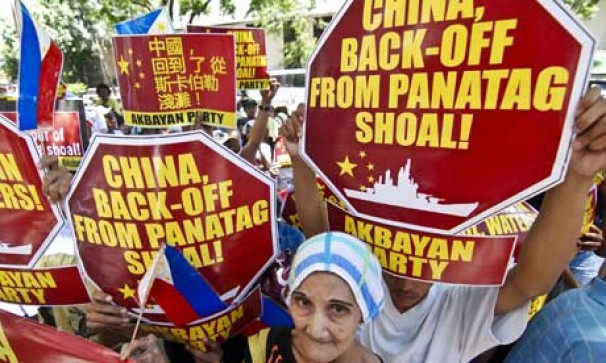
Analysis: Stormy weather predicted over South China Sea dispute

Philippine protesters call on China to back off
Ten years after ASEAN and China agreed to a declaration of conduct, parties are now rushing to sign a code of conduct by the annniversary deadline 

A multilateral code of conduct to deal with South China Sea (SCS) territorial disputes, scheduled to be signed later in 2012, could create false expectations if it fails to include concrete steps to resolve disputes in the area, analysts told a conference in Washington last week. 

My analysis, published on July 2 in Jane's Defence Weekly, continues here (subscription required).

Friday, June 29, 2012

Stability in Taiwan Strait factor in South China Sea conflict

An oil platform in the South China Sea
The recent stability in the Taiwan Strait is a source of new tensions in the South China Sea, as it has freed up Chinese military assets 

The relative calm in the Taiwan Strait since 2008 is one of the principal factors behind China’s increasingly aggressive stance in the South China Sea, a Vietnamese academic told a conference in Washington on Wednesday. 

The two-day conference, organized by the Center for Strategic and International Studies (CSIS), was held amid rising tensions in the South China Sea following the announcement by China National Offshore Oil Corp (CNOOC) earlier this week that it was offering nine blocks for joint operation with foreign firms in waters that Vietnam claims fall within its exclusive economic zone (EEZ), prompting Hanoi to lodge an formal protest. 

Speakers from China, Vietnam and the Philippines — all claimants in the South China Sea disputes — were invited to give presentations on the subject, while academics from the US, Japan and India, which do not have sovereignty claims in the area, provided external rationales for their involvement in conflict resolution. No one from Taiwan, one of the six claimant countries, presented at the conference. 

Full article in the Taipei Times continues here.

Friday, June 15, 2012

The blue-green faultline weakens Taiwan

Pan-green legislators continue to occupy the floor of the Legislative Yuan yesterday
Given the nature of the Chinese threat, political parties in Taiwan should focus their energies on external risks rather than against each other 

Taiwan is one of very few countries about which it can be said that it faces a threat to its survival. Given this, decisionmakers should ensure that resources and energy are properly channeled to meet any challenge head-on.

Unfortunately, that is not always the case. Israel’s situation is analogous to Taiwan’s: Both are threatened by an external enemy bent on denying them the right to exist and which have shown determination to use force to achieve that end. Granted, the analogy only goes this far, as the dynamics of power in the two conflicts differ markedly. In Taiwan’s case, it is the weaker party in the struggle, while Israel in its struggle has the upper hand militarily and is an occupying force, which generates a whole new set of grievances. 

That being said, the threat facing Israel is no less serious and its gravity has served as a rallying force for its people. There are undeniably serious differences of opinion inside Israel about how to deal with the challenges created by the Palestinians’ right to self-determination or attacks against Israelis by groups like Hamas and the Palestinian Islamic Jihad. Israel’s democratic way of life has helped bring those differences into contrast. However, all Israelis, from those who support the use of force to resolve the conflict to those who regard the occupation as the main cause of the conflict, agree on the need to do what is necessary to ensure the survival of their nation. 

This is an example that Taiwanese appear unwilling to follow. 

My unsigned editorial, published today in the Taipei Times, continues here.

Wednesday, June 13, 2012

Former MIB spy sentenced for leak; Bergersen out

Former MIB deputy dep't head Pang Ta-wei
While Pang Ta-wei got into trouble for the second time, a former Pentagon analyst jailed in the US for providing secrets to China has been released 

The Taiwan High Court yesterday sentenced a retired military intelligence officer to three years and six months for violations of the National Intelligence Services Act (國家情報工作法).

The court ruled that Pang Ta-wei (龐大為), a former deputy department head at the Military Intelligence Bureau (MIB), had already been convicted for leaking national secrets in 2007 in a book, which reportedly included information about his unit’s espionage activities in China from the early to mid-1990s. Pang had been sentenced to 18 months in prison for leaking classified information pertaining to national security.

In 2009, Pang completed his memoir, titled Intelligence Journal, which was allegedly based on notes he had taken while serving at the bureau, as well as other related documents. After the book, written under a pen name, was put on sale in January 2010 through a publishing house in Hong Kong, Pang was once again accused of leaking national intelligence. 

In its ruling yesterday, the court said it had taken Pang’s health — he is undergoing treatment for chronic myelogenous leukemia — into consideration in sentencing him.

My article, published today in the Taipei Times, continues here.

Tuesday, June 12, 2012

Fast-attack missile boats’ Achilles’ heel?

Hsiung Feng launchers are installed on a frigate
By disabling radar and data links needed to acquire target information, China could blind Taiwan’s fast-attack missile boats and render them practically useless 

The effectiveness of Taiwan’s fast-attack missile boats to counter the Chinese military will largely depend on the vessels’ ability to acquire targeting information, which might not be guaranteed in a full-scale war scenario, a defense expert said recently. 

Unable to compete with the People’s Liberation Army Navy on a tonne-for-tonne basis, the Taiwanese Navy has in recent years embarked on an “asymmetrical” program, developing and fielding fast-attack boats equipped with a variety of surface-to-surface and anti-ship missiles. 

Since 2010, three squadrons, for a total of 31 170-tonne Kuang Hua VI fast-attack missile boats, have entered service in the navy. Each boat is equipped with four Hsiung Feng II (HF-2) anti-ship missiles, which have a range of approximately 150km. Last year, the military also began modifications on some of its 500 tonne Ching Chiang-class patrol boats to outfit them with four Hsiung Feng III (HF-3) ramjet-powered supersonic anti-ship missile launchers. Five Cheng Kung-class frigates have also been outfitted with HF-3s as part of a NT$12 billion (US$406 million) program to arm the navy with 120 HF-3s, a 300km-range missile that since last year has been known as Taiwan’s “carrier killer.” And a new 450-tonne radar-evading fast attack corvette currently under development is expected to be outfitted with eight HF-2 and HF-3 launchers, and possibly the 650km-range HF-2E. 

All those platforms, however, could be rendered into useless hulls if the offshore radars and data links required to launch the missiles are disabled. 

My article, published today in the Taipei Times, continues here.

Sunday, June 10, 2012

Taiwan placing its F-16C/D request in holding pattern

F-16 aircraft in flight
Despite promising momentum on the US side, Taipei appears to have abandoned all efforts to procure the aircraft, defense industry insiders are saying 

Taiwan is committed to a full upgrade for its fleet of 145 F-16A/Bs, but may be hinting at a possible F-35 Joint Strike Fighter request in order to delay its acquisition of 66 F-16C/Ds as it faces budgetary constraints and a difficult political situation domestically.

The majority of the aircraft currently in service in Taiwan’s air force were acquired in the 1980s or early 1990s. With the ageing F-5Es to be decommissioned, and rumours that some Mirage-2000s — whose spare parts are increasingly costly — could suffer a similar fate soon, Taiwan has launched efforts to modernise its fleet through mid-life upgrades of the domestically-produced F-CK-1 Indigenous Defence Fighter (IDF) and US-made F-16A/Bs, along with possible new acquisitions.

A recent report commissioned by Lockheed Martin claimed that without new procurements, the number of serviceable aircraft in Taiwan’s air force would drop by 70 per cent by 2020, and by 50 per cent if new aircraft are acquired.

My article, published in the June issue of Jane’s International Defence Review, continues here (subscription required).

Friday, June 08, 2012

Military holds major tri-service exercise in southern Taiwan

AH-1W helicopters fire on targets in Pingtung yesterday
This was only the second time in four years that the media were invited to attend the Lien Yung exercise
  
The armed forces yesterday held a major live-fire drill in Pingtung County, weeks after the Ma Ying-jeou (馬英九) administration was accused of being soft on national defense for not using live ammunition during the Han Kuang series of exercises in April.

The Lien Yung exercise, which Ma attended, was held at the Tri-Service Joint Training Base at Paolishan (保力山) in Henchun (恆春), Pingtung County, the nation’s only base for live-fire exercises of this magnitude. In all, 935 members from the army, air force and navy took part in the drill, which involved F-16A/B aircraft, AH-1W attack helicopters, OH-58D reconnaissance helicopters, CM-11 battle tanks, M109 howitzers and Javelin anti-tank missiles, as well as a variety of grenade launchers and rifles, all aimed at targets on the flank of the mountain. 

My article, published today in the Taipei Times after grueling travel in hot and humid Pingtung, continues here.

Democracy is no mere commodity

Taiwanese voters in the Jan. 14 presidential election
Acknowledging that Taiwan is the first Chinese democracy does not mean one agrees that Taiwan is part of China. Those are two different issues 

Some political commentators from the pan-green camp were recently angered by remarks by President Ma Ying-jeou (馬英九), which they interpreted as saying that Taiwan’s democratic way of life was a “Chinese democracy,” arguing instead that it was a “Taiwanese democracy.” 

Many of Ma’s detractors seem to regard the president’s comments on the subject as part of his administration’s attempts to Sinicize Taiwan, to the detriment of its identity as distinct from China. 

While a case can be made about the Ma government’s tendency to overemphasize the Chinese “bloodlines,” “history” and “culture” that are part of the mix of Taiwanese identity, those who see Ma’s efforts as a dangerous attempt at rewriting history should in turn be wary of making claims that depart from reality. Arguing that democracy in Taiwan is “Taiwan’s democracy,” it must be said, does exactly that. 

My op-ed, published today in the Taipei Times, continues here.

How to alienate an important ally

An F-16A/B takes part in an exercise in Pingtung yesterday
Members of the US Congress who over the years have fought for Taiwan could be reluctant to do so again if Taipei does an about-face on the F-16C/D 

President Ma Ying-jeou (馬英九) came into office in 2008 on the promise that he would improve relations with the US, the nation’s most important diplomatic ally, a goal he claimed he had attained as he campaigned for a second term. 

Though it denied doing so, Washington in the months leading to the Jan. 14 presidential election acted in a way that supported Ma’s contention, with some officials in US President Barack Obama’s National Security Council sabotaging Democratic Progressive Party (DPP) presidential candidate Tsai Ing-wen’s (蔡英文) visit to the US prior to the vote. 

That is not to say that Ma’s relations with Washington were always smooth, especially when it came to the US beef controversy, which led directly to the ouster of Ma’s first National Security Council secretary-general, Su Chi (蘇起). However, it can be said that the relationship has been stable overall, following years of shakier ties under the DPP’s Chen Shui-bian (陳水扁). 

All that could be about to change, though, as the Ma administration appears close to committing an about-face that could not but be felt as a transoceanic slap in the face by some of Taiwan’s staunchest supporters in Washington. 

My unsigned editorial, published today in the Taipei Times, continues here.

Wednesday, June 06, 2012

US officials wary of possible Taiwan-China cooperation in South China Sea

Fishing boats navigate the South China Sea
While US defense officials encourage the peaceful development of relations in the Taiwan Strait, in private some fear cooperation could go too far 

Although US defense officials welcome recent efforts to improve relations across the Taiwan Strait, some are starting to show a high degree of concern about possible cooperation between Taiwan and China on South China Sea disputes, Taiwanese academics say. 

At the Shangri-La Dialogue in Singapore last weekend, US Secretary of Defense Leon Panetta said Washington strongly supports the efforts that Taiwan and China have made in recent years to improve cross-strait relations. 

While Panetta strongly encouraged further development in that direction, in more quiet settings, US officials are reportedly expressing reservations about possible cooperation between Taiwan and China on military issues, including South China Sea disputes and an eventual mutual-trust mechanism. 

My article, published today in the Taipei Times, continues here.

Friday, June 01, 2012

Taiwan seeking full US$5.2bn upgrade for F-16s

An F-16A/B in flight at Hsinchu AFB on Wednesday
Taiwan is expected to sign the LOA within 45-60 days. What is not included in this LOA will be part of a second one in two years 

The air force will procure the full US$5.2 billion upgrade package for its fleet of F-16A/B aircraft notified to US Congress in September last year, but will do so in two phases, the Taipei Times has learned. 

This latest twist in the F-16 saga comes after reports in February said that the Executive Yuan had decided it would give the air force only US$3.7 billion to upgrade its 145 F-16A/Bs, forcing the military to trim some of the articles included in the US$5.2 billion package, which includes Active Electronically Scanned Array (AESA) radars, electronic warfare suites, air-to-air missiles and, more controversially, a variety of Joint Direct Attack Munitions (JDAM) kits. 

Air Force Command Headquarters announced early last month that it had received an official answer from the US, which reportedly contained articles that reflected the US$3.7 billion allocated by the Executive Yuan. Taiwan is currently evaluating the contents of the letter and is expected to sign the letter of agreement within 45 to 60 days. 

However, a defense industry source told the Times yesterday that Taiwan would still procure the entire US$5.2 billion upgrade, but would do so in two phases, with the second phase — worth about US$1.5 billion — taking place in two years. 

My article, published today in the Taipei Times, continues here.

The stigma that never goes away

Su Tseng-chang takes the helm at the DPP on Wednesday
Taiwanese politicians — and now warheads — are ‘anti China,’ part of a linguistic bias that seeks to negate Taiwan as a legitimate entity in itself 

Taiwan probably has the distinction of being the global leader on the frequency by which it is referred to as being “anti-” something, an underlying bias among journalists and academics that is as unfair to its peaceful constituents as it is to reality. 

For years, the Democratic Progressive Party (DPP), which played an instrumental role in the democratization of the country and which is founded on the principle of self-determination, has been plagued by references, usually in foreign media, as an “anti-China” party. No matter what it does, the DPP is portrayed as a political entity that would will China out of existence if it could. 

In reality, throughout the years and under various leaders, the party has shown itself amenable to exchanges with China and has engaged in dialogue with Chinese officials on a number of occasions, in both above-board and behind-the-scenes settings. Even under former president Chen Shui-bian (陳水扁), whom Beijing reviled as an “extremist” bent on “splitting the motherland,” the DPP made several attempts, especially during its first term, to foster closer relations, so much so that the economic interrelationship in the Taiwan Strait changed dramatically during that period, developments that simply could not have happened had Chen and the DPP been “anti-China.” 

My unsigned editorial, published today in the Taipei Times, continues here.