Saturday, July 31, 2010

Why 'Formosa Betrayed' wasn't filmed in Taiwan

Those who have already seen the movie Formosa Betrayed, which is scheduled for release in Taiwan on Friday, may have noticed that the actors’ accents, the locales and many of the characters didn’t look or sound “authentic.” The reason for this is very simple: The Taiwan scenes weren’t filmed here, but in Thailand.

However, the decision to shoot there, rather than where the political thriller is set, wasn’t entirely in the hands of the producers. In an interview with the Taipei Times in Taipei on Thursday, Will Tiao (刁毓能), one of the main actors and the producer of the film, suggested politics played a big part.

“What most people don’t know is that we came to Taiwan, we had casting sessions here and we wanted Taiwanese actors,” said Tiao, a Taiwanese-American.

However, the shadow of the giant market next door weighed heavily.

“A number of performers didn’t want to do this because they were afraid of what this would do to their careers in China,” he said. “We interviewed a number of actors and later would hear through their agent: ‘We read the script and we decided no, we’re not doing it.’”

Another issue with the Taiwanese performers who auditioned was that as the movie is primarily in English. Many of the actors weren’t fluent enough.

Those, however, were not the main reasons why the film wasn’t shot here.

The movie studio had turned to the National Development Fund (NDF), a Cabinet agency, for funding, a process that started in 2007, one year before shooting began and when Chen Shui-bian (陳水扁) of the Democratic Progressive Party was still in power.

This article, published today in the Taipei Times, continues here. The rest of my interview with Will Tiao will be published on Monday.

Friday, July 30, 2010

Fugitive dissident not done trying to re-enter China

One of China’s most wanted fugitives says he hasn’t given up trying to return to China and won’t relent in his efforts to pressure Beijing to democratize.

Wuer Kaixi, a prominent student leader during the 1989 Tian anmen Square protests, told the Taiwan Foreign Correspondents Club yesterday that despite two failed attempts, he would continue to try to re-enter China to visit his parents in Urumqi, Xinjiang, whom he hasn’t seen for 21 years.

Since Wuer Kaixi became a wanted “criminal” after the Tiananmen crackdown, his parents have been barred from leaving the country.

The dissident, who lives in exile in Taiwan, was turned back after attempting to enter Macau last year and was barred from boarding a flight from Tokyo to Beijing last month.

He was arrested by Japanese police and detained for two days after attempting to jump over a security gate to get into the Chinese embassy in Tokyo.

“I am now able to say I am a political dissident with jail experience — two days,” the 42-year-old said.

This article, published today in the Taipei Times, continues here.

Friday, July 23, 2010

PRC’s new rules could limit Chinese reports on Taiwan

New regulations by China’s Propaganda Department on provincial and metropolitan news media could have serious implications for investigative reporting and press freedom in the country, Reporters Without Borders (RSF) said on Wednesday — and could undermine the ability of Chinese media to obtain information about Taiwan.

The latest restrictions reportedly include a ban on exchanges of newspaper articles with media in other provinces, and a prohibition on media in metropolitan areas carrying their own reporting on national or international stories, or modifying the coverage of stories on such topics provided by state-owned media.

It remains to be seen if the regulations would apply to Chinese media operating in Taiwan.

At present, five regional Chinese media outlets operate in Taiwan. Reporters from Fujian SETV, the Fujian Daily, Xiamen TV, Hunan Television, the Shenzhen Special Zone Daily and the Shenzhen Economic Daily are posted here.

Five state-owned outlets — Xinhua news agency, the People’s Daily, China Network Television, China National Radio and China News Service — also have reporters filing from Taiwan.

If the regulations are applied to Chinese media operating in Taiwan, the regional media outlets based here could be barred from providing their reporting to media in Chinese provinces, or media in metropolitan areas could be prohibited from using reporting about Taiwan from sources other than state-owned media, such as Xinhua.

The new regulations also include a call to cease all negative reporting about the police and judicial authorities.

Hong Kong’s Ming Pao newspaper said the new regulations were implemented on July 1.

This story, published today in the Taipei Times, continues here.

Wednesday, July 21, 2010

Speakers nix PRC cyber warfare talk under pressure

Experts at a private Taiwanese security company decided to pull out of a security conference in Las Vegas after coming under what was described as pressure from Chinese and Taiwanese agencies.

Wayne Huang, chief technology officer and founder of Taiwanese security vendor Armorize Technologies, and Jack Yu, a researcher at the company, were scheduled to give a talk on Chinese cyber warfare capabilities at the Black Hat USA 2010 security conference, which will be held in Las Vegas on Wednesday and Thursday next week.

They said they decided to pull out last week after coming under pressure from several Chinese and Taiwanese agencies.

“The Chinese Cyber Army: An Archaeological Study from 2001 to 2010,” derived from information gathered from intelligence groups across Asia, had been advertised as an in-depth analysis of government-backed Chinese cyber espionage.

“Using facts, we will reconstruct the face of the Cyber Army, including who they are, where they are, who they target, what they want, what they do, their funding, objectives, organization, processes, active hours, tools and techniques,” the Black Hat Web site quoted the presenters as saying.

On Wednesday last week, Armorize chief executive officer Caleb Sima wrote on Twitter that the talk had been pulled because the “Taiwanese [government] is prohibiting it due to sensitive materials.”

Black Hat conference organizers yesterday confirmed to the Taipei Times that the talk had been cancelled, but refused to discuss the reasons why. 

This article, published today in the Taipei Times, continues here.

Sunday, July 18, 2010

'Tourist' may have been guided by PRC intel

Information has come to light that could indicate that a Chinese tourist who was caught in May last year taking photos in a restricted area of an army recruitment center in downtown Taipei may have been directed by Chinese intelligence.

On May 25 last year, Ma Zhongfei (馬中飛), a Chinese tourist who reportedly was chairman of a high-tech company, left his tour group at Taipei 101 and ended up at an Armed Forces recruitment center on Keelung Road, about 2km away from the landmark. After entering a computer warfare command area through a back door, Ma was caught by security taking photos in the computer warfare command area.

While the recruitment center is open to the general public, the computer warfare command area is a restricted facility.

After being apprehended by military police, Ma was handed over to the Taiwan High Prosecutors’ Office for investigation on suspicion of illegally intruding into a military area.

The following day, a prosecutor ordered Ma’s release and did not bar him from leaving Taiwan. The Ministry of Justice said it didn’t have sufficient evidence to indict him.

A former government official who handled intelligence matters under the former Democratic Progressive Party administration told the Taipei Times last week that the Ma case was far more alarming than it first appeared and hinted that political intervention may have played a role in the decision not to charge him.

This article, published today in the Taipei Times, continues here.

Monday, July 12, 2010

China corrupts, wherever it goes

As Chinese President Hu Jintao (胡錦濤) passed through the Canadian capital late last month ahead of the G20 meeting, there was yet another example of the nefarious influence the Chinese government is having on freedom of expression worldwide. Given Taiwan’s proximity to — and increasingly close ties with — the Asian giant, this latest development should serve as a warning.

While the great majority of state visits with world leaders in Ottawa conclude with a press conference, Hu’s didn’t. In fact, it has since been revealed that the office of Canadian Prime Minister Stephen Harper agreed to cancel the joint press conference to prevent critical Chinese journalists from participating. The Chinese embassy in Ottawa was reportedly concerned that the press conference would include reporters from two media organizations reviled by Beijing — the Epoch Times and New Tang Dynasty TV.

A few weeks prior to Hu’s visit, the Chinese embassy had reporters from those two organizations barred from attending the press conference. The request was first turned down by the parliamentary press gallery, on the grounds that the media organizations were full members of the gallery.

Not to be dissuaded, the embassy then went straight to the prime minister’s office. Initially, as the Globe and Mail reported, Harper’s office attempted to strike a compromise with the gallery. Facing principled opposition, Harper’s office decided to cancel the press conference altogether, sparking accusations from Helene Buzzetti, president of the parliamentary press gallery in Ottawa, that Harper had agreed to Chinese censorship.

This op-ed, published today in the Taipei Times, continues here.

Sunday, July 11, 2010

Telling the story

Years in the making and produced on a shoestring budget, Formosa Betrayed has already played in select theaters in the US and Canada. Starting on August 6, it will finally be playing in the country whose story it strives to bring to a wider audience — that of Taiwan.

This author had a chance to see the much talked-about movie on Friday at a pre-screening in Ximending. Some Taiwanese Americans had already told me that, ostensibly for budgetary reasons (the movie cost US$7 million, pocket change by contemporary Hollywood standards), the Taiwan scenes were actually filmed in Thailand. As a result, Taiwanese — along with expatriates who have lived in Taiwan long enough — can immediately tell that most actors and extras are Thai rather than Taiwanese, which is also reflected in how they speak. The same applies to the location, which anyone familiar with Taipei would tell you isn’t an accurate representation.

In the end, however, this doesn’t really matter. After all, big-budget movies have also, albeit for different reasons, used people from another ethnic group, and different locales, to tell “historical” stories. Chinese actress Zhang Ziyi playing a Japanese geisha on a set in California is a perfect example of this.

What makes Formosa Betrayed work as a movie is that it is actually quite entertaining, has very few longueurs and flows well. It makes good use of non-linear storytelling and foreshadowing. Furthermore, the main actors do a convincing job and have some pretty intense scenes. Beyond the pure entertainment value, which should attract people who otherwise would not be interested in a political movie about little-known, distant Taiwan, is the fact that it tells an important story, one that is inspired by actual events.

It is important to emphasize that the movie is not a documentary, nor does it pretend to portray the era with airtight accuracy. In fact, for the Taiwanese who lived during that dark period in Taiwan’s history, or who, like this author, have made Taiwan their specialization, certain anachronisms will catch the eye, such as large poster, with dictator Chiang Kai-shek’s figure and text calling on Taiwan to “retake” the mainland, or the presence of military and police on almost every street corner. While these scenes would have been realistic for a movie taking place in the 1960s or 1970s, they are slightly inaccurate in a 1980s setting, when (a now-dead) Chiang’s dream of retaking the mainland had long been seen as pure folly, and where police brutality, though still existent, was no longer as overt as it is portrayed in the movie.

That said, by mixing fiction with historical fact, Formosa Betrayed manages to make the White Terror era and the 228 Massacre of 1947 not only alive again, but also interesting. That part of Taiwan’s history, successfully effaced by the regime responsible for the atrocities through propaganda, education, and a system of fear that lingered on well after Martial Law was lifted in 1987, is little known by those who either did not live through it or who are not from Taiwan. And yet, it was formative to the nation’s psyche and helps explain the political rift that still exists on the island. It also makes it easier to understand why many Taiwanese who lived during that dark period, are apprehensive at President Ma Ying-jeou’s courting of authoritarian China. Theirs isn’t irrational fear, as many media would portray it, but one that is founded on first-hand experience of relatives being arrested, taken away, locked away for years, tortured and, in many instances, killed by the authorities.

This regime of fear, whose deadly hand extended to the US in the form of murder of dissidents (often with the help of triad organizations) — and is the core of the movie — has conveniently been forgotten by many who now hope for rapprochement between Taipei and Beijing. Younger generations of Taiwanese, those born in the 1990s, know very little about the other Taiwan, the one that a mere 30 years ago was more akin to China than the vibrant, free, safe and wealthy democracy that it is today. People didn’t talk about such things as 228 back then, lest they be taken away by the authorities. Many today still cannot talk about it, conditioned as they were to avoid discussing such dangerous topics.

As a result, generations of Taiwanese suffer from amnesia, and as long as the story isn’t told, the catharsis that is required for healing as a nation will not occur. While older generations of Taiwanese have, in some cases, sought to tell tomorrow’s leaders about what it was like to live under the White Terror, Taiwanese youth today does not make for a receptive audience. In many cases, this is ancient history for them, and they would rather focus on getting a good education and a good job (and play video games, chat with friends and read Japanese manga). Documentaries, history books and academic articles — the domain in which 228 and the White Terror have been explored — simply has no appeal to young people.

That is why a movie like Formosa Betrayed is so important — and timely. The format is far likelier to appeal to young people than jargon-filled academic discussions or late-night political talk shows. It is also far likelier to interest non-Taiwanese and awaken enough curiosity in some, who will then turn to the history books or pay more attention to what is currently happening in the Taiwan Strait.

In many ways, art is a far more powerful educator than even the best speech or academic work, and has the capacity to engender emotional reactions that simply cannot be aroused by, say, works of non-fiction or documentaries. It is that emotional connection that turns forgotten causes into objects of mobilization. Taiwan has long been an orphan, easy to ignore or subsume into China, because its people (out of fear, perhaps) haven’t told their story to the world in a way that appeals to people’s imagination. Formosa Betrayed does that, just as Steven Spielberg’s Schindler’s List did in its treatment of the Holocaust, which eventually created a new wave of public interest (even among non-Jews) in the question.

It is also aptly titled, as it gradually dawns on the audience that the betrayal is not so much by the authoritarian regime in Taiwan, but rather by the US, which conveniently looked the other way when their man in Taipei, be it Chiang or his son, Chiang Ching-kuo, served their purposes in the Cold War, even if this implied ruling Taiwanese with an iron fist. There was nothing free about “free China,” yet this is what government officials in Washington called it. Independence and democracy movements were nuisances and terribly inconvenient to a government that was fighting its ideological (and sometimes hot) war against communism.
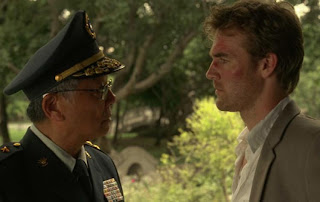
Fast-forward to today, and the war of ideologies has been replaced by regional integration, free trade and stock markets. China, the old enemy, is no longer regarded in that light, while Taiwan is an active democracy. And yet, the same old aspirations for freedom and right to choose one’s future continue to be regarded as nuisances and “trouble-making.” In many ways, the conflict between ideals and geopolitical imperatives, remains as true today as it was during the period covered in the movie. In one of the most powerful scenes in the movie, a young, idealistic FBI agent, skillfully played by James Van Der Beek, has a shouting match with his boss back in Washington after returning from Taipei. Political forces want him to ignore human rights violations in Taiwan; his sense of justice, however, tells him this is what really matters. The conflict isn’t fiction: It was alive then, and it is alive today, despite the different times.

By fictionalizing a story about a different time, Formosa Betrayed makes its important message timeless, which is what art is all about. Taiwan’s story is a fascinating one, one that the world ignores at its own loss. Perhaps this movie will get the ball rolling, and who knows, maybe director Ang Lee — a product of this land — will make his own big-budget Taiwanese version of Schindler’s List one day.

The DVD of Formosa Betrayed will be released in the US on July 13.

Friday, July 09, 2010

Can we trust the WTO to ‘review’ the ECFA?

During an e-mail interview with the Central News Agency (CNA) earlier this month, in which the expected benefits of the Economic Cooperation Framework Agreement (ECFA) signed by Taipei and Beijing were discussed, WTO Director-General Pascal Lamy was quoted as referring to Taiwan not by its official designation at the trade organization, but rather as “Chinese Taipei.”

Wire searches returned the key two entries — one, the original interview in English, and the other a Chinese translation of that interview.

In the English article, titled “ECFA will help Taiwan integrate into global economy: WTO,” CNA quotes Lamy as saying: “Now, the ECFA is an important initiative in this endeavor and we think it could considerably improve cross-strait relations and can be very important for ensuring the competitiveness of domestic industries and further integrate Chinese Taipei into the world economy.”

Meanwhile, the Chinese version avoided direct mention of the national title [「現在,ECFA在這些努力中是一個重要作為,我們認為可以相當程度地改善兩岸關係,對確保國內產業競爭力及進一步納入世界經濟也是非常重要」].

I have since learned from a contact at CNA that throughout the interview, CNA reporters always referred to Taiwan as “Taiwan,” while Lamy invariably referred to it as “Chinese Taipei.” He did not even use Taiwan’s official name as a WTO member, the (admittedly tongue-twisting) Separate Customs Territory of Taiwan, Penghu, Kinmen and Matsu, or a more convenient shorthand, such as Republic of China.

This op-ed, published today in the Taipei Times, continues here.

Thursday, July 08, 2010

CNN censors its own

Over the years, the focus of my criticism of states that deny freedom of expression to their citizens or prevent journalists from doing their work has, given my position, been China, or that country’s impact on such freedoms abroad. However, this does not mean that when other states — especially those that are ideologically aligned with my views — transgress on freedom of the press, I will choose to remain silent.

As it turns out, the US, this great defender of freedom and democracy, has its own problems when it comes to freedom of expression, especially when the topic is the Middle East. Case in point: CNN this week fired Octavia Nasr, a 20-year CNN veteran based in Atlanta, Georgia, after she used Twitter to express, in all of 140 words, her admiration for Grand Ayatollah Mohammed Hussein Fadlallah, who passed away in Lebanon on Sunday.

Part of Nasr’s message read as follows: “Sad to hear of the passing of Sayyed Mohammed Hussein Fadlallah … One of Hezbollah’s giants I respect a lot.”

Hezbollah, as we all know, is listed as a terrorist organization by the US and other Western governments. However, although Fadlallah was an early supporter of the Islamic Revolution in Iran and was a spiritual leader and mentor to Hezbollah when it was formed following the Israeli invasion of Lebanon in 1982, he later distanced himself from the organization’s ties with Iran and never supported the wave of kidnappings it launched in the 1980s. In other words, he was, at most, a moderate voice within Hezbollah, whose designation as a terrorist group is, in my view as a former intelligence officer who worked on that file for more than a year, questionable and self-defeating.

Fadlallah, like many Lebanese, resisted the invasion of his country by Israeli forces and its shelling by US Navy vessels. And while it was Hezbollah that first brought car bombings into the headlines, those means (and others) were part of a war of resistance, not terrorism, as Israel would want us to believe. Calling him a “giant,” as Nasr did, especially after he distanced himself from the radical arm of Hezbollah, was more support for a cleric who became increasingly moderate than for “terrorism.”

CNN had no right to fire Nasr for her comments, especially as she did not make them on CNN, but rather in a personal Tweet. I’m pretty sure, too, that had another CNN journalist expressed similar admiration for, say, Ariel Sharon, who over his life was responsible for the deaths of thousands of Lebanese and Palestinians, and whose views were equally “radical” — if not more — than Fadlallah’s, that reporter would never have been fired.

Shame on CNN for once again highlighting the fact that it is not truly an independent media organization, especially when the Middle East is concerned.

Wednesday, July 07, 2010

Let the blackmail begin

The China Times editorial have of late been a gold mine for my middle-of-the-night musings on the Economic Cooperation Framework Agreement (ECFA) signed between Taiwanese and Chinese semi-official agencies last week. Between stories in the office last night, I came upon an op-ed that basically argued that if the legislature were to make any changes to the ECFA document while it “reviews” it, it would risk derailing the whole trade pact — and cross-strait relations  — in the process. In other words, according to the China Times, the legislature had better not do its job and should pass the ECFA as a whole, quirks and all.

The opinion piece also argued that making changes to the ECFA document would set a bad precedent (something President Ma Jing-jeou himself argued last week) and put at risk Taiwan’s ability to sign free-trade agreements with other countries — as if other countries looked askance upon legislative bodies doing what they’re supposed to be doing, that is, ensure that pacts, treaties and agreements signed by the executive are not detrimental to the interests of the constituents who brought them into office in the first place.

What’s even more worrying is that the person(s) writing this is/are Taiwanese. But then again, anything coming from the China Times Group nowadays reads like something scripted back in Beijing. The ECFA blackmail begins …

Tuesday, July 06, 2010

Jumping the gun on ECFA benefits

It occurred to me on Monday night, as I was deciding which stories would go where in the paper, that all the countries, think tanks and individuals who have hailed the Economic Cooperation Framework Agreement (ECFA) signed between Taiwan and China last week have acted prematurely.

At most, as nobody except those who actually drafted and signed the document are aware of its full contents, what the would-be supporters of the ECFA should say is that they support the spirit of a trade agreement between the two sides of the Taiwan Strait. As the documents currently only exist in Chinese and have been kept at a safe distance from public scrutiny, even trade organizations like the WTO — which is expected to “review” the translated version of the document to ensure it complies with the international body’s regulations — have been premature in their embrace of the trade pact.

What is interesting is that while the Chinese Nationalist Party (KMT)-dominated legislature in Taiwan is likely to “review” the document as a whole rather than clause by clause, as the opposition Democratic Progressive Party has requested, once it receives the English version of the document, the WTO would be expected to evaluate its contents in more than cursory fashion. In other words, the WTO’s review of the ECFA will likely be more thorough than that of the legislature. And of course, we can expect no “review” — not even the pretense of one — on authoritarian China’s side. 

Another question mark is whether Taiwan and China will, alongside the English translations, provide the Chinese originals so that the WTO can ascertain the legitimacy of the English versions it receives from the parties involved.

A possible scenario is one in which a document “approved” by the legislature is criticized on its finer points by the WTO (that is, of course, if the WTO does its job). How would Taiwan and China respond, then? Would they comply and make the appropriate corrections, or would they ignore the WTO, claiming that the trade agreement is a domestic matter, or one that involves two sides of the same coin? This is where the unanswered question of whether the ECFA is a treaty or not becomes so important. If the trade agreement is not regarded as a treaty (and therefore not involving two sovereign states, as only states can sign treaties), then how could the WTO have any say in the matter, as its mandate is to regulate trade between states? 

Already, there have been rumors that WTO Director-General Pascal Lamy privately believes the ECFA is a domestic matter (I even saw, though chose not to use, an except of an interview with Lamy by CNA in which he is quoted as referring to Taiwan as “Chinese Taipei.” Whether this is what he actually said, or revisionism by CNA editors, remains to be determined).

‘Bedeviled’ by near-sightedness

Washington Post reporter Keith Richburg (with staff writer John Pomfret and staff researchers in Beijing and Shanghai) had an irritating piece on cross-strait relations on June 30, which replicated a number of mistakes often made by international media.

The article, titled “China, Taiwan sign trade pact,” opens by regurgitating the old platitudes we have been reading about since Ma Ying-jeou came into office, from the 60 years of cross-strait hostility to Ma’s efforts to improve ties with China. It then paints a very rosy picture of the Economic Cooperation Framework Agreement (ECFA) signed by the two sides in Chongqing, China, last week, followed by this paragraph:

“U.S. officials, however, have predicted that the trade pact will not remove the issue of U.S. arms sales to Taiwan from a list of problems bedeviling Washington’s relations with Beijing,” followed by a reference to the US$6.4 billion arms package announced earlier this year, which the author tells us “prompted a withering response from China and a freezing of military ties with the United States.”

Let’s go back to the byline. It’s always problematic when a report that talks about Taiwan is written by people based in Beijing. When one sees such a byline, he or she should already know that the report will be lopsided and almost invariably reflect the official position in Beijing. That is a major handicap for Taiwan in terms of global media coverage: Only the major wire agencies have someone posted here, while newspapers can’t be bothered and rely on China-based reporters. This suggests that newspapers like the Washington Post and others should perhaps rely on freelancers a little more — that is, if balance were actually something their news desks value.

US arms sales are often characterized by such reports as “bedeviling” or “irritants.” Ironically, China’s threatening posture across the Taiwan Strait, the People’s Liberation Army’s hardline policy on Taiwan, and the 1,500 missiles it targets it with are never called “bedeviling” or “irritants” to Washington’s relations with Beijing, as if it were perfectly normal to thus threaten a peaceful neighbor. It’s a chicken-or egg-kind of thing, and the US sells weapons to Taiwan because China continues to threaten it, not the other way around.

Turning to the supposed benefits of the ECFA (relying, among others, on the always-dependable state-controlled Xinhua news agency, as well as Taiwan’s semi-official Chung-Hua Institution for Economic Research*), the article says “Also, Taiwan has been badly battered by the global economic crisis that began in 2008. It was unable to jump-start its export-oriented economy without full and free access to China’s massive market,” which is factually untrue, as Taiwan has just experienced six months of almost unprecedented growth in exports — all prior to the signing of the ECFA last week.

The entire article only provides this on opposition to the trade agreement: “Still, the pact has generated intense resistance in Taiwan, particularly from the opposition Democratic Progressive Party [DPP], which favors more independence from the mainland and fears that opening Taiwan’s markets will lead to the island being economically swamped by China.” No explanations or quotes from DPP officials, as if the passage were mere filler, an afterthought rather than representative of views shared by many Taiwanese.

Immediately after this paragraph, the article quotes Xu Shiquan, former director of Taiwan Studies at the Chinese Academy of Social Sciences, as referring to the ECFA as a “milestone.”

There have been many reports about the potential negative impacts of the ECFA on Taiwan, both in terms of its economy and sovereignty. Why the Post could not be bothered to at least quote from one of them, let alone mention one, either stems from the paper’s lack of boots on the ground in Taiwan, or its lack of interest in providing more balanced reporting.

* The institution was founded with an establishment fund totaling NT$1 billion, with NT$900 million coming from the central government and the ROC-US Economic and Social Development Fund, and the remaining NT$100 million being donated by the industrial and business sectors.

See also, on the subject of the ECFA, my unsigned editorial on the pan-blue media hoping the DPP will refrain from engaging in partisan politics in the review of the trade agreement by the legislature.

Sunday, July 04, 2010

Sovereignty upheld? Think again

President Ma Ying-jeou’s (馬英九) administration on Tuesday was all jubilance after the Economic Cooperation Framework Agreement (ECFA) was signed in Chongqing, China, saying that it had managed to sign the pact in a way that upheld Taiwan’s sovereignty.

While it is too soon to tell whether the breakneck pace with which the deal was negotiated (about six months) and the legislature’s likely rubberstamping of the ECFA documents will hurt Taiwan’s interests, the mechanism used to complete the process most certainly did. In that regard, the Ma administration could be accused of dishonesty.

The reason for this is one important point that reports in the international media have generally missed — the ECFA was not signed by two governments but rather, two quasi- official bodies, the Straits Exchange Foundation (SEF) and the Association for Relations Across the Taiwan Strait (ARATS). No government official on either side of the Taiwan Strait — and more importantly, no elected government official on Taiwan’s side — was involved in the signing.

By relying on two semi-NGOs (the SEF receives government funding) to sign the deal, Taipei allowed Beijing to portray the ECFA as a domestic matter rather than one between two internationally recognized sovereign states. This alone, despite the alleged absence of “political” language in the ECFA documents, sends a dangerous political signal to the international community.

This op-ed, published today in the Taipei Times, continues here.

Wednesday, June 30, 2010

China lobbying provokes freeze on US arms sales

The president of the US-Taiwan Business Council yesterday confirmed a report in a US-based defense magazine that the US State Department had frozen US congressional notifications for new arms sales to Taiwan “until at least spring next year.”

Citing sources in Taipei and Washington, Defense News on Monday wrote that the suspension was the direct result of “effective lobbying by Beijing.”

“The Chinese are ramping up the pressure and engaging us in disinformation to complicate our review, particularly in the context of a vulnerable process for arms sales,” a defense analyst in Washington told the magazine.

US-Taiwan Business Council president Rupert Hammond-Chambers told the Taipei Times that so far, three notifications had been frozen, with more expected to “stack up” as the year progresses. He said the freeze has been in force for “at least a month,” but would not confirm the content of the notifications.

This article, published today in the Taipei Times, continues here. I am still awaiting responses from the US State Department and the Department of Defense's Defense Security Cooperation Agency.

Tuesday, June 29, 2010

The deed is done

Jason Miks of Australian magazine The Diplomat contacted me yesterday for comment on the economic cooperation framework agreement (ECFA) Taipei and Beijing are signing today. This was an opportunity for me to condense six months into a few rather conversational paragraphs. For those who haven't been following the developments closely, this should provide a good introduction — at least to the side that does not agree with the manner in which the whole process took place.

The economic cooperation framework agreement (ECFA) that will be signed in Chongqing on Tuesday is controversial for a number of reasons:

Firstly, in good old Chinese Communist Party (CCP) style, most of the negotiations were conducted behind doors and only very recently were the “early harvest” lists — the items from each side that will be receiving preferential tariff treatment — made public. Secondly, two public referendums proposed by opposition parties were turned down by the government on technicalities that would probably be unacceptable anywhere else in the world (at least in democracies). Third, while the trade pact is to be “reviewed” by the Legislative Yuan during an extra legislative session in July or August, the legislature is almost three-quarters controlled by the Chinese Nationalist Party (KMT) — President Ma Ying-jeou’s party, of which he is also chairman. If the previous 12 agreements that the Ma administration has signed with China are any indication, the LY will once again serve more as a rubber stamp than an actual instrument meant to keep the government honest. Fourth, both sides refused to negotiate under a WTO framework, which would have ensured that both entities are treated as equals [the ECFA document is entirely in Chinese and each side will provide the WTO with its own English version, we are told].

There is a misconception out there that the main opposition party, the Democratic Progressive Party (DPP), is “anti-ECFA” and “anti-China.” It isn’t. It is, rather, in favor of taking a more cautious approach and believes the public has the right to have a say over a pact that will undeniably have a substantial impact on the future of this country. Most trade agreements require years of negotiations. Not only was the ECFA negotiated in record time — about six months — but a fixed deadline appears to have been imposed for its signature, which is never a good thing in negotiations. Furthermore, beyond the complexities inherent in a trade pact, it involves one entity (China) that does not recognize the existence of the other (Taiwan), claims sovereignty over it and threatens force to accomplish this, if required. 

Beijing has made no secret that it sees an ECFA as a stepping stone to unification; this could explain its “generosity” on the “early harvest” list and other sweeteners likely to follow. That’s why we’re seeing reports on TV and in the papers that Taipei is getting “almost everything that it wants” from Beijing. There are, therefore, very serious political implications to an ECFA, something that the KMT denies but that the CCP has made no secret of. Short of “selling out” Taiwan, as some have accused Ma of doing, his administration may very well be falling into a trap set by Beijing.

In terms of social impact, it’s too soon to tell, but an ECFA will likely benefit large industries while hurting the smaller and traditional ones. There is also great fear that a flood of cheap Chinese goods will hurt small industries in Taiwan (a phenomenon that has already been observed with ASEAN countries that recently entered into an FTA with China).

We must remember, as well, that an ECFA is transitory rather than an end in itself. More trade liberalization will follow, but the psychological blow has already been struck and a line has been crossed. If the KMT can get away with the manner in which it shoved the EFCA down people’s throat, whatever comes next that does not touch on politics should be a relatively smooth ride. The ECFA and future agreements will create facts on the ground that will be very difficult to undo, even if the DPP were to return into office in 2012. 

Overall, greater economic entanglement with China will give the latter more power to blackmail Taipei and more leverage on the various sectors of its industry. Even if not overt, this is a political outcome to what has been portrayed by Ma as a “purely economic” trade pact. It doesn’t matter that there is no political language in the ECFA documents to be signed on Tuesday.

See also my editorial on the same subject in the Taipei Times today.

Monday, June 28, 2010

No need for Taiwan FTA, Philippine minister says

Recent comments by the Philippines’ trade and industry secretary cast doubt on the feasibility of Taiwan being able to sign free-trade agreements (FTA) with other economies in the region after it signs an economic cooperation framework agreement (ECFA) with China.

A major pillar of President Ma Ying-jeou’s (馬英九) rationale for signing the controversial trade pact has been that the ECFA would pave the way for such agreements.

“Our ‘one China’ policy stands. An FTA with Taiwan is still too early to say and … our commercial matters with Taiwan are being handled adequately through the JEC [Philippines-Taiwan Joint Economic Conference],” Philippine Trade and Industry Secretary Jesli A. Lapus was quoted by the Manila Bulletin as saying on June 22.

Lapus said the JEC was working well and that the next meeting between Taiwanese and Philippine representatives — the 17th — would be held in Taiwan. The JEC was initially scheduled to be held in the first quarter, but was rescheduled to the fourth quarter to accommodate the entry of a new administration in the Philippines.

“Let the new administration call the shots” on the possibility of expanding the JEC to a full-fledged FTA between Taiwan and the Philippines, he said.

This article, published today in the Taipei Times, continues here.

Sunday, June 27, 2010

When the gulag meets capitalism with Chinese characteristics

In the Kafkaesque world of Chinese political repression, two words stand out as epitomizing continuity and adaptation in the Chinese Communist Party’s (CCP) reliance on incarceration to ensure its survival: lao (勞, labor) and gai (改, reform). Drawing from the Maoist philosophy that work for the betterment of the nation will purify one’s thoughts, the laogai, or “reform through labor,” is a system by which “antisocial” elements are removed from society and “reformed.” Not only are convicts and dissidents detained and “reformed,” but as Laogai: The Machinery of Repression in China shows, the state profits handsomely from the unpaid labor that takes places in those camps.

My book review, published today in the Taipei Times, is available here (pdf) and here (html).

Saturday, June 26, 2010

Did Kurt Vonnegut's brother ruin the 626 protest?

What does a Canadian reporter, columnist and deputy news editor do on his one day off in Taipei? The obvious answer, if you lived in Taiwan, would be to say: Go to the Canada d’eh celebration on the beach, especially when this is only the second Saturday you’ve had off in about four years. When it comes to this odd Canadian, however, the answer would be: go to an anti-ECFA rally in downtown Taipei.

I met up with a couple of friends at the Longshan MRT station at about 3pm, whence we snaked our way through the gathering crowd and ended up at the Wanhua rail station, were former president Lee Teng-hui (李登輝) was expected to make a speech sometime after 3:30pm. From our walk starting at the MRT station, where I only saw three police officers, to the train station, I’d estimate there were several thousands protesters (far more already than the 5,000 TVBS said would show up earlier in the day), all gathered to express their anger at, and demand a referendum on, the economic cooperation framework agreement (ECFA) the Taiwanese government is expected to sign with China in Chongqing next week. As always, the composition of protesters was about 85 percent people of a certain age, and 15 percent young adults or teenagers.

This was my fifth or six major demonstration here since I moved to Taiwan, and as expected, people were friendly and welcoming (I was once again thanked, given paraphernalia and asked to have my picture taken with some Taiwanese), and the banners and placards were colorful, well-designed and original. There even was a man who, in my view, was the epitome of the Taiwanese demonstrator, with two LCD panels affixed to his chest and an epilepsy-inducing led-lit hat on his head (my fear is that later on, when mother nature decided to pour down on us, the poor man may have been electrocuted — but hey, it was a worthy cause). Some people were blasting their gas canister horns or by-now World Cup-famous vuvuzelas, and one man had an actual trumpet, while flag-studded vehicles played speeches, songs and recordings. Overall, though, this was by far the quietest protest I’ve attended in Taiwan. There were very few foreigners (less than I’ve seen at previous protests), but I did run into Ralph Jennings from Reuters on his bicycle. It was very hot and I was happy I’d brought my Cambodian kroma, or scarf, which saved me for a heat stroke back in Cambodia when I was building houses there last year.

After Mr. Lee and others were finished making their speeches, we all began our long walk toward the Presidential Office, where another group of protesters — who had launched their  anti one China  march on Zhongxiao E. Road — would meet up with us. The procession was extraordinarily orderly, and during the hour and a half that we walked, we only encountered a handful of police officers, who were making sure people were stopping at the red lights (protesters would actually thank the officers after the light turned green, how rude!). Only once did I see a small group of Criminal Investigation Division (CID) officers — three of them — taking pictures and filming the protest. This was a welcome departure from previous protests, especially those that surrounded visits by Association for Relations Across the Taiwan Strait (ARATS) officials in November 2008 and earlier this year, where the presence of thousands of law-enforcement officers was actually intimidating and severely hurt the image of the city and central governments. My guess is that there were no senior Chinese officials to protect, and little signs that violence was brewing (for some odd reason, AFP reported today that police presence was heavy; it certainly wasn’t where I went). None of the agents provocateurs who were expected to show up and create trouble — as they did in November 2008 — did so, at least not on the route we were on.

Then, at about 6pm, the rain began, and it poured. Given the season we’re in, I had thought that demonstrators were getting a break today, as by 2pm — when it inevitably starts raining — not a drop had fallen, and the weather bureau said chances of showers were fairly small. But rain it did, even if belatedly. Our theory was that the KMT paid Bernard Vonnegut, author Kurt Vonnegut’s brother and co-inventor of cloud seeding (patented in 1975), to bring the rain. But that’s just a theory. Organizers called on demonstrators not to go home, and it looks like most people heeded the call. 

We continued walking for a while, but after taking a short break at the one 7-Eleven we encountered in our entire walk, and seeing that the rain was not abating, we called it quits and went to have dinner instead. Sadly, this means we did not make it to the Presidential Office, where more speeches were expected. But we did our part. 

As to whether the demonstration will have any effect on government policy regarding trade with China, I have strong doubts. The ECFA will be signed, no matter what, and the legislative “review” — in a legislature where the ruling KMT has a three-quarter majority — will be little more that window dressing. Taiwanese have grown cynical of mass demonstrations, which, weather aside, could explain the substantial drop in participation I have noted since I began attending rallies four years ago. At best, today sent a signal, and hopefully some good pictures will be circulated worldwide so that readers abroad can be aware that a substantial percentage of Taiwanese do not support the ECFA, or at least oppose the manner in which it was negotiated in secret and shoved down our throats by the government. As I’ve said before, media (including my employer) played into the KMT’s hands when they referred to the trade pact as a “proposed ECFA.” Proposed implies that under certain conditions, a plan could be altered, or nixed altogether. In this instance, there was no such intention, and the pact was to be signed, no matter what.

(Funny anecdote: At one point during the march, I was approached by a young Taiwanese woman who told me she was from the media and was hoping to interview a foreigner about the protest. I asked her which organization she was from, to which she responded: the Liberty Times. When I told her we shared the same employer, she realized that she could hardly interview me, as the Taipei Times belongs to the Liberty Times Group.)

Thursday, June 24, 2010

Cross-strait ‘radicals’ and ‘hardliners’

From the Merriam-Webster dictionary: Hard-line, adj. Definition: advocating or involving a rigidly uncompromising course of action. Radical, adj. Definition: marked by a considerable departure from the usual or traditional: extreme b: tending or disposed to make extreme changes in existing views, habits, conditions, or institutions c: of, relating to, or constituting a political group associated with views, practices, and policies of extreme change d: advocating extreme measures to retain or restore a political state of affairs.

With this in mind, let us turn to today’s reporting by Agence France-Presse on a vote by Hong Kong lawmakers on democratic reform:

Hong Kong lawmakers on Thursday agreed to enlarge the electoral base for choosing the city’s [sic] leader, while stopping well short of one person, one vote for the Chinese territory’s seven million people … A split in the pro-democracy opposition allowed passage for the first part of a package of political reforms, to expand the Beijing-backed committee that elects the chief executive from 800 members now to 1,200 in 2012.


Now, the interesting bits:

Radical legislator ‘Long Hair’ Leung Kwok-hung accused moderates in the Democratic Party of betrayal, as hardliners vowed to settle for nothing less than universal suffrage in 2012.

Three words stand out, all editorializing: radical, moderates, and hardliners, all terms that aren’t used, further down in the story, to qualify “the former British colony’s communist overseers in Beijing,” or, in a separate story on June 21, Hong Kong “Chief Executive Donald Tsang.”

Not unlike its reporting on Taiwan, where it invariably describes the opposition Democratic Progressive Party and Taiwan Solidarity Union as “anti China” and radical,” AFP is once again portraying anyone who disagrees with Beijing in a bad light. Rather than avoid politically hued characterizations altogether (in a bid for journalistic neutrality) or, conversely, making sure that such characterizations are equally applied when necessary, AFP limits its use of negative connotations to Hong Kong lawmakers seeking democracy and universal suffrage and Taiwanese parties that want Taiwan’s 23 million people to determine their own future without the threat of use force by China.

Surely, if AFP weren’t so openly biased, it would have used the term “hardliner” for Beijing and Tsang, who, as per the Merriam-Webster definition provided above, “advocat[e] … a rigidly uncompromising course of action” — in this case, denying residents of Hong Kong universal suffrage and ensuring that Beijing continues to control the territory, often against the wishes of its people.

The same applies to the term “radical.” How could support for democracy and universal suffrage — accepted notions the world over — possibly be equated with “extreme changes in existing views, habits, conditions, or institutions” or “constituting a political group associated with views, practices, and policies of extreme change” or “advocating extreme measures to retain or restore a political state of affairs”?

Using non-violent means to ensure the rights of Taiwanese and Hong Kongers isn’t radical or hard-line or extremist. So why does AFP continue to use such terms, if not to please Beijing?

Saturday, June 19, 2010

Nuclear power plant a ‘disaster’: contractor

The Kuosheng nuclear power plant in Wanli (萬里), Taipei County, is an “absolute disaster,” according to the head of a diving company charged with conducting underwater maintenance at the plant.

Making assertions that raise concerns about the safety of the plant, Robert Greenspan, president of the Rapid City, South Dakota-based Midco Diving and Marine Services, said during a telephone interview with the Taipei Times on Tuesday last week that Taiwan Power Corp (TPC), the operator of the nuclear power plant, was treating the suppression pool — a critical component in case of an emergency — as a “garbage dump.”

The cleaning contract for the suppression pool was awarded to Taiwanese firm Ming Tai and subcontracted to A&P Solar Enterprises, a California-based company. A&P in turn subcontracted the diving portion of the work to Midco.

Greenspan’s company conducted underwater maintenance at Unit 2 in November 2008 and March last year.

Soon after starting work at the suppression pool — a 6m deep pool surrounding the nuclear reactor that can release large quantities of water to cool the reactor to prevent a meltdown — Greenspan’s team came upon a scene they were not prepared for.

“I’ve worked in half a dozen nuclear plants in the US,” Greenspan said. “I’d never seen anything like this … You could find everything short of a bicycle in there.”

Among the foreign objects found were cable spools, oxygen tanks and masks. As they were doing work, more debris kept falling in, Greenspan said.

This article, published today in the Taipei Times, continues here.