Friday, February 18, 2011

AIT confirms US role in major spy investigation

While Taiwan, with Washington’s help, conducts a probe in the nation’s worst spying scandal in 50 years, a source said the damage to the Taiwan-US alliance would be marginal

The American Institute in Taiwan (AIT) yesterday confirmed to the Taipei Times that US authorities are assisting Taiwan with an investigation into the activities of General Lo Hsien-che (羅賢哲, left), who was arrested last month on suspicion of spying for China.

Lo’s espionage activity, described as possibly the worst spy case to hit Taiwan in the past half century, is believed to have begun in 2004 when he was recruited by Chinese intelligence while he was posted in Thailand. News of the arrest sparked fears that Taiwan’s military might have been severely compromised, especially its command, control, communications, computers, intelligence, surveillance and reconnaissance (C4ISR) systems, to which Lo is believed to have had access.

As the great majority of defense platforms used by Taiwan’s military are acquired from the US, there has also been speculation that the developments could have negative repercussions on US-Taiwan military relations at a time when US President Barack Obama’s administration already appears reluctant to release additional arms packages to Taipei.

One possible casualty, some analysts claim, could be the politically sensitive sale of F-16C/D aircraft to Taiwan.

Following announcements by the military that a probe into Lo’s actions has been launched, AIT spokesperson Sheila Paskman told the Taipei Times by telephone that US authorities were assisting with the investigation, without specifying the level of assistance or which agency was involved.

My article, published today in the Taipei Times, continues here.

Thursday, February 17, 2011

New alliance targeting CCP ‘villains’

Among the more than 11,000 Chinese Communist Party officials appearing on a blacklist for their human right violations is Liaoning Governor Chen Zhenggao, who arrived in Taiwan for a visit on Tuesday

A new alliance launched in Taipei on Tuesday last week has reportedly compiled a list of more than 11,000 Chinese Communist Party (CCP) officials it says should be barred from visiting Taiwan for the role they have played in human rights abuses in China.

The “No CCP Villain International Alliance,” which comprises groups such as the Victims of Investment in China Association (VICA), the Taiwan Friends of Tibet and the Falun Gong Human Rights Lawyers Working Group, as well as human rights activists and individuals who were persecuted by Chinese authorities, has handed its list to Democratic Progressive Party Legislator Chen Ting-fei (陳亭妃), who is expected to pass it on to the National Immigration Agency (NIA) and the Mainland Affairs Council (MAC), the Epoch Times reported on Monday.

The legislature passed a resolution in early December barring known CCP human rights abusers entry into Taiwan. The resolution, co-introduced by Chen and adopted by parties on both sides of the aisle, requires government authorities — including the MAC and the NIA — to deny Chinese officials who are known to have been involved in human rights abuses entry into Taiwan.

Greater Kaohsiung and Chiayi, as well as Changhua, Hualien, Miaoli and Yunlin counties, have adopted similar, albeit separate, resolutions.

Despite the measures, later that month Beijing Deputy Mayor Ji Lin (吉林) was allowed to visit the country despite claims by rights organizations that he had played a key role in the repression of Falun Gong practitioners since 1998.

My article, published today in the Taipei Times, continues here.

Wednesday, February 16, 2011

Ex-NSC official warns on ‘overreaction’ to spy case

As Beijing continues its zero-sum game with Taiwan, a former adviser to President Ma had one prescription for Taipei: do nothing

A former National Security Council (NSC) official yesterday said Taipei needs to be very careful about how it responds to a major espionage case involving China lest it impact other issues.

Philip Yang (楊永明), a senior adviser at the NSC from 2008 until last year and now a professor of political science at National Taiwan University, told the Taiwan Foreign Correspondents’ Club that the arrest last month of Major General Lo Hsien-che (羅賢哲) on espionage charges served as a reminder that despite warming relations across the Taiwan Strait, in the military and intelligence spheres, “Taiwan and China remain locked in a Cold War mindset.”

However, despite the seriousness of the charges against Lo — whose actions since he began spying for China in 2004 could have severely compromised Taiwan’s national security and its ties with the US military — Yang said President Ma Ying-jeou’s (馬英九) administration should choose its response carefully to avoid “overspill.”

Asked by the Taipei Times if Taipei could perhaps retaliate by canceling a visit to Taiwan next week by Association for Relations Across the Taiwan Strait Chairman Chen Yunlin (陳雲林), Yang said the controversy should not be linked to other areas of engagement with China, adding that escalation could have “domestic implications.”

So far, the Ma administration has yet to officially complain to Beijing over the Lo incident and China’s refusal to draw down its military posture. This silence is in stark contrast to the way in which Taipei reacted to a decision by the Philippines earlier this month to deport, at Beijing’s request, 14 Taiwanese fraud suspects to China despite opposition by Taiwanese officials.

My article, published today in the Taipei Times, continues here.

Tuesday, February 15, 2011

Egypt is a false analogy for Taiwan

Not only do the conditions for an uprising as experienced by Egypt in recent weeks do not obtain in Taiwan, but going down that road would endanger Taiwan sovereignty, not protect it

Following weeks of demonstrations in Egypt that ultimately forced former Egyptian president Hosni Mubarak to step down on Friday, some commentators have suggested that events in North Africa could serve as a catalyst for discontent with President Ma Ying-jeou (馬英九).

There are, however, a number of reasons why this analogy is wrongheaded and Taiwanese not only cannot — but should not — go down that road.

For one, the situations in Egypt and Taiwan are very different. Taiwan does not have a radicalized and easily mobilized political opposition such as Egypt’s Muslim Brotherhood, which has a long tradition of opposing despotic rule.

The closest Taiwan ever came to having a “radical” underground was in the 1970s, and even then its tactics were largely pacifistic, unlike the violence used by extremist wings of the Brotherhood, one of whose most prominent former members is al-Qaeda leader Osama bin Laden’s right-hand man, Ayman al-Zawahiri.

Even at its worst, the repression imposed on Taiwanese during the Martial Law era pales in comparison to that Egyptians have faced for decades. This is not to delve into moral relativism, but merely to shed light on different histories that, in one case, gave rise to radicalism, while in the other led to peaceful opposition. This is also why Taiwan today is a mostly successful democracy, while Egypt remains an unstable society.

My unsigned editorial, published today in the Taipei Times, continues here.

Monday, February 14, 2011

Ball in Taiwan’s camp on missile defense, analyst says

All the pieces for the air defense puzzle are there. Will the Ma administration take the final step to ensure success by 2015?

Despite the ability of the radar systems deployed by Taiwan’s military to track and engage large numbers of targets simultaneously, Patriot PAC-2 and PAC-3 missile batteries alone would be insufficient to deter China from launching a missile attack, a US specialist wrote.

“Patriot batteries are only one element of a complete missile-defense system,” Ed Ross, a former principal director for security cooperation operations at the Defense Security Cooperation Agency and senior director for China, Taiwan, Hong Kong and Mongolia at the Office of the Undersecretary of Defense for Policy, wrote in the latest issue of the Jamestown Foundation’s China Brief.

“The radars have a range of approximately 170 kilometers, insufficient to detect the majority of PRC [People’s Republic of China] missiles in the boost phase [over Chinese territory],” Ross wrote.

Although PAC-3 missiles were specifically designed for missile defense, he wrote, “unless they are tied into an integrated command, control, communications, computers (C4) system that provides for early warning missile detection, tracking and the prioritization of incoming threats, the number of ballistic missiles they are likely to intercept in a large-scale attack would be greatly reduced.”

My article, published today in the Taipei Times, continues here.

Canadian Society looks to new era in Taiwan

Amid efforts by the Canadian government to encourage closer business relations with Taiwan, the Canadian Society in Taiwan is reinventing itself with a new name, new board directors and a series of activities

Taiwan-based companies, big and small, with ties to Canada will soon see their social calendar fill up as the Canadian Society in Taiwan prepares to reinvent itself as a Canadian chamber of commerce in Taiwan, with a greater focus on business and a more dynamic list of activities.

With a new board of directors, including the chiefs of major business players, such as Ford and Lion Travel, the chamber of commerce will hold its first social event on Thursday at the Brass Monkey between 7pm and 9pm, providing a chance for members old and new to learn more about the organization’s plans for the future and to widen their social network.

In a telephone interview yesterday, Canadian Society in Taiwan president Leo Seewald told the Taipei Times the newly revamped organization would set up networking meetings for its members every second month and lunch meetings with speakers from the business community or visiting Canadian diplomats every month in between.

Representatives from big multinationals to small businesses are all welcome to join, Seewald said, as long as their operations have a “Canada slant” — a connection to Canada in terms of the products or services they offer or who they cater to.

For the first year, the membership fee would be NT$500, a bargain compared with that asked of members joining other chambers of commerce in Taiwan, he said. Barring concerns from regulatory authorities, the official name of the new organization is expected to be the Canadian Chamber of Commerce in Taiwan.

Although the organization is in the process of redesigning its Web site, information on how to join and contact information is available on the Canadian Society in Taiwan Web site.

Wednesday, February 09, 2011

Treason in high office

I had promised myself that this week — my first time off since October 2009 — I would stay away from the computer as much as possible and try, however unfeasible this was, to avoid Taiwanese politics. Knowing myself, I was aware that it would be impossible for me to be completely insulated, and admittedly I have taken an occasional peek at the news and some of the online Taiwan forums of which I am a member.

Six days into my vacation, however, I find it impossible to stay away from the keyboard — especially in light of recent developments in cross-strait affairs that, try as I might to ignore them, came to my attention. Somehow I think this urge to break radio silence, if you will, stems in part from the fact that I am currently reading Robert D. Kaplan’s Hog Pilots, Blue Water Grunts: The American military in the air, at sea, and on the ground. The reason I say this is that, reading of Kaplan’s time in the company of members of the armed forces made me realize that I, too, have come to know such people in the Taiwanese military during my visits to military bases across the country. I have dined with and been briefed by officer from all the ranks, from young Taiwanese doing their compulsory service all the way to generals, at bases from Tsuoying to Penghu, and from all the services. I have been flown several times on Air Force C-130 Hercules aircraft, been treated with respect and friendliness by press officers, young soldiers and veteran officers alike (in fact, I have enjoyed far greater access to the military here than I did as a graduate student at the Royal Military College of Canada or as an intelligence officer in Canada). In other words, just like Kaplan, I have come to know some of them fairly intimately and to appreciate the sacrifices they have made by choosing a career path that is far less rewarding financially than ordinary jobs in the private sector, and is obviously more dangerous. For many career officers, defending the nation, is a way of life, a calling, and we should all be thankful for that.

Now, let me get to my point. As the military struggles to keep the widening military gap in the Taiwan Strait as narrow as possible despite low morale and five years of cuts in defense spending growth (with three consecutive years of contraction since Ma Ying-jeou [馬英九] came into office),* the Ma administration has chosen a path of conciliation with Beijing that it seems unable to depart from. Despite claims of warming ties across the Taiwan Strait, there is ample evidence that China has retained an overly aggressive policy vis-à-vis Taiwan, in both the political and military spheres. There have been, for example, countless instances of Chinese “goodwill” translating into attempts to erase Taiwanese identity at international bodies as well as movie festivals.

The past week alone points to an accelerating program to undermine Taiwanese sovereignty rather than give it the international space that, we are told, would result from closer ties between Taipei and Beijing. Last week, amid pressure from Beijing, the Philippines ignored pleas from Taiwanese authorities and illegally deported 14 Taiwanese to China for their alleged involvement in a scam ring. In other words, greater international space for Taiwan now means that second-rate third world countries like the Philippines can treat Taiwan with disrespect.

Earlier this week, Taiwan announced it would not oppose the Asian Medical Students Association (AMSA) — an organization of which Taiwan is a co-founder — allowing China in as a member. Not happy with likely membership, Beijing is now seeking to change Taiwan’s title from “AMSA-Taiwan” to “AMSA-Taiwan, China.” So much for reciprocity and “win-win.” 

And now it has emerged that Major General Lo Hsien-che, head of the Communication, Electronics and Information Division at Army Command Headquarters, has allegedly been working as a Chinese spy since 2004, in what some media are already calling the greatest national security breach since the lifting of Martial Law in 1987, if not in the past half-century. Given Lo’s access, critical defense components such as the Po Sheng (“Broad Victory”) system that integrates military communications and facilitates operational jointness, the Army’s land communications system, Apache helicopters and a subterranean fiber-optic communications network may have been compromised. (The Ministry of National Defense on Tuesday said that despite “détente” with Taiwan, China has increased its intelligence-gathering activities relating to its military.)

Lo’s case is only the most recent in a series of military scandals to emerge since Ma launched his policy of engagement. What this means, to get back to my initial point, is that the young men and women who every day put their lives on the line to defend Taiwan are doing so amid the increasing likelihood that their entire system may have been compromised, so much so that in the event of war in the Taiwan Strait, their ability to counter Chinese aggression would be severely handicapped. Countless Taiwanese could be killed not because of lack of training or equipment, but because the Ma government looked the other way when, under the guise of “goodwill,” China stole national security secrets and dug holes in our system as termites would to a log. To allow the armed services to be thus undermined and to do nothing to remedy the situation — which is exactly what the Ma administration has been doing, in the name of warm relations — comes very close to treason.

One could then ask: What can be done? At the very least, a responsible government that is truly committed to defending Taiwan and the way of life its people sacrificed so much to achieve would take all these incidents into consideration and temporarily suspend cross-strait negotiations. Given the recent incidents, a strong president would look at the visit by Association for Relations Across the Taiwan Strait (ARATS) Chairman Chen Yunlin (陳雲林) scheduled for later this month and cancel it as a means to signal discontent and perhaps bring about a change in behavior on Beijing’s part. Failure to do so (the likeliest scenario) invites more such behavior and crosses the line from rapprochement into capitulation. 

I now count some members of the armed forces as friends; I would not want any of them to be needlessly killed just because their commander in chief either lied to us or deluded himself into thinking that, despite ample evidence to the contrary, Beijing had honorable intentions toward Taiwan and its people.

* A US-based official involved in arms sales to Taiwan recently asked me to provide data on the Taiwanese military budget. Based on my calculations, defense budgets from 2006-2011 were as follows:

Year
NTD(bn) USD(bn) %GDP change (year on year)
-------------------------------------------------------------------------------
2011
297.2 9.27 (a)  -0.33%
2010
297.4 9.3 2.17 -6.9%
2009
318.6 10.17 2.2 -4.22%
2008
334 11.5 2.94 +9.86%
2007
304 10.51 2.69 +20.63%
2006
252 8.7 2.21 --

My data comes from media reports (which tend to vary slightly) as well as Directorate-General of Budget, Accounting and Statistics (DGBAS) statistics for the Central Government General Budget (legal budget rather than proposed budget). My USD figures are at the current exchange rate and thus were slightly lower from 2009 downwards, given that the greenback was stronger against the NT.

(a) As GDP for 2011 cannot be calculated at present, it is impossible to determine the percentage of the defense budget to GDP. It is nevertheless expected to be below 2.5%.

Tuesday, February 08, 2011

A dangerous precedent

With the deportation to China of 14 Taiwanese suspects by the Philippine government, we are seeing the emergence of extraordinary rendition with Chinese characteristics, for which there are precedents

The Philippine government’s decision last week to abide by a request from Beijing and extradite 14 Taiwanese to China — despite a request by Taipei not to do so — is a situation that President Ma Ying-jeou’s (馬英九) administration will have to handle with care.

The precedent set by Manila is a clear example of the difficult environment Taiwan continues to navigate despite improving relations across the Taiwan Strait. It highlights yet again the willingness of regional states beholden to Chinese money to toe the line on Beijing’s “one China” policy.

Prior to last week, pressure by Beijing — even when cross-strait relations were more strained — tended to be limited to symbolic matters, such as the name under which Taiwanese delegations attend artistic events. In more extreme cases it has resulted in the blocking of a Taiwanese trade office in Phnom Penh or the prevention of Taiwan from participating in regional organizations or UN agencies.

As the Chinese economy continues to grow and the region becomes increasingly attached to China, such behavior by third countries will likely become more frequent.

The forced deportation to China of the 14 Taiwanese takes us into completely new territory, where an increasingly confident China now believes it has extrajudicial rights over Taiwan.

My editorial, published today in the Taipei Times, continues here.

Thursday, February 03, 2011

Taiwan condemns ‘totalitarian’ China over ‘spy’ detention

Chinese prosecutors allege that James Sun was recruited by the Military Intelligence Bureau to steal secrets from China. By the time Chinese interrogators were done with Yang Delong, a key witness, Yang was said to have no teeth left

Taiwan’s representative office in Australia on Tuesday accused the “repressive totalitarian security apparatus” in China of attempting to “smear” Taiwan by claiming that an Australian citizen arrested in Beijing five years ago was spying for Taipei.

Australian newspapers on Tuesday reported that James Sun, an Australian citizen of Chinese origin who worked for an agency recruiting foreign students to Australia, was detained by Chinese security officials in January 2006 on suspicion of spying for Taiwan.

During his trial, Sun was alleged to have confessed to “seducing” Yang Delong, an acquaintance in the Chinese air force, into copying more than 1,000 classified documents and smuggling them out to be passed on to Taiwanese intelligence.

The Taipei Economic and Cultural Office (TECO) in Australia denied Taiwan had anything to do with Sun and rejected claims that it may have been recruiting agents from within the Chinese-Australian community.

The “allegation is a sheer fabrication concocted by the repressive totalitarian security apparatus to smear Taiwan,” TECO said in a statement on Tuesday. “The operations of the TECO in Australia have always been transparent, law abiding and conducive to the righteous cause of safeguarding rule of law, freedom of expression and human rights.”

My article, published today in the Taipei Times, continues here.

Wednesday, February 02, 2011

Australian ‘spy’ in harsh detention

A new case involving a man accused of spying in China for Taiwanese intelligence is sparking fury among Australian lawmakers and at the Taiwanese representative office under

Australian newspapers yesterday revealed that James Sun, an Australian citizen, has been in jail in China for five years after being arrested by Chinese authorities on suspicion of spying for Taiwan.

After serving two years on death row, Sun is now serving a life sentence at Beijing Prison No. 2 in what the Sydney Morning Herald described as “harsh conditions.”

Sun’s wife, who contacted the media this week, said the Australian government had known of her husband’s detention since 2006, but had never made the case public. She was four months pregnant when her husband was convicted of spying for Taiwan, she says.

Reports say that in January 2006, Sun, who worked for an agency recruiting foreign students to Australia, went to China to visit his mother. He was apprehended by state security officials as he was heading out to dinner with friends from his days in the People’s Liberation Army Air Force.

Six days after Sun’s family reported him missing, officials at the Australian embassy in Beijing located Sun at a detention facility operated by the Chinese Ministry of State Security. Chinese authorities accused Sun of “seducing” Yang Delong, a former colleague who was still serving in the air force, into copying more than 1,000 classified documents and passing them on to Taiwanese intelligence, the Herald reported.

My article, published today in the Taipei Times, continues here.

Tuesday, February 01, 2011

A tale of greed and bad governance

In terms of wealth per capita, Taiwan remains far ahead of China and certainly does not need help from across the Taiwan Strait to deal with poverty, especially when that help comes with unificationist propaganda

It’s hard to tell which is more embarrassing — that hundreds of Taiwanese would prostrate themselves before a wealthy Chinese tycoon so they could receive a “red envelope” from his hand, or the fact that after two-and-a-half years in office, President Ma Ying-jeou’s (馬英九) administration has failed to look after the economic well-being of its own people.

A visit to Taiwan this week by Chinese recycling magnate Chen Guangbiao (陳光標, pictured above), ostensibly on a “thanksgiving” tour to hand out an estimated NT$500 million (US$17.2 million) to Taiwan’s poor, initially sparked controversy when it was revealed that said envelopes were embossed with the inscription “the Chinese race is one family (中華民族一家親).”

Whether this was intentional or not, this gratuitous inscription raised the twin specters of “Han” chauvinism and the Chinese Communist Party’s united-front tactics, this time not by throwing money at Taiwanese corporations, but rather at its underprivileged.

To be fair, once we look past his proclivity for ostentation, Chen has already donated millions of dollars to China’s destitute, which is a testament to his generosity. That said, despite a relative shift in wealth across the Taiwan Strait, Taiwan’s GDP per capita is still five times higher than that of China and the latter has hundreds of millions of people who have yet to be lifted out of poverty.

My op-ed, published today in the Taipei Times, continues here.

China is a ‘big brother’ indeed

For the Chinese Communist Party, even unrest in places as far away as Egypt is seen as a threat to its hold on Zhongnanhai

Critics of Chinese philanthropist Chen Guangbiao (陳光標) might have recoiled in horror over the weekend after the tycoon said China was like a “big brother” to Taiwan. The fact of the matter is, China is indeed a “big brother” — but in the Orwellian sense.

In their tumultuous history of interaction with Chinese, which has intensified amid efforts by President Ma Ying-jeou (馬英九) to foster closer ties across the Taiwan Strait, Taiwanese often complain about China’s lack of knowledge about Taiwan. In the same vein, survivors of the Tiananmen Square massacre in 1989 point to continued efforts by Chinese authorities to filter information on the mass demonstrations that led to the crackdown, with the result that ordinary Chinese now suffer from collective amnesia.

So much for the observation by Chinese intellectual Wang Hui (汪暉) that “history, experience and knowledge are resources we must use to overcome ourselves in our present state.” Or, for that matter, the “one country, two systems” formula often touted for Taiwan, which risks sucking Hong Kong — the first experiment — into China’s cognitive limbo: More than two decades after the Tiananmen Square protests, former student leaders like Wang Dan (王丹) and Wuer Kaixi (吾爾開希) now find themselves unable to enter the territory.

My editorial, published today in the Taipei Times, continues here.

Monday, January 31, 2011

Talks on ECFA submission ongoing: MOEA

After weeks of asking the Straits Exchange Foundation for updates on the submission of the ECFA to the WTO, the Bureau of Foreign Trade finally responded. An expert on preferential trade agreements comments

Taipei and Beijing are still negotiating the “best timing” to submit the Economic Cooperation Framework Agreement (ECFA) document to the WTO, government officials said.

Chang Chun-fu (張俊福), deputy director of the Ministry of Economic Affairs’ (MOEA) Bureau of Foreign Trade, said both sides had translated the document into English, but had yet to decide when to notify the global trade body on the content of the pact.

“We are taking all things into consideration, but there is no time limit,” he said, adding that some countries took years to complete the process.

Earlier last week, the bureau’s ECFA Task Force told the Taipei Times it “would notify the ECFA to the WTO pursuant to the WTO’s rules and procedures,” adding that “as a usual practice, we will consult the other signatory before making any RTA [regional trade agreement] notifications.”

My article with Ko Shu-ling, published today in the Taipei Times, continues here.

Sunday, January 30, 2011

Sea power with Chinese characteristics

In Red Star Over the Pacific, Toshi Yoshihara and James R. Holmes examine China’s navy and how it is influenced by Mao Zedong ... and a 19th century US Navy flag officer

China’s maritime capacity, two associate professors of strategy at the US Naval War College argue in an important new work, is close to reaching a point where its theories will be put into practice. What this commanding of the seas “with Chinese characteristics” will look like, and what it will imply for regional stability and the ability of the US to remain involved in the region, is the focus of Toshi Yoshihara and James R. Holmes’ Red Star Over the Pacific.

While there is no dearth of studies on the People’s Liberation Army Navy (PLAN), efforts to understand it have for the most part been limited to the Order of Battle — that is, tallying up what China currently deploys, plans to deploy and is developing. Much less effort, however, has been put into understanding China’s maritime doctrine, and this is where Yoshihara and Holmes’ book, which assesses a variety of Chinese-language sources and pronouncements on the subject, provides helpful illumination.

My review of Red Star Over the Pacific, published today in the Taipei Times, continues here.

Tuesday, January 25, 2011

National defense on the cheap

If Taiwan did not face a determined opponent like China, its armed forces would probably be adequate. But in the face of a rising and still belligerent power, the stalled modernization of the Taiwanese military is worrying — and largely the KMT’s making

Last week’s United Air Defense Fire missile exercise — the largest since President Ma Ying-jeou (馬英九) took office in May 2008 — sparked consternation in many circles after six of the 19 missiles fired either misfired or encountered technical problems.

Although a hit ratio below 70 percent is considered less than optimal, what several media outlets omitted — fixated as they were on the failures — was the fact that some missiles, including the indigenous Tien Kung II “Sky Bow,” the only potential “game changer” on display last week, performed quite well.

Given the timing of the exercise and the fact that reporters were allowed on the Chung-shan Institute of Science and Technology’s (CSIST) off-limit Jiupeng missile testing base for the first time since 2002, the Ministry of National Defense was likely seeking to send a signal of strength to China. The failures and the subsequent media focus on the shortcomings indicate that that effort may have backfired and highlighted weakness rather than strength.

Ma, who attended the exercise, said after its conclusion that he was not satisfied with the outcome and called on the armed services to determine what went wrong and redouble their efforts.

While there is little to disagree with in Ma’s remarks, there is no small irony in the fact that his discontent targeted an exercise that fielded equipment that belongs in a museum rather than in the field facing a military giant.

My editorial, published today in the Taipei Times, continues here.

Monday, January 24, 2011

Beans are spilled — ECFA is political

Studies show that in the past decade, Taiwan trade with Asia performed as well as, and in some cases better than, countries that signed various trade agreements from which Taiwan was excluded

It may have been inadvertent, but recent praise by US Secretary of State Hillary Rodham Clinton and US President Barack Obama for the Economic Cooperation Framework Agreement (ECFA) cut through the smokescreen blown up by President Ma Ying-jeou’s (馬英九) administration by directly pointing to its political impact.

Ever since the idea of a free-trade-like agreement between Taiwan and China was proposed, Ma and his government have emphasized time and again that the pact was purely economic in nature and had no political ramifications whatsoever. This position, stemming from necessary constraints, dovetailed with Ma’s promise not to enter political dialogue with Beijing during his term in office.

Though critics of the ECFA have not been deceived by these pronouncements and have repeatedly assailed it over its political ramifications, and despite open references to it by Beijing officials as an instrument of unification, Taipei has been unwavering in its claim that politics are extraneous to the agreement.

However, no sooner had Washington begun praising the trade agreement in terms of its political benefits than Taipei shifted gear and interpreted this as encouragement for extended dialogue with Beijing. Speaking at the US Department of State on Jan. 14, Clinton praised the ECFA and called for more dialogue and exchanges.

My op-ed, published today in the Taipei Times, continues here.

Friday, January 21, 2011

Taiwan likely to hold second set of missile tests

The majority of missiles that failed in the NT$300 million (US$10 million) missile exercise earlier this week were foreign-made. Some of those will be re-tested during a second exercise later this year

Following a less-than-stellar major missile test on Tuesday, a military official yesterday said that a second exercise would likely be held in the second half of this year.

Of the 19 missiles fired during the United Air Defense Fire exercise, held at the Chungshan Institute of Science and Technology’s Jiupeng missile testing base in Pingtung County, two misfired and four encountered various problems resulting in failure to detonate upon nearing their target.

Following the exercise, President Ma Ying-jeou (馬英九) told media he was “not satisfied” with the results and called on the military to improve its performance.

Among those that failed were the indigenous Tien Chien II “Sky Sword” (TC-II) and French-made Mica — both air-to-air missiles — as well as the US-made surface-to-air Sparrow, which misfired and plummeted into the South China Sea.

In all, 11 types of missile were fired — almost every air-to-air and surface-to-air missile in the nation’s arsenal minus the AIM-120 AMRAAM and PAC-2 missile systems, Defense News quoted an unnamed defense official as saying.

My article, published today in the Taipei Times, continues here.

What failed on Tuesday:

- 1x Mica air-to-air (FR)
- 1x Dual-Mounted Stinger surface-to-air (US)
- 1x TC-II air-to-air (TW)
- 3x Sparrow (1x AIM-7 air-to-air and 2x RIM-7 surface to air) (US)

Wednesday, January 19, 2011

Ma ‘unhappy’ with major missile test

President Ma Ying-jeou and military officials deny a major missile exercise was in reaction to a visit to Washington by Chinese president Hu Jintao or the J-20 stealth fire recently unveiled by Beijing

President Ma Ying-jeou (馬英九) yesterday said he was “not happy” with the results of a major air defense missile test at a testing base in Pingtung County that coincided with the departure of Chinese President Hu Jintao (胡錦濤) for Washington on a state visit.

In the first major exercise open to the media at the Chungshan Institute of Science and Technology’s (CSIST) Jiupeng missile testing base in Pingtung County since 2002, three services — the air force, army and marine corps — fired 11 types of surface-to-air and air-to-air missiles, including the indigenous-made Tien Kung II “Sky Bow” (TK-II) and US-made RIM-7 “Sparrow.” A total of 19 missiles were fired during the air defense drill.

Months in the making and involving the participation of 576 members of the armed forces and the CSIST, the exercise showcased a number of platforms, including the F-16A/B, Mirage 2000, F-5E/F, Ching Kuo Indigenous Defense Fighter and AH-1W Cobra attack helicopter, as well as various ground-based launchers.

However, despite the impressive array, six of the 19 missiles encountered technical problems, with one Sparrow climbing about 200m into the air before radically changing direction and plummeting into the South China Sea. Of the six malfunctions, four involved missiles coming close to their target, but failing to detonate, while the other two missed their target altogether.

The TK-II, which has a range of 200km, performed handsomely, the military said, reportedly destroying its target at a distance of 100km. At its narrowest point, the Taiwan Strait is about 130km wide.

Air force Political Warfare Department director Pan Kung-hsiao (潘恭孝) told reporters at a debriefing that the military and CSIST were investigating the causes of the malfunctions. Early reports pointed to problems with tracking mechanisms and target acquisition.

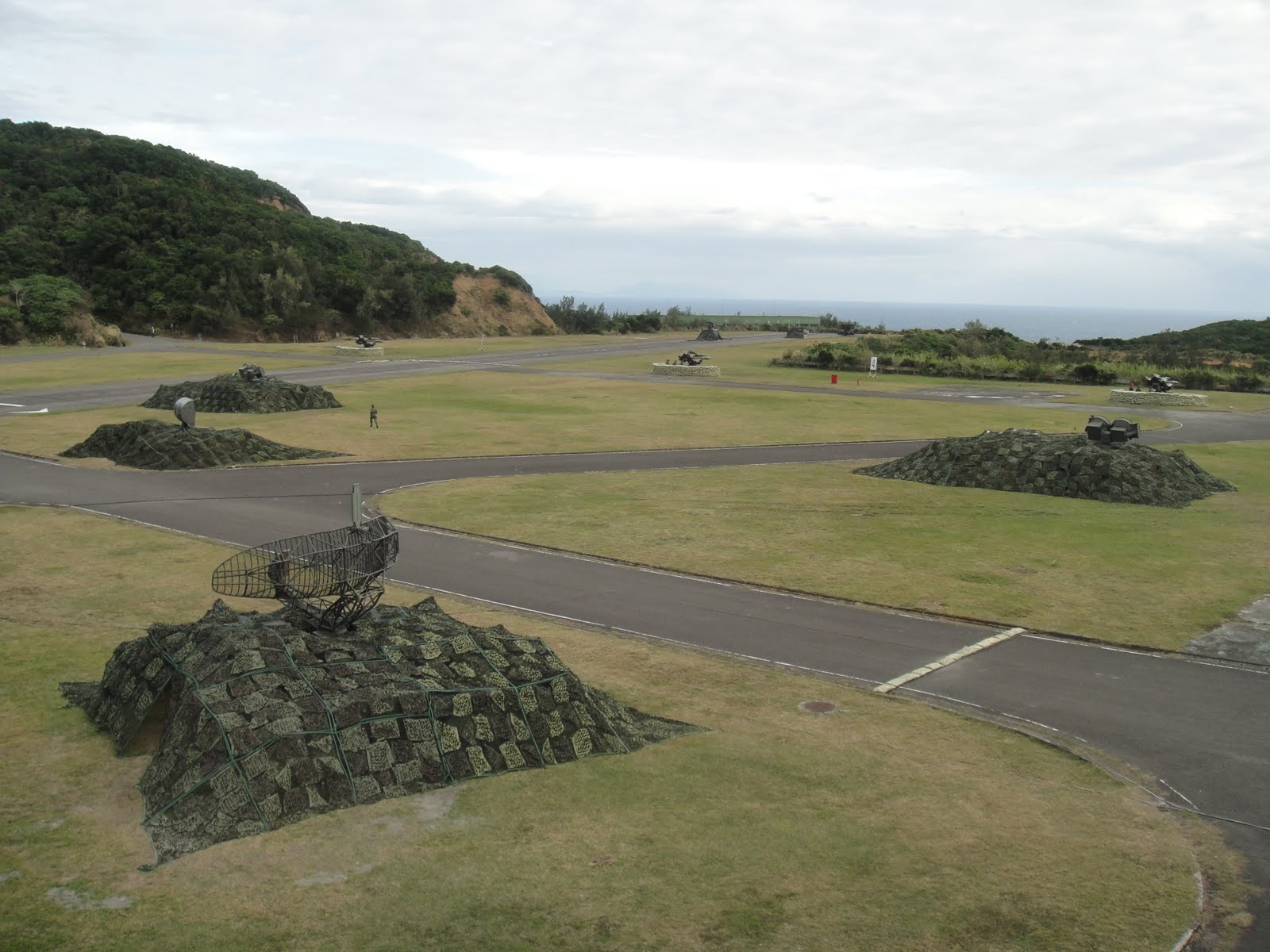
At a press conference following the exercise, Ma, who had watched from a building overlooking the sprawling testing base located deep in the mountains, appeared unimpressed.

My coverage on location of the United Air Defense Fire exercise, published today in the Taipei Times, continues here.

Tuesday, January 18, 2011

Sweeping Taiwan under the carpet

Pretending that Taiwan does not exist will not succeed in convincing Hu Jintao that the subject should not be raised during his state visit. In fact, it is a sign of weakness

Briefing the press corps prior to a visit by Chinese President Hu Jintao (胡錦濤) to Washington this week, US National Security Adviser Tom Donilon made extra efforts to avoid mentioning Taiwan, leading some media to conclude that Taiwan perhaps would not be on the agenda.

At a time when Beijing’s political weight is in the ascendancy and that of the US is increasingly in question, the last thing Washington should do is send signals of weakness — and avoiding a topic, in the hope that somehow Beijing would forget, is just that.

If Donilon’s press conference is any indication of US President Barack Obama’s strategy for dealing with Hu, it shows us that rather than seek to set the agenda on a problem that continues to haunt Northeast Asia, Washington will allow the Chinese leader to do so, at which point US officials will have little choice but to backtrack or use soothing language that can then be exploited by Beijing.

My editorial, published today in the Taipei Times, continues here.

Friday, January 14, 2011

Taiwan rights ranking stable: Freedom House

In the fifth consecutive year Freedom House was reporting a decline in political rights and civil liberties worldwide, Taiwan remained stable, though the watchdog for the second year in a row raised questions over government interference in the media

US-based watchdog Freedom House released yesterday its annual Freedom in the World report, with little change in Taiwan’s ranking despite some concerns over continued government interference with the media.

Based on the organization’s initial findings for last year, which were to be made public at a conference in Washington, Taiwan scored 1 in the political rights sphere and 2 on civil liberties, the same as the previous year.

“Taiwan remained one of Asia’s strongest democracies,” Sarah Cook, Asia research analyst and assistant editor at Freedom House, told the Taipei Times by e-mail yesterday.

“Municipal elections held [on Nov. 27] were widely viewed as free and fair, despite a shooting at a rally the evening before the polls,” Cook said.

She did not mention, however, the rapid mobilization by some senior Chinese Nationalist Party (KMT) officials to exploit the shooting of Sean Lien (連勝文) for the party’s benefit the following day.

On the handling of the corruption charges against former president Chen Shui-bian (陳水扁), Cook said: “Procedural irregularities evident in earlier stages of ... [the] case did not appear to repeat as the case moved up the judiciary during the appeal’s process.”

My article, published today in the Taipei Times, continues here.

Tuesday, January 11, 2011

Taiwanese, Hong Kongers angry: panelists

Minority parties in Taiwan and Hong Kong face the remnants of a Leninist past and increasingly powerful conglomerates and vested interests, which bodes ill for democracy and good governance

Amid a growing sense of disenfranchisement, young people in Taiwan and Hong Kong are increasingly angry and want their governments to pay more attention to them, two panelists told a conference on democracy building in Taipei yesterday.

Speaking during a panel on majority and minority rights in government at the “Democracy Building in Interesting Times” conference organized by the Taiwan Foundation for Democracy, the Heritage Foundation and Institute for National Policy Research, Alan Leong (梁家傑), a pro-democracy activist and one-time contender for the post of Hong Kong chief executive, said that while about 60 percent of people in Hong Kong support full democracy, its advocates remain the minority in the Legislative Council.

“Functional constituencies” representing the interests of conglomerates, big business and other small groups, as well as interference by Beijing, ensure that these legislators are forever in the opposition, said Leong, leader of the Civic Party.

That system, he said, gives those “vested powers” de facto veto powers and ensures that the “fruits of economic success” are not shared evenly and remain in the hands of the few.

Leong also said that in light of the proposed electoral models for the elections of chief executive and the Legislative Council in 2017 and 2020 respectively, “there is practically no way that Hong Kong can see universal and equal suffrage” applied during the vote.

Speaking of the deficiencies in the system, Leong said: “It is indeed a coincidence that the Hong Kong people comes to expect so much from the opposition parties in a system where the opposition is supposed to be irrelevant and ineffective.”

“This is not what the designer of our political system had in mind,” he said.

My article, published today in the Taipei Times, continues here. 

The end of this article stemmed from a question — admittedly a loaded one — that I asked Mr. Leong, in that I prompted him to talk about identity. Unexpectedly, this engendered a response that included the contention that Taiwan is part of China, which to me confirmed yet again that even democracy activists in China and Hong Kong cannot necessarily be counted on to be supporters of Taiwan independence. Experiences can be shared, the desire for democracy can be common, but self-determination and the rights of minority, as Chinese academic Wang Lixiong (王力雄) has argued, are not necessarily matters such individuals are willing to support.

The ‘wayward cousin’ syndrome

Regarding the Chinese threat as the antics of a ‘wayward cousin’ rather than a classical external threat could account for the Ma administration’s apparent lack of seriousness on the subject

Even after North Korea invaded the South in 1950, sparking the Korean War, followed by decades of tensions marked by skirmishes, missile tests, nuclear detonations, artillery attacks and the sinking of a navy vessel, the authorities in Seoul have often been less strident about the North Korean threat than their allies like Japan and the US, a response that, at first glance, may seem counterintuitive.

Two phenomena could account for this reaction: cultural proximity — South Koreans often refer to North Koreans as “wayward cousins” involved in a family dispute — and the fact that South Korea would suffer the brunt of an attack by the North. As such, the leadership in Seoul has often gone to great lengths to avoid unnecessarily alienating Pyongyang.

In many ways, Taipei under President Ma Ying-jeou (馬英九) appears to have reached similar conclusions with regards to China. Amid a growing sense of alarm among regional powers at an increasingly assertive Chinese military, one of the few countries that has downplayed the threat is Taiwan. There is no small irony in this, given that Taiwan, despite supposedly warming ties with Beijing, remains the primary, albeit not the only, target of China’s rapidly growing and modernizing military.

As with Seoul vis-a-vis North Korea, Taipei has emphasized the need for dialogue, while Ma, who never misses an opportunity to remind Taiwanese of their “Chinese heritage” and the “Chinese nation,” also seems to regard Chinese as “wayward cousins” in an unresolved family feud. Ma’s tendency to look at Chinese as a misled family member, rather than the “other,” could help explain what comes across as his failure to fully account for the magnitude of the Chinese threat, or at least shed some light on his often fuzzy definition of Taiwan and Taiwanese, as is often the case with the two Koreas.

My unsigned editorial, published today in the Taipei Times, continues here.

Thursday, January 06, 2011

It takes two to play at detente

How much signaling can the Ma administration do before those efforts cross the line from olive branch to capitulation?

Detente is like a carefully orchestrated minuet, with each side reacting in accordance with the subtle shifts of the other. Only when participants abide by those governing rules, and when both operate under the assumption that the other will reciprocate, can bodily poetry avoid descending into artistic catastrophe.

When it comes to efforts at detente in the Taiwan Strait launched by President Ma Ying-jeou (馬英九), one side has shown a willingness to dance. Amid efforts to encourage better relations with Beijing, Taipei has repeatedly signaled that it is ready to de-escalate. The frequency of military exercises has been reduced and those that are held often do not involve live fire or invoke a Chinese attack. The overall military budget has been cut and now stands at about 2.5 percent of GDP, less than the 3 percent Ma had promised to secure for national defense. Officials inform us it is unlikely the military budget will increase significantly in the near future.

Budgets have tightened to such a extent that, citing “financial constraints,” the Ma administration announced in October that it would seek to defer payment on PAC-3 missile batteries and 60 UH-60M Black Hawk helicopters it has committed to purchase from the US, raising questions over the year of delivery.

Meanwhile, reports over the last six months claim that the National Security Bureau, the nation’s top civilian intelligence service, has been ordered to stand down on intelligence collection in China and may have become less generous in sharing signals intelligence on China with key allies, such as the US and Japan. Intelligence-sharing agreements being what they are, this will likely result in reciprocal stinginess and could be disastrous in terms of preparedness for the Taiwanese military.

My op-ed, published today in the Taipei Times, continues here.

Tuesday, January 04, 2011

An inconsistent Presidential Office

President Ma’s only consistency is his inconsistency, which makes it very difficult for the electorate to take him at his word

If futures were built on promises, Taiwan under President Ma Ying-jeou (馬英九) would be the envy of the international community — prosperous, dignified and safe from harm.

Sadly for Ma, running a country requires more than slogans designed to meet a moment’s requirements — statesmanship calls for vision, action and consistency, all qualities that our promise-prone president, after more than two-and-a-half years in office, has yet to show us he possesses.

While it would be unfair to expect politicians to deliver on every promise they make or to turn every slogan shouted at a podium into reality, they should nevertheless meet minimum standards of consistency. In other words, for promises to be part of a vision, they should be followed through with action, commitment and resources.

Ma’s promise to create an all-volunteer military by 2015 — a laudable, albeit costly idea — is one example of a plan that is unlikely to come to fruition as a result of lack of commitment and funding. The Ma administration’s vow to submit the text of the Economic Cooperation Framework Agreement (ECFA) signed with China last year to the WTO also looks like an empty one now that the “early harvest” list has come into force without the global trade body having seen the documents.

What Ma has delivered so far is a long list of promises, the implementation of which has left much to be desired and which do not appear to be part of an overall plan. In fact, his only consistency has been his inconsistency, with slogans thrown cheaply about depending on the nature of the audience being addressed. By dint of repetition, Ma has succeeded in undermining his credibility in the eyes of Taiwanese, who by now could be forgiven for taking a cynical view of his vows.

My unsigned editorial, published today in the Taipei Times, continues here.

Tuesday, December 28, 2010

Whither Taiwan’s free media?

Little by little, with subtle changes and amendments, the media environment in Taiwan is being boiled to death like the proverbial frog

The media environment in Taiwan is in a state of crisis, one that did not fully capture the public’s imagination until someone from deep inside said he’d had enough and resigned.

US-based Freedom House may have called it “one of the freest in Asia,” but Taiwanese media are under severe pressure and many indicators are pointing in the wrong direction. The signs were there, but it took reporter Huang Je-bing’s (黃哲斌) resignation from the China Times on Dec. 12, after 16 years of service, to draw attention to the severity of the problem and prompt fellow journalists into action.

The source of Huang’s discontent was the growing practice of government product placement in the media to promote its policies, which in effect constitutes the masquerading of propaganda as news.

The potential for abuse is self-evident, especially when we put it in the context of President Ma Ying-jeou (馬英九) administration’s friendly attitude toward one of Asia’s worst offenders in terms of media freedom: China.

My unsigned editorial, published today in the Taipei Times, continues here.

Wednesday, December 22, 2010

MOFA silent on Chinese patrol boats

The region is moving ever-closer to naval confrontation in the waters surrounding the disputed Diaoyutai Islands

The Ministry of Foreign Affairs yesterday would not comment on reports that China was allegedly on the brink of permanently deploying large fisheries patrol vessels near the Diaoyutai Islands (釣魚台) claimed by Taiwan, Japan and China.

Ministry spokesman James Chang (章計平) said the ministry was not able to comment, as the Mainland Affairs Council was responsible for assessing the authenticity of the information and communications with China.

Chang said the ministry would closely monitor reports on the matter and restated the ministry’s position that all parties should set aside disputes and handle the matter peacefully and rationally.

A diplomatic official told the Taipei Times on condition of anonymity that the deployment was related to Japan’s new defense guidelines, approved by the Diet on Friday, which painted China as a bigger threat than Russia and as a result was shifting its defense from the northern island of Hokkaido to the south, such as Okinawa and territories claimed by both Japan and China.

The Asahi Shimbun reported on Monday that an unnamed “senior Chinese official” at the Ministry of Agriculture’s Bureau of Fisheries had informed it in an exclusive interview on Saturday that China could soon permanently deploy large fisheries patrol vessels in waters near the Diaoyutais.

This article, published today in the Taipei Times, continues here.

Tuesday, December 21, 2010

Why has the WTO yet to be notified about ECFA?

With two weeks left before the full terms of a controversial trade pact signed between Taiwan and China in June come into force, the global trade body has yet to see the documents. Will it ever?

President Ma Ying-jeou’s (馬英九) administration and its counterparts in Beijing accomplished the nearly impossible this year by signing a complex trade agreement between two entities that are technically at war — and one of which does not recognize the other’s existence — in a matter of months.

While free-trade and free-trade-like agreements signed between two states on an equal footing (at least in terms of two-way recognition) usually require years of negotiations, the Economic Cooperation Framework Agreement (ECFA) signed between Taiwan and China on June 29 took a little more than five months.

Now, either officials from the Straits Exchange Foundation and the Association for Relations Across the Taiwan Strait, the two semi-official bodies that were charged with negotiating the trade pact, were incredibly talented and managed to resolve the immense hurdles that have haunted any type of relation between the two entities, or the two sides were too impatient and couldn’t wait to sign the agreement, which offered “proof” that Ma’s cross-strait policies were bearing fruit.

I leave it to the reader to decide which is likeliest, though I would strongly urge that we bear in mind William of Ockham’s sagacious case for parsimony when seeking to explain the cause of a phenomenon amid a plurality of hypotheses.

My op-ed, published today in the Taipei Times, continues here.

Ma’s delusions of ‘soft power’

Still sounding like he’s running in the 2008 presidential election, Ma Ying-jeou stole an overused term by a prominent US academic and used it to show how much nicer his policies are than those of his predecessor

After years of assailing our ears with notions of “win-win” situations President Ma Ying-jeou (馬英九) has now latched onto a new term that, unfortunately for us, he now seems intent on milking dry: “soft power.”

No sooner had US political scientist Joseph Nye (see above with Ma), the person who coined the overused and oft misused term, left after a quick visit earlier this month than Ma was borrowing it to describe his policies over the past two-and-a-half years. All of a sudden, Ma’s body of work appeared to blossom into a monument to so-called soft power, which, if we looked closely enough, was a euphemism for everything the administration of his predecessor, former president Chen Shui-bian (陳水扁), supposedly was not.

It was soft power, Ma claimed, that recently led the EU and Canadian governments to grant Republic of China (ROC) passport holders visa-waiver treatment. Never mind that governments decide whether to grant exemptions on the basis of such practical considerations as the security of travel documents. In this case, those requirements included the introduction of biometric passports in 2008 — first issued after Ma came into office, granted, but the result of policies implemented under the Chen administration.

In other words, visa exemptions were granted because manifold requirements were met, not because of soft power à la Ma.

My unsigned editorial, published today in the Taipei Times, continues here.

Tuesday, December 14, 2010

Giving in to local Chinese zealotry

We seem to have entered an era where state governors, mayors and officials in the world’s most powerful nations can be browbeaten by lowly Chinese officials who are slightly overzealous in their nationalistic entrepreneurialism

Over the years, Chinese authorities have relentlessly attempted to prevent Taiwan from joining international organizations lest this give Taipei the sovereign legitimacy that Beijing considers anathema to its “one China” principle.

Although such behavior has made it impossible for Taiwan to have its voice heard in international forums like the UN or the WHO, Beijing’s object was ostensibly the symbolism of Taiwanese participation rather than the practicalities and benefits that Taiwan would derive from membership.

Despite superficially warmer ties between Taipei and Beijing since President Ma Ying-jeou (馬英九) launched his cross-strait lovefest two years ago, Chinese officials have often overlooked the “goodwill” they are alleged to have showered on their Taiwanese compatriots by continuing to deny Taiwan international breathing space. This has targeted symbols of Taiwanese nationhood, such as a delegation of moviemakers at the Tokyo International Film Festival in late October attending under the name “Taiwan.”

However, behind such headline-grabbing acts of insanity lurk several instances of Chinese officials impeding Taiwanese efforts in a different sphere altogether: the economic sector. This is often the result of Chinese officials at the local level pressuring governments by raising the specter of Chinese “anger.”

My unsigned editorial, published today in the Taipei Times, continues here.

Sunday, December 12, 2010

‘Taiwan consensus’ is a travesty

Su Chi is back with a new consensus, an ill-defined rhetorical contraption that blames the DPP for cross-strait misunderstandings and that highlights his poor understanding of plurality

If one thing can be said of former National Security Council secretary-general Su Chi (蘇起), it is that the man is infatuated with consensuses.

It was he who, just as the Democratic Progressive Party (DPP) was coming into office after the nation’s first transition of power in 2000, came up with the ambiguous — and dubious — “1992 consensus.” And it was he who, now wearing his academic hat, told a conference on Monday that what the nation needed was a “Taiwan consensus.”

In prescriptions that, on the surface (and only there) may have come across as infused with wisdom, Su said that before Taipei can approach more contentious areas of negotiation with Beijing such as Taiwan’s sovereignty, the DPP should take the initiative and work with the Chinese Nationalist Party (KMT) in forging a consensus.

Leaving aside the fact that Taiwan’s sovereignty shouldn’t be negotiable (especially not under coercive terms), Su then conveniently forgot recent history when, using the analogy of the “small triangle” between the DPP, KMT and the Chinese Communist Party (CCP), he posited that the triumvirate was unstable because the DPP does not talk with the other two extremes of the geometrical object.

In other words, tensions in the Taiwan Strait, or lack of communication, are solely the DPP’s fault, as if the KMT didn’t have a long history of ignoring the DPP or stalling debate at the legislature — the nation’s democratic echo chamber, if you will.

My op-ed, published today in the Taipei Times, continues here.

US governor nixes visit due to China

Even on matters of trade, China continues to deny Taiwan the international space that would truly stand for goodwill

Missouri Governor Jay Nixon planned to visit Taiwan on a trade mission this week — until the Chinese consulate and business leaders said the visit could “anger” the Chinese government and harm an airport deal with China, forcing him to scuttle the trip, reports said.

Nixon, who last year attended the signing of an agreement between Taiwanese and Missouri business groups in his office, had announced on Dec. 1 that he would head a trade mission to Taiwan and South Korea from Dec. 10 to Dec. 16. While in Taiwan, the governor was scheduled to be party to the signing of a letter of intent on a US$600 million purchase of Missouri agricultural products by the Taiwanese government, the St. Louis Post-Dispatch reported. Nixon was to be accompanied by a large delegation of government and business officials, including representatives of agricultural organizations.

One day after Nixon’s announcement, Mike Jones, chairman of the Midwest China Hub Commission (MCHC), sent the governor a letter on behalf of the commission asking that the visit be postponed. A representative of the Chinese government was afraid the trip would be received negatively in Beijing, the letter allegedly said.

My article on the matter, published today in the Taipei Times, continues here.