Tuesday, August 23, 2011

‘Apple Daily’ claims on Taiwan Strait incident stretch credulity

Nearly one month after reports emerged of an incident in the Taiwan Strait involving Chinese aircraft, a new article portrays the situation as being far more serious

The Chinese-language Apple Daily newspaper yesterday had an article in which it claimed that eight Chinese fighter aircraft, rather than two as initially reported, were involved in the June 29 incident in the Taiwan Strait, and that two of those went well beyond Taiwan’s side of the center line, taking them near Taiwan’s east coast.

The report also states that Sukhoi-27 and Su-30 aircraft were involved, with the aircraft coming in four waves of two fighters. The two aircraft that came within 150km off Taiwan’s each coast near Hualien — bringing Taipei within range of their air-to-ground missiles for a full 43 minutes — and to Japan’s ADIZ near the disputed Diaoyutai Islands (釣魚台), were Su-30s, the article claims, adding that Taiwanese and Japanese fighters were scrambled to chase off the Chinese aircraft.

If true, such action by the People’s Liberation Army Air Force (PLAAF) would be escalation on an unprecedented scale.

Initial reports of the incident, which emerged late last month, said two Chinese Su-27s had been shadowing a high-altitude US U-2 surveillance aircraft and that in the process, one or two of the Chinese fighters had briefly crossed into Taiwan’s side of the imaginary median line in the Taiwan Strait. Follow-up reports argued that the incident was accidental.

Taiwan’s Ministry of National Defense yesterday vehemently denied the information contained in the Apple Daily report. And for a reason — they are very likely false.

Readers are well aware that I am no big fan of Beijing’s claims on Taiwan or Chinese expansionism in the region, but such rash action as that described in the article sounds out of character for the Chinese Communist Party, especially at a time of high tensions in the region marked by growing apprehension among China’s neighbors and, perhaps most importantly, when relations between Taipei and Beijing are at their best in decades. It would make no sense whatsoever for Beijing to threaten Taiwan when its policy of annexing the latter appears to be on track. Furthermore, Taiwan will hold presidential and legislative elections in January next year; the leadership in Beijing remembers all too well (the 1995-1996 missile crisis in the Taiwan Strait) how self-defeating saber rattling can be in the lead-up to elections in Taiwan: The surest way for Beijing to give votes to the pro-independence Democratic Progressive Party, and to have Taiwanese rally round the flag, is to threaten them militarily.

Almost invading Taiwanese airspace at this time would also make it likelier that the US would agree to sell Taiwan the 66 F-16C/D aircraft it has been seeking since 2007. Beijing, which sees such a sale as a “red line,” is well aware that Washington will likely not release the aircraft for Taiwan. Unless, that is, China makes it obvious, by being overly belligerent, that Taiwan needs them.

It is also interesting to note that the article, which does not identify any sources, comes mere days after Legislative Speaker Wang Jin-pyng (王金平) told the legislature that Taiwan’s hopes of getting the F-16C/Ds had all but vanished, making him the first senior Taiwanese politician to make such a claim publicly. Doubtlessly, someone passed on this “information” to the Apple Daily as a means to increase pressure on Taipei and Washington over the F-16s, on which a decision is expected to be announced on Oct. 1.

Then there’s the issue of Japan, its ADIZ and the Diaoyutai islets. It’s one thing for Chinese fishing vessels or marine security ships to come close to the disputed islands; it’s another one altogether to send modern multi-role fighter aircraft close to the area. Such provocation would only serve to strengthen the US-Japan alliance and encourage the latter to accelerate the modernization of its forces and deployments within the region, thus further “boxing in” China. Here again, Beijing would gain nothing from such an outcome.

Lastly, it is very difficult to believe that if, as the article claims, Japan was forced to scramble its own aircraft to intercept the Su-30s, such information would not eventually have been leaked to conservative Japanese media in the almost two months that have elapsed since the incident took place.

The CCP and the PLA may be strongly nationalistic, but they are not fools. China will escalate, but it will do so gradually, not by suddenly dispatching modern combat aircraft between Taiwan and Japan.

Taiwan’s self-defeating behavior

For the sake of the longstanding US-Taiwan alliance, it is incumbent upon Taipei to answer one question at this critical juncture: Where is Bill Moo?

At a time of great uncertainty over Taiwan’s ability to purchase advanced combat aircraft from the US, one would expect Taipei to do its utmost to send the right signals to Washington, not only that it takes national defense seriously, but also that it would ensure that US technology does not end up in China’s hands.

Struggling to convince the electorate that it is committed to national defense, President Ma Ying-jeou’s (馬英九) administration in recent years made no less than 21 appeals to Washington to agree to the sale of 66 F-16C/Ds. However, there is evidence that those sound bites aside, Taiwan’s efforts to secure the sale under Ma have been halfhearted at best. As a result, various reports have recently stated that the deal is all but dead and that Taiwan will have to make do with upgrades to its aging F-16A/Bs, which could include top-of-the-line radar technology.

Now recent developments are threatening even that. Enter Ko-suen “Bill” Moo (慕可舜), a former top sales representative for Lockheed Martin who was arrested in Florida in 2005 for attempting to sell, among other items, an F-16 engine to a region of China long known for its reverse-engineering of military technology. After doing time in a US federal prison, Moo was deported to Taiwan last week, where he promptly disappeared from radar screens.

However hard Taiwanese officials try to argue that Moo never broke any laws in this nation, the very presence in Taiwan of Lockheed Martin’s former top sales representative for radar and C4ISR systems for Taiwan, added to his deep contacts with the then-upper echelons of the air force, are enough to make one pause. Even more worrying is the fact that the authorities appear to be clueless as to his whereabouts.

My unsigned editorial, published today in the Taipei Times, continues here.

Monday, August 22, 2011

Where is Bill Moo?

Despite notification by US authorities that Bill Moo was being deported to Taiwan, almost no one seems to know where, or who, he is

The controversy over the fate of Ko-suen “Bill” Moo (慕可舜), a Taiwanese businessman who was arrested by US federal agents in Miami in 2005 for attempting to ship sensitive military technology to China, continued to mount yesterday following his deportation from the US to Taiwan last week, with officials saying they have no idea about his whereabouts.

Moo, who was sentenced to six-and-a-half years in a US federal prison in 2005 for seeking to export defense articles — including an F110-GE-129 afterburning turbofan engine for the F-16 — to China, landed at Taiwan Taoyuan International Airport on Wednesday, accompanied by two US officers.

[...]

In a press release on Wednesday, the US Department of Homeland Security’s Immigrations and Customs Enforcement agency said that upon arrival in Taiwan, Moo was turned over to local authorities. It added that Enforcement and Removal officers had coordinated the removal with the Homeland Security Investigations Office of International Affairs and local authorities in Taiwan.

However, judicial authorities on Friday said they had no information about Moo’s arrival.

In a follow-up by the Taipei Times, Ministry of National Defense spokesman David Lo (羅紹和) said yesterday that the ministry also was “not aware” of Moo’s deportation.

Lo’s comment came despite confirmation to the Taipei Times by a senior officer from the National Immigration Agency’s Border Affairs Corps at the Taoyuan airport on Saturday that the American Institute in Taiwan had informed Taiwanese authorities prior to Moo’s deportation of his imminent arrival.

My article, published today in the Taipei Times, continues here, with comments from KMT and DPP legislators, as well as revelations about Moo, his role at Lockheed Martin, and his deep connections within the Taiwanese Air Force.

Saturday, August 20, 2011

Bill Moo’s back in town

The Taiwanese businessman who attempted to sell sensitive military technology to China in 2005 was deported to Taiwan this week. Where is he now? Judicial authorities don’t seem to know

A Taiwanese who was convicted of conspiring to export defense articles from the US to China on Tuesday was deported and returned to Taiwan, the US Immigration and Customs Enforcement (ICE) said on Wednesday.

Ko-suen “Bill” Moo (慕可舜, pictured below) was arrested in Miami, Florida, on Nov. 9, 2005, by US Homeland Security Investigations agents for trying to purchase sophisticated military parts, including an F-16 aircraft engine and an AGM-129 cruise missile, and export them to China without obtaining an export license from the US Department of State.


Prior to his arrest, Moo had shown undercover ICE agents, whom he believed were individuals who could get him an F-16 engine, a document indicating that Beijing also wanted to acquire AGM-129 cruise missiles, as well as AIM-120 air-to-air missiles. He was arrested when he went to inspect the engine.

The businessman had previously been Lockheed Martin’s top agent in Taiwan. Among the projects he was involved in while representing the firm in Taiwan were the Anyu 4 air defense program. He was also the principal sales agent on the Po Sheng “Broad Victory” C4ISR project, which has long been the focus of Chinese espionage and resulted in a series of arrests by US authorities during the same period.

My article, published today in the Taipei Times, continues here.

Note: Bill Moo has extensive connections, and it is very likely that prior to his arrival in Taiwan, orders were issued to judicial authorities not to lay a hand on him. More to come ...

Thursday, August 18, 2011

No delays on Patriot systems, defense contractor says [with update from print version]

Although efforts to procure a fifth and sixth PAC-3 missile defense battery are ‘on track,’ Taiwan must sign the letter of authorization before the end of December, or prices could go up

A US defense contractor yesterday denied local reports that efforts by Taiwan to procure two additional PAC-3 air defense batteries were jeopardized by political bickering and a lack of funds.

The Chinese-language United Daily News on Monday wrote that since the US had agreed to sell two additional Patriot Advanced -Capability-3 (PAC-3) systems in January last year, the military had had difficulty raising enough money to complete the deal, as the cost of acquisition allegedly exceeded the military’s budget by as much as 40 percent.

[...]

Contacted for comment, an official at Raytheon, the US defense firm that manufactures the Patriot ground systems, said it was their understanding that the purchase of the two fire units [and one training unit] was “on track.”

That position was echoed by a US-based source familiar with the situation, who told the Taipei Times last night that the program was in the final stages and on schedule to be signed this fall. The ministry on Monday denied the reports and said it was proceeding with the purchase.

My article, published today in the Taipei Times, continues here.

UPDATE: A source who contacted me after deadline had passed confirmed a few things regarding the PAC-3 acquisitions. As mentioned in my article, upgrade work on the three PAC-2 batteries around Taipei is proceeding, with Raytheon delivering the first Configuration-3 radar set to Taiwan in June, reportedly 11 months ahead of the schedule set by the Taiwanese Air Force. Regarding the four PAC-3 batteries and 330 missiles included the 2008 notification, Taiwan has already signed the LOA and delivery is expected by 2014/15. As for the two other fire units, one training unit and 114 missiles and included in the 2010 notification, the LOA is currently going through review process in Taipei.

The US side hopes Taiwan will sign the LOA soon, as the price option for the items included in the 2010 notification — which holds prices for most parts at the same level as for the previous four fire units — will terminate at the end of December. Any delay in procurement could entail additional costs in future. According to the source, failure to procure the last two fire units could become a political issue, as it would leave a large part of southern Taiwan uncovered.

Wednesday, August 17, 2011

Ex-‘Varyag’ gets unusual command


China’s first aircraft carrier will fall under direct command of the Central Military Commission, the highest state military organ, making it a “strategic” asset similar to China’s nuclear arsenal

The retrofitted Soviet-era hull has been assigned a commander and is set to be delivered to the Chinese navy by Aug. 1 next year, with entry into service in the South China Sea on Oct. 1, 2012. A ceremony unveiling its new name will be held in October this year.

My article, published today in Jane’s Defence Weekly, continues here (subscription required).

During last week’s sea trial, the carrier’s engines, electronic and navigation systems and weapons were all checked, with unconfirmed reports by Xinhua of a possible aircraft takeoff and landing on the flight deck.

Tuesday, August 16, 2011

Attributing blame for the F-16 fiasco

The KMT has put the Taiwanese military in a position of weakness, both in qualitative and quantitative terms. Was it ineptitude, or part of a plan to erode Taiwan’s deterrent?

“We are so disappointed in the United States,” a Taiwanese defense official said over the weekend, reacting to confirmation that Taipei would not be sold the F-16C/D aircraft it has been seeking from the US since 2007.

While the sense of disappointment with Washington is perfectly understandable, another actor in the saga deserves equal condemnation, if not more: the Chinese Nationalist Party (KMT). It was the KMT, enjoying a majority in the legislature during then-president Chen Shui-bian’s (陳水扁) administration, that blocked the budgets that would have allowed Taiwan to continue modernizing its armed forces.

Two possible scenarios present themselves here. Either the KMT undermined Taiwan’s defense apparatus as part of a plan to demonstrate, when it regained office in 2008, that it was stronger on defense than its predecessor, only to be caught wrong-footed when the backlog reached more than US$12 billion. Or it knew all along that this would happen and proceeded by orchestrating a gradual erosion of the nation’s deterrent capability.

Either way, the end result is the same. Taiwan today finds itself in a very difficult position when it comes to its ability to defend itself against aggression from China.

My unsigned editorial, published today in the Taipei Times, continues here.

Cross-strait scientific research hits a snag

A neurobiologist at Peking University is seeking to change more than a decade of apolitical collaboration between scientists on both sides of the Strait

Cross-strait politics entered the world of science recently after a Chinese neurobiologist insisted that Taiwanese co-authors identify their university as being located in “Taiwan, China.”

News of the spat were first reported by ScienceInsider, a blog of the Science journal, on Friday, which said that cross-strait cooperation on scientific research had accelerated in the past decade. Usually, collaborators from both sides stayed clear of politics by avoiding references to “Republic of China” and “People’s Republic of China” and simply using “Taiwan” and China” respectively, it said.

However, the growing sense of nationalism in China appears to have entered the lab, with neurobiologist Rao Yi (饒毅) of Peking University insisting that a Taiwanese team led by neurobiologist Chiang Ann-shyn (江安世, pictured) of National Tsing Hua University (NTHU) in Hsinchu, which collaborated with Rao’s group on research, identify the university as being located in “Taiwan, China.”

Following back-and-forth visits and “exchanges of ideas,” one of Chiang’s students assisted Rao’s research team with scientific experiments seeking to understand the role of octopamine, a biomolecule, in the brain of Drosophila, a genus of small flies commonly known as “fruit flies.”

Rao drafted a paper on the findings and included Chiang and the student as co-authors. However, references to NTHU located it in “Taiwan, China.”

My article, published today in the Taipei Times, continues here.

Monday, August 15, 2011

Hacking attack on DPP a potential ‘Watergate’

The nature of the classified information retrieved by hackers targeting the DPP underscores the KMT’s fears of losing next year’s election, a security expert says

The recent hacking attacks targeting Democratic Progressive Party (DPP) officials and senior staff at Chairperson Tsai Ing-wen’s (蔡英文) presidential campaign office could be Taiwan’s version of the Watergate scandal, a former official in charge of electronic communications for the government has said.

The DPP last week announced that the e-mail accounts of senior officials and staff at Tsai’s office had been hacked into and that confidential information had been stolen. In a press release, the party said that an investigation had traced the attacks back to IP addresses from Xinhua news agency bureaus in Beijing and Malaysia, addresses in Australia, as well as the Research, Development and Evaluation Commission (RDEC) in Taipei.

Among those targeted was Alex Huang (黃重諺), deputy director of the party’s Policy Research Committee, who said he received between 10 and 20 e-mails a day that looked like they were written by colleagues, but that, once opened, would automatically install malware that monitors a user’s computer.

A former senior official who handled electronic communication security under former president Chen Shui-bian’s (陳水扁) administration told the Taipei Times on condition of anonymity last week that the truly worrying aspect of the recent attacks was the domestic angle.

My article, published today in the Taipei Times, continues here.

F-16C/Ds for Taiwan no go

No F-16C/Ds will be sold to Taiwan, though the upgrade program on its F-16A/Bs will proceed and will include AESA radar as a sweetener.  But here's the catch: only one wing is to be retrofitted, rather than the whole 146 aircraft

Taiwan will not be getting the 66 F-16C/D aircraft it has been requesting since 2007, a Ministry of National Defense official has confirmed, and fewer of its older F-16s will be retrofitted, news that could strike a blow to President Ma Ying-jeou’s (馬英九) administration as it heads into elections next January.

“We are so disappointed in the United States,” the official told Defense News on the sidelines of the Taipei Aerospace and Defense Technology Exhibition (TADTE), which ended on Saturday, blaming the decision on pressure from Beijing.

The article, released last night and written by the magazine’s Asia Bureau chief, Wendell Minnick, said a US Department of Defense delegation had arrived in Taiwan last week to deliver the news to Taipei and that as an alternative it had offered to secure the upgrade package for Taiwan’s ageing fleet of F-16A/B aircraft.

“The US Pentagon is here explaining what is in the upgrade package,” a US defense industry source told the magazine. “They are going to split the baby: no C/Ds, but the A/B upgrade is going forward.”

“The switch is meant to soften the blow of denying new planes to Taipei,” a source at Lockheed Martin, maker of the F-16, told Defense News.

My article, published today in the Taipei Times, continues here.

Saturday, August 13, 2011

Clear skies ahead for Taiwan's AIDC

Regardless of the outcome to the F-16 sale, Taiwan's premier aerospace company is looking forward to a busy schedule in the coming years

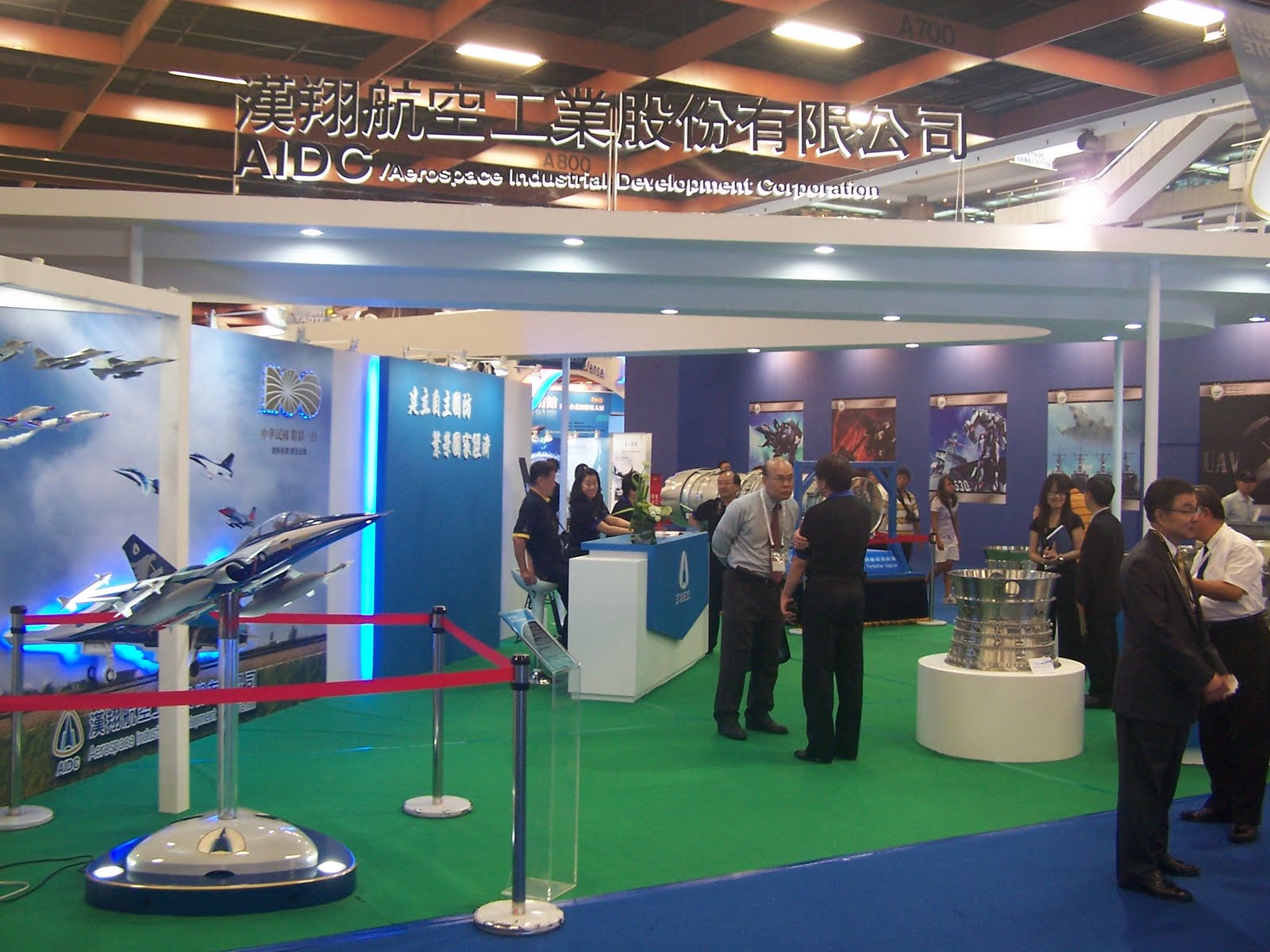
State-owned Aerospace Industrial Development Corp (AIDC, 漢翔航空) is facing promising prospects for the coming years, with an advanced trainer program in the works and the likelihood of a major role in a possible F-16A/B upgrade project.

One of the main projects AIDC is working on is a new advanced and completely indigenous trainer, Mike Lee (李適彰), secretary-general of the National Defense Industrial Association of Sino (中華國防工業發展協會), told the Taipei Times on the sidelines of the Taipei Aerospace and Defense Technology Exhibition yesterday.

The firm has been working on a XAT-5 prototype, a twin-engine trainer that, according to some industry analysts, could be based on the Indigenous Defense Fighter’s (IDF) airframe.

Although he would not provide a time frame and said the air force had yet to green-light a specific model, Lee, who also serves as a special assistant to AIDC chairman Jason Liu (劉介岑), said the next few years would be the perfect time to introduce a new trainer to replace the twin-engine AT-3 — also manufactured by AIDC — that entered service in 1984.

Turning to the mid-life upgrade of Taiwan’s 130 F-CK-1A/B “Ching Kuo” IDFs, Lee said work on the first 71 aircraft was continuing and provided the air force had the budget, a second-phase upgrade, which would complete the remainder of the fleet, could be launched at some point. The first phase of the program has delivered six upgraded aircraft so far.

My article, published today in the Taipei Times, continues here with updates on a possible AIDC role for the F-16A/B upgrades and F-16C/Ds, as well as the possible development of a fifth-generation fighter and the IDF-II “goshawk.”

Friday, August 12, 2011

AESA radar upgrade for F-16s in doubt

Although a decision by Washington not to sell Taiwan F-16C/Ds would make the release of the AESA radar more likely, in the current political environment, even that cannot be taken for granted

As Taiwan awaits Washington’s decision on whether it will sell the Lockheed Martin F-16C/D aircraft Taipei has been seeking since 2007, rumors are now emerging that Taipei’s request for preferred radar system for an upgrade program for its ageing F-16A/Bs might also be encountering difficulties.

The US government is scheduled to announce on Oct. 1 — national day in the People’s Republic of China — whether it will proceed with the sale of 66 F-16C/Ds to Taiwan or limit itself to a US$4.5 billion upgrade for Taiwan’s 144 F-16A/Bs acquired in the early 1990s.

Taiwan does not regard the upgrades as an alternative to the F-16C/Ds and maintains that the two options must be exercised to ensure a balance of air power in the Taiwan Strait.

In addition to new electronic warfare systems, radio, engines and missiles, one key component of the upgrade would be the acquisition of advanced active electronically scanned array (AESA) radar, a “drop in” modular system regarded as an ideal option to give aging fighter fleets the world over a second life, especially as countries are becoming increasingly reluctant to acquire the problem-plagued F-35.

My article, published today in the Taipei Times, continues here, with a dispatch from the Taipei Aerospace & Defense Technology Exhibition 2011. This article is based on interviews with Raytheon, Northrop Grumman and Lockheed Martin.

Update: I was informed by a knowledgeable source at TADTE today that Northrop Grumman’s SABR, one of the two AESA options for Taiwan’s F-16s, might not qualify as some of its components (reportedly antenna systems) have not been cleared for export. This would leave only Raytheon’s RACR, or, should the AESA deal not be approved, some version of a mechanically scanned array radar, also produced by Northrop Grumman.

Thursday, August 11, 2011

Taiwan sends not-so-subtle signal on China’s carrier

CSIST and MND officials were all winks when asked to explain the unusual display, and the fact that the top research center falls under the Ministry of National Defense means it was no accident

In a blunt departure from tradition, the military yesterday displayed a model Hsiung Feng (“Brave Wind”) III (HF-3, 雄風三) anti-ship missile with, as a backdrop, a large picture of a burning aircraft carrier that bore a striking resemblance to China’s retrofitted Varyag, which embarked on its maiden voyage earlier in the day.

The booth, set at a prominent location at the Taipei Aerospace and Defense Technology Exhibition (TADTE), which opens today, was the center of attention of reporters who were given a chance to take a look around during a pre-show visit.

[...]

While the HF-3 had been on display at previous shows, this was the first time it was shown in a context that prominently identified its intended target. Although no flag or ensign could be seen on the computer-generated rendition of the aircraft carrier and accompanying fleet, the “ski jump” ramp and general outlook were oddly similar to the Varyag China acquired from Ukraine in 1998.

My article, published today in the Taipei Times, continues here. My take for JDW appears here (subscription required)

Tuesday, August 09, 2011

Rooting out injustice

What we need is development with a heart, or a road to modernity minus the bulldozers and police contingents

Hardly a week goes by nowadays without farmers, environmentalists, unions and rights activists petitioning the central government over issues of corporate predation upon the land and the individual. While every instance could be looked upon as isolated and unrelated, their frequency in the past two years means that one cannot help but see a trend.

It would be easy to blame President Ma Ying-jeou’s (馬英九) administration for all the ills that have befallen the farmers who toil this land or the inhabitants of areas that are to be destroyed to make room for industrial projects. However, the problem is a more fundamental one, one that has deeper roots than the policies of a single administration. The answers and solutions, if ever we find them, will only emerge when people and organizations that purport to fight for freedom and justice in Taiwan themselves stop exploiting those who work for them.

Sometimes this hits so close to home that we don’t even see it.

My editorial, published today in the Taipei Times, continues here.

Monday, August 08, 2011

Taiwan faces non-democratic choices

Democracy should be about the art of the possible, a quest for the best possible outcome, and not solely a mechanism by which to choose the least bad option

One should always be wary of specialists who, from the cushioned comfort of their distant armchairs, make grand telescopic pronouncements about what it is that other countries “want.” Sadly for Taiwan, there is no shortage of such individuals who pretend to know what Taiwanese want.

Without the benefit of being in situ and really getting to know Taiwanese, their dreams, fears and all, it is easy for foreign analysts to personalize policy and to substitute public will for government rhetoric, especially under an administration in Taipei that has left little room for dissenting opinion.

Never — at least not since Taiwan was a nominal democracy — has the falseness of the assumption that a government speaks for its people been so markedly obvious than since President Ma Ying-jeou (馬英九) came into office in May 2008. And yet, commenting recently on signs that Taiwan and China were moving toward some type of convergence, esteemed academics, people like Robert Sutter of George Washington University, will confidently tell others that “If Taiwan says ‘This is what we want,’” then the US had no right to object.

What is sorely missing from such facile observations is a refinement of what is meant by “Taiwan” and whether the individuals who purport to speak in its name truly reflect public will.

My op-ed, published today in the Taipei Times, continues here.

Tuesday, August 02, 2011

Beware of the Chinese flu (or Ma Jian as a symbol of the present)

There is no need, nor is it desirable, for Taiwan to rush into rapprochement with China. It can afford to wait — and current trends in China make such patience absolutely imperative

The lone figure of exiled Chinese author Ma Jian (馬建) being denied entry into his homeland last week should be enough to remind candidates in January’s presidential election of the need to approach China with the utmost caution.

The London-based Ma, whose application to enter China via Hong Kong on July 23 was turned down without explanation from Chinese officials, had previously returned home on several occasions since leaving in 1986. That he would be denied entry at a time when China is, by most accounts, seemingly in the ascendant, is a testimony to the uncertainty that haunts the Chinese Communist Party (CCP) amid domestic turbulence and an upcoming leadership transition.

Needless to say, a party that had full confidence in its ability to rule would not be preoccupied with the arrival of an author, however critical of the regime, on a mission to buy books in Shenzhen before returning to London.

My unsigned editorial, published today in the Taipei Times, continues here.

Thursday, July 28, 2011

Intrusion by PLA plane more than routine: analysts

It is unlikely that Beijing would carelessly violate the median line in the Taiwan Strait. A number of hypotheses help explain why it did

Although the Ministry of National Defense and some Chinese Nationalist Party (KMT) legislators played down the significance of an incident involving two Chinese fighter aircraft in the Taiwan Strait late last month, analysts say the matter is more than simply routine.

Confirming on Monday media reports that one of two Chinese Sukhoi-27 (Su-27) fighter aircraft shadowing a US U-2 spy plane had crossed the median line in the Taiwan Strait on June 29, ministry officials maintained this was an isolated incident and did not regard it as provocative.

The Chinese aircraft are believed to have been from the 40th Fighter Regiment, 14th Fighter Division at Nanchang-Xiangtang Air Base in Jiangxi Province.

Although the intrusion — reportedly the first since an April 1, 2001, mid-air collision between a US Navy EP-3 aircraft and a Chinese J-8 fighter — prompted the ministry to dispatch two F-16s to intercept the Chinese fighters, KMT legislators said Beijing would not seek to provoke Taiwan at a time when relations in the Taiwan Strait are “at their best in decades.”

KMT Legislator Herman Shuai (帥化民) said the incident was the result of pilot error.

My analysis, published today in the Taipei Times, continues here, with comments by the US Department of Defense, PACOM, Roger Cliff and Gary Li. My take on the incident for JDW can be accessed here (subscription required).

Tuesday, July 26, 2011

Ma Ying-jeou the misunderstood

The walls of contradiction that President Ma Ying-jeou has erected around his China policy are slowly closing in on him

Last week, for the fifth time in less than three years, President Ma Ying-jeou (馬英九) was “misquoted” by foreign media over matters pertaining to his cross-strait policy. Whether he gives his interviews in English or in Mandarin, the response from Ma’s office is always the same: Either the world doesn’t get it, or it is out to get Ma as part of some obscure multinational plot to discredit him.

Considering how much time he and his speechwriters have had to flesh out a comprehensive and intelligible cross-strait policy, it is hard to believe that Ma does not by now have clear formulations with which to explain his plan for dealing with Beijing. One would also assume, with a presidential election just around the corner, that Ma’s office would make every effort to ensure that reporters are able to reproduce their interviews with the president with clarity and accuracy. Besides, Japanese reporters, the latest victims in the streak of misquote accusations, have a reputation for being cautious about checking facts.

However, it could well be that our Janus-faced president has not one China policy, but two ever-shifting and occasionally overlapping policies.

My unsigned editorial, published today in the Taipei Times, continues here.

Monday, July 25, 2011

DW News makes false claim on F-16 sale

The Chinese-language DW News service on Sunday claimed that US-Taiwan Business Council president Rupert Hammond-Chambers had “confirmed” that the US would only promote upgrades to Taiwan’s ageing 144 F-16A/Bs and turn down efforts by Taipei to procure 66 more advanced F-16C/Ds.

I have it on good authority that this claim derives solely from a misreading of a press release by the council last week, in which Hammond-Chambers said an announcement by Washington that it would announce on Oct. 1 whether it will proceed with the sale of the F-16C/Ds gave the impression that it would not move forward with the sale. Rather than providing confirmation, this was nothing more than Hammond-Chambers’ assessment of the agreement reached between US Secretary of State Hillary Rodham Clinton and Senator John Cornyn.

DPP issues statement on South China Sea tensions

The DPP espouses a multilateral approach to resolving territorial disputes in the South China Sea. One wonders, however, if Taiwan, excluded as it is from ASEAN, would be able to participate in any talks

The Democratic Progressive Party’s (DPP) Department of Foreign Affairs on Saturday called for a multilateral approach to the ongoing tensions in the South China Sea.

The DPP’s reiteration of its position that issues related to the South China Sea must be addressed through a multilateral framework came following a draft agreement on the guidelines for the implementation of the Declaration of Conduct between China and ASEAN earlier this month.

“Despite several calls from China for ‘cooperation between the two sides of the strait’ on the South China Sea issue, the DPP urges President Ma Ying-jeou’s [馬英九] administration to take part in multilateral talks with all parties involved in order to serve Taiwan’s best interest and to preserve regional stability,” the statement said in English.

The statement said that when Ma served as Mainland Affairs Council deputy minister in the 1990s, he said that the two sides of the strait must set aside sovereignty differences and work together on the South China Sea issue while “dealing with outside parties in a unified way.”

My article, published today in the Taipei Times, continues here, with an update on the Haijian 50 (海监50), the latest China Marine Surveillance vessel to be commissioned.

Sunday, July 24, 2011

VOA China scores small victory in battle for survival

It remains unclear whether, if passed, the amendment would save the 40 jobs or so that are to be cut if VOA ceases all traditional broadcasts in Cantonese and Mandarin to China

The battle to keep Voice of America’s (VOA) Mandarin and Cantonese radio and TV broadcasts to China alive continued in the US House Committee on Foreign Affairs on Wednesday with a unanimous vote for a proposal that would secure money for the embattled China unit.

The authorization bill, sponsored by US Representative Dana Rohrabacher during a markup hearing, reserves US$13.76 million from the total budget for government-sponsored broadcasting next year to be strictly used for Mandarin and Cantonese radio and TV broadcasts. That amount is equal to thie operational budget for VOA’s China unit for FY2011.

“Of the funds to be appropriated to the Broadcasting Board of Governors [BBG], [US]$13.76 million is authorized to be appropriated only for Voice of America Mandarin and Cantonese-language radio and satellite television broadcasting,” it says. “Such funds may not be used for any other purpose.”

The authorization bill was included in the State Department Authorization Act for FY2012. It is now scheduled for a markup hearing at the Appropriations Subcommittee on July 27.

My article, published today in the Taipei Times, continues here.

Saturday, July 23, 2011

Lai Changxing expelled

As expected, the Chinese fugitive who has been at the center of controversy for 11 years was kicked out of Canada on Friday and now faces an unenviable future in the Chinese legal system

After an 11-year court saga, Chinese fugitive Lai Changxing (賴昌星) was finally expelled from Canada on Friday and will now find himself in the hands of the Kafkaesque court system in China.

As I wrote in an op-ed in the Ottawa Citizen earlier this week, Beijing’s assurances that Lai will not be executed should, given China’s track record on such matters, be enough to give us pause. As some commentators wrote this week, maybe Beijing will stick to its promise, but the chances that something bad will happen to him while in jail — say, a heart attack after being tortured — are high (one of Lai’s brothers has already died while in detention).

And despite China’s assurances, the judge who ordered his deportation has since admitted that Canadian officials would not be allowed to attend the closed hearings.

It has since emerged that Tao Mi, an employee at Lai’s company whose initial statement to Chinese police had implicated Lai, later gave a statement to a Canadian lawyer in China recanting that testimony. A Chinese official was present when Canadian immigration officials interviewed Tao and Tao hasn’t been heard from since. What’s more, Clive Ansley, the lawyer who had taken the initial statement from Tao and later testified in Lai’s defense, saw his license to practice in China revoked and was expelled.

I’ve already spoken my mind about the Harper administration on the matter, and how it is now “selling to the almighty dollar” and its gullible officials are being played by China. This makes me ashamed to come from a country that puts such morally compromised officials into high office (not that the Liberals fared much better on China, but at least Lai wasn’t expelled during their tenure).

What I find equally disheartening are the dozens of comments, ostensibly by Canadian readers, accompanying online articles about Lai’s fate. In most cases, the commentators are in favor of his expulsion and lament the 11 years, at some cost to Canadian taxpayers, it took before a final decision was made. Such comments, with their emphasis on legal costs and a borderline racist view of immigrants, are not reflective of the Canada that I grew up in. None of those individuals ever question the legal system back in China that claims Lai is a criminal, or even acknowledge the shenanigans that surrounded the whole case. Some don’t even seem to care whether he is executed or not. 

This is disgusting. I’m staying in Taiwan, thank you very much.

Taiwanese navy must turn asymmetrical

The days when the Taiwanese navy could rely on technological superiority to overcome numerical inferiority are gone, James Holmes and Toshi Yoshihara argue

The Taiwanese navy can no longer hope to compete with China for control of the waters adjoining Taiwan and should instead embark on a program that focuses on “sea denial,” two academics argue in a landmark study of Taiwan’s naval strategy.

Calling for a break with Taiwan’s naval power paradigm, Chinese navy experts James Holmes and Toshi Yoshihara of the US Naval War College write that denying the People’s Liberation Army Navy (PLAN) use of the waters around Taiwan would be nearly as effective for homeland defense as fighting for outright sea control, as designated in the current strategy.

To achieve sea denial — the naval strategy of the weaker side in a conflict — Taipei would have to “forgo its desire for sea control” and “resist the allure of the high-end ships strong navies use to take command of vital expanses,” they write in the 67-page Defending the Strait: Taiwan’s Naval Strategy in the 21st Century published this week by the Jamestown Foundation, adding that “reconfiguring the fleet and devising inventive tactics would let the ROCN [Republic of China Navy] take advantage of the island’s geography.”

My article, published today in the Taipei Times, continues here.

Friday, July 22, 2011

China 'officially launches' second Type 071 LPD

The ship was already launched in November last year, with little fanfare. The announcement that it was officially launched — a splashier affair — recently looks timed to coincide with rising tensions in the South China Sea

The People's Liberation Army Navy (PLAN) has officially launched its second Yuzhao-class Type 071 landing platform dock (LPD) in Shanghai, Chinese media have reported.

With a length of 210 m and a width of 28 m, the 19,000-tonne Jinggangshan (井岡山) can accommodate helicopters, armoured fighting vehicles, boats, landing craft and about 1,000 soldiers.

My article, published today in Jane's Defence Weekly, continues here (subscription required).

China confirms first test flights for U8 helo UAV

China could be on the brink of achieving critical mass in the field of unmanned aerial vehicle technology

China's first indigenously developed unmanned helicopter has completed its first series of test flights, state media reported on 20 July.

The U8, developed by the China Helicopter Design Institute under state-owned Aviation Industry Corporation of China (AVIC), made 29 sorties during 15 days recently, remaining in the air for an aggregate 577 minutes. It reached altitudes of 1,060 m at Tianshui City in Gansu Province and 3,060 m in Xining, Qinghai Province, Xinhua news agency reported.

My article, published today in Jane’s Defence Weekly, continues here (subscription required).

Wednesday, July 20, 2011

Beijing pulled a fast one on Baird

Fools or cynics, the Conservatives are insulting our intelligence as they try to rationalize their volte-face on China

Commenting on the deportation case of fugitive Lai Changxing (賴昌星) while in Beijing on Monday, Canadian foreign affairs minister John Baird said he had “no reason” to distrust the assurances of the Chinese government when it said that capital punishment will no longer be used for white-collar crimes.

Lai, who fled to Canada and has been wanted since 1999 on allegations by China that he masterminded a $10-billon (U.S.) smuggling ring, was suddenly ordered deported by Canadian authorities last week — coincidentally, mere days before Baird was to embark on his visit to China — until a court order on Wednesday stalled those efforts. He could now be deported as early as next week.

One of the crucial elements in Lai’s 12-year court case in Canada was whether he would face torture or execution if he were returned to China, wavering that is seen as having “damaged” relations between Ottawa and Beijing. The assurances given Baird now appear to have assuaged fears that his deportation could give rise to a Chinese replay of the shameful Maher Arar case.

My op-ed, published today in the Ottawa Citizen under the title “Reason to Distrust,” continues here.

Tuesday, July 19, 2011

Enough with the pessimism

Defeatism has descended upon the West. It’s all doom and gloom, with seemingly intractable economic crises and an opponent that threatens to outpace us. Calm down — we’ve been there before

In addition to helping us avoid repeating the mistakes of the past, history can also teach us that our pessimistic urges, when we believe that all is lost, have nothing original about them.

There was a time, soon after the euphoria that followed the end of World War II, when failure seemed certain and that the selflessness and sacrifices of the “greatest generation,” which had ensured victory of the “free world” against fascism, had been spent in vain. The early successes of the Soviet Union, starting with the detonation of its first nuclear bomb in August 1949 through the launch of the Sputnik satellite in October 1957, added to the “loss” of China in 1949 and ill-starred beginnings to the Korean War in 1950, came as body blows that threatened to fell what just a few years before had seemed like an implacable force.

Soon, mass pessimism was taking hold of Washington and allied capitals, leading otherwise intelligent officials to inflate the Soviet threat with the so-called “missile gap” that put the West’s very existence at risk. 

[...]

Sixty years later, the West finds itself in a similar situation. Just as it did back then, pessimism pervades in the wake of a sweeping ideological victory.

My unsigned editorial, published today in the Taipei Times, continues here.

Thursday, July 14, 2011

Official confirms ‘carrier killer’ is being developed [UPDATED]

By making the program official, China wants the US to know that the PLA is developing ways to counter the US presence in the region. Comments about a technical bottleneck were to ensure the warning did not sound too threatening 

People’s Liberation Army (PLA) Chief of General Staff Chen Bingde (陳炳德) confirmed earlier this week that China was developing the Dong Feng 21D (DF-21D, 東風21D) anti-ship ballistic missile (ASBM), the first Chinese official to publicly state that the missile is in development. (Note: pictured left is a DF-21C and its road-mobile launcher, not a DF-21D.)

His comments came as the English-language China Daily reported that the DF-21D had a range of 2,700km (see update at bottom), well beyond assessments by the Office of Naval Intelligence last year, which put it at about 1,500km.

The missile, which is capable of hitting moving targets at sea and is seen as a potential threat to aircraft carrier battle groups, would represent a powerful deterrent to the US Navy in the Pacific (see map, right, which can be enlarged).

However, Chen said the DF-21D, which can be fired from mobile land-based launchers, was still in the research, development and testing stage, adding that such high-tech devices were difficult to bring to maturity.

My article, published today in the Taipei Times, continues here.  My article in Jane’s Defence Weekly is available here (subscription required).

Update:

I have since heard from another source who happens to know someone at the China Daily. According to his account, staff at the paper added the part on 2,700km themselves. An original version of the article, since removed from the China Daily Web site, appears to have directly quoted Chen Bingde saying the missile had a range of 2,700km. However, and as my article makes it clear, the claims about the extended range have yet to be confirmed, and no official Chinese coverage mentions such a range. That said, this doesn’t mean it would be technically impossible to increase the range of the DF-21D, as Fisher and others told me yesterday.

My article and assessment of the reasons for Chen’s official announcement remain valid. Chen wanted to let the US know that China is indeed developing effective ways to counter US ‘hegemonism’ in the Pacific, but without making it sound too threatening, hence the caveat on the difficulties in its R&D.

Wednesday, July 13, 2011

Chinese media won’t ‘educate’ the Chinese about Taiwan

Fourteen years of contact between Hong Kong and China have failed to ‘transform’ China. What makes anyone think the outcome will be any different with Taiwan?

I had the honor yesterday of having lunch with the consul-general in Hong Kong of a certain Scandinavian country, who was leading a delegation of officials on a short fact-finding visit in Taiwan. During our wide-ranging, 90-minute lunch, we touched on a number of topics regarding politics in Taiwan, from the January elections — the object of their invitation — to relations between Taiwan and China.

Toward the end of our meeting, one member of the delegation asked me for my opinion on the ability of Chinese reporters based in Taiwan to truthfully report on the electoral process, and whether this would be an opportunity for China to learn more about what it is like to evolve in a pluralistic democracy.

My response was something to the effect that Chinese reporters were pre-approved by their state-owned media and that it was unlikely anything they sent back across the Taiwan Strait that did not reflect Beijing’s official line was unlikely to make it past the censors. I added that Chinese media were increasingly pooled, with regional media allowed only to reproduce the “official” version provided by state media (such as its wire agencies).

The consul-general, a keen and engaging observer of politics in the region, said that based on his experience in Hong Kong and travels in the mainland, he was not very optimistic about the prospects of Chinese reporters based in Taiwan providing as an honest window for Chinese to learn about Taiwan. While, with some exceptions like the Apple Daily, Hong Kong media have relative ease of (though by no means free) access in China, the opposite is markedly different, he said, with Chinese reporting on events in Hong Kong providing a highly censored version. On the large protests that are held in the Special Administrative Region on a regular basis over matters such as universal suffrage (which remains beyond reach), freedom of expression or Article 23 of the Basic Law, Chinese media will almost invariably portray them as instances of civil unrest threatening stability, while negating all mention of the root causes of the protests or the context in which they occurred. In other words, the aim of Chinese reporting about Hong Kong is to portray democracy as “chaotic” and “unruly,” as something undesirable and potentially dangerous in the mainland.

If Chinese media failed to learn from their contact with Hong Kong, there is little reason to believe that things will be any different with Taiwan. It’s been 14 years since the territory was “returned” to China; those who advocate contact as a means to liberalize and democratize China have very little to show to support that theory.

Tuesday, July 12, 2011

Biden to tell Beijing US won’t sell F-16C/Ds to Taiwan: report

Insiders say the vice president is rarely called upon to do the heavy lifting for the Obama administration. Could this be the exception to the rule?

US Vice President Joe Biden, who is expected to embark on a state visit to China in the middle of next month, will provide assurances to Beijing that the US has no plans to sell Taiwan the F-16C/D aircraft it is seeking, reports said yesterday.

During his visit, Biden will explain why the US President Barack Obama’s administration, facing pressure from US Congress and required to meet its obligations under the Taiwan Relations Act, would agree to upgrade Taiwan’s fleet of 144 F-16A/B aircraft, the Chinese-language news service DW News (多維新聞) reported, citing an unnamed “senior US official.”

However, Biden will reportedly tell his Chinese hosts that Washington has no plans to sell to Taiwan the 66 more advanced F-16C/D it has been seeking since 2006, the report said.

An official announcement on Washington’s decision not to release the F-16C/Ds and to proceed on the upgrade plan will be made in September, it said.

Contacted for comment, US-based officials knowledgeable about arms sales to Taiwan could not corroborate the information about Biden’s planned assurances, nor could the identity of the “senior official” be independently ascertained.

At press time, the Taipei Times was still awaiting a response from Biden’s office.

My article, published today in the Taipei Times, continues here.

The limits of exclusion

A new political party claims that to protect Taiwan, people who were born in or have lived in Taiwan for an extended period but who identify as Chinese should be expelled. Here’s why this could be dangerous

Election fever is slowly descending upon Taiwan, promising excitement as contrasts and divisions become more salient between and within parties. The birth of a new political party over the weekend, whose main objective is the creation of a new country, will add to that febrility.

Although the arrival of a new party is a welcome development in a pluralistic democracy like Taiwan, it is important that we closely scrutinize its ideology to ensure that it does not deviate too much from the ideals that buttress our society.

Announcing its formation on Sunday, the Taiwanese National Party (TNP) left no doubt that its raison d’etre centered on a hardened nationalistic stance vis-a-vis China. Given Beijing’s unyielding claims to Taiwan, added to fears that President Ma Ying-jeou’s (馬英九) administration is being too “soft” on China, it is not surprising that, with elections looming, we would see the emergence of more hard-line rhetoric.

To a certain extent, that is a welcome development, as it will add a new angle to the soul-searching that ought to precede important elections such as those in January.

However, some elements of the TNP platform give us reason to pause.

My unsigned editorial, published today in the Taipei Times, continues here.

Monday, July 11, 2011

Doubts are raised over alleged sub-launched missile

Without long overdue mid-life upgrades, the Dutch-built submarines would be incapable of firing the Hsiung Feng II anti-ship missile, experts say

Reports last week that Taiwan had test-fired Hsiung Feng II (“Brave Wind”) anti-ship missiles from a Dutch-built Hailung (“Sea Dragon”)-class submarine last month may have been wrong, Defense News wrote in an article on Friday.

The Chinese-language Liberty Times (the Taipei Times’ sister newspaper) broke the story on Thursday, which was then picked up by Agence France-Presse (AFP) and published in this newspaper on Friday (“Taiwan test-fires self-developed sub-launched missile,” July 8, page 1).

A former Taiwanese navy officer who reportedly worked with ordnance used on the submarines told Defense News that the Hailung-class subs had “absolutely no capability” of launching anti-ship missiles from their torpedo tubes.

This article, which I wrote as a Staff Writer, continues here. Note: With a Ministry of National Defense under the Ma Ying-jeou (馬英九) administration that has become increasingly unwilling to share information with the media, or as in this case to deny outright information that is obviously false, such misleading reporting is likely to happen again. We even contacted MND today for comment on the Defense News report, and their chief spokesman again refused to comment.

Saturday, July 09, 2011

Neglect is hurting military morale

As an authoritarian regime with strict control of information, Beijing is in a far better position than Taipei to highlight military successes while masking failure, a propaganda imbalance that could affect morale in Taiwan

In his Art of War (孫子兵法) military treatise, ancient Chinese strategist Sun Tzu (孫子) makes a convincing case for the need to ensure good morale in the ranks while undermining that of one’s opponent, adding that this will be a determining factor in a military’s will to fight.

If Sun Tzu were alive today and asked to assess the balance of morale in the Taiwan Strait, he would quickly conclude that the People’s Liberation Army (PLA) is faring much better than the Taiwanese military. A handful of factors in recent years have contributed to this state of affairs, including the inability of Taiwan to keep up with the PLA in terms of modernization of its military, defeatism in the public sphere and lack of a clear mandate from the executive branch.

My op-ed, published today in the Taipei Times, continues here.

Friday, July 08, 2011

China launches 'science research' satellite

Results of the scientific work carried out by Shijian satellites have never been published, giving rise to speculation that they are used to conduct surveillance and collect electronic intelligence

China launched an experimental orbiter from the Shijian family of satellites on 6 July to conduct what it calls "space scientific experiments".

The SJ-11-03, developed by China Spacesat, a subsidiary of China Aerospace Science and Technology Corp (CASC), was lifted on a Long March II-C carrier rocket from the Jiuquan Satellite Launch Center in Gansu Province. Among its many functions, CASC is known to support the General Staff Department (GSD) and General Armaments Department (GAD) in the development of space-based surveillance systems.

The satellite has a perigee of 701 km to 723 km and apogee of 98.21-degree orbit, similar to that of its predecessor, the SJ-11-01, which was launched in November 2009 and has a perigee of 695.7 km and an apogee of 710.6 km.

My article, published today in Jane's Defence Weekly, continues here (subscription required).

US defense cuts make F-16 sale more urgent

For reasons both strategic and financial, selling F-16s to Taiwan is a no-brainer, a lobby group argues

Amid announcements of defense cuts by US President Barack Obama’s administration and workforce reductions at Lockheed Martin, the manufacturer of the F-16 aircraft, the US government should take a fresh look at the impact of selling the fighter aircraft long sought by Taiwan, the US-Taiwan Business Council said on Wednesday.

Following news that the US defense budget could be cut by US$1.4 trillion over 12 years, Lockheed Martin on Sunday announced plans to cut 1,500 jobs across the country ahead of expected flattening demand from the US defense establishment.

In a press communique on Wednesday, the US-Taiwan Business Council called on Washington to consider the positive impact of selling the 66 F-16C/D aircraft requested by Taiwan since 2006.

News of the layoffs at Lockheed Martin, it wrote, “highlights the need for the US government to reassess its position on the sale and to consider the positive economic impact of releasing F-16s to Taiwan.”

My article, published today in the Taipei Times, continues here.

Tuesday, July 05, 2011

Taiwanese military reportedly develops ‘stealth’ coating

Unconfirmed reports of a test during nighttime claim a missile boat with the stealth coating managed to come to within 730m of another vessel before it was picked up by radar

The Taiwanese navy has made a major breakthrough in the development of an absorbent paint that can provide stealth capabilities to its weapons platforms, local media reported yesterday.

The radar-absorbing material, which reports said has been in development for a number of years, was recently tested on a 57-tonne Hai Ou (“Seagull”)-class fast attack boat (not pictured here; those are Kuang Hua VIs) , which has no stealth features, the Chinese-language United Daily News reported.

Two Seagulls, the No. 53 and No. 59, were deployed during the test. The No. 53, whose hull, machine guns, missiles and cabin were coated with the absorbent material, remained invisible to radar, while the No. 59, which was used as a control and did not receive the coating, was easily detected.

Only after the No. 53 came within sight did the radar finally detect it, reports said.

My article, published today in the Taipei Times, continues here.

A mirage of cross-strait peace

What should be clear to Ma is that the ‘separation’ is the product of far more than accidents of history or a family feud — it is a choice

Touting his achievements while addressing the Central Advisory Committee of the Chinese Nationalist Party (KMT) on Sunday, President Ma Ying-jeou (馬英九) turned to rhetoric that sounded far more like wishful thinking than statements of fact, which raises questions about his vision for Taiwan’s future.

The first bump occurred when he said that thanks to his policy of rapprochement with China over the past three years, war in the Taiwan Strait “has already become history.”

Not only did this ignore the massive military buildup that is taking place across the Strait, it also purported to read into a future that remains rife with uncertainty. Whether there is war in the Strait will be contingent on a number of variables over which Ma has little control, including political developments in China and the choice of 23 million Taiwanese as to whether they would accept being ruled by the Chinese Communist Party (CCP). Although Ma has vowed not to seek unification, Beijing has repeatedly made it clear that its patience on the matter is not infinite.

My unsigned editorial, published today in the Taipei Times, continues here.

Monday, July 04, 2011

Contract awarded for first four Black Hawk helicopters

Once integrated into the armed forces, the Black Hawks will replace its aging fleet of UH-1H Huey helicopters and serve a series of functions

Sikorsky Aircraft Corp was awarded a US$48.6 million firm-fixed-price contract for the procurement of four “green” UH-60M Black Hawk helicopters to Taiwan, the US Department of Defense announced last week.

Work will be performed at the Sikorsky plant in Stratford, Connecticut, with an estimated -completion date of May 30, 2013, said the release, issued on Thursday.

The four “green” helicopters — a term referring to initial assembly of a standard platform before customer add-ons are requested — are part of the 60 Black Hawk utility helicopters included in the US$6.4 billion Foreign Military Sale (FMS) notified to US Congress in January last year.

My article, published today in the Taipei Times, continues here.