Wednesday, July 17, 2013

Think again, mister — Taiwan isn’t actually ‘small’

Bruce Jacobs speaks to the TFCC in Taipei
Size is a state of mind, and Taiwan has long been the victim of an inability to truly acknowledge its national power, says Bruce Jacobs 

Fresh from months lecturing across Europe and North America, Taiwan hand Bruce Jacobs, professor of Asian languages and cultures at Monash University in Melbourne, argued in Taipei last week that size doesn’t matter — or to be more precise, that Taiwan isn’t, despite the popular view, “small.” As he sees it, the realization that Taiwan is in fact a “middle power” could have implications not only for how we look at Taiwan, but perhaps more importantly, for its ability to forge a path for itself.

With Typhoon Soulik homing in on Thursday, its structure more than twice the size of Taiwan proper, it was easy to think that Jacobs had perhaps lost all sense of proportion after traveling large expanses of territory in recent months. Or maybe not.

My article, published today in the Taipei Times, continues here. (Photo by the author)

Soldier’s death is a wake-up call

Taiwanese soldiers during Han Kuang 29 on Penghu
Hung’s death should be an occasion to take a serious look at the conditions under which our soldiers operate and the means by which the military can be made more attractive 

As if the Ministry of National Defense did not already have enough on its plate as it makes the fitful transition to an all-volunteer military system, the death of a 23-year-old soldier under mysterious circumstances on July 4 risks making the task of attracting recruits all the more onerous.

Army Corporal Hung Chung-chiu’s (洪仲丘) death in Taoyuan, from what the public is told was heat stroke, is a stark reminder of the risks that come with a job in the armed forces, as well as of the culture of violence that exists in military establishments the world over. It is one thing for soldiers to be reprimanded when they break regulations, or for their training to push them to the limits of their physical abilities. After all, the military needs to produce individuals who are capable of handling stress and able to operate under extraordinary hardships. However, it is another to engage in what can only be described as “hazing” or mistreatment, which rather than embolden soldiers serves only to undermine their morale and damage the reputation of the armed forces.

My unsigned editorial, published today in the Taipei Times, continues here. (Photo by the author)

Tuesday, July 16, 2013

Sex change causes stir over legality of marriage

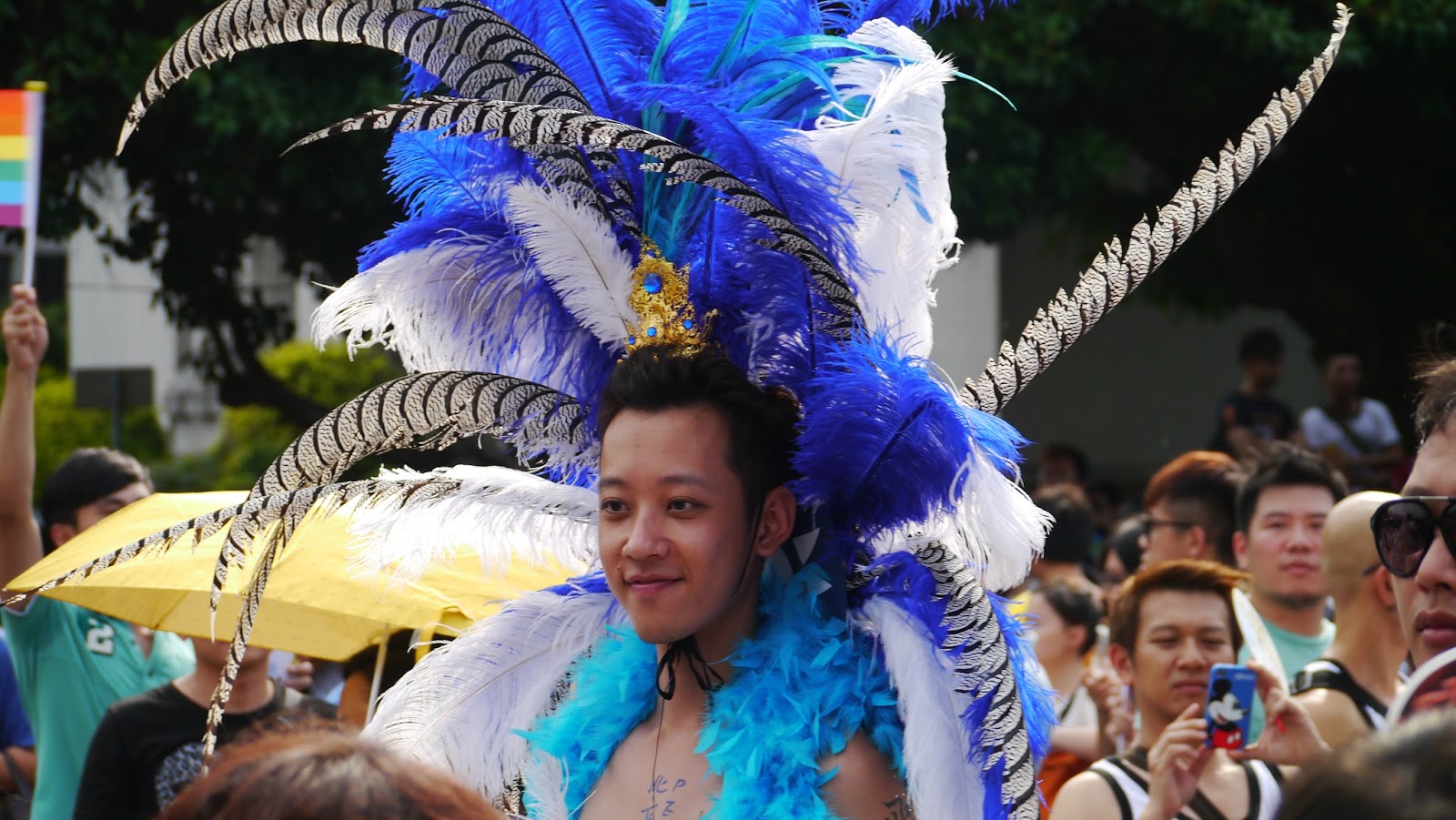
A participant at the LGBT parade in Taipei last year
'In the eyes of government officials, gender is far more important than the value of marriage and family' 

Academics are accusing the government of basic human rights violations after the Ministry of the Interior (MOI) earlier this year stripped a transgender couple of their legally married status, in a case that raises fundamental questions about the meaning of marriage. 

Prior to getting married in October, Abbygail Wu (吳伊婷), 27, and her partner, Jiyi Wu (吳芷儀), 29, obtained the necessary papers by registering with government authorities to obtain their marriage certificate. In their application, Jiyi Wu applied as the “husband” in the couple, while Abbygail Wu did so as the “wife.” Two months earlier, the Wus had undergone sex changes, or “gender reassignment surgery,” to tranform them from men into women. However, when earlier this year Jiyi Wu applied for legal status as a woman, the Taipei City Household Registration Office noticed some “irregularities” and turned to the city’s Department of Civil Affairs, which in turn requested input from the ministry. 

In the end, the ministry revoked the marriage certificate and stated that marriage can only occur between a man and a woman. 

My article, published today in the Taipei Times, continues here. (Photo by the author)

Friday, July 12, 2013

It’s military drill season in the East China Sea

PLAN officers at attention on the Type 051C Shenyang
All the elements of tit-for-tat exercises by the principal countries are present this week 

Judging from the frequency, size, and coincidence of military exercises that are being held this past week alone in the East China Sea, it is easy to conclude that tensions in the region — especially over the disputed Senkaku/Diaoyu islands — are continuing to rise, something that Japan’s defense white paper, released earlier this week, seems to confirm.

What is especially troubling, despite efforts by the governments involved to downplay the drills by repeatedly stating that they are not aimed at any third party, the fact of the matter is that live-fire military drills are increasingly becoming instruments of policy, and are being timed in a way that can only be described as escalatory.

My article, published today in The Diplomat, continues here.

Tuesday, July 09, 2013

Taiwan’s all-volunteer military: vision or nightmare?

A soldier aims his rifle at Huadong
Taiwan is trying to shift to an all-volunteer force. Problems lie ahead 

As the young soldiers lined up along the coast at the crack of dawn, moments before rocket systems, main battle tanks and combat aircraft pulverized imaginary targets out at sea as part of the annual Han Kuang military exercises, it was impossible not to wonder how Taiwan’s military would fare in the advent of a real invasion by China’s People’s Liberation Army (PLA). Would they offer stiff resistance, fight bravely and efficiently, or would they surrender in the face of a much more powerful and zealous adversary?

According to the Taiwanese government, force modernization — a leaner, smaller, more professional and tech-savvy military — is the answer to the country’s future defense needs. The main pillar of this transformation is Taipei’s multi-year program to drop mandatory military service and shift to an all-volunteer force (AVF). Under current plans, by early 2015 the armed forces should be composed of 176,000 volunteers, from the 235,000 volunteers and conscripts at present, for a total active duty force of 215,000 (from 270,000).

The challenges Taiwan faces in making a successful transition – and in building a leaner and meaner military that can pose a credible deterrent to China – are many.

My feature, published today in The Diplomat, continues here.

Chinese arrogance hits new heights

Taiwan's Hsieh Su-wei, the latest victim
China cannot help itself, even when the obvious result is self-defeating 

History is replete with examples of hubris and its nefarious consequences for both perpetrator and those on the receiving end. Sadly for us all, every great power seems powerless against its call — and that includes China. Hubris manifests itself in various ways, including arrogance, unchecked nationalistic sentiment, imperial overstretch, chauvinism, racism and, quite often, impoliteness.

My unsigned editorial, published today in the Taipei Times, continues here.

Thursday, July 04, 2013

Anger rises over the Dapu fiasco

The inability of the Ma administration to connect with the victims of ‘modernization’ projects boggles the mind

As Friday’s “deadline” approached for the demolition of four families’ homes in Dapu (大埔) in Miaoli County’s Jhunan Township (竹南), to make way for — hear this — roads around a planned science park, I headed for the Executive Yuan in Taipei to observe yet another round of protests by the home owners, farmers, and their supporters, who hours earlier had been forcefully removed from the area ahead of a regular meeting inside the EY.

Police await at the EY
I got off at Shandao Temple MRT at the National Police Administration exit, and headed for the EY nearby. From the number of police officers I encountered on my way there, it was evident that the powers that be were expecting trouble — and a much larger crowd than the one that I had spent time with the previous day.

No wonder. The anger over the injustice at Dapu has been rising, and people are growing sick and tired of being lied to by local county heads and some of the most senior of government officials in Taipei. Not only had then-premier Wu Den-yih (吳敦義) broken his promise, made in 2010, to halt the demolitions, but the now vice president has distanced himself from such expectations in recent days, saying he had never made such a vow. To add insult to injury, he now claims that his intervention had been for the sake of facilitating negotiations, which had succeeded in convincing 20 of the 24 households to agree to have their houses demolished. Earlier this week, he compared this achievement to an exam, saying that anyone who obtained a 98 percent grade should be happy — as if those 2 percent were not human beings, but mere marks on a paper. What he also not mentioned is the fact that the 20 households that finally did agree to be evicted did so under duress and very likely were compelled to pick the least bad of the options given them (some had agreed even before compensation was offered, and were understandably miffed when they realized that others were being offered a bit of money). Even for those who did get financial compensation, the amount offered per household — about NT$900,000, or US$32,000 — is insufficient to help them acquire new land (the government has offered to sell them some plots) and build a new house. In most cases, the relocation will leave them by as much as $3 million in the red.

One resident, 72-year-old Chu Feng Min (朱馮敏), committed suicide to protest the land seizures back in 2010.

Meanwhile, appeals to Premier Jiang Yi-huah (江宜樺) to intervene in the case have fallen on deaf ears, and Jiang has said that the decision whether to proceed with the demolitions rests with Miaoli County Commissioner Liu Cheng-hung (劉政鴻), whose ethics and sense of justice can only be likened to those of a Chicago gangster. Jiang, who before becoming premier had been a professor at National Taiwan University and had studied the political thoughts of no less a figure than the German-American political theorist Hannah Arendt, seems to have lost sight of his alleged liberal views, something that isn’t unusual for individuals who enter government.

Peng Hsiu-chun, left, with her ailing husband
The press conferences this morning were tearful affairs, especially when Chang Sen-wen (張森文), a resident of Dapu, was brought in a wheelchair, unconscious, while Peng Hsiu-chun (彭秀春), his wife, sobbed at his side. If things keep going like this, it is very likely Chang won’t last much longer. Their house, which originally measured 11 ping (36.3 square meters), is now only 6 after it was nearly cut in half to make way for a road that was being widened. There were many tears among the protesters and press corps, which had turned up en masse, while the residents and their supporters took turns to appeal yet again for government intervention at the eleventh hour.

Melee on the EY grounds
Once the press conference was finished, some silent code was given and immediately dozens of protesters stormed the wall and, with the use of blankets and other means, rolled over it and over some small trees on the other side, then over barbed wire, where they were met by several dozens of police officers. A few were injured in the process (mostly cuts, or having the wind knocked out of them). At some point, two cops were struggling to drag away a young female protester who had wrapped her legs around a tree. A second group of protesters, meanwhile, clashed with police in front of the main gate, amid shouts of anger directed at Liu, Jiang, and others. From my vantage point atop the fence, I could sense a powerful wave of anger coursing like electricity among the protesters. It was something that one could almost reach out and touch. It took a lot of self-control for me not to join those who screamed their indignation, who cannot believe that this is happening in Taiwan today.

Then things calmed down, and the clashes ended. The dozens of activists who had managed to cross over to the EY lawn were let go, and one final press conference was held before the crowd started dispersing.

Protesters on the EY side
Soon afterwards, the Presidential Office announced that Wu had ordered Liu to “suspend” or delay tomorrow’s demolitions, which for those among us who have observed Wu for a while, was nothing more than politics of illusion, deceit to give the appearance of government intervention when in fact the demolitions were not planned for Friday, but could take place at any moment’s notice from that Friday on. In other words, Wu did nothing, and only made it possible for Liu to wear the protesters out (many of them will head for Dapu on Friday morning) and carry out the demolitions when nobody’s looking. 

There have been so many such instances in the past year that it is difficult not to feel powerless. One has every reason to be uplifted by the mobilization of people — students, professors and civil society — in support of the weak against the predations of the state, but the unresponsiveness of this government, the seeming inability to connect with the victims as humans to humans, is deplorable. In my home country of Canada, crooks like Liu would be behind bars (as seen recently in Toronto and Montreal); here, not only do they get away with it, but even the central government, “liberals” like Jiang, assist them in their activities by looking the other way. 

Something will have to give. Let us hope there’s a special place in hell for the people behind this type of behavior. (All pictures by the author)

Wednesday, July 03, 2013

Voices for Taiwan’s future

The battle for Taiwan’s future starts here at home, through endeavors that will ensure that honest and qualified individuals are given the responsibilities of high office

It’s been going on for several months now, and with the passage of time, their skin has been getting darker, their waists slimmer, and the battle wounds — a scratch here, a bruise there — have adding up. Over the past year, hundreds, perhaps thousands, of young Taiwanese, most of them university students, though some are still in high school, have mobilized against a variety of issues, protested in Taipei and across Taiwan, organized information sessions and concerts, and developed a plethora of Web sites to monitor developments (sometimes almost in real-time), and to provide documents, photos, and film clips.

Aboriginal protester against the Miramar project
With the exception of the alliance against the monopolization of Taiwan’s media industry and the growing influence of China within the sector, all the issues that have animated and brought together the young protesters have been what we could describe as “local” in nature. From the opposition to the destruction of houses and small businesses in the Huaguang Community (華光) in Taipei to efforts to safeguard the residents of the Losheng Sanatorium (樂生) in Sinjhuang District (新莊), New Taipei City (新北市); from protests against the seizure and demolition of farmers’ houses and land in Miaoli County’s Dapu (大埔) to those targeting the construction of wind turbines dangerously close to residences in Yuanli (苑裡), again in Miaoli County; from efforts to halt the construction of a hotel resort on Aboriginal land on Taitung County’s Shanyuan Beach (杉原) to that of a cement factory in Dongcing Village (東清) on Orchid Island, the young activists have oftentimes sacrificed weekends, lost sleep, pulled all-nighters, skipped meals, been arrested, beaten up, followed, monitored, ridiculed, gotten heat strokes, caught colds, compromised their studies, and spent their own money to travel from one part of the country to the other. They did all of this not for the sake of self-aggrandizement, as some critics have proposed, but rather to draw attention to causes that, in their view, are important ones, and whose outcomes are a key component of their homeland’s identity.

Leaders have emerged in the process, and some have done exceptionally well, so much so that their efforts were attacked by individuals who, for example, were incredulous at the youth’s ability to raise relatively large sums of money for their causes. Others have come forward as reluctant public figures, by force of things pulled from obscurity as greater forces — often in the name of “progress” — threatened to destroy their homes, livelihoods, and so on.

Through their perseverance, youth activists have managed to make acts of injustice that would likely have been perpetrated unnoticed into ones that speak to the nation at large, attracting interest from the local media, and in some instances international ones. They have exposed government officials as complete liars, corporate leaders as thugs, county commissioners as crooks, legislators as self-serving, media moguls as unprincipled, and oftentimes brought out the very worst in individuals in positions of authority, forcing them to show their true colors to the electorate.

Protesters at Huaguang during a round of demolitions
One needs to be there, in their midst, exposed to the unforgiving elements, repelling PVC shields and muscle, to understand the depth of their determination. One needs to see the tears, the rage in their muddied faces, as protesters and victims fight for what they believe in, or for as little as the right to keep one’s roof over one’s head as rapacious governments and corporations seek to take those from them, again for the sake of “progress.” Equally, one needs to be amid the cops and the hired thugs to witness the unseen angles of the story, the sympathy for the protesters as a police officer drives a youth to the police station (“if someone built wind power units this close to my home, I’d be protesting, too”), the hired muscle who calls it quits as he no longer wants to fight “his own people,” the cop crying as people sing old Taiwanese songs at protests outside the Legislative Yuan, or the tears running down a female cop’s cheeks as an old farmer, her way of life threatened, confronts a member of the Executive Yuan.

There has been beauty, and there has been ugliness throughout. Some Taiwanese have donated money, rented tents, provided shelter, food, and encouragement. Others — including legislators from both sides of the divide, some who should know better as three decades ago they themselves (and their parents) were storming the barricades — have libelously referred to the activists as “professional protesters,” or accused them of undermining social stability. Others have called the youth of being naïve, of being played by unseen corporate forces, or of being mere pawns in the struggle between, in one instance, the nuclear and wind power industries. But as anyone who bothers to get to know them will quickly realize, those very same protesters — many of them graduates from the nation’s top universities — have mastered their subjects to a dot, and often offer commentary that goes well beyond the simplified accounts in the media or, help us, given by officials.

Activist in Yuanli
There are those who will give the young activists a paternal pat on the head and mild encouragement, but who will then argue that they need to grow up and tackle “real” issues, those that touch on Taiwan’s relations with China. However, there is terrible shortsightedness in regarding “local” protests as if they are somehow disconnected from the larger problematic of cross-strait relations, for in fact, the two are closely related. After all, how can we expect this government to kept Taiwan’s best interests at heart in its negotiations with China when its officials cannot even play fairly with their own citizens? How can, say, Vice President Wu Den-yih (吳敦義), who many believe has presidential aspirations for 2016, be a credible candidate when time and again he has given us proof that he is fully deserving of the unflattering nickname (hint: it rhymes with “friar”) that Taiwanese have given him? Or how can people place their hopes in the Democratic Progressive Party (DPP) when it selects issues on the basis of their value as a tool by which to make the Chinese Nationalist Party (KMT) look bad ahead of important elections? Or when one of its most esteemed legislators, who comes from a family with an unassailable tradition of opposing injustice, belittles activists and browbeats other DPP legislators into silence, because the protesters oppose a project that involves a form energy that she has espoused — even when the implementation of that project leads to undeniable (and repeated) violations of human rights? Or that also acted inhumanely when it was in power, sometimes on the very issues that engender protests today?

The fact of the matter is, all those “local” issues are directly related to national ones: keeping officials, local and central, honest, while ensuring that the rights of every inhabitant on this island, whether he be rich or poor, young or elderly, are respected by those in power, are inherently about Taiwan’s relations with China, as they speak to the nature, spirit, and character of the government that rules over this nation. If officials in Taipei cannot ensure that Ms Zhang’s house in Dapu isn’t bulldozed to make way for a road, despite promises (which he now denies ever making) by then-premier Wu in 2010 that such an outcome would be averted, if Mr Chiang cannot be treated fairly by a city government that wants to erect a wonderland for the super-wealthy on the ashes of Huaguang, then how can we possibly expect them to be fair when they strike deals with the authoritarian vultures in Beijing? If crooks and miscreants are allowed to retain positions of power in Taiwan, they will remain crooks and miscreants in their dealings with China, and quite possibly so in amplified form.

The battle for Taiwan’s future, and for its democracy, starts here at home, through endeavors that will ensure that honest and qualified individuals, people who have Taiwan’s interests at heart, are given the responsibilities of high office. This is what the young protesters are doing, and they are aware of what’s at stake, both locally and nationally. (All photos by the author) Taipei Times version here.

When gangsters enter politics

The White Wolf returns to Taiwan on Saturday
Chang An-le’s return means that intimidation, if not violence, will play a greater role in politics

There are those within the pan-green camp who are willing to give the administration of President Ma Ying-jeou (馬英九) the benefit of the doubt and who refuse to buy into the belief that it is bent on selling out Taiwan to China. However, every now and then the Ma government does things that make it very difficult to remain patient with it.

 The latest incident involves the return to Taiwan, after 17 years in exile, of former Bamboo Union leader Chang An-le (張安樂) on Saturday. After checking through immigration, the most-wanted criminal emerged from the airport, handcuffed and escorted by police, smirking like a conqueror. By some inexplicable agreement or oversight, Chang — also known as the “White Wolf” — was hiding his handcuffs with a pamphlet advocating his plans for the “peaceful reunification” of Taiwan and China. Awaiting him at the airport were hundreds of thugs and the racist invertebrate Kuo Kuan-ying (郭冠英), who surely found more reason to celebrate after Chang was released on bail later the same day.

My unsigned editorial, published today in the Taipei Times, continues here.

Tuesday, July 02, 2013

China, Russia to Hold Largest-Ever Naval Drills (Joint Sea 2013)

A PLAN ship, aircraft, take part in a drill
A total of 19 vessels, with seven from China, will take part in the exercise 

The Chinese and Russian will hold their largest-ever joint naval exercise from July 5-12 in the Sea of Japan, a Chinese official announced on July 1.

Fang Fenghui, Chief of the General Staff of the Chinese People’s Liberation Army (PLA), said that “Joint Sea 2013/Naval Interaction 2013” made the announcement during a visit to Moscow. The following day, the Ministry of Defense in Beijing said that four destroyers, two missile frigates and a support ship, would participate in the exercise, which will be conducted in the Bay of Peter the Great. The vessels left the port of Qingdao on June 28.

Fang said the exercises did not target any third party and were meant to strengthen cooperation between the two armed forces and to enhance their capability in coordinating military operations to help safeguard regional security and stability. The exercises are also part of ongoing efforts by the PLA Navy to familiarize its naval officers with operations away from China’s traditional theater of operations.

My article, published today in The Diplomat, continues here.

Thursday, June 27, 2013

So what if Taiwan funds AEI? A response to The Nation

Taiwanese pilots pose in front a F-16 at Hualien AFB
The Nation misses the mark with an article that attempts to draw a link between funding of a think tank and support for U.S. arms sales to Taiwan 

A June 25 article in the left-leaning The Nation claims to have unearthed what could only be described as a nefarious conspiracy of “secret foreign donors” involving the Taipei Economic and Cultural Representative Office (TECRO), Taiwan’s de-facto embassy in the U.S., and the American Enterprise Institute (AEI), a Washington-based think tank. 

At the heart of the article is the argument that at the time that AEI — “one of the Beltway’s most consistent advocates for the sale of advanced fighter jets to Taiwan” — was advocating for arms sales to the island, the Taiwanese government was showering it with US$550,000 in contributions, making Taipei its fourth-largest donor in financial year 2009. Furthermore, we are told that AEI had “never publicly acknowledged” the donations. (TECRO told The Nation that it was simply facilitating a donation that a Taiwanese University had made to AEI). 

Drawing from various excerpts from articles and papers written by researchers at AEI (including some published in The Diplomat), and using techniques that, truth be told, border on guilt by association — e.g., mentioning former Deputy Secretary of Defense Paul Wolfowitz’s (the Left’s version of Lucifer) ties to the institution — the rest of the article endeavors to raise questions about the independence and integrity of the institute. “To what extent have they consulted with the Taiwanese government?” it asks. Those are perfectly legitimate questions, and we’re all for transparency in the funding of research institutions — especially when it comes from abroad. The problem is that the article’s claims are based on two assumptions that belie a poor understanding of the think tank world and, more importantly, the maddeningly complex workings of U.S.-Taiwan relations. 

My article, published today in The Diplomat, continues here. (Photo by the author)

Wednesday, June 26, 2013

‘Apple Daily’ delivery truck set on fire in Hong Kong

A woman reads the Apple Daily in Taiwan last year
A second incident within a week targeting Jimmy Lai’s media empire in Hong Kong  raises questions

I won’t bother to pitch this during the news meeting today, as my employer doesn’t give a rat’s ass, either because it fails to see the connections, or because — let’s be honest here — Jimmy Lai’s (黎智英) group is a direct competitor of the Liberty Times Group. Anyway, here it goes.

Exactly one week after suspects crashed a stolen car into Mr. Lai’s residence in Hong Kong, leaving an axe and a machete behind as a warning, reports are now emerging that early this morning, two men, armed with knives, stopped an Apple Daily delivery truck, ordered its occupants to step out of the vehicle, and proceeded to set it ablaze using lighters. Their act of arson completed, the perpetrators fled the scene, and soon thereafter firefighters were able to put the flames out before the truck — and its contents — were entirely destroyed.

As I wrote last week, the series of incidents targeting the owners of media outlets known for their criticism of Beijing (and therefore banned on the mainland) is a worrying trend, which has evident implications for the media environment in Taiwan.Yes, as some have observed, there is always the possibility that all of this is related to organized crime. But given how Beijing has cracked down on the media in recent months, there could very well be a connection.

Smartphones are making us dumber

Taiwanese children experiment with smartphones
The long-term physical and psychological consequences of this mass addiction to tablets and smartphones cannot bode well for humanity 

From the way people behave on the MRT, on buses, at coffee shops, restaurants, in parks, or on sidewalks, one would think that Taiwan had been hit by a zombie infestation well before the release of summer zombie blockbuster World War Z. Everywhere one turns, they are there, walking about in a daze, sitting comatose, completely oblivious to their surroundings and absorbed in their smartphones, their insect-like fingers tapping and sliding furiously. 

Hailed just a few years ago as a great technological advance, the smartphone has since turned into an instrument that has made the general population more dumb, less attentive, asocial and disconnected from reality. 

My unsigned editoral, published today in the Taipei Times, continues here.

Thursday, June 20, 2013

Where we part

Hard at work on a hot summer day
He certainly doesn’t know everything, but he knows enough about Taiwan to treat its immense complexities and people with humility and respect 

For years this writer was a good little soldier from the green camp working at a green organization. With the exception of the very occasional snipe from the enemy blue camp — which reached its apex with the threat of deportation over an article on Chinese espionage in September 2011 — he was cruising: he regurgitated what his employer expected of him, and what readers of his employer’s publication looked for, i.e., confirmation and reinforcement of their preconceived ideas.

Then something odd happened; the blue camp left him alone, and instead the animosity increasingly came from within the green camp. That this would occur should not come as a surprise, for his views on the touchy questions of Taiwanese politics, identity, and self-determination matured over the years. In other words, his writing became less a matter of black and white, of antipodes, as it sought to better reflect the huge complexities that underscore the Taiwan “question.”

Of course, this maturing could not have occurred had he chosen the path of least resistance, or if he’d contented himself with keeping his employer and followers happy. Instead, as someone who regards his work as a responsibility (as much to himself as to his readers), he used the access that his position as a journalist gave him to deepen — and in similar ways widen — his understanding of Taiwanese (see the upcoming Officially Unofficial: Confessions of a journalist in Taiwan, for more on this journey). While those who think little of journalists are legion, there is no denying that very few professions provide as much access to a variety of sources as journalism. Granted, that can be abused and misused, and it often is, but in the proper hands, it’s an instrument of undeniable power for those who truly seek to learn, to understand.

What came out of this was the conviction that Taiwanese are much more resilient, self aware, and capable of charting their future, than most people believe. And it was this very realization that got him into trouble with the green camp writ large. A special class of his new critics are expatriates (by no means all of them) in Taiwan, many of whom seem to assume that marrying a Taiwanese and spending a few years teaching English are sufficient, in and of themselves, to make them experts on Taiwan capable of discussing its politics, history, and identity. Profession, training, education, all are irrelevant, as if Taiwan had the unique property of being thoroughly understandable by virtue of proximity alone.

All of them indisputably “love” Taiwan, its people, its ease of living. But many among them also have a sense of superiority that frankly smacks a little of colonialism, of that which Orwell lamented in his fellow British countrymen (and women) abroad. Old habits die hard. The very same people who praise Taiwanese “kindness” and “loveliness” then turn around and accuse them of being ignorant, of being easily bought, of not knowing their own history (as if Canadians or Americans knew more about their own history!). Or worse, of being “brainwashed” by a nefarious KMT which they cannot conceive of being other than a monolithic copycat of its past (interestingly, those people never manage to explain the contradiction: if the KMT were so successful at controlling the minds of Taiwanese through the media and the education system, how could Taiwanese identity and support for independence have continued to grow under four KMT administrations, first under Lee Teng-hui [李登輝], and later under Ma Ying-jeou [馬英九]?)

The armchair experts, despite their lack of access, their long absence from Taiwanese soil (this includes a number of Taiwanese who haven’t lived here for decades), their inability to understand the local languages, resent the notion that Taiwanese are as alert as they are to the challenges ahead. This is especially true of those who, like recent converts to Christianity, feel an urge to prove that they are greener than the greenest among Taiwanese, an affliction that makes extremists of them and sidelines them to the point of irrelevance.

How do they know, to use a recurrent example, that the Taiwanese military has given up, that morale among the troops is low, when they’ve never set foot on an army base, had lunch with recruits and generals, soaked in a pool with soldiers, or traveled with them to various exercises, something journalists do routinely? How can they know that the KMT is betraying Taiwan (or conversely, that there is room for cooperation) if they don’t interact with government officials and party members? And yet, among them one will find those who argue that Tsai Ing-wen (蔡英文) is a sellout who supports unification with China, and that anyone in Taiwan who doesn’t actively call for the release of former president Chen Shui-bian (陳水扁) is a traitor.

They mask their lack of access (“Hello Minister —, I’m a blogger in Chiayi and I’d like to ask you a few questions about your policy on the Diaoyutais”) through intransigence and by passing judgment on everything, often from the comfort of their living room, without every having done the legwork that is a necessary part of journalism. And deep inside, they cannot countenance the notion that Taiwanese, or any other “yellow” or “brown” being, are their equals. Their love for Taiwan is equaled by their belief that as superior whites they are here to “educate” the Taiwanese, to open their eyes, and ultimately to save them from themselves. Perhaps this stems from a sense of having failed back home, and the need to make oneself more relevant here in Taiwan.

This isn’t everybody, of course; there are laudable exceptions, and they know who they are.

That’s where he parts with those who have criticized him and his work in the past two years or so: he refuses to regard himself as superior, in any way, to Taiwanese, especially when it comes to questions such as their identity, their political choices, their past, and their future. In other words, rather than lecture them (or berate them when they “misbehave”), he has dialogue with them and seeks to learn from them, which, fundamentally, is what journalists are supposed to do. His eyes and his brain are open, he is an equal, not anyone’s superior, not a Jekyll and Hyde, who one day loves Taiwanese and the next stabs them in the back by treating them as inferior.

He certainly doesn’t know everything, but he knows enough about Taiwan to treat its immense complexities with humility, and to give Taiwanese of all stripes, from farmers to senior government officials, the respect they deserve. How ironic that such an admission would lead to accusations that he has sold out! If the belief that most Taiwanese are intelligent enough to handle the great challenges that confront them, and aware enough of the dangers that lurk out there, is selling out, then yes, he’s guilty as charged.

Wednesday, June 19, 2013

Thugs descend on Hong Kong: Attacks on Jimmy Lai and Chen Ping

Next Media's Jimmy Lai
Worrying signs in Hong Kong that underworld figures are being used to silence Beijing’s critics

Apparently this development isn’t newsworthy enough for my employer, so here it is — an exclusive. Less than three weeks after Chen Ping (陳平), the billionaire publisher of iSun Affairs magazine, was assaulted as he was leaving his office in Hong Kong, early this morning someone crashed a stolen vehicle into the gate of media mogul Jimmy Lai’s (黎智英) residence in Kowloon before speeding away. Ominously, they left an axe and a knife behind.

Although Hong Kong police has yet to break the cases, the incidents are hardly a coincidence and they suggest active efforts to intimidate the two influential men. Soon after his hospitalization in early June, Mr. Chen told a press conference that the source of the attack was probably to be found in Beijing, or within pro-Beijing types in Hong Kong. “I don’t think I’ve offended the mafia, but maybe the mafia-types were told what to do by certain other people,” he said. “Maybe I offended a few people in the Chinese Communist Party (CCP) regime.” Indeed, iSun, which is currently undergoing restructuring, has a solid tradition of presenting articles that are highly critical of the CCP on questions such as human rights and Tibet.

Chen shows his injuries
The same applies to Mr. Lai’s Apple Daily, which is banned in the Mainland for its criticism of the party and overt support for Hong Kong democrats. Nor was this morning’s incident his first brush with violence: Molotov cocktails were lobbed at his residence in 2008. Mr. Lai, the owner of the Next Media group, made news in Taiwan last year after he announced his intention to sell his Taiwan media operations to a consortium led by the Beijing-friendly Tsai Eng-meng (蔡衍明), chairman of the Want Want China Times Group, a move that directly led to the formation of the Anti-Media Monopoly movement. After the deal fell through, Lai announced his renewed commitment to keeping his operations in Taiwan intact, minus Next TV.

Those two cases, along with physical attacks in recent years against other well-known figures in Hong Kong, such as Abert Ho (何俊仁) and Albert Chan (陳偉業) — or just last week, against a 50-year-old man who was trying to stop harassment of the Falun Gong movement (the Youth Care Association is believed to be behind the beating) — raise worrying questions about the environment in which supporters of democracy and media freedom now operate in the former British territory. And it doesn’t take too much imagination to guess what this might portend for the media environment in Taiwan, which is also under tremendous pressure from Beijing.

More and more, it seems that thugs and violence are being used to silence critics of Beijing in Hong Kong. Stay tuned...

Two ways to look at envoys (like Wu Poh-hsiung)

Wu, left, and Xi, right, meet in Beijing last week
Are the visits to China by KMT members who no longer hold office really that worrying? Or is their role simply to keep Beijing distracted? 

As he faces China’s leader across the long wooden table, a gigantic mural of tall mountains, valleys and temples as a backdrop, there are two ways of looking at the significance of this pudgy envoy and what his presence there means for the future of Taiwan. 

The first is to regard former Chinese Nationalist Party (KMT) chairman Wu Poh-hsiung (吳伯雄) as a threat. The man no longer has a position in office, nor did Taiwanese elevate him to some position with their votes. No, Wu is like a shadow, operating behind the scenes and free, it seems, of the restraints that apply to elected party officials or government figures. 

Across from him sits Chinese President and Chinese Communist Party (CCP) General Secretary Xi Jinping (習近平) and a few CCP cronies. Wu and Xi are heading a KMT-CCP summit in Beijing, the first since Xi’s ascension to the leadership. Wu is accompanied by former National Security Council secretary-general Su Chi (蘇起) — a Beijing regular — KMT Deputy Chairman Hung Hsiu-chu (洪秀柱) and former KMT vice chairman Chan Chun-po (詹春柏). This is, we are told, the first meeting to be held under the “one China” framework rather than the so-called “1992 consensus.” 

As expected, Wu said everything that Beijing wanted to hear, and in the days that followed last week’s meetings, the CCP promised a whole new series of measures to win the “hearts and minds” of Taiwanese. 

My unsigned editorial, published today in the Taipei Times, continues here.

Tuesday, June 18, 2013

Philippines seeks air defense systems, MLRS from Israel

The Rafael Iron Dome in action
Alarmed by a dispute with China and unhappy with lack of U.S. support, the Philippines may be turning to other countries as it seeks to bolster its defenses 

Notorious for dragging its feet on defense modernization, the Philippine government may finally be putting its money where its mouth is thanks to a territorial dispute with China and the belief that the U.S. is unwilling to come to its defense. According to media reports, the Philippine military intends to procure surface-to-air missiles (SAM) and multiple-launch rocket systems (MLRS) from two Israeli defense contractors. And this time, it seems to mean it. 

An unnamed source told the Manila Standard, late last week that Philippine Defense Secretary Voltaire Gazmin could head for Israel this week to sign agreements with the two firms, which have been identified as Rafael Advanced Defense Systems Ltd. and Israel Military Industries Ltd. (IMI). 

My article, published today in The Diplomat, continues here.

Monday, June 17, 2013

Wind turbine troubles — the Yuanli case

A group of residents in Miaoli County have banded together to halt the construction of wind turbines close to their homes. But corporate interests are getting in the way 

“Where do you want to go?” the old taxi driver inquired as we approached his car outside the Yuanli (苑裡) train station in Miaoli County, a small stop reminiscent of train stations in an old Western movie. “Please take us seaside, where they are building the wind turbines,” we said. 

The driver, assuming we were ordinary tourists, had evidently not expected such a request. “Why would you want to see those?” he asked. “There are much better things to see here — there’s a puppet show.” 

A man walks by the seashore
But we insisted. While driving, he pointed toward a small community behind the vibrantly green rice paddies, right by the seashore. “Those wind turbines are trouble. People are protesting,” he said. 

The residents of Yuanli Township launched their resistance movement against InfraVest GmbH, a German wind power company, in September, after a concerned Chen Ching-hai (陳清海), a local artist and owner of the Xin Diao Ju (心雕居) wood sculpture gallery, attended a pre-construction information session for residents living within 250m of the planned wind turbines. He learned that the firm intended to build 14 wind turbines, each capable of generating 2,300 kilowatt hours (kWh) of energy, along the township’s 2km pristine coastline. 

A counter-protest at the site
But something wasn’t altogether right: records of the meeting showed that only 18 people in the four affected communities were present at the briefing. Worried about the density and close proximity of turbines to their homes, Chen and the residents formed the Yuanli Self-Help Group (苑裡反瘋車自救會). In all, of the 7,682 residents of Yuanli, 4,281 signed the petition opposing the construction of so many turbines in their neighborhood, and so close to their homes. It wasn’t hard to imagine why the villagers opposed the plan. (Removed from printed article: On our two-hour train ride from Taipei to Yuanli, we’d encountered several dozens of the 80m-tall structures, the long metallic stems, the egg-shaped cores, bringing to mind scenes from H.G. Wells’ The War of the Worlds. We’d expected laser beams to start zapping all life forms at any instant.) 

Since September, members of the self-help organization have protested at the Bureau of Energy, the Environmental Protection Agency (EPA), the Executive Yuan, the Control Yuan and in front of the InfraVest office in Taipei. Chen, the leathery-skinned group leader, went on hunger strike for 10 days and had to stop after he began throwing up blood. 

The electronics box
The organization claims that InfraVest manipulated data and paperwork to obtain approval from the EPA. They also allege that the firm submitted a single application for Yuanli, Tongsiao (通宵) and Jhunan (竹南) townships for the Environmental Impact Assessment (EIA) to create the illusion of a much larger area for the wind farms and to avoid the 10 percent land usage quota. By doing so, it also avoided having to address the three townships’ idiosyncratic environmental specifications. After receiving conditional EIA approval, InfraVest submitted a Difference of Environmental Impact (DEI) evaluation and requested that five wind turbine sites be shifted to Yuanli, bringing the total there to 14 and above the 10 percent limit. 

The face of opposition
More importantly, the residents accuse InfraVest of not following the distance requirement in the company’s own DEI report, which clearly states that “the wind turbines should ideally be erected away from other structures, and for the wind turbines facing north or south, the turbines should be at least 350m away from each other. For the wind turbines facing east or west, the distance between the turbines should be at least 210m.” 

This feature article, co-written with Ketty Chen, was published today in the Taipei Times and continues here. See this article for my coverage on the thugs hired by InfraVest to scare off protesters ... and journalists. (All photos by the author)

Thursday, June 13, 2013

In defense of political journalists

A street in Tainan
Rather than actually counter arguments, critics of journalists often come up with theories about ulterior motives, as if everybody were willing to sell their soul 

If this writer could somehow encompass all the character traits of which he has been accused over the years, or if he were afflicted by all the mental conditions that self-made psychiatrists have identified in him, he would have been institutionalized long ago, and would be sharing a dank cell with Cinicinnatus C. 

Who is this writer? What is he? He writes about politics, mostly, as a journalist who also often tips his toe into the dangerous waters of opinion. He is motivated by an urge to explore, to understand, and to tell. He does it because he cannot conceive of himself doing anything else, and because he suffers from a serious case of hypergraphia. He regards his work as a responsibility — not only to conduct his work honestly and professionally, but also to demonstrate an ability to learn, to grow, and to progress, even if, in the extreme, this results is positions that contradict his previous work. He believes, above all, in the need to be the antithesis of stasis. 

The late Polish journalist Ryszard Kapuscincki, writing about Herodotus, perhaps put it best: “The man who ceases to be astonished is hollow, possessed of an extinguished heart. If he believes that everything has already happened, that he has seen it all, then something most precious has died within him — the delight in life.” 

It would be reasonable to assume that most journalists, at least those who regard the profession as a calling rather than simply a job, are animated by feelings that approximate those stated above. And yet the expectation from readers, many of whom seem to take devilish pleasure in hating journalists, is that reporters should be little more than propagandists, that their work should not challenge their assumptions, but instead support, or reinforce, their preconceived ideas. When a journalist refuses to do that, those readers react in horror, and rather than parry with a solid counterargument, they come up with sundry reasons to explain why the journalist has lost his way. Here are some of the theories that have been advanced with regards to this writer over the past two years. Every single one of them does away with human agency, with free will; each one hints rather emphatically at ulterior motive:

He criticizes the Chinese Nationalist Party (KMT) to please his masters, the “green camp,” and the Democratic Progressive Party (DPP); he publishes an article about Chinese espionage in the Wall Street Journal on the orders of the Liberty Times and/or the DPP to make the KMT and the Ma Ying-jeou (馬英九) administration look bad ahead of an important U.S. arms sales announcement; he calls for expatriate humility because he suffers from Stockholm Syndrome after the KMT threatened to expel him for his piece in the Journal; he “hates old people”; he points out successes in the Ma administration because he needs to maintain access to high-ranking officials; he writes for the money and therefore cannot be trusted (a theory that could only be advanced by someone who has never worked as a journalist); or he “shifted to the right,” as a friend wrote recently, because he is angling for a cushy job at a think tank in Washington, D.C. 

All of this is wrong — cheap, and downright insulting, in fact. Things are far more simple, or complex, depending on how one looks at it. Most journalists worth their salt will not sell their souls, period. They accept crappy salaries, equally crappy work hours, constantly fight with their bosses so as to be able to do their job, and will even accept pay cuts, demotions, to join news organizations which they perceive are closer ideologically to their own views. 

If this writer’s sole motivations were glory, comfort and riches, he would not have abandoned a promising career in Canadian intelligence, let alone write a highly critical book about the agency he’d worked for, at some personal risk. He would not be constantly subjected to criticism — threats, even — from managers at his current job. Every day, other journalists go through similar trials as they conduct their work, and will on occasion put their personal safety on the line for the sake of a story (this much cannot be said of their critics). Yes, there are bad journalists oout there, plenty of them, unfortunately. But not all of them are rotten, and in fact, the rotten ones are those who ceased to be astonished, who have seen it all. 

This writer’s views on politics in Taiwan have indeed shifted in recent years, but not for the reasons invented by his critics. He has made a journey, and if he has become more critical of the green camp, it is because he generally sees it to be failing, its ways self-defeating, its constituents incapable of moving beyond a past that long ago ceased to be valid. Money, future jobs, the urge to please power, Stockholm Syndrome, have nothing to do with it. 

We’re human, we make mistakes, and we’re certainly not always right. But give us some credit: we have free will, agency, and we are not, despite the polluting, corrupting nastiness of the politics we come in contact with on a daily basis, cynics who will sell our principles for the sake of a few more dollars, or the chance to secure a more prestigious job in the uncertain future. We’re not all Adrian Leverkuhns. Most of us have a rigidly ethical and principled approach to journalism and will never agree to write something we don’t believe to be true.

Wednesday, June 12, 2013

Let go of the past, it's the future that matters

Various swords at a temple in Tainan
If the only thing that Taiwan’s supporters can summon to protect Taiwan are dusty archival documents, then this nation’s prospects are indeed bleak 

Given Taiwan’s idiosyncratic international situation, it is often — and understandably — tempting to turn to the past for clarity and proof in pronouncements made by political leaders, or written in official documents, that Taiwan is not part of the People’s Republic of China (PRC), as Beijing claims. 

Over the years, many ardent supporters of Taiwan have unearthed a variety of documents to demonstrate that Taiwan was never a part of what is now known as China, or the PRC. Some have made the case, and not unconvincingly, that Taiwan could not be considered to have ever been part of China since the height of the “mainland’s” influence occurred at a time when the latter was itself a Manchu colony. 

Others have turned to historical documents to make the case that after Japan’s defeat in World War II, Taiwan became a protectorate of the UN, part of the US’ territory, or that its status remained in limbo, that it was never officially “returned” to the Republic of China (ROC) government, let alone communist China. 

My unsigned editorial, published today in the Taipei Times, continues here.

Monday, June 10, 2013

Wind power firm hires thugs to protect site

Security personnel guard the site in Yuanli
A German firm is hiring muscle as security at a controversial construction site in Miaoli, but there is a problem: The guards are operating well beyond their authority 

It became clear as the taxi entered the narrow road, hemmed in on both sides by lush rice fields, that we were not welcome there.

The moment the cab driver brought his car to a halt and rolled down his window, a group of individuals who were sitting on rocks, smoking cigarettes, stood up and approached the car. Most of them wore white construction helmets, simple white shirts and black pants. 

Work continues at the site
The yellow construction cranes jutting above the tree line indicated that we had reached our destination. We were in Yuanli Township (苑裡), Miaoli County, at the site of a controversial wind turbine project by German wind power company InfraVest GmbH, which for the past eight months has met growing opposition by villagers, most of them farmers, who claim that the devices are intrusive and too close to their homes. 

Security takes a break
We stepped out of the car and were immediately approached by one sunglasses-toting white shirt, who curtly asked us who we were and what we wanted. A few meters away, a group of men, one of them busily chewing on betel nut, cast hostile glances in our direction. 

My article, published today in the Taipei Times, continues here.

RT-2000 multiple rocket launchers on Matsu?

A RT-2000 during HK29 on Penghu
The military may have inadvertently confirmed the deployment of the Ray Ting-2000 on the outlying island of Matsu, less than 1 km from China 

Taiwan has deployed a powerful multiple rocket launcher (MRL) on the outlying island of Matsu capable of hitting targets in China’s Fujian Province, reports are saying, less than two months after the launcher was made the centerpiece of the annual Han Kuang military exercises. 

Located less than 1 km from the coast of Fujian, the Matsu group of islets — there are 36 in total — have served as a forward defense for Taiwan’s military and a key interception point against Chinese amphibious forces. About 5,000 Taiwanese soldiers are deployed on the islands, from a peak of approximately 50,000 during the Cold War. The steady drop in military personnel there can be attributed in part to improving relations between Taipei and Beijing in recent years. 

My article, published today in The Diplomat, continues here.

Saturday, June 08, 2013

Canada’s engagement with Asia is overdue

Defense Minister MacKay, left, with Chang Wanquan
If Canada is to have any influence politically in the Asia-Pacific, its pivot must include more than just military talks with China 

For a Pacific country, Canada has been a relative latecomer to the Asia-Pacific. But if this week’s visit to the region by Defence Minister Peter MacKay is any indication, the government may finally be taking the first steps in engaging a part of the world will be hugely significant for our nation’s security in the future. 

Up to the present, Canada’s principal focus in East Asia has been economic, with little effort by Canada to play a more active, if not significant, political role within a region that, quilt-like, is an mixture of liberal democracies and repressive authoritarian regimes, and where simmering conflicts have the highest likelihood of sparking a major — possibly nuclear — war. Tellingly, it is also the only region where military spending has been rising. 

For those reasons, and given the implications for Canada’s trade relationships as well as the safety of its citizens based in the region, a reorientation to the Asia-Pacific, both institutional and psychological, is long overdue. Canada can no longer afford to treat major political issues in Asia as if the outcomes were of negligible import to our nation. Nor can our universities, government agencies, and think tanks continue to remain fixated on the Americas and Europe. 

My op-ed, published today in the Ottawa Citizen, continues here.

Wednesday, June 05, 2013

A serious warning from Hong Kong

Chen Ping, founder of iSun Affairs Weekly
A coincidence, or a random act? Perhaps, but given how China treats freedom of expression, one can be forgiven for assuming the worst 

As those who care about such matters take a moment to commemorate tge 24th anniversary of the Tiananmen Square Massacre, an incident in Hong Kong on Monday was a reminder of just how fragile freedom is, of how vulnerable it is to those who would cage it for their own selfish interests. 

Just as he was leaving his office in Hong Kong’s Chai Wan district, Chen Ping (陳平), the 58-year-old billionaire publisher of the political weekly iSun Affairs, was assaulted by two baton-wielding thugs in their 20s or 30s, sustaining injuries to his head, arms and chest, and requiring hospitalization. An investigation has been launched and it is not known who was behind the attack, but one can guess. 

My unsigned editorial, published today in the Taipei Times, continues here.

NOTE: This development is of special significance for me, as just last month I was publishing my first article (translated into Chinese) in Mr. Chen's publication, iSun Affairs Weekly.

Tuesday, June 04, 2013

The Chen Shui-bian drama gets weirder

Former president Chen is escorted by police
Sensing that history (and his former party risks) leaving him behind, Chen appears to be resorting to theatrics 

Taiwan’s Ministry of Justice confirmed on Monday that former president Chen Shui-bian, who is serving a 20-year jail sentence for corruption, attempted suicide by hanging on the evening of June 2, the latest in a long list of dramatic events involving the controversial former leader. 

According to reports, the 62-year-old, who served as president from 2000-2008, tried to hang himself with a towel in a bathroom at Taichung Prison’s Pei Teh Hospital, but was stopped by a guard, who immediately sent him over to medical staff for examinations. 

My article, published today in the University of Nottingham’s China Policy Institute Blog, continues here.

Japan mulls preemptive strike capability

A JSDF uniform
A greater sense of threat, a more hardline government, and a permissive set of circumstances could make this a reality 

Finding itself in an increasingly complex and hostile security environment, Japan has taken the first steps towards developing a pre-emptive first-strike capability. This is a controversial move in a region that remains wary of a potential return to Japanese militarism. 

Just a few years ago, the idea that the Japan Self-Defense Forces (JSDF) would be given the ability to conduct operations that go beyond “self defense” would have sounded ludicrous, not to mention that offensive capabilities would have contravened a longstanding interpretation of Japan’s pacifist constitution. 

But North Korea’s continuing belligerence and pursuit of nuclear weapons and ballistic missiles, as well as China’s growing assertiveness and sovereignty claims, both appear to be changing Tokyo’s calculations. 

My article, published today in The Diplomat, continues here.