Wednesday, February 27, 2013

Ang Lee and the pursuit of dreams

Taiwanese director Ang Lee receives his Oscar on Sunday
A nation is not built on lawyers, doctors and businesspeople alone; it needs thinkers, writers, philosophers, filmmakers, painters, architects and professional athletes 

Taiwanese film director Ang Lee’s (李安) award of best director at the Oscars on Sunday night for Life of Pi was a source of tremendous pride for Taiwan, especially after he thanked Taiwanese for their help in making the movie. 

The Oscar is a new benchmark in Lee’s illustrious career and one that he made little secret he coveted. However, the evidence of his greatness as a filmmaker manifested itself well before the 58-year-old native of Pingtung County stepped onto the podium to receive his Oscar. 

Over the years, Lee has transcended his identity as an Asian and tackled with great precision a surprisingly versatile list of genres, from Victorian Britain in Sense and Sensibility — a feat of civilizational displacement perhaps only equaled by Japanese novelist Kazuo Ishiguro in his book The Remains of the Day — to the American West and male homosexuality in Brokeback Mountain. From less ambitious and more local efforts like his Father Knows Best trilogy (家庭三部曲) to the martial arts extravaganza Crouching Tiger, Hidden Dragon (臥虎藏龍), Lee has constantly pushed the envelope of storytelling and proven himself as one of the greatest filmmakers of our time. 

However, there was nothing preordained in Lee’s rise to the top. My unsigned editorial, published today in the Taipei Times, continues here.

Tuesday, February 26, 2013

F-35 grounded due to engine issues

The Lockheed Martin F-35 during a trial
America's most expensive defense program, the F-35, suffers yet another setback 

Already hit by soaring costs, delays and second thoughts by potential customers, Lockheed Martin’s F-35 Joint Strike Fighter (JSF) ran into more problems last week when a crack was discovered during a routine inspection, prompting the grounding of all aircraft.

The more than half-inch crack on the low-pressure turbine blade of a conventional takeoff and landing F-35A was discovered on February 19th during a routine inspection at Edwards Air Force Base in California. Under strict protocol, ground inspections are held after every 50 hours of engine service. After these findings were corroborated by a different test, all 51 F-35s currently in service in the U.S. fleet were grounded as a precautionary measure, and all further tests and training flights were halted for the three variants of the radar-evasive aircraft. Soon afterwards, the British Ministry of Defense also announced its own suspension of all test flights.

My article, published today in The Diplomat, continues here.

Friday, February 22, 2013

Zombies in Taiwan!

I am trying something new with this, and exploring novels ways to tell the story of Taiwan to the world

Thus began the terrifying struggle of the island’s 23 million people against the greatest challenge the nation has ever faced: zombies. In the weeks ahead, we will meet a large number of Taiwanese, some real, most fictional, first as they try to comprehend the nature of the catastrophe that has descended upon them, and then, after the initial shock has passed, as they battle the walking dead for their survival. Though satirical, this account uses a background that is anything but fictional, drawing from Taiwan’s idiosyncratic position within the international community, its diplomatic isolation, the perpetual threat from China, deeply divided domestic politics, greed, government incompetence, and the tyranny of its geography as a small island-nation.

This is a work of fiction, but beyond that, it is also an attempt to tell the island’s complex story in a different, and perhaps more entertaining, way. The serialized narrative, launched today, can be accessed here at The Zombie Emergency: Taiwan. Hope you like it!

A new definition of military success

A Ching Kuo IDF in flight
Once we reassess what Taiwan can accomplish militarily and combine this with domestic factors in China that mitigate against massive military campaigns, Taiwan’s defense prospects no longer seem so bleak 

 Nobody’s sure exactly when the balance of power in the Taiwan Strait shifted in China’s favor, but in recent years it has become increasingly clear that in the unlikely event that the two countries decided to slug it out, the People’s Liberation Army (PLA) would have a definite, if not overwhelming, advantage.

That reality — China spends at least 10 times more on defense than Taiwan — has had a tangible impact on troop morale in Taiwan, leading many to conclude that the nation would surrender the moment the first Chinese combat aircraft screamed above their heads. This, in turn, has encouraged a small number of academics and government officials abroad to conclude that since it has already “lost,” Taipei ought to strike the best deal it can before Beijing loses patience on “reunification” and decides to use force to settle the matter once and for all.

Related to such perceptions is the argument, again made by some experts, that the US, Taiwan’s principal guarantor of security and the source of its modern weapons, should cease arms sales to Taipei, as their impact on Taiwan’s ability to change the outcome of a war would likely be marginal at best, while causing damage to relations between Washington and Beijing (some of the major forces behind efforts to end US arms sales to Taiwan under the Taiwan Relations Act are members of the so-called “Sanya Initiative,” which serves as a platform for exchanges between retired US and Chinese military officers).

My op-ed, published today in the Taipei Times, continues here.

Wednesday, February 20, 2013

North Korea’s Daily Double

Real or fake? A KN-08 IRBM TEL in April 2012
North Korea may have been signaling to the U.S. and its allies that it would test a missile if additional sanctions were put in place following its nuclear test 

Less than a week after Pyongyang defied the international community with a third nuclear blast South Korean sources allege that one day prior to the blast and despite increased scrutiny, North Korea tested a long-range missile engine. 

Quoting unnamed South Korean officials, Yonhap News Agency reported on February 17th that Pyongyang had carried out a combustion testing of the engines for the intermediate-range KN-08 missile at the Dongchang-ri launch site on February 11th, with the aim of extending the range of the missile beyond 5,000 km. Military sources said the engines were intended for a new intercontinental ballistic missile (ICBM). 

My article, published today in The Diplomat, continues here.

The scars of Typhoon Morakot

The single house that was spared in the Siaolin landslide
More than three years on, areas devastated by Typhoon Morakot see little sign or rehabilitation 

As millions of Taiwanese hit the road, took the high-speed rail or flew home to celebrate the Lunar New Year last week, one area of Taiwan had nothing festive about it: Three years on, many parts of Greater Kaohsiung devastated by Typhoon Morakot in August 2009 continue to bear the scars of nature’s fury and government inattention. 

Traveling the area, one is struck by how little has changed since Morakot, the most damaging Typhoon to hit Taiwan in decades, swept through southern parts of the nation, causing billions of dollars in damage and killing as many as 700 people.

Most roads around Siaolin Village (小林) and Namasiya Township (那瑪夏) remain unpaved, making it very difficult for vehicles to drive around and subjecting visitors to unbearable dust clouds. In Siaolin, a single, forlorn house that by pure luck was spared in a landslide that killed hundreds, remains defiantly. Underneath the heavy canopy of rocks lie the remains of bodies never uncovered, a reminder of our powerlessness against the forces of nature. The area is filled with dry rivers filled with rocks, crushed roads and tunnels, and the sundry remnants of man-made objects pulverized by a much greater force. 

My unsigned editorial, published today in the Taipei Times, continues here.

Thursday, February 07, 2013

Retired air force Lt. Col. gets 12 life terms in China spy case

China continues to seek access to classified military information through recruiting retired officers who remain in close contact with active forces 

The High Court on Tuesday gave retired air force Lieutenant Colonel Yuan Hsiao-feng (袁曉風) 12 life sentences for passing classified military information to China over a period of six years, adding to a list of spy cases to hit the nation in recent years. A court official said yesterday that Yuan passed unspecified military secrets to China between 2001 and 2007 through Chen Wen-jen (陳文仁), a former colleague in the air force.

Lt.-Col. (Ret.) Yuan Hsiao-feng
Using flash drives, Yuan and Chen are alleged to have provided classified information to China on 12 separate occasions. Yuan, who was deployed at an air force ground control unit, was found guilty on 12 counts of leaking secrets, each of which carries a mandatory life term, the court official said. Yuan, who retired in 2007, was reportedly paid a total of NT$7.8 million (US$269,000) by China for his efforts, though the High Court would not confirm the figure. Chen received a lighter sentence of 20 years imprisonment, as he had already retired from the military at the time the crimes were committed. 

My article, published today in the Taipei Times, continues here.

Wednesday, February 06, 2013

Want Want media group is a cancer

Want Want China Times Group chairman Tsai Eng-meng
The Want Want China Times Group does not need China’s assistance to behave like an authoritarian bully. It already is one 

The controversy that has surrounded the involvement of US professors in a campaign opposing media monopolization in the past week served as a reminder — inadvertently so for the principal target of the campaign — that while Chinese influence in the nation’s media is of major concern, reprehensible behavior at home is equally problematic. 

Massachusetts Institute of Technology (MIT) professor Noam Chomsky probably never knew that when he accepted an invitation by a young Taiwanese to have his picture taken with a placard opposing media monopolization in Taiwan, he would get sucked into the vortex of cross-strait politics.

Whether, as he claims, he was unaware of the China angle, is secondary. What matters is that the reaction by the Want Want China Times Group once again showed how vicious and totalitarian its outlets can get when the group or its chairman, Tsai Eng-meng (蔡衍明), face criticism. 

My unsigned editorial, published today in the Taipei Times, continues here.

Tuesday, February 05, 2013

Military confirms admiral questioned in espionage case

The admiral was commander of the 146th Attack Squadron in Magong, Penghu

The Ministry of National Defense (MND) yesterday confirmed that an admiral has been questioned over his alleged involvement in what could be one of the nation’s most serious espionage cases.

Ministry spokesman Major-General David Lo (羅紹和) confirmed reports that Admiral Hsu Chung-hua (徐中華) has come under investigation, but would not provide further details. Media reported that Hsu, commander of the 146th Attack Squadron based in Magong, Penghu, has been transferred from his position. Chengkung-class frigates, which are in the process of being armed with the Hsiung Feng III supersonic “carrier killer” anti-ship missile, are among the vessels comprising the 146th, which would play a primary role countering the Chinese navy in the event of hostilities in the Taiwan Strait [...]

The CMS Haijian 8002
In related developments, the China Marine Surveillance (CMS) under the State Oceanic Administration on Saturday commissioned the Haijian 8002, China’s first kiloton-class civilian surveillance ship, which will join the CMS fleet in charge of patrolling and enforcing China’s sovereignty rights in the East China Sea, which includes the Diaoyutai Islands (釣魚台) claimed by Taiwan, China and Japan.

My article, published today in the Taipei Times, continues here.

CtiTV apologizes over its Chomsky ‘mistranslations’

Activists were quick to show what was wrong
Although the media outlet claims the errors were the result of negligence, Taiwanese critics believe this was a deliberate attempt to mislead viewers

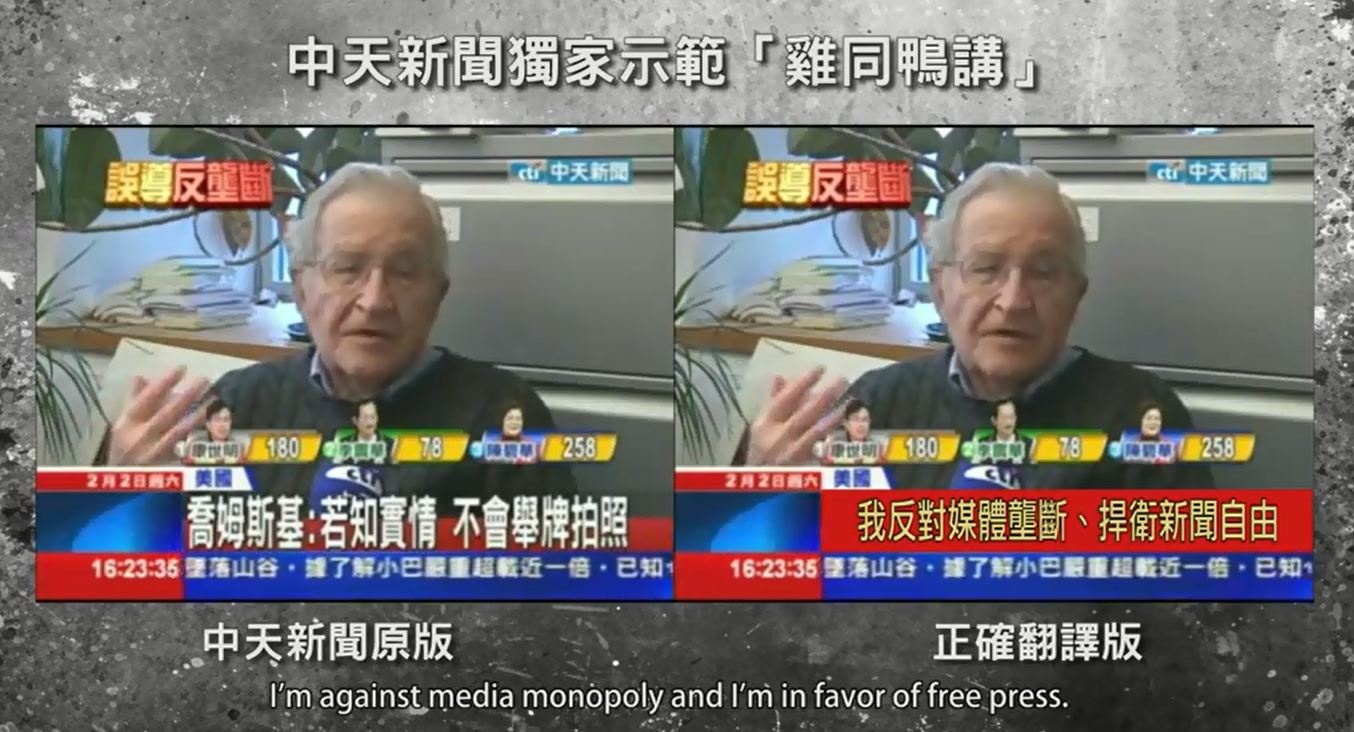
CtiTV yesterday apologized for what it described as a “negligent” translation of its interview with Massachusetts Institute of Technology (MIT) professor Noam Chomsky about the ongoing controversy over the movement against media monopolization in Taiwan. 

The interview, conducted last week by CtiTV Washington bureau chief John Zang (臧國華), came in the wake of a series of articles in the Chinese-language China Times — part of the Want Want China Times Group (旺旺中時集團) — alleging that Taiwanese graduate student Lin Ting-an (林庭安) had deceived Chomsky by failing to explain the slogan on a placard the professor was photographed holding that denounced “China’s black hands” interfering in local media. 

My article, published today in the Taipei Times, continues here.

China’s Navy Aims for Transparency

A PLAN fleet heads for the West Pacific
As the PLA Navy launches a new series of drills in the Pacific, China seems to be striving for clearer signalling 

As it becomes more mature and self-confident, the People’s Liberation Army Navy (PLAN) in recent years has held exercises at sea with increased frequency, and further out in the West Pacific. In 2012 alone, it held seven such drills beyond the first island chain, with surface ships and submarines often passing through channels that lie close to the disputed Diaoyu/Senkaku Islets, its warships have held various drills in waters in Taiwan’s rear. While China seeks to position itself as an ocean-going navy to protect its maritime interests and territorial integrity, its efforts continue for the most part to be marred by a lack of transparency, which only serves to aliment fears with its neighbors. That might be about to change. 

Last week, China embarked on its first naval exercises of 2013, amid rising tensions between Tokyo and Beijing over an island row in the East China Sea. The Chinese Ministry of National Defense announced on January 30 that despite the tensions, it would proceed with a scheduled deep-water series of navy drills in the West Pacific in early February. 

Three vessels from the PLAN’s North Sea Fleet — the Type 052 guided-missile destroyer Qingdao, and two Type 054A missile frigates, the Yantai and Yancheng, left the port of Qingdao on January 29th on their way to conduct exercises in the Pacific. State-run Xinhua news agency said the vessels would conduct as many as 20 drills simulating maritime confrontation, open-sea mobile combat, law enforcement missions and open-sea naval commanding, in a large body of international water including the Yellow, East and South China seas, the Miyako Strait, the Bashi Channel, as well as areas north, south and east of Taiwan. 

My article, published today in The Diplomat, continues here.

Saturday, February 02, 2013

Chomsky denies being deceived in media dispute

Noam Chomsky, no stranger to controversy
The MIT professor said that he was not ‘misled’ by student Lin Ting-an, as the Want Want China Times Group has alleged 

Massachusetts Institute of Technology professor Noam Chomsky yesterday sought to clarify matters regarding allegations by media owned by the Want Want China Times Group (旺旺中時集團) this week that he had said he was “misled” by a Taiwanese student who asked him to have his picture taken with a placard opposing media monopolization in Taiwan. 

In a series of articles on Thursday, the Chinese-language China Times, one of the many publications owned by the group, claimed that Chomsky, along with New York University (NYU) professor Ned Block, were “misled” by not having the full content of the Chinese message on the placard explained to them. The controversy centered on the part of the text that read in Mandarin: “Say no to China’s black hands,” a reference to Chinese influence in Taiwanese media. 

Several articles and commentaries on talk shows run on TV stations controlled by Want Want vilified Lin Ting-an (林庭安), a graduate student at National Yang Ming University’s Institute of Philosophy of Mind and Cognition, who approached Chomsky for his support. The reports accused her of misrepresenting the facts to the 84-year-old professor. 

Chomsky, who said he had been deluged with letters about the controversy from individuals and the media, clarified his stance in an e-mail yesterday, which he said also stood for Block. 

My article, published today in the Taipei Times, continues here.

Friday, February 01, 2013

Retired generals seek cross-strait cooperation on island disputes

Admiral Fei Hung-po (Ret.)
A former Taiwanese admiral told a forum in Hong Kong that Taiwan and China must issue a joint declaration on the disputed Diaoyutai Islands 

Retired senior military officers from both sides of the Taiwan Strait are pressuring President Ma Ying-jeou (馬英九) to allow greater cooperation with China, telling a forum earlier this week that the Diaoyutai Islands (釣魚台) controversy provides the perfect context in which to do so. 

The comments, which called for the creation of a cross-strait military cooperation mechanism, were made on the sidelines of a workshop organized by the Chinese Century Communicating Association (中華世紀交流協會) in Hong Kong on Tuesday.

Saying that military exchanges between retired Taiwanese and Chinese generals in recent years were “single-faceted” and “meaningless friendship-building activities,” admiral Fei Hung-po (費鴻波), a former deputy chief of general staff, added that current regulations prevented more constructive dialogue between the two sides from taking place. 

My article, published today in the Taipei Times, contines here.

Chomsky’s volte-face? Want Want goes after another student

Maybe Want Want will go after him/her next
In what has become a predictable pattern, the group’s various outlets launched another series of attacks against a detractor 

Media outlets operated by the Want Want China Times Group (旺旺中時集團) yesterday intensified their campaign against a movement by a young Taiwanese student that invited two well-known US professors — who now claim they were “misled” — to be photographed holding a placard opposing media monopolization in Taiwan. 

In a series of articles occupying a full page, the Chinese-language China Times, one of several print media owned by the group, provided what it claimed were exchanges with Noam Chomsky, a famous linguist from the US’ Massachusetts Institute of Technology (MIT) and a controversial figure on the intellectual left, as well as Ned Block, a New York-based philosopher, in which both said they were unaware that the placard contained language opposing Chinese manipulation of Taiwanese media.
 
Noam Chomsky holds the placard
Chomsky, 84, said he did not know that the message on the placard, which was written in Chinese and read “Anti-Media Monopoly. Say no to China’s black hands, defend press freedom. I am safeguarding Taiwan here in MIT,” had anything to do with China or Taiwan. 

Lin Ting-an (林庭安), a Taiwanese graduate student at the Institute of Philosophy of Mind and Cognition at National Yang Ming University, who wrote to Chomsky asking for his support prior to visiting him at MIT, says she clearly explained the matter to him and translated the Chinese content before the photograph was taken. 

My article, published today in the Taipei Times, continues here.

Wednesday, January 30, 2013

Ma’s hedging strategy wants it all, sows confusion

President Ma Ying-jeou
The Ma administration had better improve its messaging soon, or the delicate balancing act, too rife with contradictions to be sustainable in the long run, will come crashing down 

As if Taiwan’s status and official designation were not confusing enough for those who are not familiar with its precarious situation, President Ma Ying-jeou’s (馬英九) foreign policy in recent months has seen so many twists and turns as to stun even the most seasoned of policy wonks. 

The root of the confusion is not, as some of his detractors would have it, that Ma is bending to Beijing’s will, but rather that he wants it all. He wants to improve relations with China, the US, Japan and the rest of the international community, but at the same time his administration feels it must rock the boat to ensure that Taiwan is not ignored while elephants clash, and must prepare for a rainy day should the current detente in the Taiwan Strait shift in a different direction. 

As a result, while Ma has proposed the widely hailed East China Sea peace initiative, Taipei has also engaged in brinkmanship of a kind never seen before, sending militaristic signals and appealing to nationalistic sentiment, while relying on the Coast Guard Administration to flex some muscles at sea over the Diaoyutai Islands (釣魚台) dispute. 

My unsigned editorial, published today in the Taipei Times, continues here.

Monday, January 28, 2013

Coast Guard games off the Diaoyutai/Senkaku islands

The CGA's 500-tonne Hualien coastal patrol ship
Despite approaching Japan-Taiwan talks on fisheries issues, some Taiwanese continue to apply pressure on the sovereignty angle  
Japanese media reported at the weekend that a Coast Guard Administration vessel was seen operating in waters near the Diaoyutais, coming within 39km off Uotsuri Island, the largest islet in the chain, known as the Senkakus by the Japanese.

The 11th Regional Coast Guard Headquarters in Naha, Okinawa Prefecture, said the Taiwanese vessel entered the area at 7:10am. The Hualien 119, a 500-tonne medium coastal patrol ship, left the contiguous area at 8:25am. Around the same time, Chinese patrol vessels were observed sailing in the contiguous zone outside Japanese waters for the third day in a row. 

The Coast Guard Administration said the Hualien was on a routine maritime patrol mission. My article, published today in the Taipei Times, continues here.
Saturday, January 26, 2013

Diaoyutai backdrop?

The Diaoyutais belong to us, the patch reads
Nationalism expresses itself in different forms amid territorial disputes 

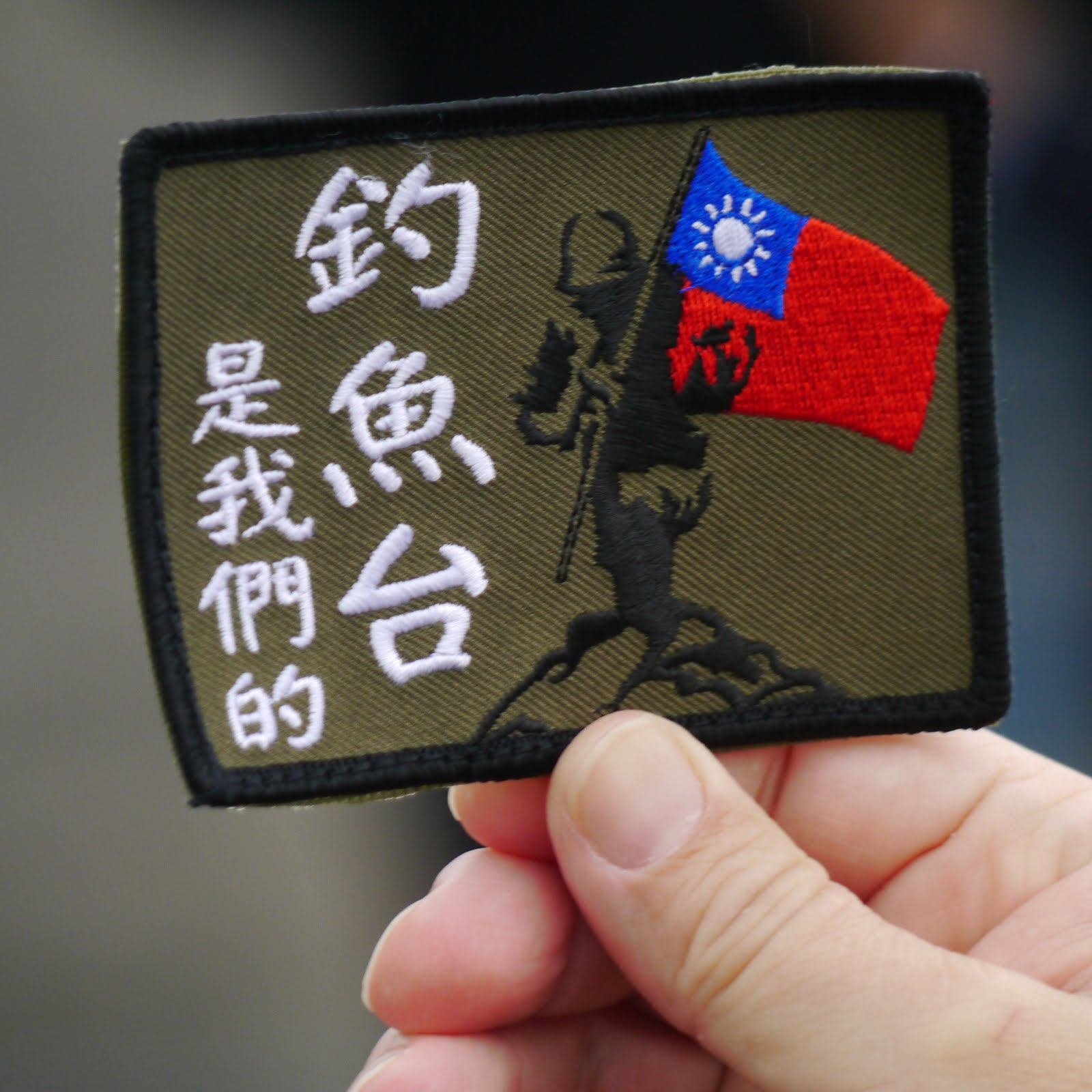
While the series of exercises held this week in Greater Kaohsiung and Hualien did not involve the territorial dispute with Japan and China over the Diaoyutai/Senkaku islands in the East China Sea, a number of members of the Military Journalists Association traveling with reporters had a new patch on their jackets that reads 釣魚台是我們的 ("the Diaoyutais belong to us"), with a depiction of a Taiwanese soldier planting a Republic of China flag on a rock. I was able to snap a picture of one while at Hualien AFB

Although probably not officially sanctioned — like a previous incident last year when a F-16 took off carrying a Mk82 bomb with the same inscription under its wing — one of the members said they were distributing the patches as a symbol of support for Taiwan's claims to the islets.

Friday, January 25, 2013

Visit to Hualien Air Force Base; F-16 basics

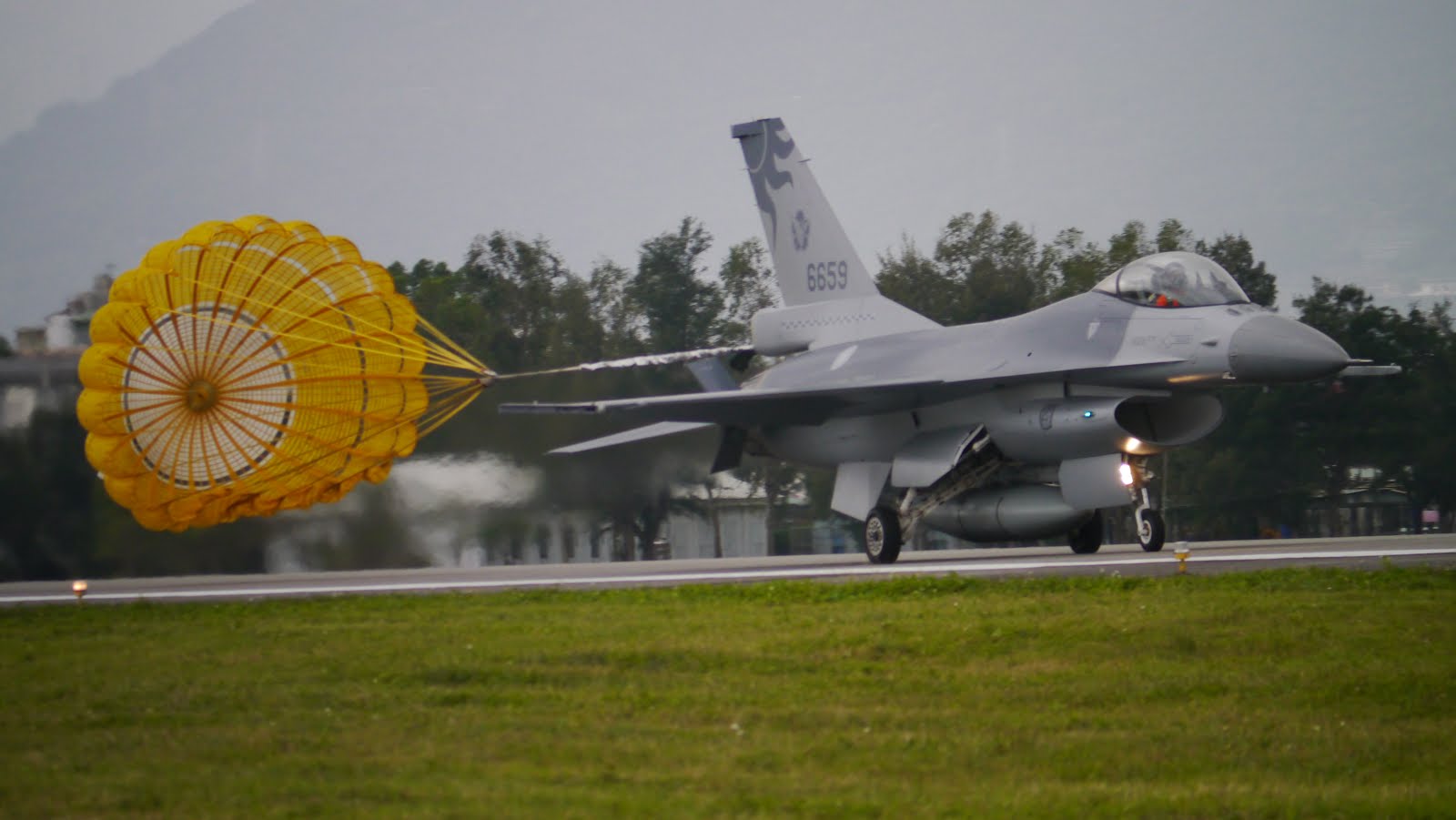
On day two of its pre-Lunar New Year series of exercises, the Ministry of National Defense took a group of reporters — this writer included — to Hualien AFB, home to the 401st Tactical Fighter Wing of F-16A/Bs, one of two locations in Taiwan where the still impressive aircraft are based (the other is the 455th Tactical Fighter Wing at Chiayi AFB).

A F-16A landing
Although there wasn’t anything new to the exercises, this was a great opportunity to snap pictures and watch the aircraft in action. Ground crew demonstrated their ability to outfit and scramble the aircraft within six minutes of receiving an order for action, while pilots displayed their skills through a series of short landings and demanding maneuvers intended to test the aircraft’s capabilities to the limit.

F-16 in concrete hangar
Being able to get very close to the aircraft gave us the opportunity to take very good pictures of the aircraft and of ground crew as they wed various missiles to the aircraft. While there understandably were restrictions on our movements (one must be brought from point A to point B by bus), we were nevertheless able to take some pictures of infrastructure, including runways to hangars. Here are some of the highlights on the base and the main types of armaments carried by Taiwan’s F-16s. 

Seen above is a typical concrete hangar for the aircraft. As China’s ballistic missile arsenal has improved over the years, defense experts have called for new measures to ensure aircraft survival. One of the actions taken has been to build an underground base in a hollowed section of nearby Chiashan, which could withstand a missile barrage, with a series of exits allowing the F-16s to exit afterwards. The ROC Air Force has also invested in rapid runway repair kits, allowing for quick resumption of runway operations following a missile attack.

The new bomb-resistant hangars
Another, more recent investment came in the form of a new type of hangar, seen here, whose surface forces a warhead to detonate prior to making contact with the hangar, thus greatly increasing survivability.

Ground crew prepare missiles
Here, ground crew prepares to fix AIM-9M “Sidewinder” and AIM-7M “Sparrow” air-to-air missiles onto the wings prior to takeoff. Four crew were needed to carry one AIM-9M. A motorized vehicle was used to carry the larger AIM-7M.

AGM-84L Harpoon missile
Aside from the AIM-9M short-range missile, the AIM-7M medium-range missile, and the AGM-84 “Harpoon” anti-ship missile, The F-16s can also be fitted with Mk-82 500-pound bombs. After they are upgraded as part of a US$5.2 billion package, the F-16s will be fitted with a variety of JDAM bombs.

Wednesday, January 23, 2013

Taiwanese Navy holds exercise; unveils new minesweepers

A number of vessels from the Tsuoying Naval Base, plus an aircraft and a helicopter, participated in an exercise off Greater Kaohsiung 

One of the two refurbished Osprey mine hunters
The navy yesterday unveiled two refurbished minesweepers acquired from the US last year during a demonstration in waters off Greater Kaohsiung simulating a submarine intrusion.

A Lafayette-class frigate with media onboard, accompanied by two Chengkung-class frigates, a German-made minesweeper and two Osprey-class mine hunters headed into the Taiwan Strait to seek out an intruder submarine.

A KH-6 fast-attack boat
Six Kuang Hua VI fast-attack missile boats, an S-2T Turbo Tracker anti-submarine aircraft and an S-70C helicopter, which dropped a sonobuoy to locate the enemy submarine, were also involved in the drill. The mine hunters — MHC 1310 and 1311 — were obtained in August.

A navy Hai Lung submarine surfaced after the S-70 dropped a Mk46 torpedo. It was the first time that the Osprey mine hunters had been on public display.

Chengkung-class frigate 1105. Note the HF-3 launchers
A number of vessels anchored at Tsuoying Naval Base, including some that participated in the exercise, showed that progress is being made in a NT$12 billion (US$406 million) program launched in May 2011 to outfit the Chengkung frigates, as well as the domestically made Ching Chiang-class patrol boats, with Hsiung Feng III supersonic anti-ship cruise missiles.

Four HF-3 launchers were seen on the two Chengkung-class frigates, PFG 1105 and PFG 1109. In all, 120 HF-3s are to be added to the navy’s arsenal under the program.

Lafayette-class frigate, viewed from our Lafayette
Taiwan’s submarine-chasing capabilities will be substantially enhanced after it receives 12 refurbished US P-3C Orion maritime aircraft to replace the aging S-2Ts it acquired in the 1980s. Navy officials said the exercise highlighted the nation’s military preparedness and combat readiness ahead of the Lunar New Year.

My article, published today in the Taipei Times, continues here.

Recalls are a risky non-policy

Protesters express their anger at the president on Jan. 13
The DPP is perfectly justified in mobilizing against the Ma administration, but channeling that discontent is itself insufficient 

Concluding the large “Fury” (火大) protest in Taipei on Jan. 13, Democratic Progressive Party (DPP) Chairman Su Tseng-chang (蘇貞昌) announced plans to seek the recall of Chinese Nationalist Party (KMT) legislators who have “failed to listen to the voice of the people” and possibly President Ma Ying-jeou (馬英九). 

Such an effort, though deriving from justifiable anger at the Ma administration’s less-than-stellar performance on a variety of fronts, cannot serve as a stand-in for actual policy alternatives on the opposition’s part. In fact, the recall of officials, which the smaller Taiwan Solidarity Union (TSU) has since said it would support, is a non-policy that, if mishandled, could undermine the democratic foundations of this country and end up hurting the opposition’s image.

My unsigned editorial, published today in the Taipei Times, continues here.