Saturday, March 23, 2013

A new force, the key to Taiwan’s future

Participants at the Losheng 316 rally in Taipei
Through a fledging amalgam of people and organizations, Taiwanese may be leading their nation into a new phase of national consciousness 

I’ve been attending, covering and writing about protests in Taiwan for about seven years now, not only for the entertainment value (though they do tend to be colorful and original), but also because I genuinely believe that they serve as an indicator of social and political stability.

I have noticed in the past 12 months or so an interesting shift in the composition of those who participate in the protests and the frequency with which those protests are held. As I wrote in an editorial last week, not a week goes by nowadays without a protest of some sort being organized, a sign, in my opinion, that the government is failing to address issues that are important to the polity.

Far more important, in my opinion, is the fact that more and more young people are turning out to protest. In fact, in the past year or so, several protest campaigns have been organized by young Taiwanese who mobilized using the most modern social platforms, coordinated with law enforcement agencies, ensured order and security at the events, and led the events. Some have faced arrest, opprobrium by the media, government officials and older people, though they did not allow such reactions to discourage them. Many have done so while writing exams or applying for graduate school.

If we put all the causes together, several thousands of young Taiwanese have rallied on weekends and weekdays, sometimes even spending all-nighters at a time when the rest of the nation was celebrating some holiday or another.

Baby girl at anti-nuclear protest
I always make sure to bring my camera when I go to protests, which hapless me, usually take place on my days off. Using a 45-200mm lens rather than the standard wide lens, I tend to focus more on single individuals than on large numbers of protesters, which allows me to better capture people’s expressions. Eyes are a window to a person’s soul, the saying goes, and to me having the ability to observe people’s eyes reveals a lot about their state of mind and how seriously they take the cause. Anyone who accuses young Taiwanese of political apathy, or of not caring about “real” and “serious” issues, should observe close-up pictures of the participant at the rallies that were held recently in Taiwan. I challenge anyone who looks at those — the protests against media monopolization, against nuclear energy, the destruction of people’s residences at Losheng or on “stolen land” near National Taiwan University — to argue that the young people there aren’t determined, that they are only present to snap pictures and have fun with their friends. The light in their eyes, the steadfastness of their ways, gives me great hope.

As I’ve argued many times before, young Taiwanese will become involved when the issues speak to their own lives and their perceived interests. As such, the composition of the crowd at rallies organized by the green camp targeting “the government,” “the Chinese Nationalist Party” or “China” is usually homogenous — people in their sixties or seventies whose voting behavior is already known (green). Based on my own observations, the ratio of young people to old at those rallies is about 1:10.

Opponent of media monopoly
However, social causes, issues of justice or matters that are seen as having a real, direct and immediate impact on people’s lives, tend to attract people from across the spectrum: university students, young professionals, newly formed families, individuals who have voted for various parties, green and blue, as well as “Taiwanese” and “Mainlanders” (the latter to terms that, in my view, have become meaningless, as all are inhabitants and citizens of Taiwan). For those, the ratio of young-to-old protesters is probably 8:1. The only aberration I’ve seen since 2008 were the protests surrounding the first visit by Chen Yunlin (陳雲林), the then-chairman Association for Relations Across the Taiwan Strait, which though it attracted mostly people from the green camp, also involved a larger mobilization of younger Taiwanese.

Beyond the protests, symposiums and academic gatherings have also reflected this generational divide. Contrast, say, last Friday’s World Taiwanese Congress (WTC) in Taipei, with the various focus groups and lectures organized to address a variety of issues, from the destruction of private property by the government to the risks posed by the monopolization of the media environment. Truth be told, I skipped this year’s WTC, well remembering the slumber fest that it was last time I went two years ago. It’s little wonder that older Taiwanese believe the younger generations cannot be bothered to become involved in political issues: if the only yardstick used is attendance at lectures (mostly in Taiwanese) in dark conference halls by people who have been regurgitating the same old message for decades, then yes, one could conclude that young Taiwanese couldn’t care less.

Woman at Losheng 316 protest
But that’s not the case; their lack of participation at those events stems from the fact that the issues addressed there are seen as irrelevant to young people’s lives. In many ways, young Taiwanese have moved on and no longer understand political participation as meaning opposition to KMT authoritarianism. Rather than look to the past, they look to the future, harping not on issues that, in their mind, have already been resolved (democracy, identity), but focusing instead on matters of justice, on issues that will directly impact their lives: jobs, salaries, one’s ability to own (and keep) a house, etc. One could even argue that young Taiwanese are applying Nelson Mandela’s message of forgiveness (of past wrongs perpetrated by the Apartheid regime) and inclusiveness (a new South Africa for all its inhabitants, white and black). There is true hope for this nation and its ability to heal from the wounds of the 228 Massacre and the White Terror when young Taiwanese turn out in large numbers to protest at the injustice perpetrated by a KMT government that seeks to demolish houses that have served as homes to “Mainlanders” for decades. Issues of “Taiwanese” versus “Mainlander” are unimportant to them: what matters is the injustice caused by those who wield power against those who do not. And more often than not, those issues of injustice span several years and involve both KMT and DPP administrations.

Kneeling over 3km at Losheng rally
Old arguments about who is a “true” Taiwanese and who isn’t, or how “evil” a supposedly monolithic KMT is, are divisive, and do not build solid foundations for a nation. Solidarity does. And that sense of solidarity appears to be snowballing, with more and more organizations showing support for, and participating alongside, other groups. This cross-pollination of causes has become all the more apparent in recent protests, with young individuals one day rallying against the unfair treatment of laid-off workers, only to show up again a few weeks later leading a group of protesters on a 3km six-step-and-kneel walk to Ketagalan Blvd to oppose the destruction of the Losheng Sanatorium (a perfect example of both DPP and KMT administrations going against the wishes of the people, though to be fair I should point out that the issue of land-grabbing appears to have worsened under the current KMT administration).

Rather than single-issue groups, several organizations, which share similar values, now work together to raise awareness of important issues, and rarely do so through the lens of one’s political preference. In many cases, the organizers would rather that political parties not turn out at their events, or will at least keep them at arms’ length.

Protester at a pro-Tibet rally
Through this fledging, still somewhat rough amalgam of people and organizations — “little platoons,” the 18th-century political thinker Edmund Burke called them — Taiwanese may be leading their nation into a new phase of national consciousness, one that at long last manages to transcend the age-old blue-green, Taiwanese/Mainlander political divide that continues to undermine progress. Little by little, as the causes they espouse attract academics and officials, this emerging movement could coalesce into a third force — a transformative and healing force, one that once and for all could liberate all of Taiwan’s 23 million people from a stultifying status quo that stems directly from an unresolved past, from a past that some people, for various reasons, would rather remained unresolved.

This op-ed was published today in the Taipei Times.

Thursday, March 21, 2013

China’s version of the (now failing) diplomatic truce: Prevent Taiwan from joining regional security forum

UN Sec.-Gen Ban Ki-moon speaks at last year's JIDD
Taiwanese delegates at a security forum in Jakarta had their invitations ‘withdrawn’ after Chinese officials filed a complaint 

It’s probably too soon to tell whether this is a sudden shift in policy under the new leadership of President Xi Jinping (習近平) or the result of mounting frustration in Beijing over Taipei’s continued refusal to engage in political talks, but in the past week alone, China has twice reneged on its commitments under the so-called “diplomatic truce” implemented after Ma Ying-jeou (馬英九) became president in 2008 by continuing to limit Taiwan’s international space.

First, one day after Pope Francis was installed in the Vatican, Beijing called on the Holy Church to sever its diplomatic ties with Taiwan, a move that directly contravenes the tacit agreement between Taipei and Beijing that, under the truce, they would not attempt to steal each other’s allies. The Vatican is Taiwan’s sole diplomatic ally in Europe. Ma’s attendance at the investiture — the first time a Taiwanese president was invited to attend the ceremony — added to the full diplomatic treatment of Ma’s delegation by Italian authorities, surely had something to do with Beijing’s discontent.

Now, as the Financial Times reports today, also this week, two Taiwanese academics and two officials at Taiwan’s representative office in Jakarta, Indonesia, were at the last minute prevented from attending the two-day Jakarta International Defense Dialogue (JIDD) after the Chinese embassy became aware of their presence and complained to the Indonesian defense ministry, the organizer of the event. Jakarta caved in, and the invitations for the event beginning on Wednesday were, in effect, withdrawn, thus barring Taiwanese from engaging in dialogue with other regional partners on security issues. Coincidentally, and I believe this is just that, a coincidence, former Democratic Progressive Party chairperson Tsai Ing-wen (蔡英文) happens to be in Indonoesia these days.
Among other things, the Taiwanese reportedly hoped to discuss security issues in the hotly contested South China Sea with American and Philippine delegates. Taiwan was able to participate at last year’s JIDD, with no complaints from Beijing. However, the organizer said that as the event is organized by the government, Jakarta must take objections by other countries into consideration.

So much for improving cross-strait ties.

SM-3: The Future of Missile Defense in Asia?

A SM-3 is fired at sea
European countries are mulling a plan to pool SM-3 missiles and to share radar-tracking. Could Asia do it too?

Raytheon Corp on March 5th reached a new milestone by successfully testing a Standard Missile-3 (SM-3) ballistic missile interceptor using a non-Aegis data link, an important step in efforts to equip more naval vessels to employ the full range of missiles in the Standard Missile family. 

The SM-3 Block IA interceptor uses an S-band data link that can “handshake” with the AN/SPY-1 used on Aegis-equipped warships to provide guidance toward medium-range airborne targets in the exo-atmosphere. The SM-3 Block IB, currently under development and expected to enter service in 2015, also uses the S-band as a data link baseline. 

However, aware of the limitations that reliance on S-band-compatible data links posed for SM-3 sales and regional cooperation in “upper tier” air defense, in 2010, Raytheon began developing a prototype dual-band data link that would enable warships to use both the S-band and X-band radar to communicate with SM-3 missiles.

My article, published today in The Diplomat, continues here.

Wednesday, March 20, 2013

NASA-linked Chinese scientist arrested

A SAR orbiter over the earth
The 32-year-old Bo Jiang, a native of Chengdu, may have tried to leak source code for high-tech imaging technology 

A Chinese research scientist employed as a contractor for a Virginia-based firm doing contract work on space defense technology for NASA was nabbed by the FBI last week as he attempted to flee the U.S. to China, possibly with classified information in his possession. 

Frank Wolf (R-VA), Chairman of a House Appropriations Committee subcommittee that oversees the NASA budgets, said Bo Jiang worked at the National Institute of Aerospace (NIA) in Hampton, Virginia, and had access to high-value information. He also alleged that Jiang had brought with him “voluminous sensitive” NASA documents during a trip to China in 2012. 

Bo Jiang
Reports said Jiang had “virtually unlimited, unescorted access to the NASA Langley facility,” which conducts space defense-related projects for NASA. During a subcommittee hearing last week, Wolf said that Jiang may have been hired by the NIA to “circumvent” regulations on the hiring of foreign nationals by the space agency. 

My article, published today in The Diplomat, continues here.

Taiwan is hostage to a blatant lie

A banner is displayed during a rally on Feb. 28
Everybody knows that Beijing is the aggressor in the Taiwan Strait, yet experts all over the world continue to pretend that it is otherwise 

As a famous US professor once told an up-and-coming Taiwanese academic, there is something about Taiwan that makes even the best and the brightest of minds stop thinking. 

Time and again, otherwise intelligent academics, journalists, writers and government officials have managed to get it all wrong when it comes to Taiwan. The fact that a country whose 23 million people would make it the ninth-largest country in Europe by population size, and whose economy is among the 20 largest economies globally, is so regularly misunderstood is predominantly the result of Chinese propaganda and the willingness of other countries to allow Beijing to get away with its lies.

Not only is Taiwan misrepresented, but the biases that are stacked against it prevent its 23 million people from deciding their own future. So entrenched has this handicap become that Taiwan, not China, is often regarded as the troublemaker, even though it is Beijing, not Taipei, that threatens war — against Taiwan, Japan and the US — over the question of its sovereignty. It is as if Czechoslovakia or Poland, not Nazi Germany, were the true instigators of World War II in Europe. 

My unsigned editorial, published today in the Taipei Times, continues here.

Friday, March 15, 2013

Sorry Beijing, You probably won’t get much more from Ma Ying-jeou

President Ma chairs a KMT meeting earler this month
Democracy and of the electoral cycle will preclude any dramatic policy shift on the KMT’s China policy 

The breadth and scope of the liberalization that has occurred in the Taiwan Strait since the election of Ma Ying-jeou of the Chinese Nationalist Party (KMT) in 2008 has been nothing short of extraordinary, at least if this progress is contrasted with what came before. For Ma critics, the KMT has gone too far, too fast, and in the process it may have undermined the sovereignty of Taiwan. However, with presidential elections less than three years away, Ma will probably be unable to deliver much more than what has already been offered to Beijing, which means that political dialogue on Taiwan’s status will remain off the table. 

Paradoxically, the reason why the cross-Strait honeymoon may be over stems from the very policies that permitted Ma to make short shrift of former premier Frank Hsieh, his Democratic Progressive Party (DPP) opponent in 2008, and to be re-elected in 2012 against a formidable challenger, the DPP’s Tsai Ing-wen. 

More than any other party, Ma’s KMT understood back in 2008 that in order to regain, and retain, power, it needed to clearly articulate what it meant by maintaining the “status quo” in the Taiwan Strait, while simultaneously providing reassurances to both Beijing and Washington. What it did better than other contenders, and why it won, was to understand the maneuvering space within which it could operate and how to balance the expectations, often at odds with one another, of China, the U.S., and Taiwan’s 23 million people. 

My article, published today on the China Policy Institute Blog at the University of Nottingham, continues here.

Thursday, March 14, 2013

A CCP candidate in Taiwan's 2016 elections?

Banners fly on Feb. 28 at Liberty Square in Taipei
What if ... a Chinese Communist Party candidate were able to take part in the presidential election in 2016? How well would he or she do? 

The refrain has been heard time and again: Only a small minority of pro-independence “splittists” oppose the eventual “reunification” of Taiwan and China to reinvigorate the Great Chinese Race. If that were indeed the case, then politicians in Beijing should be unhesitant to take up the following challenge: to field the best possible candidate they can come up with to run for president — OK, let us be fair to them, as “governor,” or “leader” — of Taiwan in the 2016 election. 

Of course, this scenario would be contingent on a number of variables. Chief among them would be for the Chinese Communist Party (CCP) to abandon its opposition to universal suffrage and elections (loosely defined here) at more than just the village level. Another would be for the vote to be restricted to people of voting age on all the territories controlled by Taiwan. After all, the object of this exercise is to determine the willingness of Taiwanese to join China, and not the desire among Chinese (ostensibly high) to unify with Taiwan. 

For the sake of this little experiment, let us assume that Beijing chooses to play along and also agrees not to threaten military action should the elections fail to yield its desired outcome — a CCP win. “Free” and “fair” elections, inasmuch as those are possible in Taiwan. 

My op-ed, published today in the Taipei Times, continues here.

Wednesday, March 13, 2013

Taiwan issues 2013 Quadrennial Defense Review

Cross-strait ties may have improved, but  the new report makes it clear that China remains Taiwan’s top security threat 

Despite the “institutionalization of cross-Strait rapprochement” launched by President Ma Ying-jeou (馬英九), China has not renounced the use of force against Taiwan and remains the nations primary military threat, the Ministry of National Defense says in the 2013 Quadrennial Defense Review (QDR) released yesterday.

Under the National Defense Act (國防法), the ministry is required to produce a QDR — a collaborative effort between defense officials, other government agencies and academics to provide the “uppermost” defense policy guidance for the next four years — within 10 months of a president’s inauguration. The last QDR was issued in March 2009.

Building on the principles of establishing a “hard ROC” laid out in the previous report, the 2013 QDR “strives for innovative development by guiding the ROC Armed Forces to maximize available defense resources and to meet security challenges in an effective manner.”

Divided into four sections, the first part, “Security Environment and National Defense Challenges,” lists the principal traditional security challenges facing the nation. With regards to China, the report says its rise is the “primary factor” for change in the Asia-Pacific security environment, adding that Beijing’s “core objective” is to “sustain economic development and enhance comprehensive national power.”

“In the foreseeable future, Mainland China’s political and military power will continue to grow, gradually changing the Asia-Pacific balance of power, geo-strategic situation and regional security,” the report says. “Mainland China’s military modernization has progressed rapidly. Its force projection capabilities have extended over the First Island Chain into the Pacific.”

“China has never renounced the use of force and continues to carry out military preparations against Taiwan and a third party that might intervene into the Strait,” it says, adding that China’s active development of “anti-access/area denial (A2/AD)” capabilities will “threaten the U.S. force projection in the Western Pacific and freedom of action in East Asia,” which could possibly include intervention in a Taiwan Strait contingency.

Besides China, “sovereignty claims over disputed islands and maritime rights and interests continue to escalate,” it says. Other challenges include the unstable situation in the Korean Peninsula and the US “rebalancing” strategy.

A low birth rate and “weakening public awareness of security threats” also pose non-traditional security challenges, it says.

To address those, the military must “actively engage force readiness, establish multiple capabilities, closely cooperate with neighboring countries, appropriately allocate and utilize defense resources, and encourage public engagement in defense affairs … to ensure our national security, maintain peace across the Taiwan Strait, and contribute to the stability of the Asia-Pacific region.”

Section two, “National Defense Policy and Strategic Guidance,” says that current defense policy gravitates around seven principles, namely: building credible capabilities; demonstrating defense resolution; safeguarding regional stability; strengthening intangible combat capabilities; enhancing disaster prevention and relief preparedness; promoting voluntarism; and improving welfare for military personnel.

Taiwan will continue to seek war prevention, homeland defense, contingency response, conflict avoidance and regional stability through the concept of “resolute defense, credible deterrence,” the report says.

While striving for such objectives, the military will renounce producing, developing, acquiring, storing or using nuclear weapons and will continue to abide by its responsibilities under the Missile Technology Control Regime.

As it prepares for possible armed conflict, the armed forces will continue to focus on joint warfighting capabilities and preparedness, the topic of section three of the report. Given the various security threats and limited resources, the military will adopt “innovative and asymmetric” concepts, including joint counter air, sea control and ground defense capabilities, the report says, adding that it will continue to develop command, control, communications, computers, intelligence, surveillance and reconnaissance (C4ISR) capabilities, integrate logistics capabilities, and strengthen reserve mobilization and joint disaster relief capacities.

The last section of the report, “Defense Organization and Transformation,” turns to defense reform and says the military will strive to “strike a balance between military modernization and force streamlining” and to build a “‘small but superb, small but strong, small but smart’ elite force capable of handling all manner of defense challenges.” To do so, the military will replace “balanced force buildup” with “prioritized force buildup” and adjust its organizational structure in accordance with the principle of “accountability and specialization,” it says. Amid effort to create an all-volunteer force, the military will streamline active duty personnel and expand its reserve force, with the goal of reducing force levels to 215,000 by the end of next year, it says.

The full report can be accessed here.

Beijing is still stalling on North Korea

Kim Jong-un and the top brass pose for a picture
As long as instability on the Korean Peninsula continues to serve Beijing’s interests, China will not be a partner we can count on to rein in the crazies in Pyongyang 

Analysts and diplomats last week were hinting at a possible attitudinal shift in Beijing on the North Korea issue after China, Pyongyang’s longtime ally, voted for UN Security Council Resolution 2094, which imposes additional sanctions on North Korea to punish it for conducting its third nuclear test on Feb. 12. However, despite signaling displeasure with Pyongyang’s brinkmanship, Beijing does not yet seem willing to do what is required to stop its neighbor from flirting with weapons of Armageddon.

The signs on Thursday last week were promising: Beijing had signed on to the latest round of sanctions, while some influential figures, such as retired People’s Liberation Army major general Luo Yuan (羅援), a prominent foreign policy hawk, were warning North Korea that although both nations had been “comrade[s] and brothers-in-arms in the past,” if Pyongyang harmed China’s national interests, “we’ll get even with you.”

However, if the reports that emerged on Monday are any indication, the optimism may have been a little premature. Beijing’s apparent change of heart might be nothing more than cosmetic.

My unsigned editorial, published today in the Taipei Times, continues here.

Tuesday, March 12, 2013

Tensions build as North Korea scraps armistice

North Korean soldiers perform drills
Pyongyang has suspended an agreement that has maintained the status quo for almost 60 years 

Tensions on the Korean Peninsula Monday reached their highest level since the November 2010 shelling of Yeonpyeong Island, with Pyongyang announcing it had scrapped the armistice that put an end to active fighting in the Korean War in 1953, as well as apparently shutting down a Red Cross communications hotline.

The moves coincided with South Korea and the U.S. launching a large-scale military exercise. The excessively strident rhetoric out of Pyongyang, which also included a threat to launch a nuclear strike against the U.S. and to cancel its nonaggression pact with the South, follows the adoption of U.N. Security Council Resolution 2094 that imposed additional sanctions against the Democratic People’s Republic of Korea (DPRK) for its third nuclear test on Feb. 12.

My article, published today in The Diplomat, continues here.

Discontent rising among Taiwanese

Anti-nuclear protesters in Taipei on Saturday
So far Taiwanese have been uncannily peaceful, and almost unnaturally patient with government officials, in their protests. That could change 

From the general mood on Saturday, it was hard to imagine that the 100,000 people who protested in downtown Taipei were mobilizing against a policy that, as they interpret it, is a matter of life and death for themselves and — judging by the large number of babies and children — their descendants.

What with the laughter, gaudy costumes, soap bubbles, incessant picture-taking and lively songs, one would think one had chanced upon a festival of some sort, not a rally against an ill-understood form of energy that, in the wake of the nuclear incident at the Fukushima Dai-ichi power plant in Japan in March 2011, fuels people’s fears of the terrible consequences should a catastrophe occur at one of the nation’s three operational plants. The same could be said about other, large protests held in recent months, such as those targeting the risks of monopolization of the nation’s media.

Festive mood notwithstanding, the issues that have catalyzed protesters are no laughing matter. If we factor in the several, smaller protests held over the past four years, it becomes clear that the general mood that has descended upon Taiwanese is far more somber.

My unsigned editorial, published today in the Taipei Times, continues here.

Friday, March 08, 2013

Eyes on Target: Taiwan’s EWR comes online

President Ma visits officers at Leshan
Given Ma Ying-jeou’s efforts to improve ties with Beijing, Taipei is understandably playing down the importance of the EWR. But the system’s impact will be felt 

After nearly a decade and US$1.37 billion, Taiwan’s long-range early-warning radar (EWR) system on Leshan, Hsinchu County, officially began operations this month (February). Although the system’s capabilities substantially enhance Taiwan’s situational awareness, another — and perhaps more significant — benefit is the role it can play securing Taiwan’s position as part of the US strategic defense network in the Asia-Pacific region.

My article, published in the current issue of National Defense University/NCCU’s Strategic Vision for Taiwan Security, can be read in full here (pdf format here).

Bring them over, let them experience Taiwan

President Ma at the workshop
It’s easy to ignore Taiwan or to regard it as a mere extension of China. Visit the place, experience its people, however, and it leaves an impression that stays with you forever 

I had arrived about half an hour early on Tuesday morning before I, along with professors Alexander Huang (黃介正) of Tamkang University and Lin Cheng-yi (林正義) of Academia Sinica, were to address the about 75 students who were taking part in this year’s Fulbright Research Workshop at the beautiful Zhongshan Hall in Taipei.

Flipping through the program booklet and short bios of the participants, I was struck by how few of the students came from sponsoring universities in Taiwan. The great majority of them, more than 80 percent, were affiliated with universities in China, with only a handful from Hong Kong and Macau (as this is a Fulbright program for students studying abroad, all must have US citizenship). My first reaction was to think to myself that, once again, academic and government institutions were putting too much emphasis on China at the expense of other countries, Taiwan included.

I shelved that thought, expecting that my presentation, Taiwan-centric as it was, would, if I was lucky, be met with cold stares or, if I ruffled too many feathers, shaking fists. (It went very well, and I think both Mr Huang and I succeeded in highlighting the many reasons why Taiwan is not China, starting with its freedoms, mores, and values system.)

Just before we began the 75-minute panel, one of the staffers told the students that President Ma Ying-jeou (馬英九), who they were scheduled to meet for a full hour on Thursday, was interested in knowing how many of them had been to Taiwan before. A quick show of hands settled the matter: about one third had done so; for the rest, this was their first time on the island.

Chatting with some of the organizers after the panel, I realized that the overrepresentation of Chinese universities wasn’t, as some would be quick to conclude, a shadowy plot by agencies to saturate Taiwan with Chinese students, but rather something much more subtle. What point would there be in having large numbers of Fulbright students from Taiwanese universities attend a workshop in Taiwan? one asked. Instead, the plan was to bring as many students as possible from Chinese universities for them to experience Taiwan first-hand and to see just how different it is from China. I later was told that while the workshop spanned three days, Fulbright provided accommodation for five nights and encouraged students to spend the weekend before or after the program traveling round the country and interacting with the people. Not a bad idea at all.

From my discussions with some of the students during lunch — the dining room was about 30 meters from the balcony from which president Chiang Kai-shek (蔣介石) used to address (one can press a button to hear recordings of his tinny voice) the crowd down below — it became evident that many of them, including a fellow Canadian from Montreal (with dual US citizenship) who now studies in Beijing, were quite taken with the place. The friendliness, politeness and orderliness of Taiwanese, the much better air quality in the cities, the absence of this indescribable sense of oppressiveness that weighs upon the individual in China, all were clear signs that they were in a very different place — perhaps a very different country, in fact, even if some were unwilling yet to articulate their first impressions to such an extent.

Thursday, March 07, 2013

Taiwan’s regional security profile grows

M60A3s maneuver at Huadong Defense Command
Amid growing regional apprehensions with China, Taipei is silently carving out a greater role for itself 

The public acknowledgement may have been accidental, but the revelation on March 4 that Singaporean soldiers in Taiwan would participate in joint live-fire exercises with their Taiwanese counterparts according to reports shouldn’t come as a surprise. As worries increase over China’s recent assertiveness, Taiwan is silently carving out a role for itself as a possible component within the region's growing security architecture.

Given its precarious situation, the island nation’s emerging role necessitates a delicate balancing act, the result of both President Ma Ying-jeou’s efforts to improve relations with Beijing and of other countries’ fear of angering China by being seen as cooperating too closely with Taipei.

The subtle shift in Taiwan’s situation occurred about two years ago. Not entirely by coincidence, this took place around the same time the U.S. was announcing its “strategic shift,” or “pivot,” to Asia as a counterweight to China. As China flexes its diplomatic and military muscles, threatening its neighbors over disputes in the East China Sea and the South China Sea, capitals in the Asia-Pacific have begun revisiting their assumptions of China’s so-called “peaceful rise.” The process, which among many decisions includes Australia’s move to allow the basing of U.S. Marines in Darwin and the eventual basing of four U.S. littoral combat ships on a rotational basis in Singapore, has also forced regional countries to take a second look at Taiwan’s role within the region and how they can cooperate with it on security matters.

My article, published today in The Diplomat, continues here.

Wednesday, March 06, 2013

Exposing the secrets of the 228 Massacre

A protester at the 228 march last week
Making all the case files public, and changing prevailing regulations on access, is the only way to uncover the truth about an incident that continues to divide Taiwanese society  

As Taiwanese readied to observe the 66th anniversary of the 228 Massacre last week, many were angered when it emerged that President Ma Ying-jeou (馬英九), at the behest of a descendant of a perpetrator, had sent a letter to Academia Sinica’s Institute of Modern History asking it to uncover the “real facts” behind the incident. 

For critics, Ma’s request was regarded as an attempt to rewrite, possibly with the intent of whitewashing the Chinese Nationalist Party’s (KMT) responsibility, a dark, albeit defining, chapter in the nation’s history. 

While further studying of the causes, impact and future consequences of the massacre and the decades of the equally murderous White Terror that ensued, should be encouraged, it is shocking that, 66 years on, people in Taiwan, including Minister of Culture Lung Ying-tai (龍應台), can still question who bears ultimate responsibility — Chiang Kai-shek (蔣介石), governor Chen Yi (陳儀), unruly KMT soldiers, corrupt government officials or Taiwanese “thugs” — or how many people were slain, which is proof that the story is incomplete. 

There are two main reasons why a full understanding of the massacre, or incident, depending on one’s point of view, remains elusive to this day. 

My unsigned editorial, published today in the Taipei Times, continues here.

Tuesday, March 05, 2013

Fulbright Workshop – Global Engagement: International Affairs: notes

The beautiful Zhongshan Hall in Taipei, our venue
I had the honor on Tuesday to be part of a panel, alongside profs Alexander Huang of Tamkang University and Lin Cheng-yi of Academia Sinica, on Taiwan’s international affairs at the Fulbright Taiwan Research Workshop

Taiwan under President Ma Ying-jeou (馬英九) has launched efforts to improve relations with China. Those efforts have paid dividends in economics, trade, and cultural exchanges, but areas of concern remain. After all, absence of war does not mean absence of conflict. The following are issues of concern:
  • Growing military threat from China, whose Second Artillery Corps has increased the number of short- and medium-range ballistic missiles it targets at Taiwan even as relations improved, plus ongoing modernization of all services;
  • Taiwan’s continued isolation from the international community, and participation contingent on Beijing’s “approval”;
  • Trends favoring “status quo” and Taiwanese identification, which could lead to China running out of patience and deciding to use force; 
  • Uncertain outcome to the 2016 presidential election in Taiwan; 
  • Question marks remain over Chinese Communist Party Secretary-General and incoming President Xi Jinping’s (習近平) ability to retain control over more extreme elements within the People’s Liberation Army. 
The U.S. “re-balancing,” or “pivot” to Asia amid growing regional apprehensions vis-a-vis China’s assertiveness, can create a greater role for Taiwan as a security partner:
  • Continued U.S.-Taiwan military exchanges (arms sales as a measure of bilateral ties and continuation of the Taiwan Relations Act of 1979);
  • Despite recent op-eds in U.S. media, it is highly unlikely that the U.S. will “abandon” Taiwan;
  • The launch in early February of the Raytheon Corp-built long-range early-warning radar (EWR) at Leshan in Hsinchu County plugs Taiwan into the emerging security architecture in the Asia-Pacific. The EWR also creates opportunities for cooperation on non-military matters, such as the tracking of debris in space;
  • Signs of growing willingness within the region to cooperate with Taiwan on security, even if this has to be carried out in an unofficial guise;
  • Signs of governments losing patience with China and diminishing returns on Beijing’s threats of “nefarious consequences”;
  • While the rest of the world does not wake up in the middle of the night worrying about Taiwan’s fate, the island-nation of 23 million people remains a key player in the global supply chain, one of the 20 largest economies in the world, and a liberal democracy with a value system similar to that in the West. 
Despite its need to create more international space for itself, Taiwan continues to have a poor public relations strategy. The Ministry of Foreign Affairs (MOFA) and other agencies seem incapable of fully explaining their policy on the Diaoyutai/Senkaku islands, Ma’s East China Sea Peace Initiative, or of countering claims that Taiwan and China might cooperate against Japan in the East China Sea. Taiwan is too inwards looking and does not pay enough attention to international perspectives and foreign media, which compounds its isolation (true for both the Chinese Nationalist Party and the Democratic Progressive Party as well). As one foreign diplomat based in Taiwan told me recently, ask six MOFA officials for comment and you’re bound to get eight answers. I would add: Ask six Ministry of National Defense (MND) officials for comment, and you’re lucky if you get two answers. MND’s difficulty in explaining its efforts to Taiwanese and to the international community fuels speculation that it is obsolete and unwilling (or unable) to fight.

Monday, March 04, 2013

Military passes off HF-2E missile launchers as delivery vehicles

A Google Earth view of a HF-2E missile site
Residents in Taoyuan County say they have seen gray cargo trucks bearing the Chinese characters for 'express delivery' 

After years of development, the military has deployed the ultra-secret Hsiung Feng IIE (HF-2E) land-attack cruise missile (LACM) and appears to be disguising the road-mobile launchers as a fleet of medium-sized express delivery vehicles, Internet reports have said.

The HF-2E LACM, developed by the Chung-Shan Institute of Science and Technology (CSIST), entered mass production under the Ma Ying-jeou (馬英九) administration and is now deployed in northern parts of the country. Three squadrons, under Missile Command’s 601 Group, are deployed in Taishan (泰山) and Sansia (三峽) in New Taipei City (新北市), and Yangmei (楊梅) in Taoyuan County, Defense News reported. 

With a range of about 650km, the subsonic HF-2E is at the heart of the national counterforce strategy and would be used to launch retaliatory strikes against military targets along China’s southeastern coast. Reports last year said the deployment was part of a NT$30 billion (US$1.02 billion) program codenamed Chichun, or “Lance Hawk.” 

My article, published today in the Taipei Times, continues here.

Thursday, February 28, 2013

China’s Navy receives first Type 056 stealth corvette

The lead ship of the Type 056 fleet
The new vessel will conduct anti-submarine warfare, escort missions and defend China's claimed territorial waters 

In what it called a major step in the “systematic upgrade of its equipment and defense,” the People’s Liberation Army Navy (PLAN) on February 25th received the first of an expected 20 Type 056 Jiangdao-class stealth corvettes, a new type of ship that experts say will play a major role in defending China’s territorial waters.

The Bengbu (hull 582) was delivered to the PLAN during a commissioning ceremony in Shanghai attended by China’s top brass, including PLAN commander Wu Shengli, who is also a member of the powerful Central Military Commission; Liu Yi, deputy commander of the PLAN, Li Andong; deputy director of the General Armaments Department; and Su Zhiqian, commander of the East China Sea Fleet.

The Type 056 program was first unveiled in 2010. Nine other Type 056 corvettes have been launched since the launch of the Bengbu lead ship in May 2012 and are now being outfitted with weapons and electronics systems. Although Chinese media reported that the new corvette would be put into service “in large quantities,” the PLAN appears to have plans to acquire a total of 20 for the time being.

My article, published today in The Diplomat, continues here.

Wednesday, February 27, 2013

Ang Lee and the pursuit of dreams

Taiwanese director Ang Lee receives his Oscar on Sunday
A nation is not built on lawyers, doctors and businesspeople alone; it needs thinkers, writers, philosophers, filmmakers, painters, architects and professional athletes 

Taiwanese film director Ang Lee’s (李安) award of best director at the Oscars on Sunday night for Life of Pi was a source of tremendous pride for Taiwan, especially after he thanked Taiwanese for their help in making the movie. 

The Oscar is a new benchmark in Lee’s illustrious career and one that he made little secret he coveted. However, the evidence of his greatness as a filmmaker manifested itself well before the 58-year-old native of Pingtung County stepped onto the podium to receive his Oscar. 

Over the years, Lee has transcended his identity as an Asian and tackled with great precision a surprisingly versatile list of genres, from Victorian Britain in Sense and Sensibility — a feat of civilizational displacement perhaps only equaled by Japanese novelist Kazuo Ishiguro in his book The Remains of the Day — to the American West and male homosexuality in Brokeback Mountain. From less ambitious and more local efforts like his Father Knows Best trilogy (家庭三部曲) to the martial arts extravaganza Crouching Tiger, Hidden Dragon (臥虎藏龍), Lee has constantly pushed the envelope of storytelling and proven himself as one of the greatest filmmakers of our time. 

However, there was nothing preordained in Lee’s rise to the top. My unsigned editorial, published today in the Taipei Times, continues here.

Tuesday, February 26, 2013

F-35 grounded due to engine issues

The Lockheed Martin F-35 during a trial
America's most expensive defense program, the F-35, suffers yet another setback 

Already hit by soaring costs, delays and second thoughts by potential customers, Lockheed Martin’s F-35 Joint Strike Fighter (JSF) ran into more problems last week when a crack was discovered during a routine inspection, prompting the grounding of all aircraft.

The more than half-inch crack on the low-pressure turbine blade of a conventional takeoff and landing F-35A was discovered on February 19th during a routine inspection at Edwards Air Force Base in California. Under strict protocol, ground inspections are held after every 50 hours of engine service. After these findings were corroborated by a different test, all 51 F-35s currently in service in the U.S. fleet were grounded as a precautionary measure, and all further tests and training flights were halted for the three variants of the radar-evasive aircraft. Soon afterwards, the British Ministry of Defense also announced its own suspension of all test flights.

My article, published today in The Diplomat, continues here.

Friday, February 22, 2013

Zombies in Taiwan!

I am trying something new with this, and exploring novels ways to tell the story of Taiwan to the world

Thus began the terrifying struggle of the island’s 23 million people against the greatest challenge the nation has ever faced: zombies. In the weeks ahead, we will meet a large number of Taiwanese, some real, most fictional, first as they try to comprehend the nature of the catastrophe that has descended upon them, and then, after the initial shock has passed, as they battle the walking dead for their survival. Though satirical, this account uses a background that is anything but fictional, drawing from Taiwan’s idiosyncratic position within the international community, its diplomatic isolation, the perpetual threat from China, deeply divided domestic politics, greed, government incompetence, and the tyranny of its geography as a small island-nation.

This is a work of fiction, but beyond that, it is also an attempt to tell the island’s complex story in a different, and perhaps more entertaining, way. The serialized narrative, launched today, can be accessed here at The Zombie Emergency: Taiwan. Hope you like it!

A new definition of military success

A Ching Kuo IDF in flight
Once we reassess what Taiwan can accomplish militarily and combine this with domestic factors in China that mitigate against massive military campaigns, Taiwan’s defense prospects no longer seem so bleak 

 Nobody’s sure exactly when the balance of power in the Taiwan Strait shifted in China’s favor, but in recent years it has become increasingly clear that in the unlikely event that the two countries decided to slug it out, the People’s Liberation Army (PLA) would have a definite, if not overwhelming, advantage.

That reality — China spends at least 10 times more on defense than Taiwan — has had a tangible impact on troop morale in Taiwan, leading many to conclude that the nation would surrender the moment the first Chinese combat aircraft screamed above their heads. This, in turn, has encouraged a small number of academics and government officials abroad to conclude that since it has already “lost,” Taipei ought to strike the best deal it can before Beijing loses patience on “reunification” and decides to use force to settle the matter once and for all.

Related to such perceptions is the argument, again made by some experts, that the US, Taiwan’s principal guarantor of security and the source of its modern weapons, should cease arms sales to Taipei, as their impact on Taiwan’s ability to change the outcome of a war would likely be marginal at best, while causing damage to relations between Washington and Beijing (some of the major forces behind efforts to end US arms sales to Taiwan under the Taiwan Relations Act are members of the so-called “Sanya Initiative,” which serves as a platform for exchanges between retired US and Chinese military officers).

My op-ed, published today in the Taipei Times, continues here.

Wednesday, February 20, 2013

North Korea’s Daily Double

Real or fake? A KN-08 IRBM TEL in April 2012
North Korea may have been signaling to the U.S. and its allies that it would test a missile if additional sanctions were put in place following its nuclear test 

Less than a week after Pyongyang defied the international community with a third nuclear blast South Korean sources allege that one day prior to the blast and despite increased scrutiny, North Korea tested a long-range missile engine. 

Quoting unnamed South Korean officials, Yonhap News Agency reported on February 17th that Pyongyang had carried out a combustion testing of the engines for the intermediate-range KN-08 missile at the Dongchang-ri launch site on February 11th, with the aim of extending the range of the missile beyond 5,000 km. Military sources said the engines were intended for a new intercontinental ballistic missile (ICBM). 

My article, published today in The Diplomat, continues here.

The scars of Typhoon Morakot

The single house that was spared in the Siaolin landslide
More than three years on, areas devastated by Typhoon Morakot see little sign or rehabilitation 

As millions of Taiwanese hit the road, took the high-speed rail or flew home to celebrate the Lunar New Year last week, one area of Taiwan had nothing festive about it: Three years on, many parts of Greater Kaohsiung devastated by Typhoon Morakot in August 2009 continue to bear the scars of nature’s fury and government inattention. 

Traveling the area, one is struck by how little has changed since Morakot, the most damaging Typhoon to hit Taiwan in decades, swept through southern parts of the nation, causing billions of dollars in damage and killing as many as 700 people.

Most roads around Siaolin Village (小林) and Namasiya Township (那瑪夏) remain unpaved, making it very difficult for vehicles to drive around and subjecting visitors to unbearable dust clouds. In Siaolin, a single, forlorn house that by pure luck was spared in a landslide that killed hundreds, remains defiantly. Underneath the heavy canopy of rocks lie the remains of bodies never uncovered, a reminder of our powerlessness against the forces of nature. The area is filled with dry rivers filled with rocks, crushed roads and tunnels, and the sundry remnants of man-made objects pulverized by a much greater force. 

My unsigned editorial, published today in the Taipei Times, continues here.

Thursday, February 07, 2013

Retired air force Lt. Col. gets 12 life terms in China spy case

China continues to seek access to classified military information through recruiting retired officers who remain in close contact with active forces 

The High Court on Tuesday gave retired air force Lieutenant Colonel Yuan Hsiao-feng (袁曉風) 12 life sentences for passing classified military information to China over a period of six years, adding to a list of spy cases to hit the nation in recent years. A court official said yesterday that Yuan passed unspecified military secrets to China between 2001 and 2007 through Chen Wen-jen (陳文仁), a former colleague in the air force.

Lt.-Col. (Ret.) Yuan Hsiao-feng
Using flash drives, Yuan and Chen are alleged to have provided classified information to China on 12 separate occasions. Yuan, who was deployed at an air force ground control unit, was found guilty on 12 counts of leaking secrets, each of which carries a mandatory life term, the court official said. Yuan, who retired in 2007, was reportedly paid a total of NT$7.8 million (US$269,000) by China for his efforts, though the High Court would not confirm the figure. Chen received a lighter sentence of 20 years imprisonment, as he had already retired from the military at the time the crimes were committed. 

My article, published today in the Taipei Times, continues here.

Wednesday, February 06, 2013

Want Want media group is a cancer

Want Want China Times Group chairman Tsai Eng-meng
The Want Want China Times Group does not need China’s assistance to behave like an authoritarian bully. It already is one 

The controversy that has surrounded the involvement of US professors in a campaign opposing media monopolization in the past week served as a reminder — inadvertently so for the principal target of the campaign — that while Chinese influence in the nation’s media is of major concern, reprehensible behavior at home is equally problematic. 

Massachusetts Institute of Technology (MIT) professor Noam Chomsky probably never knew that when he accepted an invitation by a young Taiwanese to have his picture taken with a placard opposing media monopolization in Taiwan, he would get sucked into the vortex of cross-strait politics.

Whether, as he claims, he was unaware of the China angle, is secondary. What matters is that the reaction by the Want Want China Times Group once again showed how vicious and totalitarian its outlets can get when the group or its chairman, Tsai Eng-meng (蔡衍明), face criticism. 

My unsigned editorial, published today in the Taipei Times, continues here.

Tuesday, February 05, 2013

Military confirms admiral questioned in espionage case

The admiral was commander of the 146th Attack Squadron in Magong, Penghu

The Ministry of National Defense (MND) yesterday confirmed that an admiral has been questioned over his alleged involvement in what could be one of the nation’s most serious espionage cases.

Ministry spokesman Major-General David Lo (羅紹和) confirmed reports that Admiral Hsu Chung-hua (徐中華) has come under investigation, but would not provide further details. Media reported that Hsu, commander of the 146th Attack Squadron based in Magong, Penghu, has been transferred from his position. Chengkung-class frigates, which are in the process of being armed with the Hsiung Feng III supersonic “carrier killer” anti-ship missile, are among the vessels comprising the 146th, which would play a primary role countering the Chinese navy in the event of hostilities in the Taiwan Strait [...]

The CMS Haijian 8002
In related developments, the China Marine Surveillance (CMS) under the State Oceanic Administration on Saturday commissioned the Haijian 8002, China’s first kiloton-class civilian surveillance ship, which will join the CMS fleet in charge of patrolling and enforcing China’s sovereignty rights in the East China Sea, which includes the Diaoyutai Islands (釣魚台) claimed by Taiwan, China and Japan.

My article, published today in the Taipei Times, continues here.

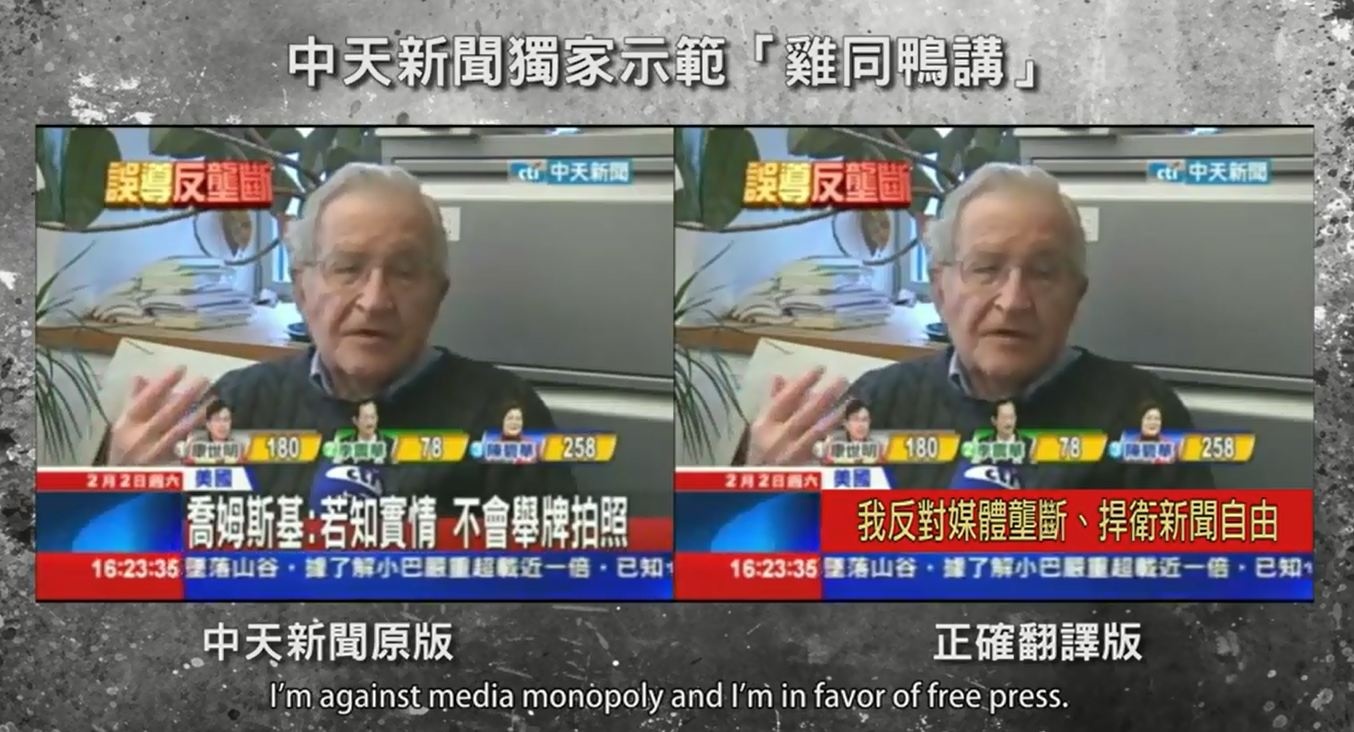
CtiTV apologizes over its Chomsky ‘mistranslations’

Activists were quick to show what was wrong
Although the media outlet claims the errors were the result of negligence, Taiwanese critics believe this was a deliberate attempt to mislead viewers

CtiTV yesterday apologized for what it described as a “negligent” translation of its interview with Massachusetts Institute of Technology (MIT) professor Noam Chomsky about the ongoing controversy over the movement against media monopolization in Taiwan. 

The interview, conducted last week by CtiTV Washington bureau chief John Zang (臧國華), came in the wake of a series of articles in the Chinese-language China Times — part of the Want Want China Times Group (旺旺中時集團) — alleging that Taiwanese graduate student Lin Ting-an (林庭安) had deceived Chomsky by failing to explain the slogan on a placard the professor was photographed holding that denounced “China’s black hands” interfering in local media. 

My article, published today in the Taipei Times, continues here.

China’s Navy Aims for Transparency

A PLAN fleet heads for the West Pacific
As the PLA Navy launches a new series of drills in the Pacific, China seems to be striving for clearer signalling 

As it becomes more mature and self-confident, the People’s Liberation Army Navy (PLAN) in recent years has held exercises at sea with increased frequency, and further out in the West Pacific. In 2012 alone, it held seven such drills beyond the first island chain, with surface ships and submarines often passing through channels that lie close to the disputed Diaoyu/Senkaku Islets, its warships have held various drills in waters in Taiwan’s rear. While China seeks to position itself as an ocean-going navy to protect its maritime interests and territorial integrity, its efforts continue for the most part to be marred by a lack of transparency, which only serves to aliment fears with its neighbors. That might be about to change. 

Last week, China embarked on its first naval exercises of 2013, amid rising tensions between Tokyo and Beijing over an island row in the East China Sea. The Chinese Ministry of National Defense announced on January 30 that despite the tensions, it would proceed with a scheduled deep-water series of navy drills in the West Pacific in early February. 

Three vessels from the PLAN’s North Sea Fleet — the Type 052 guided-missile destroyer Qingdao, and two Type 054A missile frigates, the Yantai and Yancheng, left the port of Qingdao on January 29th on their way to conduct exercises in the Pacific. State-run Xinhua news agency said the vessels would conduct as many as 20 drills simulating maritime confrontation, open-sea mobile combat, law enforcement missions and open-sea naval commanding, in a large body of international water including the Yellow, East and South China seas, the Miyako Strait, the Bashi Channel, as well as areas north, south and east of Taiwan. 

My article, published today in The Diplomat, continues here.

Saturday, February 02, 2013

Chomsky denies being deceived in media dispute

Noam Chomsky, no stranger to controversy
The MIT professor said that he was not ‘misled’ by student Lin Ting-an, as the Want Want China Times Group has alleged 

Massachusetts Institute of Technology professor Noam Chomsky yesterday sought to clarify matters regarding allegations by media owned by the Want Want China Times Group (旺旺中時集團) this week that he had said he was “misled” by a Taiwanese student who asked him to have his picture taken with a placard opposing media monopolization in Taiwan. 

In a series of articles on Thursday, the Chinese-language China Times, one of the many publications owned by the group, claimed that Chomsky, along with New York University (NYU) professor Ned Block, were “misled” by not having the full content of the Chinese message on the placard explained to them. The controversy centered on the part of the text that read in Mandarin: “Say no to China’s black hands,” a reference to Chinese influence in Taiwanese media. 

Several articles and commentaries on talk shows run on TV stations controlled by Want Want vilified Lin Ting-an (林庭安), a graduate student at National Yang Ming University’s Institute of Philosophy of Mind and Cognition, who approached Chomsky for his support. The reports accused her of misrepresenting the facts to the 84-year-old professor. 

Chomsky, who said he had been deluged with letters about the controversy from individuals and the media, clarified his stance in an e-mail yesterday, which he said also stood for Block. 

My article, published today in the Taipei Times, continues here.

Friday, February 01, 2013

Retired generals seek cross-strait cooperation on island disputes

Admiral Fei Hung-po (Ret.)
A former Taiwanese admiral told a forum in Hong Kong that Taiwan and China must issue a joint declaration on the disputed Diaoyutai Islands 

Retired senior military officers from both sides of the Taiwan Strait are pressuring President Ma Ying-jeou (馬英九) to allow greater cooperation with China, telling a forum earlier this week that the Diaoyutai Islands (釣魚台) controversy provides the perfect context in which to do so. 

The comments, which called for the creation of a cross-strait military cooperation mechanism, were made on the sidelines of a workshop organized by the Chinese Century Communicating Association (中華世紀交流協會) in Hong Kong on Tuesday.

Saying that military exchanges between retired Taiwanese and Chinese generals in recent years were “single-faceted” and “meaningless friendship-building activities,” admiral Fei Hung-po (費鴻波), a former deputy chief of general staff, added that current regulations prevented more constructive dialogue between the two sides from taking place. 

My article, published today in the Taipei Times, contines here.

Chomsky’s volte-face? Want Want goes after another student

Maybe Want Want will go after him/her next
In what has become a predictable pattern, the group’s various outlets launched another series of attacks against a detractor 

Media outlets operated by the Want Want China Times Group (旺旺中時集團) yesterday intensified their campaign against a movement by a young Taiwanese student that invited two well-known US professors — who now claim they were “misled” — to be photographed holding a placard opposing media monopolization in Taiwan. 

In a series of articles occupying a full page, the Chinese-language China Times, one of several print media owned by the group, provided what it claimed were exchanges with Noam Chomsky, a famous linguist from the US’ Massachusetts Institute of Technology (MIT) and a controversial figure on the intellectual left, as well as Ned Block, a New York-based philosopher, in which both said they were unaware that the placard contained language opposing Chinese manipulation of Taiwanese media.
 
Noam Chomsky holds the placard
Chomsky, 84, said he did not know that the message on the placard, which was written in Chinese and read “Anti-Media Monopoly. Say no to China’s black hands, defend press freedom. I am safeguarding Taiwan here in MIT,” had anything to do with China or Taiwan. 

Lin Ting-an (林庭安), a Taiwanese graduate student at the Institute of Philosophy of Mind and Cognition at National Yang Ming University, who wrote to Chomsky asking for his support prior to visiting him at MIT, says she clearly explained the matter to him and translated the Chinese content before the photograph was taken. 

My article, published today in the Taipei Times, continues here.